From the free course College Algebra on Lykke
8.4 Rotation of Axes
Key concepts: Nondegenerate conic sections · Degenerate conic sections · General form of a conic section · Rotation of axes · Angle of rotation · Rotated conics · Writing rotated conics in standard form · Identifying conics without rotating axes · The xy-term in a second-degree equation · Standard forms of ellipses, parabolas, and hyperbolas
By the end of this section the student can: Identify nondegenerate conic sections given their general form equations; Use rotation of axes formulas; Write equations of rotated conics in standard form; Identify conics without rotating axes
8.4 Rotation of Axes
A conic that looks tilted in the usual coordinate plane may become a familiar circle, ellipse, parabola, or hyperbola after the axes are rotated. The algebraic signal of that tilt is usually the cross-product term $Bxy$ in the general second-degree equation.
Conic sections and their geometric origin
A conic section is the curve formed when a plane intersects a double right circular cone. The angle and direction of the slicing plane determine the resulting curve. A plane perpendicular to the cone’s axis produces a circle. A slanted plane intersecting only one cone produces an ellipse. A plane parallel to a generating line of the cone produces a parabola. A plane intersecting both halves of the double cone produces a hyperbola.
The familiar, noncollapsed curves are called nondegenerate conic sections:
- Circle: a special ellipse whose horizontal and vertical radii are equal.
- Ellipse: a closed curve formed by a plane intersecting one cone at a slant.
- Parabola: an open curve formed when the slicing plane is parallel to a side, or generating line, of the cone.
- Hyperbola: two separate open branches formed when the plane intersects both cones.
A degenerate conic section occurs when the intersecting plane passes through the vertex of the cone, causing the curve to collapse into simpler pieces. Depending on the equation, a degenerate conic can be a point, a single line, two intersecting lines, two parallel lines, or no real graph.
A discriminant calculation can identify the general type suggested by the quadratic terms, but it does not by itself prove that the conic is nondegenerate.
The general form of a conic
Every conic can be represented, after suitable coordinate choices, by a second-degree equation of the form
$$ Ax^2+Bxy+Cy^2+Dx+Ey+F=0, $$
where $A$, $B$, and $C$ are not all zero. The terms involving $x^2$, $xy$, and $y^2$ determine the quadratic shape. The linear terms $Dx$ and $Ey$ usually shift the graph, while the constant term $F$ helps determine its location and size.
If $B=0$, the equation has no $xy$-term, so completing the square and rearranging often puts it directly into a familiar standard form. If $B\neq 0$, the graph may be rotated relative to the original $x$- and $y$-axes. In that situation, completing the square in $x$ and $y$ separately generally does not remove the mixed product $xy$.
For example, the equation
$$ 3x^2-2xy+3y^2-16=0 $$
contains the term $-2xy$. The curve is an ellipse, but its major and minor axes are not aligned with the original coordinate axes. Rotating the axes can eliminate the cross-product term and reveal the standard form.
Identifying a conic without rotating the axes
For the general equation
$$ Ax^2+Bxy+Cy^2+Dx+Ey+F=0, $$
the expression
$$ B^2-4AC $$
helps classify the conic represented by its quadratic part.
The classification is:
- If $B^2-4AC<0$, the equation represents an ellipse or circle when it is nondegenerate.
- If $B^2-4AC=0$, the equation represents a parabola when it is nondegenerate.
- If $B^2-4AC>0$, the equation represents a hyperbola when it is nondegenerate.
When $A=C$ and $B=0$, the quadratic terms are proportional to
$$ x^2+y^2, $$
so the conic is a circle or a degenerate circle, depending on the remaining terms. In particular, the test $B^2-4AC<0$ identifies a circle as part of the ellipse family, but the equality of the $x^2$ and $y^2$ coefficients identifies the special circular case.
Worked example: classification without rotating
Identify the conic represented by
$$ 10x^2-9xy+4y^2-4=0. $$
Here,
$$ A=10,\qquad B=-9,\qquad C=4. $$
Calculate the discriminant of the quadratic part:
$$ B^2-4AC=(-9)^2-4(10)(4). $$
$$ B^2-4AC=81-160. $$
$$ B^2-4AC=-79. $$
Because
$$ -79<0, $$
the equation represents an ellipse if it is nondegenerate. The equation has a nonzero constant term and does not collapse into the obvious form of a point, so the conic is an ellipse.
Rotation of axes
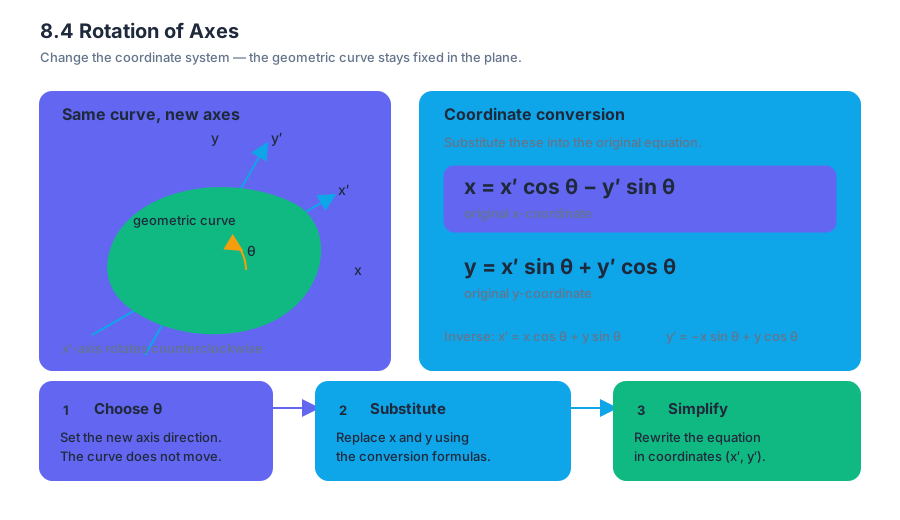
A rotation of axes changes the coordinate system while leaving the geometric curve itself in the plane. The original coordinates are denoted by $(x,y)$, and the rotated coordinates are denoted by $(x',y')$. If the positive $x'$-axis is obtained by rotating the positive $x$-axis counterclockwise through an angle $\theta$, then the coordinates are related by
$$ x=x'\cos\theta-y'\sin\theta, $$
$$ y=x'\sin\theta+y'\cos\theta. $$
The inverse relationships are
The first pair is the one normally used when rewriting an equation in the rotated coordinate system: substitute the expressions for $x$ and $y$ into the original equation, then simplify.
Finding the angle that removes the $xy$-term
For the quadratic part
$$ Ax^2+Bxy+Cy^2, $$
the angle of rotation that eliminates the cross-product term satisfies
$$ \tan(2\theta)=\frac{B}{A-C}, $$
provided the denominator is nonzero. Equivalently,
$$ \cot(2\theta)=\frac{A-C}{B}, $$
when $B\neq 0$.
The angle is doubled in these formulas: first determine $2\theta$, then divide by $2$ to obtain $\theta$. This is a common place for errors. Also, the signs of $A-C$ and $B$ determine the quadrant for $2\theta$, so the chosen angle must be consistent with the tangent or cotangent value.
Worked example: finding a rotation angle
Find an angle of rotation for
$$ 8x^2-12xy+17y^2=20. $$
Identify the coefficients:
$$ A=8,\qquad B=-12,\qquad C=17. $$
Use the cotangent form:
$$ \cot(2\theta)=\frac{A-C}{B}. $$
Substitute the coefficients:
$$ \cot(2\theta)=\frac{8-17}{-12}. $$
Simplify:
$$ \cot(2\theta)=\frac{-9}{-12}=\frac{3}{4}. $$
Thus, choose an angle satisfying
$$ \cot(2\theta)=\frac{3}{4}, $$
or equivalently,
$$ \tan(2\theta)=\frac{4}{3}. $$
Therefore,
$$ 2\theta=\tan^{-1}\left(\frac{4}{3}\right), $$
and
$$ \theta=\frac{1}{2}\tan^{-1}\left(\frac{4}{3}\right). $$
A calculator gives approximately
$$ \theta\approx 26.565^\circ. $$
Rotating the axes through this angle removes the $x'y'$-term.
Rewriting a rotated conic in standard form
To rewrite a conic after a rotation, use this procedure:
- Identify $A$, $B$, and $C$.
- Find $\theta$ using $$ \tan(2\theta)=\frac{B}{A-C} $$ or $$ \cot(2\theta)=\frac{A-C}{B}. $$
- Find $\sin\theta$ and $\cos\theta$.
- Substitute $$ x=x'\cos\theta-y'\sin\theta $$ and $$ y=x'\sin\theta+y'\cos\theta. $$
- Expand and combine like terms.
- Rewrite the resulting equation in standard form with respect to $x'$ and $y'$.
Worked example: rotating through $45^\circ$
Find a new representation of
$$ 2x^2-xy+2y^2-30=0 $$
after rotating the axes through
$$ \theta=45^\circ. $$
Since
$$ \cos45^\circ=\sin45^\circ=\frac{1}{\sqrt{2}}, $$
the rotation equations become
$$ x=x'\cos45^\circ-y'\sin45^\circ $$
$$ x=x'\left(\frac{1}{\sqrt{2}}\right)-y'\left(\frac{1}{\sqrt{2}}\right) $$
$$ x=\frac{x'-y'}{\sqrt{2}}, $$
and
$$ y=x'\sin45^\circ+y'\cos45^\circ $$
$$ y=x'\left(\frac{1}{\sqrt{2}}\right)+y'\left(\frac{1}{\sqrt{2}}\right) $$
$$ y=\frac{x'+y'}{\sqrt{2}}. $$
Substitute these expressions into the original equation:
$$ 2\left(\frac{x'-y'}{\sqrt{2}}\right)^2 -\left(\frac{x'-y'}{\sqrt{2}}\right) \left(\frac{x'+y'}{\sqrt{2}}\right) +2\left(\frac{x'+y'}{\sqrt{2}}\right)^2-30=0. $$
Use the identities
$$ (x'-y')^2=x'^2-2x'y'+y'^2, $$
$$ (x'+y')^2=x'^2+2x'y'+y'^2, $$
and
$$ (x'-y')(x'+y')=x'^2-y'^2. $$
Then
$$ x'^2-2x'y'+y'^2 -\frac{x'^2-y'^2}{2} +x'^2+2x'y'+y'^2-30=0. $$
Combine the quadratic terms:
$$ 2x'^2+2y'^2-\frac{x'^2-y'^2}{2}=30. $$
Multiply both sides by $2$:
$$ 4x'^2+4y'^2-(x'^2-y'^2)=60. $$
Distribute the negative sign:
$$ 4x'^2+4y'^2-x'^2+y'^2=60. $$
Combine like terms:
$$ 3x'^2+5y'^2=60. $$
Divide every term by $60$:
$$ \frac{3x'^2}{60}+\frac{5y'^2}{60}=\frac{60}{60}. $$
Simplify:
$$ \boxed{\frac{x'^2}{20}+\frac{y'^2}{12}=1}. $$
The rotated equation is an ellipse centered at the origin in the $(x',y')$-coordinate system. Its semimajor axis has length $\sqrt{20}$ along the $x'$-axis, and its semiminor axis has length $\sqrt{12}$ along the $y'$-axis. In the original $(x,y)$-plane, the ellipse appears tilted by $45^\circ$.
Degenerate equations: why classification needs checking
The discriminant test must be combined with an examination of the complete equation. For example,
$$ 4x^2+12xy+9y^2-16=0 $$
has
$$ A=4,\qquad B=12,\qquad C=9. $$
Therefore,
$$ B^2-4AC=12^2-4(4)(9)=144-144=0. $$
The value $0$ might suggest a parabola, but factor the quadratic expression:
$$ 4x^2+12xy+9y^2=(2x+3y)^2. $$
Thus,
$$ (2x+3y)^2-16=0. $$
This is a difference of squares:
$$ (2x+3y-4)(2x+3y+4)=0. $$
Therefore, the graph consists of two parallel lines:
$$ 2x+3y-4=0 $$
and
$$ 2x+3y+4=0. $$
It is a degenerate pair of parallel lines, not a nondegenerate parabola. Hence $B^2-4AC=0$ is necessary for the parabola classification but does not guarantee nondegeneracy.
Practice problems
-
Identify the conic represented by $$ x^2-9xy+3y^2-12=0. $$
-
Identify the conic represented by $$ x^2-9xy+3y^2-12=0 $$ using $B^2-4AC$.
-
Rotate the axes through $45^\circ$ and rewrite $$ 3x^2-2xy+3y^2-16=0 $$ in standard form.
Answers:
-
Here $A=1$, $B=-9$, and $C=3$, so $$ B^2-4AC=(-9)^2-4(1)(3)=81-12=69>0. $$ The conic is a hyperbola.
-
The same calculation gives $$ 69>0, $$ so the conic is a hyperbola, assuming it is nondegenerate.
-
Use $$ x=\frac{x'-y'}{\sqrt{2}}, \qquad y=\frac{x'+y'}{\sqrt{2}}. $$ Substitution and simplification give $$ 2x'^2+4y'^2=16. $$ Divide by $16$: $$ \boxed{\frac{x'^2}{8}+\frac{y'^2}{4}=1}. $$ The rotated conic is an ellipse.
Content adapted from OpenStax College Algebra 2e by Jay Abramson et al., licensed CC BY 4.0.
Source Materials
Study College Algebra on Lykke
This course page is free to open: signed out, you can read its first two sections, and signing in, on any plan, opens the rest. The free Lykke Chrome extension syncs your own Canvas courses, so ChatGPT, Claude and Muse can answer from your classes and deadlines. It only reads Canvas.
Add the free extensionSign in to open every section