From the free course College Algebra on Lykke
Linear Forms and Coordinate Geometry
Key concepts: Slope-intercept form · Point-slope form · Intercepts · Parallel and perpendicular lines
Exploring the various mathematical forms used to represent linear equations and their geometric properties.
Linear Forms and Coordinate Geometry
The study of linear forms is the foundational bridge between pure algebra and geometric intuition. In the Cartesian plane, a line is more than a sequence of points; it is the visual manifestation of a constant rate of change. Whether we are modeling the trajectory of a particle in a physics engine or calculating the depreciation of an asset in a financial model, the ability to manipulate and interpret linear equations is a prerequisite for all higher-level mathematics, including Calculus and Linear Algebra.
The Fundamental Constant: Slope ($m$)
At the heart of every linear form lies the concept of slope, often denoted by the variable $m$. Mathematically, the slope represents the ratio of the vertical change (the "rise") to the horizontal change (the "run") between any two distinct points on a line.
Definition: The Slope Formula For any two points $(x_1, y_1)$ and $(x_2, y_2)$ where $x_1 \neq x_2$, the slope $m$ is defined as: $$m = \frac{\Delta y}{\Delta x} = \frac{y_2 - y_1}{x_2 - x_1}$$
Why the Slope Matters
In a physical context, the slope is the rate of change. If the x-axis represents time and the y-axis represents distance, the slope is velocity. If the x-axis is production volume and the y-axis is cost, the slope is the marginal cost per unit. Understanding the slope allows us to predict future states based on current trajectories.
Classification of Slopes
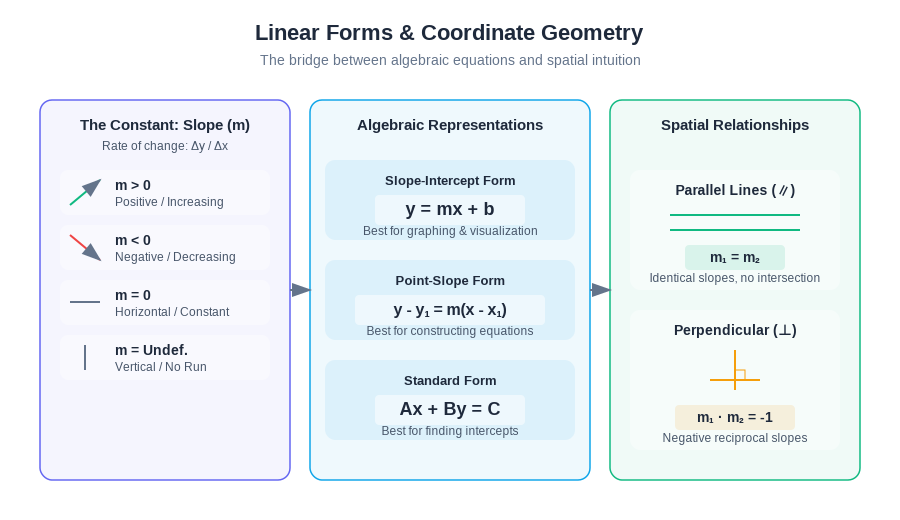
The value of $m$ dictates the orientation and behavior of the line within the coordinate system.
| Slope Value ($m$) | Direction | Geometric Interpretation |
|---|---|---|
| $m > 0$ | Upward (Left to Right) | Positive correlation; as $x$ increases, $y$ increases. |
| $m < 0$ | Downward (Left to Right) | Negative correlation; as $x$ increases, $y$ decreases. |
| $m = 0$ | Horizontal | No change in $y$; the line is parallel to the x-axis. |
| $m$ is Undefined | Vertical | No change in $x$; the line is parallel to the y-axis. |
Slope-Intercept Form: The Visual Standard
The most common way to express a linear equation is the Slope-Intercept Form. It is prized for its readability and the ease with which it can be graphed.
The Formula
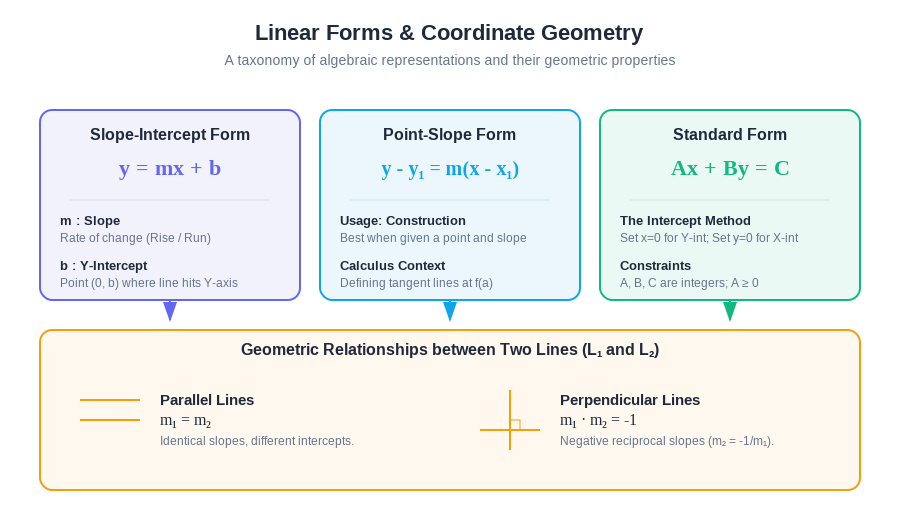
The slope-intercept form is written as: $$y = mx + b$$ Where:
- $m$ is the slope.
- $b$ is the y-intercept, the point $(0, b)$ where the line crosses the vertical axis.
Point-Slope Form: The Engineer’s Tool
While slope-intercept is great for reading a graph, Point-Slope Form is the superior tool for constructing an equation when you are given a specific point and a known rate of change.
The Derivation
The point-slope form is derived directly from the definition of slope. If we know a fixed point $(x_1, y_1)$ and a general point $(x, y)$, the slope $m$ is: $$m = \frac{y - y_1}{x - x_1}$$ By multiplying both sides by $(x - x_1)$, we arrive at the standard point-slope equation: $$y - y_1 = m(x - x_1)$$
When to Use Point-Slope
- Given a point and a slope: Immediate substitution.
- Given two points: Calculate $m$ first, then use either point in this form.
- Calculus: When finding the equation of a tangent line to a curve at a specific point $(a, f(a))$, the point-slope form is the natural choice: $y - f(a) = f'(a)(x - a)$.
Standard Form and Intercepts
The Standard Form of a linear equation is expressed as: $$Ax + By = C$$ Where $A, B,$ and $C$ are typically integers, and $A$ is non-negative.
The Power of Intercepts
Standard form is particularly useful for finding the intercepts—the points where the line crosses the axes. This "Intercept Method" is often the fastest way to sketch a line by hand.
| Intercept Type | Definition | How to Solve |
|---|---|---|
| x-intercept | Where the line hits the x-axis ($y=0$) | Set $y=0$, solve $Ax = C \rightarrow x = C/A$ |
| y-intercept | Where the line hits the y-axis ($x=0$) | Set $x=0$, solve $By = C \rightarrow y = C/B$ |
Mathematical Derivation: Perpendicular Slopes
A common question in coordinate geometry is why perpendicular lines have negative reciprocal slopes. We can prove this using geometric rotation or vectors.
Let Line 1 have slope m1 = tan(θ).
A line perpendicular to it (Line 2) is rotated by 90 degrees (π/2 radians).
The slope of Line 2 is m2 = tan(θ + π/2).

Using the trigonometric identity:
tan(θ + π/2) = -cot(θ) = -1/tan(θ)

Therefore:
m2 = -1 / m1
Or:
m1 * m2 = -1
Geometric Relationships: Parallel and Perpendicular
The relationship between two lines is determined entirely by their slopes. This is a critical concept in spatial partitioning and collision detection in computer graphics.
Parallel Lines
Two lines are parallel if they lie in the same plane and never intersect.
- Condition: $m_1 = m_2$ and $b_1 \neq b_2$.
- If the y-intercepts are also the same, the lines are coincident (they are the same line).
Perpendicular Lines
Two lines are perpendicular if they intersect at a right angle ($90^\circ$).
- Condition: $m_1 \cdot m_2 = -1$.
- Alternatively: $m_2 = -\frac{1}{m_1}$.
Summary of Relationships
| Relationship | Slopes ($m_1, m_2$) | Visual Result |
|---|---|---|
| Parallel | $m_1 = m_2$ | Lines run side-by-side, never touching. |
| Perpendicular | $m_1 = -1/m_2$ | Lines cross at exactly 90 degrees. |
| Intersecting | $m_1 \neq m_2$ | Lines cross at exactly one point. |
| Coincident | $m_1 = m_2, b_1 = b_2$ | The equations describe the same line. |
Special Cases: Vertical and Horizontal Lines
Vertical and horizontal lines are the "edge cases" of linear geometry. They often break standard algorithms because they involve zero or undefined values.
Horizontal Lines
- Equation: $y = k$ (where $k$ is a constant).
- Slope: $0$.
- Behavior: For every value of $x$, $y$ remains the same. It is parallel to the x-axis.
Vertical Lines
- Equation: $x = h$ (where $h$ is a constant).
- Slope: Undefined (division by zero in the slope formula).
- Behavior: It is not a function (it fails the vertical line test). It is parallel to the y-axis.
Real-World Application: Linear Regression and Data Trends
In modern data science, we rarely have points that fit perfectly on a line. Instead, we use the Method of Least Squares to find the "Line of Best Fit." While the underlying data is messy, the output is a simple linear form: $y = mx + b$.
Common Pitfalls and Misconceptions
- The "Zero vs. Undefined" Confusion: A horizontal line has a slope of $0$. A vertical line has an undefined slope. These are not interchangeable. In programming, a vertical line will often trigger a
DivideByZeroexception. - Negative Reciprocal Errors: When finding a perpendicular slope, students often forget one of the two steps. You must both flip the fraction and change the sign.
- Correct: If $m = 2/3$, perpendicular $m = -3/2$.
- Incorrect: If $m = 2/3$, perpendicular $m = 3/2$ (forgot sign) or $m = -2/3$ (forgot flip).
- Intercept Misplacement: The y-intercept is the point $(0, b)$, not $(b, 0)$. The latter is the x-intercept.
Advanced Concept: Distance from a Point to a Line
In coordinate geometry, we often need to find the shortest distance between a point $(x_0, y_0)$ and a line defined by $Ax + By + C = 0$. This distance $d$ is the length of the perpendicular segment from the point to the line.
Theorem: Point-to-Line Distance The distance $d$ is given by: $$d = \frac{|Ax_0 + By_0 + C|}{\sqrt{A^2 + B^2}}$$
This formula is used extensively in machine learning (Support Vector Machines) to determine the "margin" between different classes of data points.
Worked Example
Find the distance between the point (2, 3) and the line $3x - 4y + 1 = 0$.
- Identify constants: $A=3, B=-4, C=1$.
- Identify point: $x_0=2, y_0=3$.
- Substitute into formula: $$d = \frac{|3(2) + (-4)(3) + 1|}{\sqrt{3^2 + (-4)^2}}$$ $$d = \frac{|6 - 12 + 1|}{\sqrt{9 + 16}}$$ $$d = \frac{|-5|}{5} = 1$$ The point is exactly 1 unit away from the line.
Visualizing Linear Systems in Web Applications
For developers building interactive dashboards, rendering these lines requires translating Cartesian coordinates to screen coordinates (where the y-axis is often inverted).
- Slope ($m$): The ratio of vertical change to horizontal change ($\Delta y / \Delta x$).
- Y-intercept ($b$): The y-coordinate where a line crosses the y-axis (where $x=0$).
- Slope-Intercept Form: $y = mx + b$; most useful for graphing and identifying rate of change.
- Point-Slope Form: $y - y_1 = m(x - x_1)$; most useful for creating an equation given a point and slope.
- Standard Form: $Ax + By = C$; useful for finding intercepts and solving systems of equations.
- Parallel Lines: Lines with identical slopes ($m_1 = m_2$) that never intersect.
- Perpendicular Lines: Lines whose slopes are negative reciprocals ($m_1 \cdot m_2 = -1$), meeting at a $90^\circ$ angle.
- Undefined Slope: The slope of a vertical line, where the change in $x$ is zero.
- What is the slope of a line perpendicular to $y = -4x + 7$?
- A) -4
- B) 4
- C) 1/4 (Correct)
- D) -1/4
- Which form is most efficient for finding the x and y intercepts of a line?
- A) Slope-intercept form
- B) Point-slope form
- C) Standard form (Correct)
- D) Quadratic form
- If a line has a slope of 0, what is its geometric orientation?
- A) Vertical
- B) Horizontal (Correct)
- C) Diagonal
- D) It is a single point
- Calculate the slope between points (2, 5) and (4, 11).
- A) 2
- B) 3 (Correct: (11-5)/(4-2) = 6/2 = 3)
- C) 6
- D) 1/3
- True or False: A vertical line is a function.
- A) True
- B) False (Correct: It fails the vertical line test)
- What is the y-intercept of the line $3x + 2y = 12$?
- A) 4
- B) 6 (Correct: Set x=0, 2y=12, y=6)
- C) 12
- D) 3
Core Objectives
- Master Slope Calculation: Be able to find $m$ from two points, a graph, or an equation.
- Form Conversion: Practice converting between Standard, Point-Slope, and Slope-Intercept forms.
- Geometric Logic: Immediately identify if lines are parallel or perpendicular by looking at their $m$ values.
- Graphing Proficiency: Use the intercept method for Standard form and the "start at $b$, move by $m$" method for Slope-Intercept form.
Practice Exercises
- Write the equation of a line passing through (1, 2) and parallel to $y = 3x - 5$.
- Convert $y - 4 = -2(x + 3)$ into Standard Form.
- Find the distance from the origin (0,0) to the line $y = x + 2$.
- Determine the equation of the vertical line passing through (-7, 12).
Interactive demos for this section
- Linear Form Explorer: a free interactive demo that runs in your browser
- Point-Slope Form Explorer: a free interactive demo that runs in your browser
Study College Algebra on Lykke
This course page is free to open: signed out, you can read its first two sections, and signing in, on any plan, opens the rest. The free Lykke Chrome extension syncs your own Canvas courses, so ChatGPT, Claude and Muse can answer from your classes and deadlines. It only reads Canvas.
Add the free extensionSign in to open every section