From the free course College Algebra on Lykke
Quadratic Expressions and Factoring
Key concepts: Area models · Difference of squares · Factoring by grouping · Perfect square trinomials
Methods for multiplying binomials and factoring quadratic expressions using various techniques.
Quadratic Expressions and Factoring
In the landscape of algebra, the quadratic expression is a fundamental primitive. Defined formally as a polynomial of degree two, its standard form is $ax^2 + bx + c$, where $a, b,$ and $c$ are constants and $a \neq 0$. The study of these expressions is not merely an academic exercise in symbol manipulation; it is the study of parabolas, accelerated motion, optimization, and the foundational structure of higher-dimensional mathematics.
Factoring is the inverse operation of expansion. While expanding (multiplying) binomials is a deterministic algorithmic process, factoring is often an exercise in pattern recognition and structural decomposition. To factor a quadratic is to find the constituent linear factors that, when multiplied, produce the original trinomial.
The Geometry of Multiplication: Area Models
Before diving into abstract coefficients, we must ground the multiplication of binomials in geometry. The Area Model (or box method) treats the product of two binomials, such as $(x + p)(x + q)$, as the area of a rectangle with side lengths $(x + p)$ and $(x + q)$.
How it Works
- Draw a 2x2 grid.
- Place the terms of the first binomial along the top.
- Place the terms of the second binomial along the side.
- Calculate the area of each individual cell by multiplying the corresponding row and column headers.
- Sum the four interior areas to find the total expression.
Theorem (The Distributive Property Extension): For any real numbers $x, a, b, c, d$, the product $(ax + b)(cx + d)$ is given by $acx^2 + (ad + bc)x + bd$.
Comparison of Expansion Methods
| Method | Visual Intuition | Scalability | Risk of Error |
|---|---|---|---|
| FOIL (First, Outer, Inner, Last) | Low (Mnemonic-based) | Poor (Binomials only) | High (Easy to miss terms) |
| Area Model | High (Geometric) | Excellent (Polynomials) | Low (Grid enforces completeness) |
| Distributive Property | Moderate (Algebraic) | Good | Moderate |
Factoring Trinomials with Leading Coefficient $a = 1$
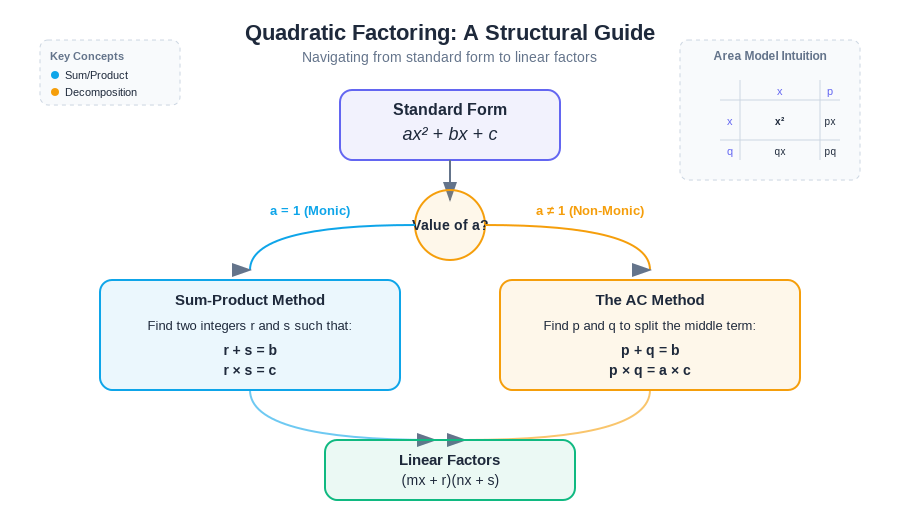
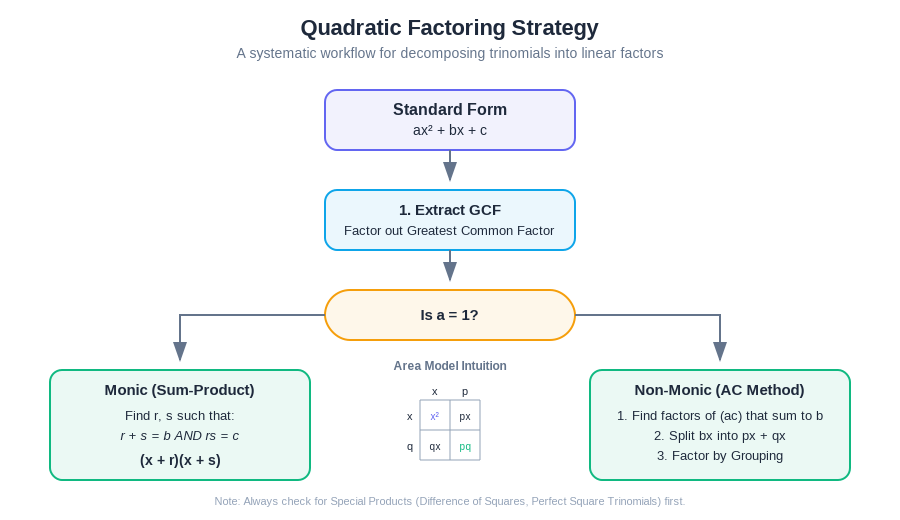
When the leading coefficient $a$ is 1, the expression simplifies to $x^2 + bx + c$. This is known as a monic quadratic. The goal is to find two integers, $r$ and $s$, such that: $$(x + r)(x + s) = x^2 + (r + s)x + rs$$
This implies a system of two equations:
- $r + s = b$ (The sum of the factors must equal the linear coefficient)
- $rs = c$ (The product of the factors must equal the constant term)
Worked Example: $x^2 - 5x + 6$
- Identify $b$ and $c$: $b = -5$, $c = 6$.
- List factors of $c$: (1, 6), (-1, -6), (2, 3), (-2, -3).
- Find the pair that sums to $b$: $-2 + (-3) = -5$.
- Result: $(x - 2)(x - 3)$.
Pattern Recognition for Signs
| Sign of $c$ | Sign of $b$ | Factors of $c$ | Example |
|---|---|---|---|
| Positive (+) | Positive (+) | Both positive | $x^2 + 5x + 6 = (x+2)(x+3)$ |
| Positive (+) | Negative (-) | Both negative | $x^2 - 5x + 6 = (x-2)(x-3)$ |
| Negative (-) | Positive (+) | One (+) One (-); larger is (+) | $x^2 + x - 6 = (x+3)(x-2)$ |
| Negative (-) | Negative (-) | One (+) One (-); larger is (-) | $x^2 - x - 6 = (x-3)(x+2)$ |
Factoring by Grouping
Factoring by grouping is a prerequisite for the AC Method (used when $a \neq 1$). It is used when an expression has four terms and no common factor exists for all four, but pairs of terms share commonalities.
The Algorithm
- Group the first two terms and the last two terms.
- Factor out the Greatest Common Factor (GCF) from each group.
- If the remaining binomial factors are identical, factor out that binomial.
Example: $3x^3 - 6x^2 + 5x - 10$
- Group: $(3x^3 - 6x^2) + (5x - 10)$
- GCF extraction: $3x^2(x - 2) + 5(x - 2)$
- Final Factorization: $(3x^2 + 5)(x - 2)$
Pitfall Alert: When the third term is negative, you must be careful with signs. For example, in $x^3 + 3x^2 - 4x - 12$, you must factor out a $-4$ from the second group: $x^2(x + 3) - 4(x + 3) = (x^2 - 4)(x + 3)$.
Factoring Trinomials with $a \neq 1$: The AC Method
When the leading coefficient is not 1, we use the AC Method. This technique transforms a trinomial into a four-term polynomial that can be factored by grouping.
The Derivation
Given $ax^2 + bx + c$, we seek to split the middle term $bx$ into $px + qx$ such that the resulting expression $ax^2 + px + qx + c$ is factorable by grouping. For this to work, the product of the split coefficients $pq$ must equal the product of the outer coefficients $ac$.
\begin{aligned}
&\text{Given: } ax^2 + bx + c \\
&\text{Goal: Find } p, q \text{ such that } p+q=b \text{ and } pq=ac \\
&\text{Rewrite: } ax^2 + px + qx + c \\
&\text{Factor by Grouping: } (ax^2 + px) + (qx + c)
\end{aligned}
Worked Example: $2x^2 + 7x + 3$
- Identify $a, b, c$: $a=2, b=7, c=3$.
- Calculate $ac$: $2 \times 3 = 6$.
- Find factors of 6 that sum to 7: 6 and 1.
- Split the middle term: $2x^2 + 6x + 1x + 3$.
- Group and factor: $(2x^2 + 6x) + (1x + 3) \Rightarrow 2x(x + 3) + 1(x + 3)$.
- Final result: $(2x + 1)(x + 3)$.
Special Products and Patterns
Certain quadratic structures appear frequently in mathematics and physics. Recognizing these "shortcuts" is essential for efficiency.
1. Difference of Squares
The pattern $a^2 - b^2$ always factors into $(a - b)(a + b)$. This is derived from the fact that the "outer" and "inner" terms of the expansion cancel each other out.
Note: $a^2 + b^2$ (Sum of Squares) is irreducible over the set of real numbers. It requires complex numbers to factor: $(a + bi)(a - bi)$.
2. Perfect Square Trinomials
These result from squaring a binomial: $(a + b)^2 = a^2 + 2ab + b^2$ or $(a - b)^2 = a^2 - 2ab + b^2$.
Identification Criteria:
- The first and last terms are perfect squares ($a^2$ and $b^2$).
- The middle term is exactly twice the product of the square roots of the first and last terms ($2ab$).
Special Pattern Summary
| Pattern Name | Expression | Factored Form |
|---|---|---|
| Difference of Squares | $x^2 - 49$ | $(x - 7)(x + 7)$ |
| Perfect Square (Sum) | $x^2 + 10x + 25$ | $(x + 5)^2$ |
| Perfect Square (Diff) | $x^2 - 12x + 36$ | $(x - 6)^2$ |
| Sum of Squares | $x^2 + 16$ | Irreducible (over $\mathbb{R}$) |
Advanced Factoring: Structural Recognition
Sometimes an expression does not look like a quadratic at first glance but shares the same underlying structure. This is often solved using u-substitution.
Example: $x^4 - 5x^2 + 4$
This is a "quadratic in form." If we let $u = x^2$, the expression becomes: $$u^2 - 5u + 4$$ Factoring the $u$-expression: $$(u - 4)(u - 1)$$ Substituting $x^2$ back in: $$(x^2 - 4)(x^2 - 1)$$ Applying the Difference of Squares to both: $$(x - 2)(x + 2)(x - 1)(x + 1)$$
Common Pitfalls and Troubleshooting
- Ignoring the GCF: Always check for a Greatest Common Factor first. Factoring $2x^2 + 10x + 12$ is much easier if you first factor out the 2: $2(x^2 + 5x + 6) = 2(x+2)(x+3)$.
- Sign Errors in Grouping: When factoring $(ax^2 + bx) - (cx + d)$, remember that the negative sign applies to the entire second group.
- Prime Polynomials: Not every quadratic can be factored into linear factors with integer coefficients. If the discriminant ($b^2 - 4ac$) is not a perfect square, the factors will involve radicals or complex numbers.
- Incomplete Factoring: Always check if your resulting factors can be factored further (e.g., a difference of squares hidden inside a result).
Interactive demos for this section
- Quadratic Area Model Demo: a free interactive demo that runs in your browser
Study College Algebra on Lykke
This course page is free to open: signed out, you can read its first two sections, and signing in, on any plan, opens the rest. The free Lykke Chrome extension syncs your own Canvas courses, so ChatGPT, Claude and Muse can answer from your classes and deadlines. It only reads Canvas.
Add the free extensionSign in to open every section