From the free course College Algebra on Lykke
Rational Expressions and Equations
Key concepts: Reducing rational expressions · Rational arithmetic · Combined rates · Mixture problems
Manipulating fractions that contain variables and solving equations involving rational terms.
Rational Expressions and Equations
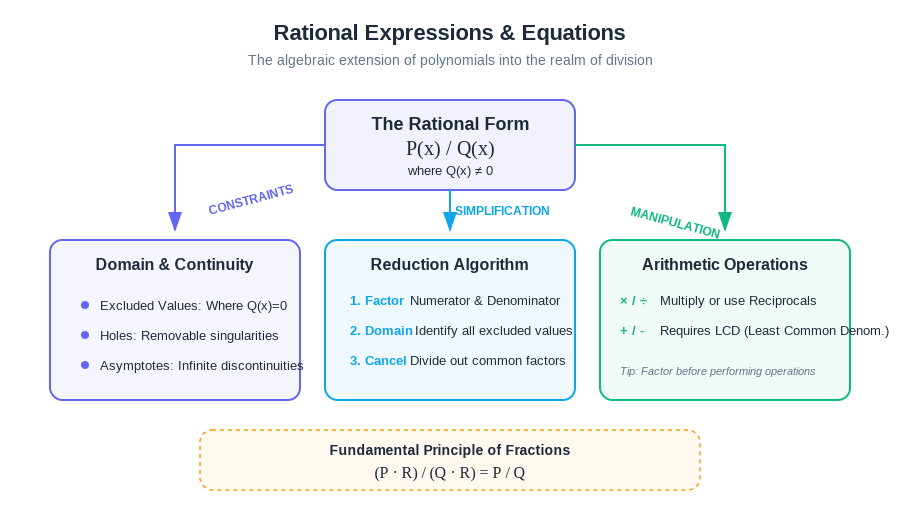
In the hierarchy of algebraic structures, rational expressions represent the formal extension of polynomials into the realm of division, analogous to how rational numbers extend the integers. A rational expression is defined as the quotient of two polynomials, $P(x)$ and $Q(x)$, expressed in the form $\frac{P(x)}{Q(x)}$, where $Q(x) \neq 0$.
Mastering this domain is not merely an exercise in symbolic manipulation; it is a prerequisite for calculus, where rational functions describe asymptotic behavior, and for engineering, where they model everything from fluid dynamics to electrical impedance. This article provides a rigorous deep-dive into the mechanics of reducing these expressions, performing complex arithmetic, and solving the transcendental equations that arise in real-world rate and mixture modeling.
Foundations of Rational Expressions
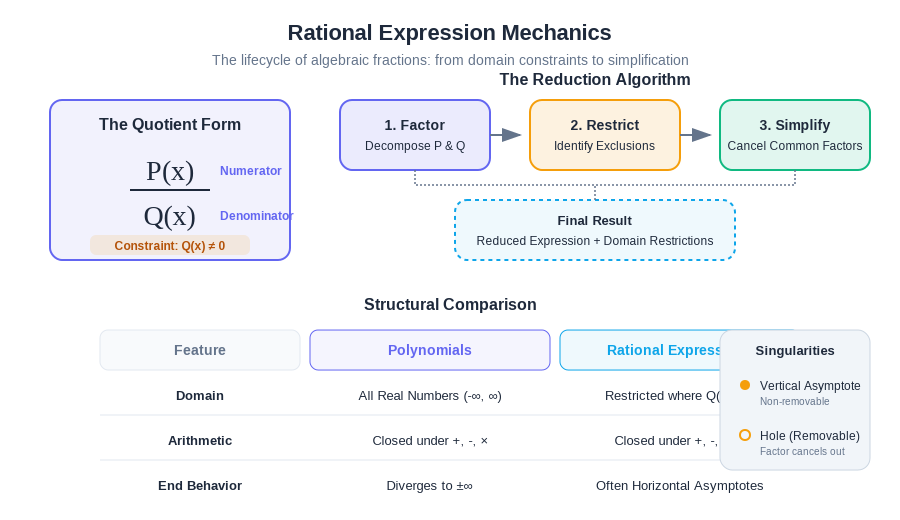
A rational expression is inherently tied to its domain. Unlike polynomials, which are defined for all real numbers, a rational expression is undefined wherever the denominator polynomial $Q(x)$ evaluates to zero. These values are known as excluded values or singularities.
The Fundamental Principle of Fractions: For any polynomials $P, Q,$ and $R$ (where $Q, R \neq 0$), the equality $\frac{P \cdot R}{Q \cdot R} = \frac{P}{Q}$ holds for all values in the domain. This principle is the mathematical basis for both simplification (reduction) and finding common denominators.
Domain Restrictions and Continuity
Before any algebraic reduction occurs, one must identify the domain. If an expression $\frac{x-2}{(x-2)(x+3)}$ is simplified to $\frac{1}{x+3}$, the value $x=2$ remains excluded from the original function's domain, creating a "removable discontinuity" or a "hole" in the graph.
| Feature | Polynomial Expression | Rational Expression |
|---|---|---|
| Domain | All real numbers $(-\infty, \infty)$ | Restricted where $Q(x) = 0$ |
| End Behavior | Approaches $\pm\infty$ | Often approaches a horizontal asymptote |
| Complexity | Linear/Quadratic/Higher Degree | Ratio of degrees (Relative complexity) |
| Arithmetic | Closed under $+$, $-$, $\times$ | Closed under $+$, $-$, $\times$, and $\div$ |
Reducing Rational Expressions
Reducing a rational expression to its lowest terms requires the complete factorization of both the numerator and the denominator. The process relies on identifying common factors that constitute a "form of one" (e.g., $\frac{x+5}{x+5} = 1$).
The Reduction Algorithm
- Factor Completely: Decompose both $P(x)$ and $Q(x)$ into irreducible factors over the real numbers.
- Identify the Domain: Note all values that make the original denominator zero.
- Cancel Common Factors: Divide out factors present in both the numerator and denominator.
- State the Simplified Result: Provide the reduced expression along with the original domain restrictions.
Rational Arithmetic: Multiplication and Division
The operations of multiplication and division for rational expressions follow the same logic as numerical fractions, but with a significantly higher overhead for bookkeeping.
Multiplication
To multiply $\frac{A}{B} \cdot \frac{C}{D}$, we compute $\frac{AC}{BD}$. However, it is computationally and algebraically inefficient to expand these polynomials first. Instead, factor everything first, then simplify across the numerators and denominators.
Division
Division is defined as multiplication by the reciprocal: $$\frac{A}{B} \div \frac{C}{D} = \frac{A}{B} \cdot \frac{D}{C} = \frac{AD}{BC}$$ Crucial Pitfall: When dividing, the domain is restricted by the zeros of $B$, $D$, and $C$ (since $C$ moves to the denominator).
Rational Arithmetic: Addition and Subtraction
Addition and subtraction are the most error-prone operations due to the requirement of a Least Common Denominator (LCD). The LCD of two or more rational expressions is the Least Common Multiple (LCM) of their denominators.
Finding the LCM of Polynomials
To find the LCM, factor each denominator completely. The LCM is the product of each unique factor raised to the highest power that appears in any single factorization.
Example:
- Denominator 1: $(x+1)^2(x-2)$
- Denominator 2: $(x+1)(x-2)(x+5)$
- LCM: $(x+1)^2(x-2)(x+5)$
The "Building Factor" Method
Once the LCD is identified, each fraction must be multiplied by a "building factor"—a fraction equal to 1 composed of the factors missing from its current denominator to match the LCD.
| Step | Action | Mathematical Representation |
|---|---|---|
| 1 | Factor Denominators | $D_1, D_2, \dots$ |
| 2 | Determine LCD | $L = \text{lcm}(D_1, D_2)$ |
| 3 | Multiply by $\frac{L/D_i}{L/D_i}$ | $\frac{N_1}{D_1} \cdot \frac{k_1}{k_1} + \frac{N_2}{D_2} \cdot \frac{k_2}{k_2}$ |
| 4 | Combine Numerators | $\frac{N_1k_1 + N_2k_2}{L}$ |
| 5 | Simplify | Factor the result and reduce if possible |
Solving Rational Equations
A rational equation contains at least one rational expression. The primary strategy for solving these is to "clear the denominators" by multiplying the entire equation by the LCD of all terms.
The Workflow for Solving
- Identify the LCD of all rational expressions in the equation.
- Multiply every term by this LCD. This transforms the rational equation into a polynomial equation (linear or quadratic).
- Solve the resulting polynomial equation.
- Check for Extraneous Solutions: This is the most critical step. Any solution that makes a denominator in the original equation zero must be discarded.
\text{Solve: } \frac{3}{x-2} + \frac{1}{x} = \frac{2}{x-2}

\text{1. LCD is } x(x-2). \text{ Excluded: } x \neq 0, 2.
\text{2. Multiply by } x(x-2):
   x(x-2) \left[ \frac{3}{x-2} \right] + x(x-2) \left[ \frac{1}{x} \right] = x(x-2) \left[ \frac{2}{x-2} \right]
\text{3. Simplify:}
   3x + (x-2) = 2x
\text{4. Solve:}
   4x - 2 = 2x \implies 2x = 2 \implies x = 1
\text{5. Verify:}
   x=1 \text{ is not in the excluded set } \{0, 2\}. \text{ Solution is valid.}
Modeling with Combined Rates (Work Problems)
Rational equations are the standard tool for solving "work" problems, where multiple entities complete a task at different constant rates.
The Work Formula
If an entity completes a task in $t$ hours, its rate is $\frac{1}{t}$ tasks per hour. When multiple entities work together, their rates are additive: $$\frac{1}{t_1} + \frac{1}{t_2} + \dots + \frac{1}{t_n} = \frac{1}{t_{total}}$$ This is essentially the Harmonic Mean formula.
Key Insight: We do not add the times; we add the rates. If Pipe A fills a tank in 3 hours and Pipe B in 6 hours, the combined time is not 9 hours, but rather the solution to $\frac{1}{3} + \frac{1}{6} = \frac{1}{t}$, which yields $t=2$.
Modeling Mixture Problems
Mixture problems involve combining two or more substances with different concentrations to reach a target concentration. These are modeled using the principle of Conservation of Mass.
The Concentration Equation
The amount of "pure" substance in a mixture is the product of the concentration ($C$) and the total volume ($V$). $$C_1V_1 + C_2V_2 = C_fV_f$$ Where $V_f = V_1 + V_2$. When solving for an unknown volume to be added, the equation often becomes rational: $$C_f = \frac{C_1V_1 + C_2V_2}{V_1 + V_2}$$
Mixture Problem Parameters
| Variable | Definition | Typical Units |
|---|---|---|
| $C$ | Concentration | %, Molarity, or Ratio |
| $V$ | Volume/Amount | Liters, Grams, Gallons |
| $C \cdot V$ | Pure Substance | Mass or Volume of solute |
| $V_{added}$ | Variable to solve | The "x" in most equations |
Common Pitfalls and Advanced Considerations
1. The Sign Error in Subtraction
When subtracting a rational expression with a polynomial numerator, such as $-\frac{x-5}{x+2}$, the negative sign must be distributed to every term in the numerator: $\frac{-(x-5)}{x+2} = \frac{-x+5}{x+2}$. Failure to distribute is the single most common error in rational arithmetic.
2. Extraneous Solutions
In the process of clearing denominators, we multiply by a variable expression. If that expression equals zero at the calculated solution, we have effectively multiplied both sides of the equation by zero, which is an invalid algebraic move. Always cross-reference solutions with the initial domain restrictions.
3. Complex Fractions
A "complex fraction" is a rational expression where the numerator or denominator (or both) also contain rational expressions. These are best handled by multiplying the "big" numerator and "big" denominator by the LCD of all "small" internal fractions.
- Rational Expression: A ratio of two polynomials $P(x)/Q(x)$.
- Excluded Value: A value of $x$ that makes the denominator zero.
- LCD (Least Common Denominator): The smallest polynomial that is a multiple of all denominators in a set.
- Extraneous Solution: A solution derived algebraically that does not satisfy the original equation due to domain restrictions.
- Combined Rate: The sum of individual rates ($\frac{1}{t_1} + \frac{1}{t_2}$) used to find total time.
- Removable Discontinuity: A "hole" in a graph occurring at a value that was canceled out during simplification.
- Why must we factor the denominators before finding the LCD?
- If a rational equation simplifies to $x=3$, but the original denominator was $(x-3)(x+2)$, what is the solution set?
- In a work problem, if Person A takes $a$ hours and Person B takes $b$ hours, why is the answer not $(a+b)/2$?
- How does the domain of $\frac{x^2-9}{x-3}$ differ from the domain of $x+3$?
- What is the effect of multiplying an equation by the LCD if the LCD is zero for a specific $x$?
Rational Expressions Mastery Checklist
- Can you factor all quadratic patterns (Difference of Squares, Trinomials, GCF)?
- Do you always state the domain before simplifying?
- Can you distinguish between a rational expression (to be simplified) and a rational equation (to be solved)?
- When adding fractions, do you remember to multiply the numerator by the "missing" factors of the LCD?
- In mixture problems, are you consistently using the formula $C_1V_1 + C_2V_2 = C_fV_f$?
- Have you practiced checking for extraneous solutions in every equation?
Interactive demos for this section
- Rational Expression Explorer: a free interactive demo that runs in your browser
Study College Algebra on Lykke
This course page is free to open: signed out, you can read its first two sections, and signing in, on any plan, opens the rest. The free Lykke Chrome extension syncs your own Canvas courses, so ChatGPT, Claude and Muse can answer from your classes and deadlines. It only reads Canvas.
Add the free extensionSign in to open every section