From the free course College Algebra on Lykke
Complex Numbers
Key concepts: Imaginary unit i · Complex conjugates · Complex arithmetic · Roots of negative numbers
Expanding the number system to include imaginary units and complex arithmetic.
Complex Numbers
The evolution of number systems has always been driven by the necessity to solve equations that were previously deemed "impossible." Just as the introduction of negative numbers allowed for the solution of $x + 5 = 2$, and irrational numbers solved $x^2 = 2$, Complex Numbers emerge as the essential expansion required to solve quadratic equations where the discriminant is negative.
In a complex number system, we move beyond the one-dimensional real number line into a two-dimensional plane, providing a framework that is not only mathematically elegant but also fundamental to modern physics, control theory, and digital signal processing.
The Ontological Expansion: Roots of Negative Numbers
For centuries, mathematicians encountered expressions like $\sqrt{-16}$ and dismissed them as "sophist" or "impossible." If you square any real number—whether positive, negative, or zero—the result is never negative. This created a logical ceiling for algebraic completeness.
To break this ceiling, we define the imaginary unit, denoted by $i$.
Definition: The Imaginary Unit The imaginary unit $i$ is defined such that: $$i^2 = -1$$ Consequently, $i = \sqrt{-1}$.
Using this definition, we can express the square root of any negative number in terms of $i$. For any positive real number $b$: $$\sqrt{-b} = \sqrt{-1 \cdot b} = \sqrt{-1} \cdot \sqrt{b} = i\sqrt{b}$$
The Cyclic Nature of $i$
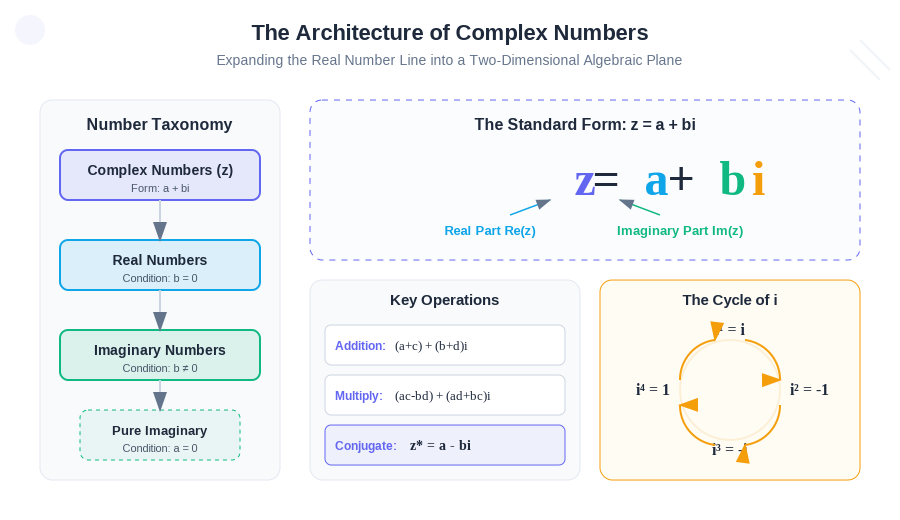
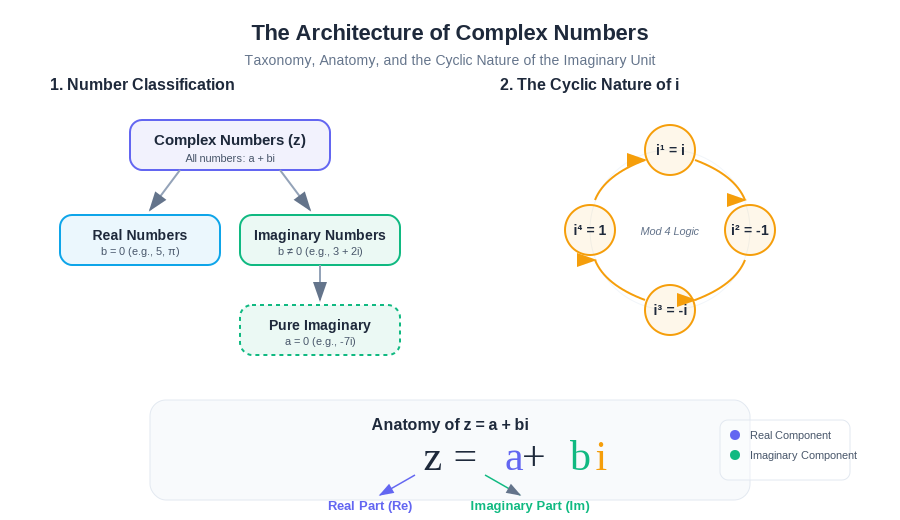
One of the most unique properties of $i$ is its cyclic behavior when raised to integer powers. This periodicity of 4 allows for the rapid simplification of high-degree imaginary expressions.
| Power of $i$ | Simplification | Result |
|---|---|---|
| $i^1$ | $\sqrt{-1}$ | $i$ |
| $i^2$ | $(\sqrt{-1})^2$ | $-1$ |
| $i^3$ | $i^2 \cdot i = -1 \cdot i$ | $-i$ |
| $i^4$ | $i^2 \cdot i^2 = (-1)(-1)$ | $1$ |
| $i^5$ | $i^4 \cdot i$ | $i$ |
Algorithm for $i^n$: To find $i^n$, divide $n$ by 4 and look at the remainder ($r$). The result is $i^r$.
Defining the Complex Number $a + bi$
A Complex Number is any number that can be expressed in the form $z = a + bi$, where $a$ and $b$ are real numbers.
- $a$ is the Real Part, denoted as $\text{Re}(z)$.
- $bi$ is the Imaginary Part, where $b$ is the Imaginary Coefficient, denoted as $\text{Im}(z)$.
Classification of Numbers
Complex numbers act as a superset of all other number types.
| Type | Form | Condition | Example |
|---|---|---|---|
| Real Number | $a + 0i$ | $b = 0$ | $5, \pi, -2.1$ |
| Imaginary Number | $a + bi$ | $b \neq 0$ | $3 + 2i$ |
| Pure Imaginary | $0 + bi$ | $a = 0, b \neq 0$ | $-7i, i\sqrt{2}$ |
Complex Arithmetic: The Algebra of Two Dimensions
Arithmetic with complex numbers follows the standard laws of algebra (distributive, associative, commutative), with the added constraint that $i^2$ must always be replaced with $-1$.
Addition and Subtraction
Addition and subtraction are performed "component-wise." You combine the real parts and the imaginary parts separately. $$(a + bi) \pm (c + di) = (a \pm c) + (b \pm d)i$$
Multiplication
Multiplication follows the FOIL (First, Outer, Inner, Last) method used for binomials. $$(a + bi)(c + di) = ac + adi + bci + bdi^2$$ Since $i^2 = -1$, the last term $bdi^2$ becomes $-bd$. $$(a + bi)(c + di) = (ac - bd) + (ad + bc)i$$
The Complex Conjugate and Division
Division of complex numbers is not as straightforward as real division. To divide by a complex number, we must "realize" the denominator (remove the imaginary component). This is achieved using the Complex Conjugate.
The Conjugate
For any complex number $z = a + bi$, its conjugate, denoted as $\bar{z}$ or $z^*$, is: $$\bar{z} = a - bi$$
The most critical property of the conjugate is that the product of a complex number and its conjugate is always a non-negative real number: $$(a + bi)(a - bi) = a^2 - abi + abi - b^2i^2 = a^2 + b^2$$
Performing Division
To divide $\frac{a + bi}{c + di}$, multiply both the numerator and the denominator by the conjugate of the denominator ($c - di$).
% Mathematical Derivation of Complex Division
\begin{aligned}
\frac{z_1}{z_2} &= \frac{a + bi}{c + di} \\
&= \frac{(a + bi)(c - di)}{(c + di)(c - di)} \\
&= \frac{(ac + bd) + (bc - ad)i}{c^2 + d^2} \\
&= \left(\frac{ac + bd}{c^2 + d^2}\right) + \left(\frac{bc - ad}{c^2 + d^2}\right)i
\end{aligned}
Worked Example: Division
Divide $z_1 = 4 + 2i$ by $z_2 = 3 - i$.
- Identify the conjugate of the denominator: $\bar{z}_2 = 3 + i$.
- Multiply numerator and denominator: $$\frac{(4 + 2i)(3 + i)}{(3 - i)(3 + i)}$$
- Expand the numerator: $$(4 \cdot 3) + (4 \cdot i) + (2i \cdot 3) + (2i \cdot i) = 12 + 4i + 6i - 2 = 10 + 10i$$
- Expand the denominator: $$3^2 + 1^2 = 9 + 1 = 10$$
- Simplify: $$\frac{10 + 10i}{10} = 1 + i$$
Geometric Interpretation: The Complex Plane
While real numbers exist on a line, complex numbers exist in the Complex Plane (or Argand Diagram).
- The x-axis represents the Real part.
- The y-axis represents the Imaginary part.
This geometric view transforms complex arithmetic into vector-like operations. Adding $3 + 2i$ to $1 + 4i$ is identical to vector addition in $\mathbb{R}^2$.
Absolute Value (Modulus)
The "size" of a complex number is its distance from the origin $(0,0)$. This is called the modulus, denoted $|z|$. $$|a + bi| = \sqrt{a^2 + b^2}$$
Advanced Applications: Why Complex Numbers Rule the World
In the real world, complex numbers are not "imaginary" in the sense of being fictional. They are the most efficient way to track two related variables simultaneously—specifically magnitude and phase.
Electrical Engineering (AC Circuits)
In Alternating Current (AC) theory, resistance is replaced by Impedance ($Z$). Impedance is a complex number where the real part is resistance ($R$) and the imaginary part is reactance ($X$). $$Z = R + jX$$ (Note: Engineers use $j$ instead of $i$ to avoid confusion with current $I$.)
Signal Processing
The Fourier Transform, which powers everything from JPEG compression to noise-canceling headphones, relies entirely on complex exponentials to decompose signals into frequency components.
Summary of Operations
| Operation | Formula / Method | Result Type |
|---|---|---|
| Addition | $(a+c) + (b+d)i$ | Complex |
| Multiplication | $(ac-bd) + (ad+bc)i$ | Complex |
| Conjugation | $\text{flip sign of } bi$ | Complex |
| Modulus | $\sqrt{a^2 + b^2}$ | Real |
| Division | Multiply by $\frac{\bar{z}}{\bar{z}}$ | Complex |
Common Pitfalls and Edge Cases
-
The Square Root Product Fallacy: A common mistake is assuming $\sqrt{-a} \cdot \sqrt{-b} = \sqrt{(-a)(-b)} = \sqrt{ab}$.
- Incorrect: $\sqrt{-4} \cdot \sqrt{-9} = \sqrt{36} = 6$.
- Correct: $\sqrt{-4} \cdot \sqrt{-9} = (2i) \cdot (3i) = 6i^2 = -6$.
- Rule: Always convert to $i$ form before performing multiplication or division.
-
Neglecting the $i^2$: Students often forget to flip the sign of the last term in a FOIL expansion. $bdi^2$ is always $-bd$.
-
The "Imaginary" Misnomer: The term "imaginary" was coined by René Descartes as a derogatory term. In modern science, these numbers are as "real" as any other; they simply describe rotations and oscillations more efficiently than standard coordinates.
-
Complex Numbers in Denominators: A final answer is generally not considered "simplified" if there is an $i$ in the denominator. Always use the conjugate to rationalize.
Interactive demos for this section
- Complex Plane Explorer: a free interactive demo that runs in your browser
Study College Algebra on Lykke
This course page is free to open: signed out, you can read its first two sections, and signing in, on any plan, opens the rest. The free Lykke Chrome extension syncs your own Canvas courses, so ChatGPT, Claude and Muse can answer from your classes and deadlines. It only reads Canvas.
Add the free extensionSign in to open every section