From the free course College Algebra on Lykke
Coordinate Geometry and Circles
Key concepts: Distance Formula · Midpoint Formula · Standard Equation of a Circle · Expanded Equation of a Circle
Applying algebraic formulas to geometric shapes on a coordinate plane.
Coordinate Geometry and Circles: The Analytic Bridge
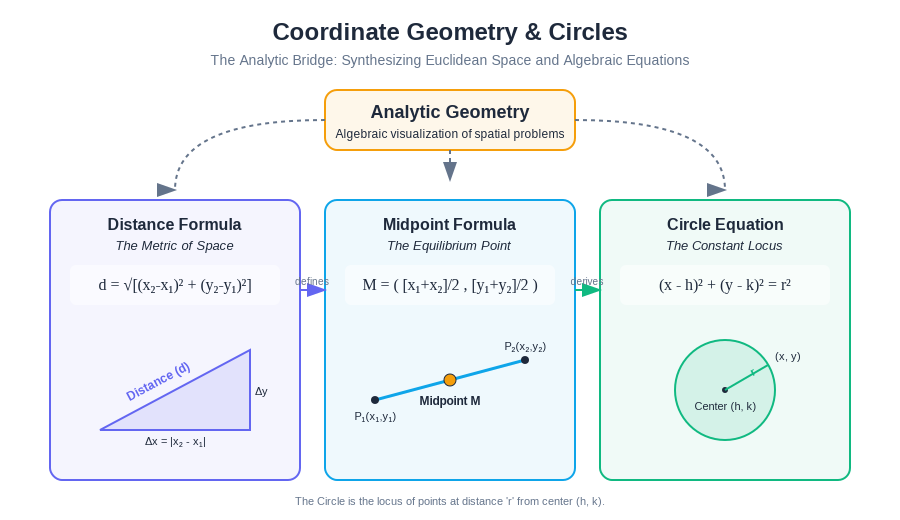
Coordinate geometry, also known as Analytic Geometry, represents one of the most significant leaps in mathematical history. By imposing a Cartesian coordinate system onto Euclidean space, we transform geometric shapes into algebraic equations. This synthesis allows us to solve complex spatial problems using the precision of algebra and, conversely, to visualize algebraic relationships through geometry.
At the heart of this discipline lies the study of the Circle—the locus of all points in a plane that are equidistant from a fixed point. Understanding the circle requires a mastery of the fundamental metrics of the Cartesian plane: distance and division.
The Distance Formula: Quantifying Space
The Distance Formula is the foundational metric of coordinate geometry. It provides a numerical value for the length of the straight-line segment connecting any two points $(x_1, y_1)$ and $(x_2, y_2)$ in a two-dimensional plane.
1. What it is
The distance $d$ between two points $P_1(x_1, y_1)$ and $P_2(x_2, y_2)$ is defined by the formula:
$$d = \sqrt{(x_2 - x_1)^2 + (y_2 - y_1)^2}$$
2. Why it matters
Without the ability to calculate distance, we cannot define circles, parabolas, or ellipses algebraically. In modern engineering, the distance formula is the backbone of Euclidean Norms in machine learning, collision detection in game development, and signal strength calculations in telecommunications.
3. How it works: The Pythagorean Derivation
The formula is not an arbitrary rule; it is a direct application of the Pythagorean Theorem ($a^2 + b^2 = c^2$).
- Draw a horizontal line from $P_1$ and a vertical line from $P_2$ to form a right-angled triangle.
- The horizontal leg (base) has a length of $|x_2 - x_1|$.
- The vertical leg (height) has a length of $|y_2 - y_1|$.
- The distance $d$ is the hypotenuse. Squaring the legs and taking the square root yields the formula.
5. Common Pitfalls
- Sign Errors: Students often confuse $(x_2 - x_1)$ with $(x_2 + x_1)$. Because the term is squared, the order doesn't matter, but the operation must be subtraction.
- Dimensionality: Forgetting that the formula expands to $\sqrt{\Delta x^2 + \Delta y^2 + \Delta z^2}$ in 3D space.
- Computational Cost: Square root operations are "expensive" for CPUs. In many applications (like comparing distances), developers use the Squared Distance ($d^2$) to avoid the
sqrtcall.
| Feature | Distance Formula | Manhattan Distance (L1) |
|---|---|---|
| Path | Straight line (as the crow flies) | Grid-based (city block) |
| Formula | $\sqrt{\Delta x^2 + \Delta y^2}$ | $ |
| Use Case | Physics, Geometry, Graphics | Pathfinding, Robotics, Taxicab geometry |
| Invariance | Rotationally invariant | Depends on axis orientation |
The Midpoint Formula: Finding Equilibrium
The Midpoint Formula identifies the exact center of a line segment. Unlike the distance formula, which yields a scalar (a single number), the midpoint formula yields a vector (a new coordinate).
1. What it is
The midpoint $M(x_m, y_m)$ of a segment with endpoints $(x_1, y_1)$ and $(x_2, y_2)$ is the arithmetic mean of the coordinates:
$$M = \left( \frac{x_1 + x_2}{2}, \frac{y_1 + y_2}{2} \right)$$
2. Why it matters
Midpoints are essential for finding centers of mass, bisecting angles, and determining the center of a circle when only the diameter's endpoints are known. In data science, it is the simplest form of Linear Interpolation (LERP).
3. How it works
Mathematically, the midpoint is the average position. If you are at $x=2$ and your friend is at $x=10$, the middle is $(2+10)/2 = 6$. This logic applies independently to both the $x$ and $y$ axes.
4. Pseudocode Derivation
ALGORITHM FindMidpoint
    INPUT: Point A (x1, y1), Point B (x2, y2)

    // Calculate the average of the x-coordinates
    SET midX = (A.x + B.x) / 2

    // Calculate the average of the y-coordinates
    SET midY = (A.y + B.y) / 2

    OUTPUT: Point(midX, midY)
END ALGORITHM
5. Variations: The Section Formula
The midpoint is a specific case of the Section Formula, which finds a point $P$ that divides a segment in a ratio $m:n$.
$$P = \left( \frac{mx_2 + nx_1}{m+n}, \frac{my_2 + ny_1}{m+n} \right)$$ When $m=1$ and $n=1$, this simplifies to the midpoint formula.
The Standard Equation of a Circle
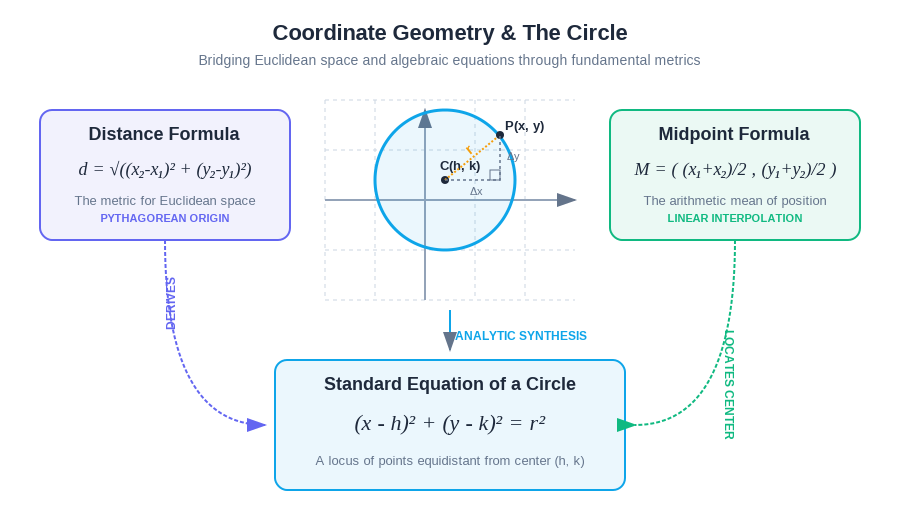
A circle is defined as the set of all points $(x, y)$ that are a fixed distance $r$ (the radius) from a fixed point $(h, k)$ (the center).
1. What it is
The Standard Form of a circle's equation is:
$$(x - h)^2 + (y - k)^2 = r^2$$
2. Derivation from Distance
If we take the distance formula between a general point $(x, y)$ and the center $(h, k)$, we get: $$\sqrt{(x - h)^2 + (y - k)^2} = r$$ Squaring both sides removes the radical and gives us the standard equation. This is a beautiful example of how a geometric definition (constant distance) becomes an algebraic constraint.
3. Parameters and Their Effects
| Parameter | Role | Effect on Graph |
|---|---|---|
| $h$ | x-coordinate of center | Shifts circle left (if $h < 0$) or right (if $h > 0$) |
| $k$ | y-coordinate of center | Shifts circle down (if $k < 0$) or up (if $k > 0$) |
| $r$ | Radius | Determines the size; must be $> 0$ |
| $r^2$ | Squared Radius | The constant on the right side of the equation |
The Expanded (General) Equation of a Circle
While the standard form is useful for graphing, circles often appear in an "expanded" or "general" algebraic form where the binomials have been multiplied out.
1. What it is
The General Form of a circle equation is:
$$x^2 + y^2 + Dx + Ey + F = 0$$ Where $D, E,$ and $F$ are constants.
2. Conversion: Completing the Square
To find the center $(h, k)$ and radius $r$ from the general form, we must perform the process of Completing the Square. This is the bridge back to the standard form.
The Process:
- Group the $x$ terms and $y$ terms together.
- Move the constant $F$ to the other side of the equation.
- For both $x$ and $y$, take the coefficient of the linear term ($D$ and $E$), divide by 2, and square it.
- Add these values to both sides of the equation to maintain equality.
- Factor the resulting trinomials into perfect squares.
3. Worked Example
Problem: Find the center and radius of $x^2 + y^2 - 6x + 8y + 9 = 0$.
- Group terms: $(x^2 - 6x) + (y^2 + 8y) = -9$
- Complete the square for x: $(-6 / 2)^2 = 9$. Add 9 to both sides.
- Complete the square for y: $(8 / 2)^2 = 16$. Add 16 to both sides.
- New Equation: $(x^2 - 6x + 9) + (y^2 + 8y + 16) = -9 + 9 + 16$
- Factor: $(x - 3)^2 + (y + 4)^2 = 16$
Result: Center is $(3, -4)$, Radius is $\sqrt{16} = 4$.
4. Special Cases in General Form
The value of the constant on the right side after completing the square (let's call it $R_{val}$) determines the nature of the graph:
- $R_{val} > 0$: A real circle exists.
- $R_{val} = 0$: The "circle" is actually just a single point (the center).
- $R_{val} < 0$: The equation represents an "imaginary circle" (no real points satisfy the equation).
| Equation Type | Form | Best For |
|---|---|---|
| Standard Form | $(x-h)^2 + (y-k)^2 = r^2$ | Identifying center/radius, graphing |
| General Form | $x^2 + y^2 + Dx + Ey + F = 0$ | Calculus (differentiation), system of equations |
| Parametric Form | $x = h + r\cos(t), y = k + r\sin(t)$ | Computer animation, physics simulations |
Advanced Extensions: Tangents and Intersections
Coordinate geometry allows us to solve for the interaction between circles and other geometric entities.
1. Tangent Lines
A line is tangent to a circle if it touches it at exactly one point. A key property is that the radius to the point of tangency is always perpendicular to the tangent line.
- Algebraic Check: Substitute the line equation ($y = mx + b$) into the circle equation. If the resulting quadratic has exactly one solution (discriminant $B^2 - 4AC = 0$), the line is tangent.
2. Intersection of Two Circles
Two circles can intersect at zero, one (tangent circles), or two points. Finding these points involves subtracting one circle equation from another to find the Radical Axis (a linear equation passing through the intersection points), then substituting that line back into one of the circles.
Summary of Formulas
Distance: $d = \sqrt{(x_2-x_1)^2 + (y_2-y_1)^2}$
Midpoint: $M = \left(\frac{x_1+x_2}{2}, \frac{y_1+y_2}{2}\right)$
Standard Circle: $(x-h)^2 + (y-k)^2 = r^2$
General Circle: $x^2 + y^2 + Dx + Ey + F = 0$
- Term: Cartesian Plane Definition: A 2D coordinate system defined by an x-axis and a y-axis.
- Term: Locus Definition: A set of points whose location satisfies or is determined by one or more specified conditions.
- Term: Completing the Square Definition: A technique used to turn a quadratic expression into a perfect square trinomial.
- Term: Radius Definition: The constant distance from the center of a circle to any point on its edge.
- Term: Diameter Endpoints Definition: Two points on a circle such that the segment connecting them passes through the center.
- Term: Radical Axis Definition: The line of points with equal power with respect to two circles; the line where two circles intersect.
- Conceptual: If you double the radius of a circle in the equation $(x-h)^2 + (y-k)^2 = r^2$, what happens to the constant on the right side of the equation?
- Calculation: Find the midpoint of the segment with endpoints $(-5, 12)$ and $(7, -4)$.
- Derivation: Why is the distance formula always positive (or zero), regardless of whether the coordinates are negative?
- Application: A circle has a diameter with endpoints $(2, 3)$ and $(8, 11)$. What is the standard equation of this circle? (Hint: Use Midpoint for center and Distance for radius).
- Analysis: Convert $x^2 + y^2 - 10x + 2y + 26 = 0$ into standard form. What kind of geometric object does this represent?
Study Guide: Mastery Checklist
- Derive the Distance Formula: Can you draw the right triangle on a coordinate plane and use $a^2 + b^2 = c^2$ to explain the formula?
- Calculate Midpoints: Can you find the center of a line segment using averages?
- Identify Circle Centers: Given $(x+5)^2 + (y-2)^2 = 49$, can you correctly identify the center as $(-5, 2)$ and NOT $(5, -2)$?
- Complete the Square: Can you transform $x^2 + y^2 + 4x - 6y - 3 = 0$ into standard form without looking at notes?
- Graphing: Can you plot a circle given its equation by first marking the center and then moving $r$ units in the four cardinal directions?
- Real-world Logic: Do you understand why $d^2$ is used in programming instead of $d$ for performance optimization?
Interactive demos for this section
- The Analytic Bridge: Distance & Midpoint: a free interactive demo that runs in your browser
Study College Algebra on Lykke
This course page is free to open: signed out, you can read its first two sections, and signing in, on any plan, opens the rest. The free Lykke Chrome extension syncs your own Canvas courses, so ChatGPT, Claude and Muse can answer from your classes and deadlines. It only reads Canvas.
Add the free extensionSign in to open every section