From the free course College Algebra on Lykke
Function Transformations
Key concepts: Translations (Shifting) · Reflections · Dilations (Scaling) · Even and odd functions
Manipulating parent functions through shifts, reflections, and dilations.
Function Transformations
In the study of calculus and advanced algebra, Function Transformation refers to the process of modifying an existing "parent function" to produce a new, related function. Rather than treating every equation as a unique entity, we view functions as dynamic objects that can be moved, flipped, and Resized within a coordinate plane. This operator-based approach is fundamental to signal processing, computer graphics, and data modeling, where "raw" data must often be normalized or shifted to fit a specific model.
The General Transformation Model
To understand transformations deeply, we must look at the generalized form of a transformed function $g(x)$ based on a parent function $f(x)$:
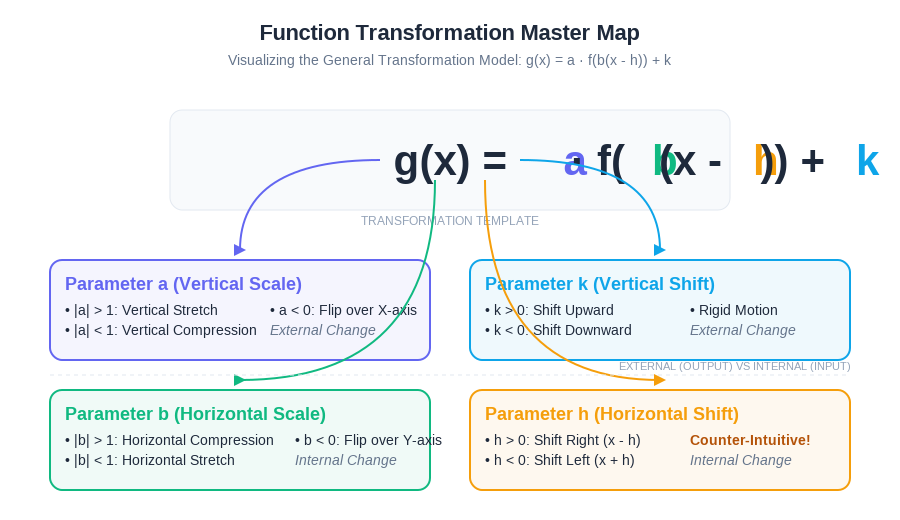
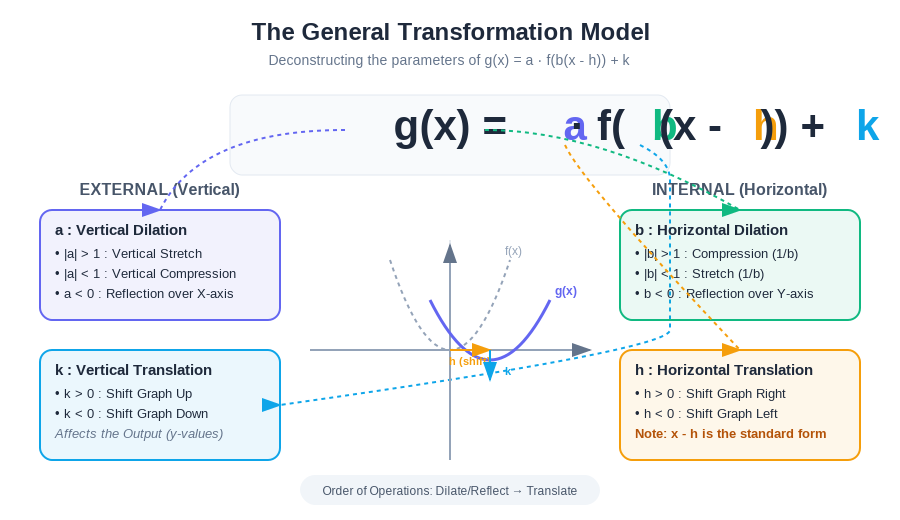
The Transformation Template: $$g(x) = a \cdot f(b(x - h)) + k$$
In this model, the parameters $(a, b, h, k)$ dictate exactly how the parent graph is altered. These parameters are categorized into External Transformations (affecting the output/y-axis) and Internal Transformations (affecting the input/x-axis).
| Parameter | Type | Action | Direction |
|---|---|---|---|
| $k$ | External | Vertical Translation | Up if $k > 0$, Down if $k < 0$ |
| $h$ | Internal | Horizontal Translation | Right if $h > 0$, Left if $h < 0$ |
| $a$ | External | Vertical Dilation/Reflection | Stretch if $ |
| $b$ | Internal | Horizontal Dilation/Reflection | Compress if $ |
Translations (Shifting)
A Translation is a rigid transformation that slides the graph of a function without changing its shape, size, or orientation.
Vertical Shifting
A vertical shift occurs when a constant $k$ is added to the output of the function: $g(x) = f(x) + k$. This is an external change. If you add 5 to the entire function, every $y$-value increases by 5, moving the graph up.
Horizontal Shifting
A horizontal shift occurs when a constant $h$ is subtracted from the input: $g(x) = f(x - h)$. The Counter-Intuitive Principle: Students often find horizontal shifts confusing because $f(x - 3)$ moves the graph to the right, while $f(x + 3)$ moves it to the left.
Reasoning: Consider $f(x) = x^2$. To get the output $0$, you need $x=0$. In $g(x) = (x-3)^2$, to get that same output of $0$, $x$ must now be $3$. Therefore, the "origin" of the function has migrated from $0$ to $3$ on the x-axis.
Reflections (Flipping)
Reflections are transformations that "flip" the graph across an axis. This is mathematically equivalent to multiplying the input or output by $-1$.
Reflection across the X-axis
When we negate the entire function, $g(x) = -f(x)$, we are negating every $y$-coordinate. This results in a vertical flip across the x-axis.
- Example: $f(x) = \sqrt{x}$ exists only in Quadrant I. $g(x) = -\sqrt{x}$ exists in Quadrant IV.
Reflection across the Y-axis
When we negate only the input, $g(x) = f(-x)$, we are negating every $x$-coordinate. This results in a horizontal flip across the y-axis.
- Example: $f(x) = e^x$ (exponential growth) becomes $g(x) = e^{-x}$ (exponential decay).
| Transformation | Equation | Axis of Reflection | Point Mapping |
|---|---|---|---|
| Vertical Reflection | $y = -f(x)$ | x-axis | $(x, y) \to (x, -y)$ |
| Horizontal Reflection | $y = f(-x)$ | y-axis | $(x, y) \to (-x, y)$ |
Dilations (Scaling)
Dilations are non-rigid transformations that stretch or compress the graph. Unlike translations, dilations change the "slope" or "steepness" of the parent function.
Vertical Scaling ($a$)
The multiplier $a$ in $a \cdot f(x)$ scales the output.
- If $|a| > 1$, the graph undergoes a Vertical Stretch. The function grows faster.
- If $0 < |a| < 1$, the graph undergoes a Vertical Compression. The function grows slower.
Horizontal Scaling ($b$)
The multiplier $b$ in $f(b \cdot x)$ scales the input. This is often the most difficult transformation to visualize because it behaves inversely to the multiplier.
- If $|b| > 1$, the graph undergoes a Horizontal Compression by a factor of $1/b$.
- If $0 < |b| < 1$, the graph undergoes a Horizontal Stretch by a factor of $1/b$.
The Scaling Paradox: In $f(2x)$, the "time" or "space" moves twice as fast, meaning the function completes its behavior in half the distance. Thus, a multiplier of 2 results in a compression to 50% of the original width.
Even and Odd Functions (Symmetry)
Symmetry is a specialized property of functions that describes how they behave under reflection. Identifying symmetry allows mathematicians to simplify integrals and engineers to reduce data storage requirements.
Even Functions
A function is Even if it is symmetric about the y-axis. Mathematically, reflecting the function across the y-axis leaves it unchanged.
Algebraic Definition: $f(-x) = f(x)$ for all $x$ in the domain.
- Geometric Insight: If the point $(x, y)$ is on the graph, then $(-x, y)$ must also be on the graph.
- Common Examples: $x^2, x^4, \cos(x), |x|$.
Odd Functions
A function is Odd if it has rotational symmetry of $180^\circ$ about the origin. This is equivalent to reflecting the graph across the y-axis AND the x-axis.
Algebraic Definition: $f(-x) = -f(x)$ for all $x$ in the domain.
- Geometric Insight: If the point $(x, y)$ is on the graph, then $(-x, -y)$ must also be on the graph.
- Common Examples: $x, x^3, \sin(x), 1/x$.
Mathematical Derivation of Symmetry
To prove a function's symmetry, we substitute $(-x)$ into the function and simplify.
Case 1: f(x) = 3x^4 - x^2 + 7
f(-x) = 3(-x)^4 - (-x)^2 + 7
f(-x) = 3(x^4) - (x^2) + 7
f(-x) = f(x)  => EVEN

Case 2: f(x) = x^3 + x
f(-x) = (-x)^3 + (-x)
f(-x) = -x^3 - x
f(-x) = -(x^3 + x)
f(-x) = -f(x) => ODD
| Property | Even Functions | Odd Functions |
|---|---|---|
| Symmetry | y-axis (Reflection) | Origin (Rotation) |
| Algebraic Test | $f(-x) = f(x)$ | $f(-x) = -f(x)$ |
| Polynomial Powers | All exponents are even | All exponents are odd |
| Product Rule | Even $\times$ Even = Even | Odd $\times$ Odd = Even |
| Mixed Rule | Even $\times$ Odd = Odd | Even $+$ Odd = Neither |
The Order of Operations in Transformations
When multiple transformations are applied simultaneously, the order in which they are performed is critical. Performing a shift before a stretch yields a different result than a stretch before a shift.
The standard convention follows the logic of "Inside-Out" (Horizontal then Vertical) or follows the algebraic order of operations (PEMDAS).
The "B-H" Pitfall
Consider the function $g(x) = f(2x - 6)$. Many students incorrectly identify this as a horizontal compression by 2 and a shift right by 6. However, the horizontal shift $h$ is only apparent when the $b$ value is factored out: $$g(x) = f(2(x - 3))$$ This reveals the true shift is only 3 units to the right.
Recommended Transformation Sequence:
- Horizontal Shift ($h$)
- Horizontal Stretch/Compression ($b$)
- Reflections (if $a$ or $b$ are negative)
- Vertical Stretch/Compression ($a$)
- Vertical Shift ($k$)
Pro-Tip: If you follow the form $a \cdot f(b(x - h)) + k$, you can apply all horizontal changes (inside the parentheses) and then all vertical changes (outside).
Concrete Example: Transforming the Absolute Value Function
Let's apply a complex transformation to the parent function $f(x) = |x|$. Target Function: $g(x) = -2|x + 4| + 3$
Step-by-Step Breakdown:
- Parent: Start with $f(x) = |x|$, the V-shape with vertex at $(0,0)$.
- Horizontal Shift ($h = -4$): Replace $x$ with $x + 4$. The vertex moves to $(-4, 0)$.
- Vertical Stretch ($a = 2$): Multiply the output by 2. The V-shape becomes narrower (steeper slopes of $\pm 2$).
- Vertical Reflection ($a$ is negative): Flip the graph over the x-axis. The V-shape now opens downward.
- Vertical Shift ($k = 3$): Add 3 to the entire function. The vertex moves from $(-4, 0)$ to $(-4, 3)$.
Resulting Vertex: $(-4, 3)$ Domain: $(-\infty, \infty)$ Range: $(-\infty, 3]$
Common Pitfalls and Edge Cases
- Ignoring the $b$ Factor: As mentioned, $f(3x - 9)$ is a shift of 3, not 9. Always factor the coefficient of $x$.
- Confusing $a$ and $b$ Effects: Remember that $a$ (vertical) acts "normally" (2 is a stretch, 0.5 is a compression), while $b$ (horizontal) acts "inversely" (2 is a compression, 0.5 is a stretch).
- Symmetry Misconception: Not every function is even or odd. Most functions (like $f(x) = x^2 + x$) are neither. A function must satisfy the algebraic identity perfectly to be classified.
- The Negative Sign: In $f(x-h)$, the formula itself has a negative. So $f(x-5)$ means $h=5$ (positive/right), but $f(x+5)$ means $h=-5$ (negative/left).
Interactive demos for this section
- Function Transformation Sandbox: a free interactive demo that runs in your browser
Study College Algebra on Lykke
This course page is free to open: signed out, you can read its first two sections, and signing in, on any plan, opens the rest. The free Lykke Chrome extension syncs your own Canvas courses, so ChatGPT, Claude and Muse can answer from your classes and deadlines. It only reads Canvas.
Add the free extensionSign in to open every section