From the free course College Algebra on Lykke
Introduction to Functions
Key concepts: Domain and range · Function evaluation · Inverse functions · Interval analysis
A comprehensive introduction to function notation, evaluation, and graphical analysis.
Introduction to Functions
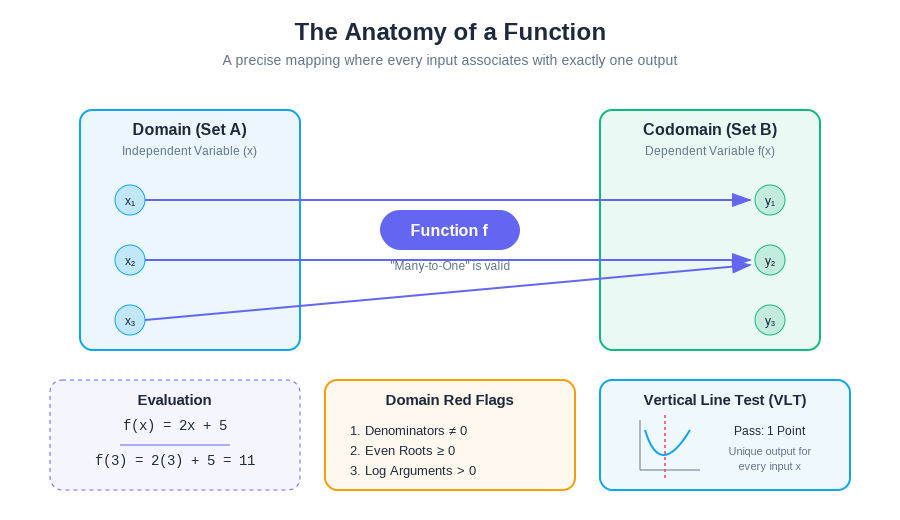
In the architecture of mathematics, a function is the fundamental unit of mapping. It represents a precise relationship where every valid input is associated with exactly one output. While elementary algebra often treats functions as mere "equations," a rigorous approach views them as transformations between sets—a concept that underpins everything from signal processing in electrical engineering to the logic gates in a microprocessor.
The Formal Definition of a Function
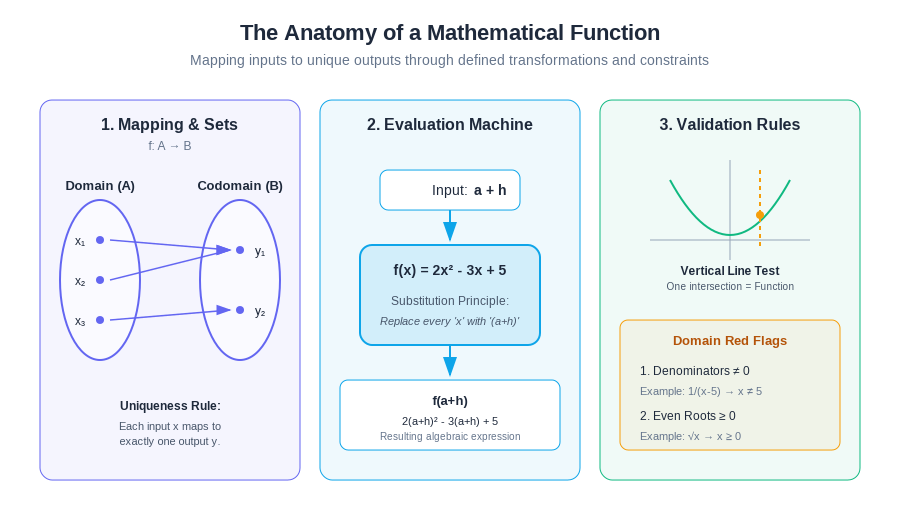
At its most abstract, a function $f$ from a set $A$ (the domain) to a set $B$ (the codomain) is a relation that associates each element $x \in A$ with exactly one element $y \in B$. We denote this as $f: A \to B$.
The Uniqueness Requirement: For a relation to be a function, it must satisfy the condition that if $(x, y) \in f$ and $(x, z) \in f$, then $y = z$. In simpler terms, a single input cannot produce two different outputs.
Distinguishing Relations from Functions
All functions are relations, but not all relations are functions. A relation is simply any set of ordered pairs. To determine if a relation is a function, we apply the Vertical Line Test (VLT) to its graph: if any vertical line intersects the graph at more than one point, the relation fails to be a function because a single $x$-value maps to multiple $y$-values.
| Feature | Relation | Function |
|---|---|---|
| Definition | Any set of ordered pairs $(x, y)$. | A relation where each $x$ has exactly one $y$. |
| Mapping | One-to-Many or Many-to-Many allowed. | One-to-One or Many-to-One only. |
| Graphical Test | No specific requirement. | Must pass the Vertical Line Test. |
| Example | $x^2 + y^2 = 1$ (A circle) | $y = x^2$ (A parabola) |
Function Evaluation and Notation
Function evaluation is the process of determining the output value $f(x)$ for a specific input $x$. In modern notation, $f(x)$ (read as "$f$ of $x$") does not imply multiplication; rather, it denotes the value of the dependent variable when the independent variable is assigned a value.
The Substitution Principle
To evaluate $f(a)$, we replace every instance of the independent variable in the function's expression with the value $a$. This applies whether $a$ is a constant, a variable, or an entire algebraic expression.
Worked Example: Evaluating a Composite Expression Given $f(x) = 2x^2 - 3x + 5$, find $f(a + h)$.
- Identify the template: $f(\text{input}) = 2(\text{input})^2 - 3(\text{input}) + 5$
- Substitute $(a + h)$: $f(a + h) = 2(a + h)^2 - 3(a + h) + 5$
- Expand and Simplify:
- $2(a^2 + 2ah + h^2) - 3a - 3h + 5$
- $2a^2 + 4ah + 2h^2 - 3a - 3h + 5$
This specific type of evaluation is the cornerstone of the Difference Quotient, used in calculus to define the derivative.
Domain and Range Analysis
The Domain is the set of all "legal" inputs for which the function is defined. The Range is the set of all resulting outputs. In College Algebra, we typically assume the domain is the set of all real numbers ($\mathbb{R}$) unless the function contains operations that are undefined for certain values.
Common Domain Restrictions
There are three primary "red flags" to look for when identifying a function's domain:
- Denominators: The denominator of any fraction cannot be zero.
- Even Roots: The radicand (expression under the root) of an even-indexed root (square root, fourth root, etc.) must be non-negative ($\ge 0$).
- Logarithms: The argument of a logarithm must be strictly positive ($> 0$).
| Function Type | Example | Domain Constraint |
|---|---|---|
| Polynomial | $f(x) = x^3 - 4x + 1$ | All Real Numbers $(-\infty, \infty)$ |
| Rational | $f(x) = \frac{1}{x-5}$ | $x \neq 5$ |
| Square Root | $f(x) = \sqrt{x+3}$ | $x+3 \ge 0 \implies x \ge -3$ |
| Combined | $f(x) = \frac{\sqrt{x}}{x-4}$ | $x \ge 0$ AND $x \neq 4$ |
Interval Notation
To describe domains and ranges precisely, we use Interval Notation. This system uses brackets [] to include endpoints and parentheses () to exclude them.
- Closed Interval: $[a, b]$ means $a \le x \le b$.
- Open Interval: $(a, b)$ means $a < x < b$.
- Half-Open: $[a, b)$ means $a \le x < b$.
- Infinity: Always uses parentheses, e.g., $(-\infty, \infty)$.
Interval Analysis: Behavior and Extrema
Beyond just finding points, we analyze how a function behaves over its domain. This is known as Interval Analysis. We look for where the function is increasing, decreasing, positive, or negative.
Monotonicity (Increasing and Decreasing)
- A function is increasing on an interval if, for any $x_1 < x_2$, $f(x_1) < f(x_2)$. Visually, the graph goes "uphill" from left to right.
- A function is decreasing on an interval if, for any $x_1 < x_2$, $f(x_1) > f(x_2)$. Visually, the graph goes "downhill."
- A function is constant if $f(x_1) = f(x_2)$ for all $x$ in the interval.
Note: Intervals of increase and decrease are always described using $x$-values (the domain) and are typically written with open parentheses.
Positivity and Negativity
This refers to the sign of the $y$-value.
- Positive: $f(x) > 0$ (The graph is above the $x$-axis).
- Negative: $f(x) < 0$ (The graph is below the $x$-axis).
- The transitions between positive and negative occur at the $x$-intercepts (zeros) of the function.
Inverse Functions
An inverse function, denoted $f^{-1}(x)$, essentially "reverses" the operation of $f(x)$. If $f$ maps $x$ to $y$, then $f^{-1}$ maps $y$ back to $x$.
Existence of an Inverse: One-to-One Functions
Not every function has an inverse that is also a function. For an inverse function to exist, the original function must be One-to-One (injective). This means every $y$-value in the range is paired with exactly one $x$-value in the domain.
To test for this graphically, we use the Horizontal Line Test (HLT):
- If any horizontal line crosses the graph of $f(x)$ more than once, the function is not one-to-one and does not have a functional inverse over its entire domain.
Finding the Inverse Algebraically
To find the equation of an inverse function, follow these steps:
- Replace $f(x)$ with $y$.
- Swap $x$ and $y$.
- Solve the new equation for $y$.
- Replace $y$ with $f^{-1}(x)$.
Worked Example: Finding the Inverse of a Rational Function Find the inverse of $f(x) = \frac{2x + 1}{x - 3}$.
- $y = \frac{2x + 1}{x - 3}$
- $x = \frac{2y + 1}{y - 3}$ (Swap $x$ and $y$)
- $x(y - 3) = 2y + 1$ (Multiply by denominator)
- $xy - 3x = 2y + 1$ (Distribute)
- $xy - 2y = 3x + 1$ (Move $y$-terms to one side)
- $y(x - 2) = 3x + 1$ (Factor out $y$)
- $y = \frac{3x + 1}{x - 2}$
- $f^{-1}(x) = \frac{3x + 1}{x - 2}$
% Example 2: Mathematical Derivation of the Inverse Property
% Using LaTeX-style notation to prove the relationship between f and f-1

\text{Theorem: The Composition of Inverses} \\
\text{If } f \text{ and } g \text{ are inverse functions, then:} \\
1. \quad f(g(x)) = x \quad \text{for all } x \text{ in the domain of } g \\
2. \quad g(f(x)) = x \quad \text{for all } x \text{ in the domain of } f \\

\text{Proof for } f(x) = 2x + 3 \text{ and } f^{-1}(x) = \frac{x-3}{2}: \\
f(f^{-1}(x)) = 2\left(\frac{x-3}{2}\right) + 3 \\
= (x - 3) + 3 \\
= x \quad \blacksquare
Properties of Inverses
The relationship between a function and its inverse is deeply symmetrical.
| Property | Function $f(x)$ | Inverse $f^{-1}(x)$ |
|---|---|---|
| Domain | Set A | Set B |
| Range | Set B | Set A |
| Ordered Pairs | $(a, b)$ | $(b, a)$ |
| Graph | Original curve | Reflection across the line $y = x$ |
Piecewise Functions
In the real world, relationships often change behavior abruptly. A piecewise function is defined by multiple sub-functions, each applying to a specific interval of the domain.
Example: $$ f(x) = \begin{cases} x^2 & \text{if } x < 0 \ x + 1 & \text{if } x \ge 0 \end{cases} $$
Evaluating piecewise functions requires a two-step process:
- Identify the interval: Determine which condition the input $x$ satisfies.
- Apply the specific rule: Use only the expression corresponding to that interval.
Common Pitfalls in Function Analysis
Even experienced practitioners encounter subtle errors when working with complex functions.
1. Confusing $f(x)$ with Multiplication
In expressions like $f(x+h)$, students often try to "distribute" the $f$, resulting in $f(x) + f(h)$. This is almost never true unless the function is linear and passes through the origin ($f(x) = cx$). This is known as the Linearity Fallacy.
2. Ignoring Domain Restrictions after Simplification
When simplifying a function like $f(x) = \frac{x^2 - 4}{x - 2}$, it reduces to $f(x) = x + 2$. However, the domain of the original function still excludes $x = 2$. On a graph, this appears as a hole (removable discontinuity) at $(2, 4)$, not a solid line.
3. Misinterpreting the Inverse Notation
The notation $f^{-1}(x)$ is frequently confused with the reciprocal $\frac{1}{f(x)}$.
- $f^{-1}(x)$ is the inverse function (undoes the mapping).
- $[f(x)]^{-1}$ is the reciprocal (flips the fraction).
4. Range Miscalculation
While the domain is often found by looking for "illegal" operations, the range is best found by looking at the graph or the inverse function's domain. Many students assume the range is "all real numbers" for any function that isn't a square root, forgetting that functions like $f(x) = x^2$ have a lower bound ($y \ge 0$).
Interactive demos for this section
- The Vertical Line Test Interactive: a free interactive demo that runs in your browser
Study College Algebra on Lykke
This course page is free to open: signed out, you can read its first two sections, and signing in, on any plan, opens the rest. The free Lykke Chrome extension syncs your own Canvas courses, so ChatGPT, Claude and Muse can answer from your classes and deadlines. It only reads Canvas.
Add the free extensionSign in to open every section