From the free course College Algebra on Lykke
Linear Equations and Inequalities
Key concepts: Multi-step linear equations · Compound inequalities · Absolute value equations · Number of solutions
Foundational principles of solving multi-step equations, compound inequalities, and absolute value equations.
Linear Equations and Inequalities
Linearity is the cornerstone of algebraic analysis. In its most fundamental form, a linear equation represents a relationship where the rate of change between variables is constant. This section explores the mechanics of manipulating these expressions, the logical frameworks governing inequalities, and the specialized handling required for absolute value functions. We move beyond simple one-step arithmetic into the realm of multi-step isolation, logical conjunctions, and the rigorous classification of solution sets.
Multi-Step Linear Equations
A multi-step linear equation is an equality involving one or more operations—distributive property, combining like terms, and inverse operations—required to isolate the target variable. Mathematically, any linear equation in one variable can be reduced to the standard form $ax + b = 0$, where $a \neq 0$.
The Mechanics of Isolation
The primary objective in solving linear equations is variable isolation. This is achieved through the application of the Properties of Equality, which maintain the "balance" of the equation by performing identical operations on both sides of the equal sign.
| Property | Algebraic Definition | Description |
|---|---|---|
| Addition Property | If $a = b$, then $a + c = b + c$ | Adding the same value to both sides preserves equality. |
| Subtraction Property | If $a = b$, then $a - c = b - c$ | Subtracting the same value from both sides preserves equality. |
| Multiplication Property | If $a = b$, then $ac = bc$ | Multiplying both sides by the same non-zero value preserves equality. |
| Division Property | If $a = b$ and $c \neq 0$, then $a/c = b/c$ | Dividing both sides by the same non-zero value preserves equality. |
| Distributive Property | $a(b + c) = ab + ac$ | Allows for the removal of parentheses by distributing a multiplier. |
Algorithmic Workflow for Multi-Step Equations
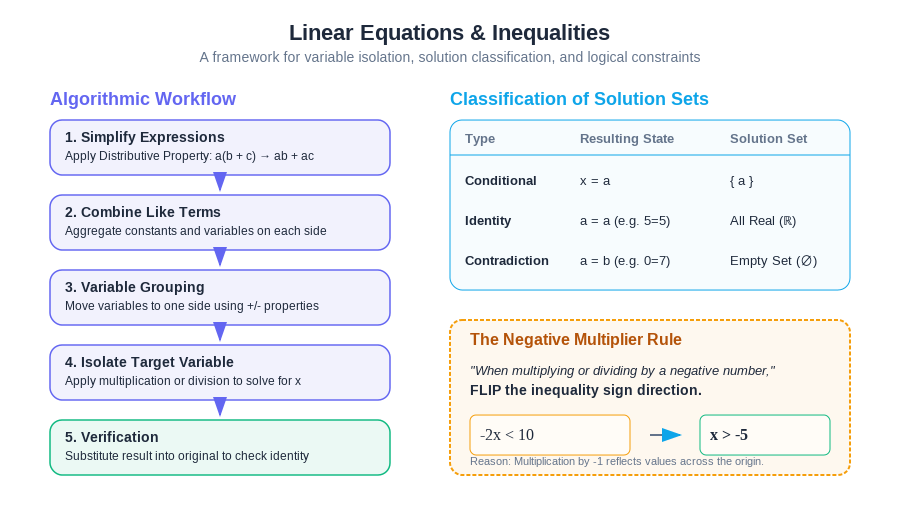
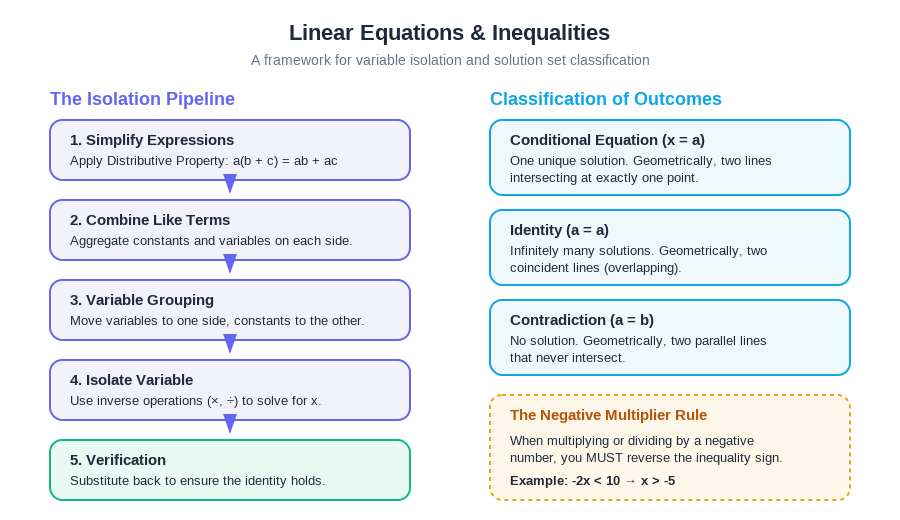
To solve a complex equation such as $3(2x - 4) + 5 = 2x - (x + 8)$, follow a structured pipeline:
- Simplify Expressions: Apply the distributive property to eliminate parentheses.
- Combine Like Terms: Aggregate constants and variable terms on each individual side.
- Variable Grouping: Use addition or subtraction to move all variable terms to one side and all constants to the other.
- Isolate: Use multiplication or division to solve for the variable (coefficient of 1).
- Verify: Substitute the result back into the original equation to ensure the identity holds.
The Number of Solutions
Not every linear equation results in a single, discrete value for the variable. In college algebra, we categorize equations based on their solution sets. This classification is vital for understanding the geometric relationship between two lines or the consistency of a system.
Classification of Solution Sets
When simplifying a linear equation, if the variable terms cancel out (e.g., $0x$), the resulting numeric statement determines the nature of the solution.
| Resulting Statement | Classification | Geometric Interpretation | Solution Set |
|---|---|---|---|
| $x = a$ | Conditional | Two lines intersecting at exactly one point. | ${a}$ |
| $a = a$ (e.g., $5=5$) | Identity | Two coincident lines (one on top of the other). | All Real Numbers ($\mathbb{R}$) |
| $a = b$ (e.g., $0=7$) | Contradiction | Two parallel lines that never intersect. | Empty Set ($\emptyset$) |
Theorem of Linear Consistency: A linear equation in the form $ax + b = cx + d$ has exactly one solution if and only if $a \neq c$. If $a = c$, the equation is either an identity (if $b = d$) or a contradiction (if $b \neq d$).
Linear Inequalities and Interval Notation
Linear inequalities extend the concept of equations to relationships of "greater than" or "less than." Unlike equations, which typically yield points, inequalities yield regions or intervals.
The Negative Multiplier Rule
The most critical distinction in solving inequalities is the behavior of the inequality sign during multiplication or division by a negative number.
Key Rule: When multiplying or dividing both sides of an inequality by a negative number, the direction of the inequality symbol must be reversed.
This is because multiplying by a negative number reflects the values across the origin on a number line, effectively reversing their relative order.
Representing Solutions
Solutions to inequalities are represented in three primary ways:
- Inequality Notation: $x > 5$
- Set-Builder Notation: ${x \mid x > 5}$
- Interval Notation: $(5, \infty)$
| Symbol | Meaning | Circle on Graph | Bracket/Parenthesis |
|---|---|---|---|
| $<$ | Less than | Open | $($ or $)$ |
| $>$ | Greater than | Open | $($ or $)$ |
| $\leq$ | Less than or equal to | Closed | $[$ or $]$ |
| $\geq$ | Greater than or equal to | Closed | $[$ or $]$ |
Compound Inequalities
A compound inequality consists of two separate inequalities joined by the logical operators AND or OR. These represent the intersection and union of sets, respectively.
Conjunctions (AND)
A conjunction is true only if both inequalities are satisfied. This usually represents a bounded interval.
- Notation: $x > a$ AND $x < b$, often written as $a < x < b$.
- Set Theory: $A \cap B$ (Intersection).
- Visual: The "middle" section where two shaded regions overlap.
Disjunctions (OR)
A disjunction is true if at least one of the inequalities is satisfied. This usually represents two divergent intervals.
- Notation: $x < a$ OR $x > b$.
- Set Theory: $A \cup B$ (Union).
- Visual: Two separate shaded regions pointing away from each other.
\text{Example of a Conjunction derivation:} \\
-5 \leq 2x + 3 < 11 \\
\text{Step 1: Subtract 3 from all parts} \\
-8 \leq 2x < 8 \\
\text{Step 2: Divide all parts by 2} \\
-4 \leq x < 4 \\
\text{Interval Notation: } [-4, 4)
Absolute Value Equations
The absolute value of a number, denoted $|x|$, is defined as its distance from zero on the number line. Because distance is non-negative, the output of an absolute value function is always $\geq 0$.
Solving $|ax + b| = c$
To solve an absolute value equation, you must account for the two possible scenarios that result in the same distance:
- The expression inside the bars is positive: $ax + b = c$
- The expression inside the bars is negative: $ax + b = -c$
Important Pitfall: Before branching into two equations, you must isolate the absolute value expression. If you are left with $|ax + b| = -c$ (where $c$ is positive), there is no solution, as an absolute value cannot equal a negative distance.
| Equation Type | Branch 1 | Branch 2 | Condition |
|---|---|---|---|
| $ | x | = k$ | $x = k$ |
| $ | x | < k$ | $x < k$ |
| $ | x | > k$ | $x > k$ |
Absolute Value Inequalities: "Great-OR" and "Less-THEN"
A helpful mnemonic for remembering how to branch inequalities:
- $|x| > k$ is a Great-OR problem (uses the OR operator).
- $|x| < k$ is a Less-THEN (Less-Than) problem (uses the AND operator).
Interpreting Equations in Context
In applied mathematics, linear equations and inequalities serve as models for constraints and relationships.
Modeling with Two Variables
When dealing with two-variable equations (e.g., $Ax + By = C$), we often interpret the intercepts:
- X-intercept: The value of $x$ when $y=0$. In a business context, this might represent the maximum number of units produced if no resources are allocated to the second product.
- Y-intercept: The value of $y$ when $x=0$.
- Slope ($m$): The rate of change. If $y$ is cost and $x$ is time, the slope is the cost per unit of time.
Systems in Context
Solving a system of linear equations (finding where two lines meet) allows us to find break-even points or equilibrium.
- If the system has one solution, the lines intersect (different slopes).
- If the system has no solution, the constraints are mutually exclusive (parallel lines).
- If the system has infinite solutions, the two constraints are redundant (the same line).
Common Pitfalls and Edge Cases
- Distributing Negatives: A common error is failing to distribute a negative sign to all terms inside a parenthesis. For example, $-(x - 5)$ becomes $-x + 5$, not $-x - 5$.
- Dividing by Zero: In literal equations (equations with multiple variables), one must state constraints. If solving $ax = b$ for $x$, you must specify $a \neq 0$.
- Absolute Value Logic: Forgetting to isolate the absolute value before branching. In $2|x| + 4 = 10$, you must subtract 4 and divide by 2 before setting up $x = 3$ and $x = -3$.
- Inequality Direction: Forgetting to flip the sign when multiplying by $-1$. This is the most frequent error in linear inequality problems.
- Empty Sets in Absolute Value: $|x + 5| = -2$ has no solution. Distance cannot be negative. Students often robotically solve $x+5 = -2$ and $x+5 = 2$, obtaining extraneous solutions.
Interactive demos for this section
- Linear Equation Visualizer: a free interactive demo that runs in your browser
Study College Algebra on Lykke
This course page is free to open: signed out, you can read its first two sections, and signing in, on any plan, opens the rest. The free Lykke Chrome extension syncs your own Canvas courses, so ChatGPT, Claude and Muse can answer from your classes and deadlines. It only reads Canvas.
Add the free extensionSign in to open every section