From the free course College Algebra on Lykke
Exponents and Exponential Growth
Key concepts: Exponent properties · Radical simplification · Exponential growth · Exponential decay
Properties of integer exponents and the visualization of exponential growth and decay.
Exponents and Exponential Growth
In the hierarchy of arithmetic operations, exponentiation represents the leap from additive scaling to multiplicative scaling. While multiplication is defined as repeated addition, exponentiation is defined as repeated multiplication. This shift in logic introduces non-linear dynamics that govern the most powerful forces in the natural and financial worlds—from the fission of atoms and the spread of viral pathogens to the accumulation of generational wealth through compound interest.
This article provides a rigorous exploration of the algebraic properties of exponents, the mechanics of radical simplification, and the functional behavior of exponential growth and decay models.
The Algebra of Exponents: Fundamental Laws
At its most basic, an exponential expression consists of a base ($b$) raised to a power or exponent ($n$), written as $b^n$. This notation signifies that the base is multiplied by itself $n$ times. However, as we move into college-level algebra, we must extend this definition beyond positive integers to include zero, negative integers, and rational numbers.
The Axioms of Exponentiation
The behavior of exponents is governed by a set of consistent algebraic laws. These are not merely arbitrary rules but are derived from the definition of multiplication.
| Law Name | Mathematical Notation | Description |
|---|---|---|
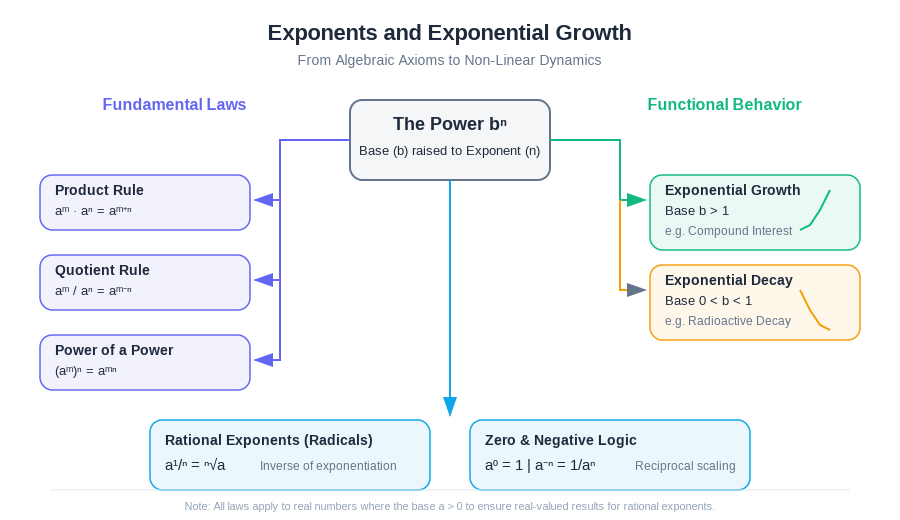
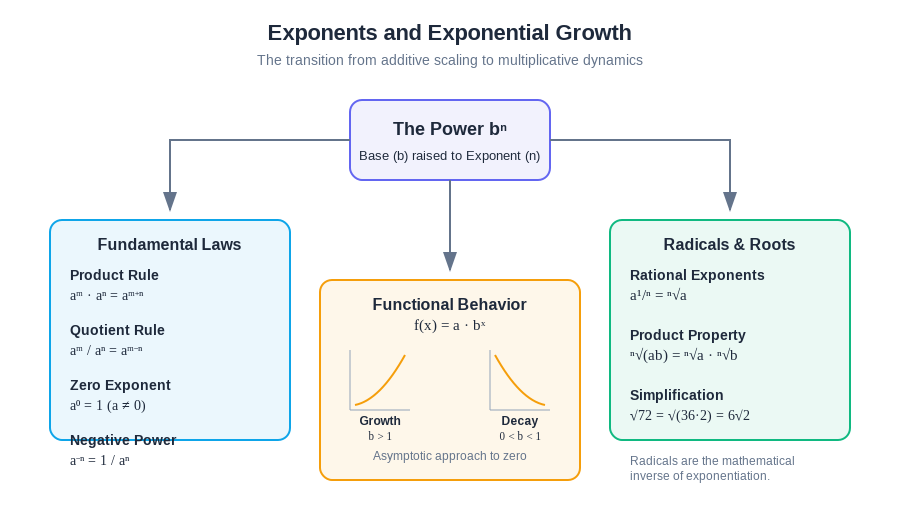
| Product Rule | $a^m \cdot a^n = a^{m+n}$ | To multiply powers with the same base, add the exponents. |
| Quotient Rule | $\frac{a^m}{a^n} = a^{m-n}$ | To divide powers with the same base, subtract the exponents. |
| Power of a Power | $(a^m)^n = a^{m \cdot n}$ | To raise a power to another power, multiply the exponents. |
| Power of a Product | $(ab)^n = a^n b^n$ | The power of a product is the product of the powers. |
| Zero Exponent | $a^0 = 1, (a \neq 0)$ | Any non-zero base raised to the power of zero is exactly one. |
| Negative Exponent | $a^{-n} = \frac{1}{a^n}$ | A negative exponent represents the reciprocal of the base raised to the positive power. |
Derivation: Why is $a^0 = 1$?
Students often find the zero-exponent rule counterintuitive. However, it is a logical necessity of the Quotient Rule. Consider the expression $\frac{x^3}{x^3}$.
- By basic arithmetic, any non-zero number divided by itself is $1$.
- By the Quotient Rule, $\frac{x^3}{x^3} = x^{3-3} = x^0$.
- Therefore, to maintain mathematical consistency, $x^0$ must equal $1$.
Radicals and Rational Exponents
A radical is the mathematical inverse of an exponent. While $3^2 = 9$, the square root of $9$ ($\sqrt{9}$) returns us to $3$. In advanced algebra, we treat radicals as rational exponents, which allows us to apply all the standard exponent laws to roots.
Definition: The Principal $n$-th Root For any real number $a$ and positive integer $n$, $a^{1/n} = \sqrt[n]{a}$. If $n$ is even, $a$ must be non-negative for the result to be a real number.
Simplification of Radicals
Simplifying a radical involves removing any perfect $n$-th powers from the radicand (the expression under the radical symbol). This is achieved through the Product Property of Radicals: $\sqrt[n]{ab} = \sqrt[n]{a} \cdot \sqrt[n]{b}$.
Table: Radical Simplification Logic
| Expression | Goal | Method | Simplified Result |
|---|---|---|---|
| $\sqrt{72}$ | Find largest perfect square | $\sqrt{36 \cdot 2} = \sqrt{36} \cdot \sqrt{2}$ | $6\sqrt{2}$ |
| $\sqrt[3]{54}$ | Find largest perfect cube | $\sqrt[3]{27 \cdot 2} = \sqrt[3]{27} \cdot \sqrt[3]{2}$ | $3\sqrt[3]{2}$ |
| $\sqrt{x^5}$ | Extract even powers | $\sqrt{x^4 \cdot x} = x^{4/2} \sqrt{x}$ | $x^2\sqrt{x}$ |
Mathematical Derivation: Rationalizing the Denominator
In formal mathematics, it is standard practice to ensure the denominator of a fraction does not contain a radical. This is called rationalizing.
% Representation of rationalizing a denominator via a conjugate
\text{Given: } \frac{1}{\sqrt{a} + \sqrt{b}} \\
\text{Multiply by the conjugate: } \frac{1(\sqrt{a} - \sqrt{b})}{(\sqrt{a} + \sqrt{b})(\sqrt{a} - \sqrt{b})} \\
\text{Expand the denominator: } \frac{\sqrt{a} - \sqrt{b}}{(\sqrt{a})^2 - (\sqrt{b})^2} \\
\text{Result: } \frac{\sqrt{a} - \sqrt{b}}{a - b}
Exponential Functions: Growth and Decay
An exponential function is a function of the form $f(x) = a \cdot b^x$, where $a$ is the initial value (the y-intercept), $b$ is the base (the growth factor), and $x$ is the exponent (usually representing time).
Distinguishing Growth from Decay
The behavior of the function is entirely determined by the value of the base $b$.
| Base Condition | Type | Behavior | Real-World Example |
|---|---|---|---|
| $b > 1$ | Exponential Growth | Increases at an accelerating rate. | Population growth, Compound interest. |
| $0 < b < 1$ | Exponential Decay | Decreases, approaching zero asymptotically. | Radioactive decay, Asset depreciation. |
| $b = 1$ | Constant | A horizontal line at $f(x) = a$. | No change over time. |
The Mechanics of the Growth Factor
In many word problems, the base $b$ is not given directly but is expressed as a percentage rate of change ($r$).
- For growth: $b = 1 + r$
- For decay: $b = 1 - r$
The Asymptotic Property Exponential functions of the form $f(x) = ab^x$ possess a horizontal asymptote at $y=0$. This means that while the value of the function may become infinitesimally small (in decay) or start extremely flat (in growth), it will never actually touch or cross the x-axis unless a vertical shift is applied.
Modeling with the Natural Base $e$
In the study of continuous processes, we encounter the irrational number $e$ (Euler's number), approximately equal to $2.71828$. This constant arises when we consider the limit of compound interest as the number of compounding periods approaches infinity.
Continuous Compound Interest Formula
The formula for continuous growth is: $$A = Pe^{rt}$$ Where:
- $P$ = Principal (initial amount)
- $e$ = Euler's number
- $r$ = Annual interest rate (decimal)
- $t$ = Time in years
Advanced Topic: Binary Exponentiation
In computer science, calculating $a^b$ where $b$ is a very large integer (as seen in RSA encryption) using the naive method of $b$ multiplications is inefficient ($O(n)$). Instead, we use Binary Exponentiation (also known as Square and Multiply), which reduces the complexity to $O(\log n)$.
Common Pitfalls and Misconceptions
- The "Freshman's Dream": A very common error is assuming $(a + b)^n = a^n + b^n$. This is false for all $n > 1$. For example, $(2+3)^2 = 5^2 = 25$, but $2^2 + 3^2 = 4 + 9 = 13$.
- Negative Base vs. Negative Exponent: A negative exponent ($x^{-2}$) does not make the result negative; it creates a reciprocal ($1/x^2$). A negative base ($(-x)^2$) may or may not be negative depending on whether the exponent is even or odd.
- Order of Operations: In the expression $-3^2$, the exponent applies only to the $3$, resulting in $-9$. To square the negative number, parentheses are required: $(-3)^2 = 9$.
- Linear vs. Exponential Growth: In a linear model, the amount of change is constant. In an exponential model, the percentage of change is constant.
Summary of Applications
The mastery of exponents and radicals is not merely an academic exercise; it is the prerequisite for understanding Logarithms, which are the inverse of exponential functions. Without these tools, we could not measure the magnitude of earthquakes (Richter scale), the acidity of liquids (pH scale), or the brightness of stars (apparent magnitude).
| Field | Application | Model Type |
|---|---|---|
| Biology | Bacterial culture growth | Exponential Growth |
| Chemistry | Half-life of Carbon-14 | Exponential Decay |
| Finance | Inflation and Purchasing Power | Exponential Decay |
| Data Science | Complexity of algorithms | Power Laws |
| Physics | Newton's Law of Cooling | Exponential Decay |
Interactive demos for this section
- Exponential Growth Visualizer: a free interactive demo that runs in your browser
Study College Algebra on Lykke
This course page is free to open: signed out, you can read its first two sections, and signing in, on any plan, opens the rest. The free Lykke Chrome extension syncs your own Canvas courses, so ChatGPT, Claude and Muse can answer from your classes and deadlines. It only reads Canvas.
Add the free extensionSign in to open every section