From the free course College Algebra on Lykke
7.1 Systems of Linear Equations: Two Variables
Key concepts: Systems of linear equations in two variables · Ordered-pair solutions · Independent, inconsistent, and dependent systems · Graphing systems of equations · Substitution method · Addition/elimination method · Verifying solutions by substitution · Linear modeling applications · Interpolation and extrapolation · Finding an input from a given output
By the end of this section the student can: Solve systems of equations by graphing; Solve systems of equations by substitution; Solve systems of equations by addition; Identify inconsistent systems of equations containing two variables; Express the solution of a system of dependent equations containing two variables
7.1 Systems of Linear Equations: Two Variables
Two conditions can determine the same unknown pair. For example, if two different pricing rules describe the same purchase, the actual quantities must satisfy both rules at once. A system of linear equations is a collection of two or more linear equations considered together, and its solution must satisfy every equation in the system.
A useful everyday analogy is a map with two roads: each equation describes one line, and a solution is a location lying on every line simultaneously. With two variables, that location is an ordered pair $(x,y)$ in the coordinate plane.
Introduction to Systems of Equations
A system of linear equations in two variables commonly has the form
$$ \begin{cases} a_1x+b_1y=c_1\ a_2x+b_2y=c_2 \end{cases} $$
where $x$ and $y$ are variables and the coefficients and constants are real numbers. An ordered-pair solution is a pair $(x,y)$ whose values make both equations true.
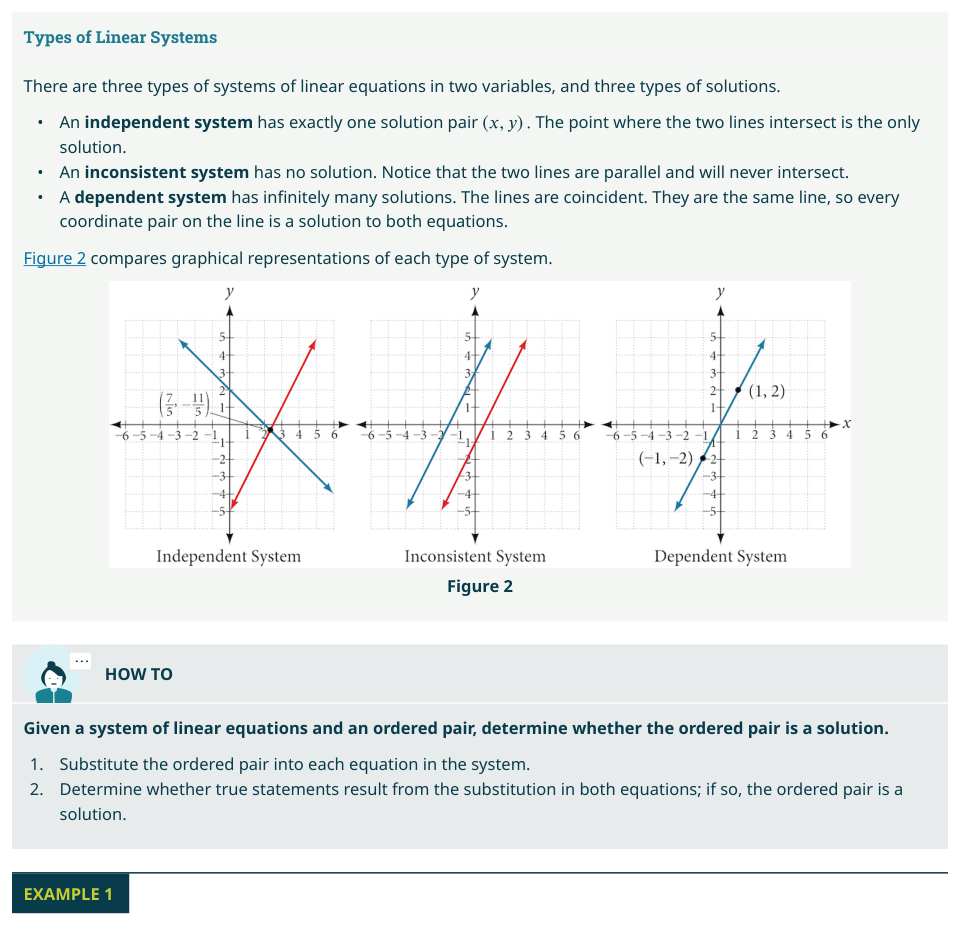
There are three possible types of systems:
- An independent system has exactly one solution pair. Graphically, the two lines intersect at one point.
- An inconsistent system has no solution. Graphically, the two lines are parallel and never intersect.
- A dependent system has infinitely many solutions. Graphically, the two equations represent the same line, so every point on that line satisfies both equations.
The key misconception is that two equations always produce two separate answers. They do not. A system may have one solution, no solution, or infinitely many solutions.
Example: Identifying an ordered-pair solution. Determine whether $(2,3)$ is a solution of
$$ \begin{cases} x+y=5\ 2x-y=1. \end{cases} $$
Substitute $x=2$ and $y=3$ into the first equation:
$$ x+y=5 $$
$$ 2+3=5 $$
$$ 5=5 $$
The first equation is true. Now substitute into the second equation:
$$ 2x-y=1 $$
$$ 2(2)-3=1 $$
$$ 4-3=1 $$
$$ 1=1 $$
Because $(2,3)$ makes both equations true, the solution is
$$ \boxed{(2,3)}. $$
Solving Systems of Equations by Graphing
To solve a system by graphing, graph both equations in the same coordinate plane. The solution is the coordinate pair at which the graphs intersect. If the lines do not intersect, the system has no solution. If the graphs coincide, the system has infinitely many solutions.
For graphing, it is often helpful to write each equation in slope-intercept form,
$$ y=mx+b, $$
where $m$ is the slope and $b$ is the $y$-intercept. Plot the $y$-intercept, use the slope to find another point, draw each line, and read the intersection.
Example: Solving by graphing. Solve
$$ \begin{cases} y=x+1\ y=-x+5. \end{cases} $$
The first line is already in slope-intercept form:
$$ y=x+1. $$
Its slope is $m=1$, and its $y$-intercept is $(0,1)$. Plot $(0,1)$. Since the slope is
$$ m=\frac{1}{1}, $$
move right $1$ and up $1$ to obtain $(1,2)$, then move right $1$ and up $1$ again to obtain $(2,3)$.
The second line is
$$ y=-x+5. $$
Its slope is $m=-1$, and its $y$-intercept is $(0,5)$. Plot $(0,5)$. Since
$$ m=-1=-\frac{1}{1}, $$
Plotting these points and drawing the two lines shows that they intersect at $(2,3)$. Thus the graphical solution is
$$ \boxed{(2,3)}. $$
As an algebraic check, set the two expressions for $y$ equal:
$$ x+1=-x+5 $$
Add $x$ to both sides:
$$ 2x+1=5 $$
Subtract $1$ from both sides:
$$ 2x=4 $$
Divide by $2$:
$$ x=2. $$
Substitute into $y=x+1$:
$$ y=2+1=3. $$
The graph and the algebra agree.
Solving Systems of Equations by Substitution
The substitution method solves a system by solving one equation for one variable and substituting that expression into the other equation. The method reduces a system with two variables to a single equation with one variable.
A practical procedure is:
- Solve one equation for either $x$ or $y$.
- Substitute that expression into the other equation.
- Solve the resulting one-variable equation.
- Substitute the value back to find the second variable.
- Check the ordered pair in both original equations.
Example: Solving by substitution. Solve
$$ \begin{cases} x+y=7\ 2x-y=5. \end{cases} $$
Solve the first equation for $y$:
$$ x+y=7 $$
Subtract $x$ from both sides:
$$ y=7-x. $$
Substitute $7-x$ for $y$ in the second equation:
$$ 2x-y=5 $$
$$ 2x-(7-x)=5. $$
Distribute the negative sign:
$$ 2x-7+x=5. $$
Combine like terms:
$$ 3x-7=5. $$
Add $7$ to both sides:
$$ 3x=12. $$
Divide by $3$:
$$ x=4. $$
Substitute $x=4$ into $y=7-x$:
$$ y=7-4 $$
$$ y=3. $$
Therefore,
$$ \boxed{(4,3)}. $$
Check:
$$ 4+3=7 $$
and
$$ 2(4)-3=8-3=5. $$
Solving Systems of Equations in Two Variables by the Addition Method
The addition method, also called the elimination method, solves a system by adding the equations so that one variable is eliminated. Before adding, multiply one or both equations by constants when necessary so that the coefficients of one variable are opposites.
The legal operations are the same principles used for ordinary equations: multiplying an entire equation by a nonzero number preserves its solutions, and adding corresponding sides of two true equations produces another true equation.
Example: Solving by addition. Solve
$$ \begin{cases} 3x+2y=16\ 5x-2y=0. \end{cases} $$
The coefficients of $y$ are opposites, so add the equations directly:
$$ \begin{aligned} 3x+2y&=16\ 5x-2y&=0\ \hline 8x+0y&=16 \end{aligned} $$
Thus,
$$ 8x=16. $$
Divide by $8$:
$$ x=2. $$
Substitute $x=2$ into the first original equation:
$$ 3x+2y=16 $$
$$ 3(2)+2y=16 $$
$$ 6+2y=16. $$
Subtract $6$ from both sides:
$$ 2y=10. $$
Divide by $2$:
$$ y=5. $$
Therefore,
$$ \boxed{(2,5)}. $$
Check the second equation:
$$ 5(2)-2(5)=10-10=0. $$
Identifying Inconsistent Systems of Equations Containing Two Variables
An inconsistent system has no solution. In the addition or substitution process, inconsistency appears as a false statement such as
$$ 0=5. $$
Graphically, the equations represent distinct parallel lines. They have the same slope but different $y$-intercepts.
Example: Identifying an inconsistent system. Solve and classify
$$ \begin{cases} 2x+3y=7\ 4x+6y=20. \end{cases} $$
Multiply the first equation by $-2$:
$$ -2(2x+3y)=-2(7) $$
$$ -4x-6y=-14. $$
Add this equation to the second equation:
$$ \begin{aligned} -4x-6y&=-14\ 4x+6y&=20\ \hline 0&=6 \end{aligned} $$
The statement $0=6$ is false. Therefore, no ordered pair can satisfy both equations:
$$ \boxed{\text{No solution; the system is inconsistent.}} $$
Expressing the Solution of a System of Dependent Equations Containing Two Variables
A dependent system has infinitely many solutions because both equations describe the same line. In an algebraic solution, the variables disappear and the remaining statement is an identity, such as
$$ 0=0. $$
The solution should be expressed as all points on the common line, not as one ordered pair.
Example: Solving a dependent system. Solve
$$ \begin{cases} 2x+3y=6\ 4x+6y=12. \end{cases} $$
$$ -2(2x+3y)=-2(6) $$
$$ -4x-6y=-12. $$
Add it to the second equation:
$$ \begin{aligned} -4x-6y&=-12\ 4x+6y&=12\ \hline 0&=0 \end{aligned} $$
The identity $0=0$ confirms that the equations are dependent. To express the infinitely many solutions, solve the first equation for $y$:
$$ 2x+3y=6 $$
Subtract $2x$ from both sides:
$$ 3y=6-2x. $$
Divide by $3$:
$$ y=2-\frac{2}{3}x. $$
Thus the solution set is
$$ \boxed{\left{(x,y)\mid y=2-\frac{2}{3}x\right}}. $$
Equivalently, every point on the line $y=2-\frac{2}{3}x$ is a solution.
Using Systems of Equations to Investigate Profits
Systems of equations can model profit because profit is revenue minus cost:
$$ P=R-C. $$
If a business has a fixed cost and a variable cost per item, its cost function is linear. If each item sells for a fixed price, its revenue is also linear. The break-even point occurs when revenue equals cost, so profit is zero.
Example: Finding a break-even point. A company has fixed costs of $$12{,}000$ and variable costs of $$8$ per item. Each item sells for $$20$. Find the number of items at which the company breaks even and the corresponding revenue.
Let $x$ be the number of items produced and sold. The cost is
$$ C=12000+8x. $$
The revenue is
$$ R=20x. $$
At break-even,
$$ R=C. $$
Substitute the expressions:
$$ 20x=12000+8x. $$
Subtract $8x$ from both sides:
$$ 12x=12000. $$
Divide by $12$:
$$ x=1000. $$
Now find the revenue:
$$ R=20x $$
$$ R=20(1000) $$
$$ R=20000. $$
The company breaks even after selling
$$ \boxed{1000\text{ items}}, $$
at revenue and cost of
$$ \boxed{$20{,}000}. $$
For fewer than $1000$ items, cost exceeds revenue and profit is negative. For more than $1000$ items, revenue exceeds cost and profit is positive.
Practice Problems
- Solve by substitution:
$$ \begin{cases} y=2x+1\ x+y=10. \end{cases} $$
- Solve by addition:
$$ \begin{cases} 4x+3y=17\ 4x-3y=7. \end{cases} $$
- Classify the system as independent, inconsistent, or dependent:
$$ \begin{cases} 3x-2y=8\ 6x-4y=16. \end{cases} $$
Answers
- Substitute $y=2x+1$:
$$ x+(2x+1)=10 $$
$$ 3x+1=10 $$
$$ 3x=9 $$
$$ x=3,\qquad y=2(3)+1=7. $$
Answer:
$$ \boxed{(3,7)}. $$
- Add the equations:
$$ \begin{aligned} 4x+3y&=17\ 4x-3y&=7\ \hline 8x&=24 \end{aligned} $$
$$ x=3. $$
Substitute:
$$ 4(3)+3y=17 $$
$$ 12+3y=17 $$
$$ 3y=5 $$
$$ y=\frac{5}{3}. $$
Answer:
$$ \boxed{\left(3,\frac{5}{3}\right)}. $$
- The second equation is twice the first:
$$ 2(3x-2y)=2(8) $$
$$ 6x-4y=16. $$
The equations describe the same line, so the system is
$$ \boxed{\text{dependent, with infinitely many solutions}}. $$
Content adapted from OpenStax College Algebra 2e by Jay Abramson et al., licensed CC BY 4.0.
Source Materials
Study College Algebra on Lykke
This course page is free to open: signed out, you can read its first two sections, and signing in, on any plan, opens the rest. The free Lykke Chrome extension syncs your own Canvas courses, so ChatGPT, Claude and Muse can answer from your classes and deadlines. It only reads Canvas.
Add the free extensionSign in to open every section