From the free course College Algebra on Lykke
3.7 Inverse Functions
An inverse function reverses the input-output action of another function: if a function sends an input $x$ to an output $y$, its inverse sends $y$ back to $x$.
3.7 Inverse Functions
An inverse function reverses the input-output action of another function: if a function sends an input $x$ to an output $y$, its inverse sends $y$ back to $x$. Temperature conversion makes the idea concrete. The Celsius-to-Fahrenheit rule
$$ F(C)=\frac{9}{5}C+32 $$
turns a Celsius temperature into a Fahrenheit temperature. The reverse conversion must undo those operations:
$$ C(F)=\frac{5}{9}(F-32). $$
The two functions reverse one another because applying both in succession returns the original temperature.
Inverse functions undo functions
Function composition, introduced earlier, provides the precise language for “undoing.” If $f$ and $g$ are functions, then $f(g(x))$ means that $g$ acts first and $f$ acts second. If $g$ is the inverse of $f$, then either order of composition produces the identity function:
$$ f(g(x))=x $$
and
$$ g(f(x))=x. $$
The identity function is the function that leaves every input unchanged:
$$ I(x)=x. $$
Thus, an inverse function restores the original input after the original function has changed it.
Inverse Function: For a one-to-one function $f$, a function $f^{-1}$ is an inverse of $f$ if
$$ f^{-1}(f(x))=x $$
for every $x$ in the domain of $f$, and
$$ f(f^{-1}(x))=x $$
for every $x$ in the domain of $f^{-1}$.
The notation $f^{-1}$ is read “$f$ inverse.” It does not mean that the function has been raised to the exponent $-1$ in the ordinary power sense. In particular, $f^{-1}(x)$ is not the same as $\dfrac{1}{f(x)}$; the reciprocal $\dfrac{1}{f(x)}$ is a different function. The inverse notation describes reversal of inputs and outputs.
Reversing ordered pairs
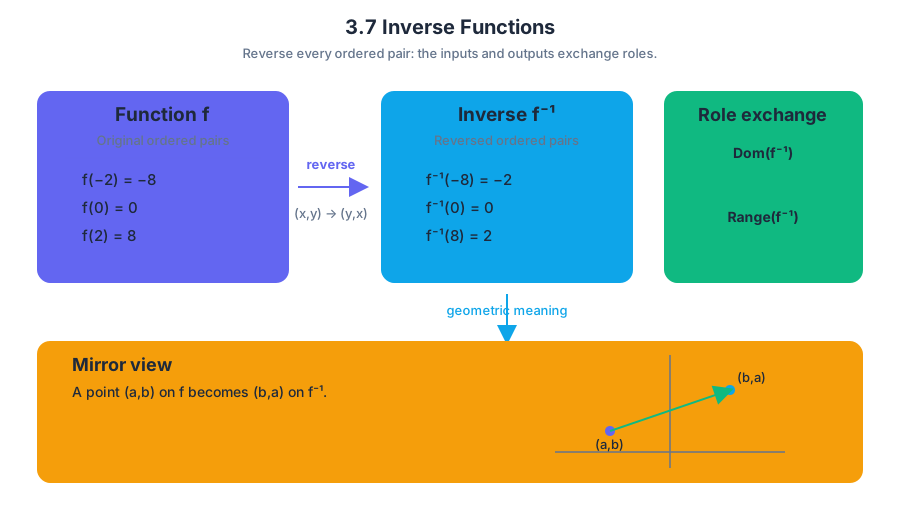
A function can be viewed as a collection of ordered pairs $(x,y)$. The inverse reverses each pair:
$$ (x,y)\longrightarrow(y,x). $$
For example, suppose
$$ f(-2)=-8,\qquad f(0)=0,\qquad f(2)=8. $$
Then the corresponding inverse values are
$$ f^{-1}(-8)=-2,\qquad f^{-1}(0)=0,\qquad f^{-1}(8)=2. $$
The domain and range exchange roles:
$$ \operatorname{Dom}(f^{-1})=\operatorname{Range}(f) $$
and
$$ \operatorname{Range}(f^{-1})=\operatorname{Dom}(f). $$
This exchange is one of the fastest ways to identify the possible domain and range of an inverse.
Geometrically, reversing each ordered pair reflects the graph across the line $y=x$. A point $(a,b)$ on the graph of $f$ becomes the point $(b,a)$ on the graph of $f^{-1}$. The line $y=x$ acts as a mirror:
Example 1: Identify inverse input-output values
Suppose $f$ is one-to-one and
$$ f(4)=7. $$
Find the corresponding input and output values for the inverse function.
Because the inverse reverses the input and output, the ordered pair $(4,7)$ becomes $(7,4)$. Therefore,
$$ f^{-1}(7)=4. $$
The inverse has input $7$ and output $4$.
One-to-one functions
Not every function has an inverse function. The issue is whether reversing the ordered pairs still produces a function. A function must assign exactly one output to each input. Therefore, after the coordinates are reversed, no input of the inverse may be paired with two different outputs.
A function with this property is called one-to-one.
One-to-one function: A function is one-to-one if each output corresponds to at most one input. Equivalently, different inputs produce different outputs:
$$ f(a)=f(b)\implies a=b. $$
For example, consider $f(x)=x^3$. Different inputs always produce different outputs, so $f$ is one-to-one. However, the function $f(x)=x^2$ is not one-to-one over all real numbers because
$$ f(2)=4 $$
and
$$ f(-2)=4. $$
The ordered pairs $(2,4)$ and $(-2,4)$ occur on the original graph. Reversing them produces $(4,2)$ and $(4,-2)$, giving two outputs for the single input $4$. That relation is not a function.
The horizontal line test gives a graphical test for one-to-one behavior: a function is one-to-one if every horizontal line intersects its graph at most once. The graph of $y=x^3$ passes the test, while the graph of $y=x^2$ fails it because a horizontal line such as $y=4$ intersects the parabola twice.
Example 2: Determine whether an inverse exists
Determine whether
$$ f(x)=x^2 $$
has an inverse function when its domain is all real numbers.
Choose two different inputs, $2$ and $-2$:
$$ f(2)=2^2=4 $$
and
$$ f(-2)=(-2)^2=4. $$
Since different inputs produce the same output, $f$ is not one-to-one. Therefore, its inverse relation is not a function, and $f$ has no inverse function on the domain of all real numbers.
Restricting a domain
A function that is not one-to-one on its original domain may become one-to-one if its domain is restricted. For $f(x)=x^2$, restrict the domain to $x\geq 0$. On this half of the parabola, the function is increasing, so each output comes from exactly one input. The restricted function has an inverse.
Alternatively, restricting the domain to $x\leq 0$ also works, but it produces a different inverse. The choice of restriction determines which half of the original graph remains.
Finding an inverse algebraically
To find an inverse formula, use the following procedure.
- Write the function as $y=f(x)$.
- Interchange $x$ and $y$.
- Solve the resulting equation for $y$.
- Rename the resulting function $f^{-1}(x)$.
- Check the result by evaluating both compositions.
Example 3: Find the inverse of a linear function
Find the inverse of
$$ f(x)=3x-5. $$
First write the equation with $y$:
$$ y=3x-5. $$
Interchange $x$ and $y$:
$$ x=3y-5. $$
Solve for $y$ by adding $5$ to both sides:
$$ x+5=3y. $$
Divide both sides by $3$:
$$ \frac{x+5}{3}=y. $$
Rewrite with the function notation:
$$ f^{-1}(x)=\frac{x+5}{3}. $$
Check the first composition:
$$ f\left(f^{-1}(x)\right)
f\left(\frac{x+5}{3}\right). $$
Substitute $\dfrac{x+5}{3}$ into $f(x)=3x-5$:
$$ f\left(\frac{x+5}{3}\right)
3\left(\frac{x+5}{3}\right)-5. $$
Cancel the factor of $3$:
$$ =x+5-5. $$
Simplify:
$$ f\left(f^{-1}(x)\right)=x. $$
Now check the other composition:
$$ f^{-1}(f(x))
f^{-1}(3x-5). $$
Substitute $3x-5$ into $f^{-1}(x)=\dfrac{x+5}{3}$:
$$ f^{-1}(3x-5)
\frac{(3x-5)+5}{3}. $$
Simplify the numerator:
$$ =\frac{3x}{3}. $$
Therefore,
$$ f^{-1}(f(x))=x. $$
Both compositions equal the identity function, so
$$ \boxed{f^{-1}(x)=\frac{x+5}{3}}. $$
Example 4: Find an inverse with a restricted domain
Find the inverse of
$$ f(x)=x^2,\qquad x\geq 0. $$
Write the function as an equation:
$$ y=x^2. $$
Interchange $x$ and $y$:
$$ x=y^2. $$
Take the square root of both sides:
$$ y=\pm\sqrt{x}. $$
The original restriction $x\geq 0$ means the original outputs satisfy $y\geq 0$. Therefore, the inverse must use the nonnegative branch:
$$ y=\sqrt{x}. $$
Hence,
$$ \boxed{f^{-1}(x)=\sqrt{x}}. $$
The domain and range exchange:
$$ \operatorname{Dom}(f)=[0,\infty), \qquad \operatorname{Range}(f)=[0,\infty), $$
so the inverse has the same domain and range in this particular example.
Check the composition:
$$ f(f^{-1}(x))
f(\sqrt{x})
(\sqrt{x})^2
x $$
for $x\geq 0$. Also,
$$ f^{-1}(f(x))
f^{-1}(x^2)
\sqrt{x^2}
|x|. $$
Because the restricted domain requires $x\geq 0$, we have $|x|=x$, so
$$ f^{-1}(f(x))=x. $$
The domain restriction is essential; without it, the final expression would be $|x|$, not $x$ for every real $x$.
Verifying proposed inverse functions
When a candidate function $g$ is proposed as the inverse of $f$, verify both compositions:
$$ f(g(x))=x $$
and
$$ g(f(x))=x. $$
Checking only one composition can overlook a domain issue, so both identities should be tested whenever the domains are relevant.
Example 5: Verify two functions are inverses
Verify that
$$ f(x)=2x+1 $$
and
$$ g(x)=\frac{x-1}{2} $$
are inverse functions.
First calculate $f(g(x))$:
$$ f(g(x))
f\left(\frac{x-1}{2}\right). $$
Substitute into $f(x)=2x+1$:
$$ f\left(\frac{x-1}{2}\right)
2\left(\frac{x-1}{2}\right)+1. $$
Cancel the factor of $2$:
$$ =x-1+1. $$
Simplify:
$$ f(g(x))=x. $$
Now calculate $g(f(x))$:
$$ g(f(x))
g(2x+1). $$
Substitute into $g(x)=\dfrac{x-1}{2}$:
$$ g(2x+1)
\frac{(2x+1)-1}{2}. $$
Simplify the numerator:
$$ =\frac{2x}{2}. $$
Therefore,
$$ g(f(x))=x. $$
Both compositions equal $x$, so $f$ and $g$ are inverses:
$$ \boxed{f^{-1}(x)=g(x)=\frac{x-1}{2}}. $$
Common misconception: inverse versus reciprocal
The expressions $f^{-1}(x)$ and $\dfrac{1}{f(x)}$ represent different ideas. For example, if
$$ f(x)=2x+1, $$
then the inverse function is
$$ f^{-1}(x)=\frac{x-1}{2}, $$
whereas the reciprocal function is
$$ \frac{1}{f(x)}=\frac{1}{2x+1}. $$
The inverse reverses the input-output process. The reciprocal multiplies the output by its multiplicative inverse. A quick diagnostic is composition: inverse functions satisfy $f(f^{-1}(x))=x$, while reciprocals generally do not.
Practice problems
-
If $f(6)=-3$, find $f^{-1}(-3)$.
-
Find the inverse of
$$ f(x)=4x+7. $$
- Determine whether $f(x)=x^2$ has an inverse function when its domain is restricted to $x\leq 0$. If it does, find the inverse.
Answers
- Reverse the input and output:
$$ \boxed{f^{-1}(-3)=6}. $$
- Write $y=4x+7$, interchange $x$ and $y$, and solve:
$$ x=4y+7, $$
$$ x-7=4y, $$
$$ \boxed{f^{-1}(x)=\frac{x-7}{4}}. $$
- On $x\leq 0$, the function is one-to-one. Starting with $y=x^2$, interchange variables and choose the nonpositive branch:
$$ x=y^2, $$
$$ y=-\sqrt{x}. $$
Therefore,
$$ \boxed{f^{-1}(x)=-\sqrt{x}}. $$
The central pattern is consistent: an inverse exists when the original function is one-to-one, its ordered pairs are reversed, its domain and range exchange, its graph reflects across $y=x$, and the two compositions return the identity function.
Content adapted from OpenStax College Algebra 2e by Jay Abramson et al., licensed CC BY 4.0.
Source Materials
Study College Algebra on Lykke
This course page is free to open: signed out, you can read its first two sections, and signing in, on any plan, opens the rest. The free Lykke Chrome extension syncs your own Canvas courses, so ChatGPT, Claude and Muse can answer from your classes and deadlines. It only reads Canvas.
Add the free extensionSign in to open every section