From the free course College Algebra on Lykke
5.7 Inverses and Radical Functions
Key concepts: Inverse functions and inverse notation · Function composition and identity functions · One-to-one functions · Domain and range relationships for inverses · Restricting a function’s domain to obtain an inverse · Inverse relationships for power functions · Square and square-root functions · Cubic and cube-root functions · Finding an inverse algebraically · Reversing ordered pairs and graph relationships
By the end of this section the student can: Find the inverse of an invertible polynomial function; Restrict the domain to find the inverse of a polynomial function
5.7 Inverses and Radical Functions
A function is invertible when its input-output process can be completely undone: if a function turns an input into an output, its inverse turns that output back into the original input. For example, cubing and taking a cube root undo one another:
$$ 2^3=8 \qquad\text{and}\qquad \sqrt[3]{8}=2. $$
The central question is: when can a function be reversed without ambiguity?
Inverse functions and inverse notation
The inverse function of a one-to-one function $f$ is written $f^{-1}$. The notation $f^{-1}$ does not mean the reciprocal $\frac{1}{f(x)}$. Instead, it names a different function that reverses the action of $f$.
If $f$ and $f^{-1}$ are inverse functions, then
$$ f\left(f^{-1}(x)\right)=x $$
and
$$ f^{-1}(f(x))=x $$
on the appropriate domains.
These equations express the idea that inverse functions “undo” one another. The first composition applies $f^{-1}$ and then $f$; the second applies $f$ and then $f^{-1}$. In either order, the final result is the original value.
For example, let
$$ f(x)=x^3 \qquad\text{and}\qquad f^{-1}(x)=\sqrt[3]{x}. $$
Then
$$ f\left(f^{-1}(x)\right)
f\left(\sqrt[3]{x}\right)
\left(\sqrt[3]{x}\right)^3
x, $$
and
$$ f^{-1}(f(x))
f^{-1}(x^3)
\sqrt[3]{x^3}
x. $$
Therefore, $f(x)=x^3$ and $f^{-1}(x)=\sqrt[3]{x}$ are inverse functions.
Function composition and identity functions
Function composition means using one function’s output as another function’s input. The composition of $f$ with $g$ is written
$$ (f\circ g)(x)=f(g(x)). $$
The function applied first is written closest to $x$. Thus, in $f(g(x))$, the function $g$ acts first and $f$ acts second.
The function that leaves every input unchanged is called the identity function. It is commonly written as $I(x)=x$. Inverse functions compose to produce the identity function:
$$ f\circ f^{-1}=I \qquad\text{and}\qquad f^{-1}\circ f=I. $$
This resembles multiplication, where multiplying by $1$ leaves a number unchanged. However, the notation $f^{-1}$ still means inverse function, not reciprocal.
Verifying inverse functions
To verify that two functions are inverses, calculate both compositions. If
$$ f(g(x))=x \qquad\text{and}\qquad g(f(x))=x $$
on the relevant domains, then $f$ and $g$ are inverse functions.
Worked example: verifying inverses
Show that
$$ f(x)=2x+3 \qquad\text{and}\qquad g(x)=\frac{x-3}{2} $$
are inverses.
First compute $f(g(x))$:
$$ f(g(x))
f\left(\frac{x-3}{2}\right). $$
Substitute $\frac{x-3}{2}$ for the input of $f$:
$$ f\left(\frac{x-3}{2}\right)
2\left(\frac{x-3}{2}\right)+3. $$
Cancel the factor of $2$:
$$ 2\left(\frac{x-3}{2}\right)+3
x-3+3
x. $$
Now compute $g(f(x))$:
$$ g(f(x))
g(2x+3). $$
Substitute $2x+3$ for the input of $g$:
$$ g(2x+3)
\frac{(2x+3)-3}{2}. $$
Simplify the numerator:
$$ \frac{(2x+3)-3}{2}
\frac{2x}{2}
x. $$
Since both compositions equal $x$, the functions are inverses.
One-to-one functions
A function must be one-to-one to have an inverse function. A function is one-to-one if each output comes from exactly one input. Equivalently, different inputs must produce different outputs:
$$ x_1\neq x_2 \quad\Longrightarrow\quad f(x_1)\neq f(x_2). $$
A common test is the horizontal line test: a graph represents a one-to-one function if every horizontal line intersects the graph at most once.
For example, the cubic function
$$ f(x)=x^3 $$
is one-to-one because it continually increases. No output is produced by two different inputs.
By contrast, the square function
$$ f(x)=x^2 $$
is not one-to-one on all real numbers. Indeed,
$$ f(2)=2^2=4 \qquad\text{and}\qquad f(-2)=(-2)^2=4. $$
The different inputs $2$ and $-2$ produce the same output. Therefore, reversing $f$ would require deciding whether an output such as $4$ came from $2$ or $-2$.
Domains and ranges of inverse functions
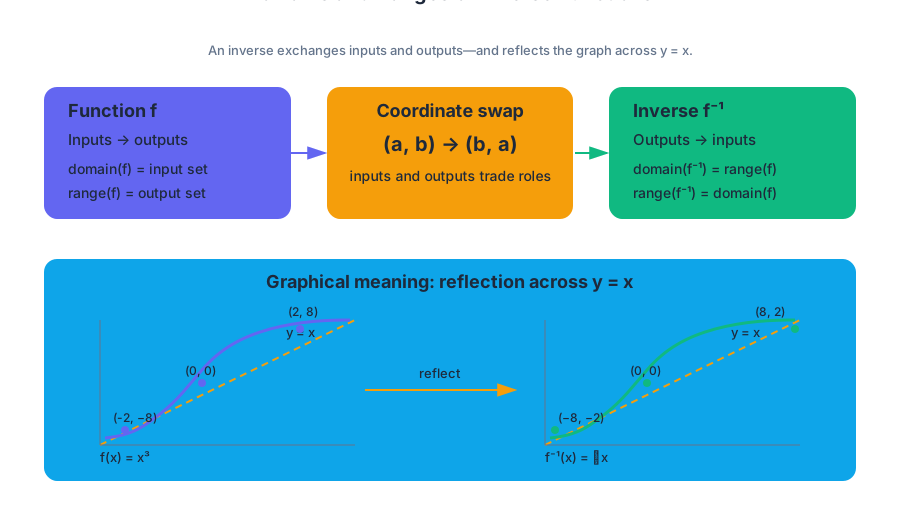
An inverse function interchanges the roles of inputs and outputs. Therefore,
$$ \operatorname{domain}(f^{-1})=\operatorname{range}(f) $$
and
$$ \operatorname{range}(f^{-1})=\operatorname{domain}(f). $$
This exchange also appears in ordered pairs. If $(a,b)$ lies on the graph of $f$, then $(b,a)$ lies on the graph of $f^{-1}$.
For the cube function $f(x)=x^3$, some points are
$$ (-2,-8),\qquad (0,0),\qquad (2,8). $$
Interchanging the coordinates gives points on the inverse graph:
$$ (-8,-2),\qquad (0,0),\qquad (8,2). $$
Graphically, the graph of $f^{-1}$ is the reflection of the graph of $f$ across the line
$$ y=x. $$
Reflection across $y=x$ interchanges horizontal and vertical coordinates, exactly matching the coordinate interchange $(x,y)\mapsto(y,x)$.
Finding an inverse algebraically
The standard algebraic procedure is:
- Write the function as $y=f(x)$.
- Interchange $x$ and $y$.
- Solve the new equation for $y$.
- Rename the resulting function $f^{-1}(x)$.
- State any domain and range restrictions.
Worked example: inverse of a cubic function
Find the inverse of
$$ f(x)=x^3+5. $$
Begin by writing
$$ y=x^3+5. $$
Interchange $x$ and $y$:
$$ x=y^3+5. $$
Solve for $y$:
$$ x-5=y^3. $$
Take the cube root of both sides:
$$ \sqrt[3]{x-5}=\sqrt[3]{y^3}. $$
Therefore,
$$ y=\sqrt[3]{x-5}. $$
Rename the function:
$$ \boxed{f^{-1}(x)=\sqrt[3]{x-5}}. $$
Because the original cubic has domain and range equal to all real numbers, the inverse also has
$$ \operatorname{domain}(f^{-1})=(-\infty,\infty) $$
and
$$ \operatorname{range}(f^{-1})=(-\infty,\infty). $$
Restricting a domain to obtain an inverse
If a function is not one-to-one on its original domain, we can sometimes restrict its domain so that every output occurs exactly once. A domain restriction removes inputs; it does not alter the formula itself.
For the square function $f(x)=x^2$, restricting the domain to
$$ [0,\infty) $$
removes the negative side of the parabola. On this restricted domain, each output has exactly one input, so the function becomes one-to-one.
The restricted function is
$$ f(x)=x^2,\qquad x\geq 0. $$
Its inverse is the principal square-root function:
$$ f^{-1}(x)=\sqrt{x},\qquad x\geq 0. $$
The inverse has domain $[0,\infty)$ because that is the range of the restricted square function. Its range is also $[0,\infty)$ because that is the restricted domain of the original function.
Worked example: restricting a quadratic
Find the inverse of
$$ f(x)=x^2-4,\qquad x\geq 0. $$
Write the equation using $y$:
$$ y=x^2-4. $$
Interchange $x$ and $y$:
$$ x=y^2-4. $$
Add $4$ to both sides:
$$ x+4=y^2. $$
Take the square root:
$$ y=\pm\sqrt{x+4}. $$
Because the original restriction is $x\geq 0$, the original outputs satisfy
$$ y=x^2-4\geq -4. $$
For the inverse, the range must equal the original domain, so the inverse must have range $[0,\infty)$. Therefore, choose the positive branch:
$$ \boxed{f^{-1}(x)=\sqrt{x+4}}. $$
The domain of the inverse is
$$ [-4,\infty), $$
and its range is
$$ [0,\infty). $$
The negative square-root branch is not included because it would produce negative outputs and would not reverse the restricted function.
Inverse relationships for power functions
Power functions provide important inverse pairs. For odd powers, the function is one-to-one on all real numbers:
$$ f(x)=x^3 \qquad\Longleftrightarrow\qquad f^{-1}(x)=\sqrt[3]{x}. $$
More generally, odd-power functions and odd-root functions undo one another:
$$ \left(\sqrt[3]{x}\right)^3=x \qquad\text{and}\qquad \sqrt[3]{x^3}=x. $$
Even-power functions require a domain restriction. The function
$$ f(x)=x^2 $$
must be restricted to either $[0,\infty)$ or $(-\infty,0]$ to become one-to-one. With the restriction $x\geq 0$, its inverse is
$$ f^{-1}(x)=\sqrt{x}. $$
Functions involving roots are called radical functions. The inverse of a quadratic, after a suitable domain restriction, is a square-root function; the inverse of a cubic is a cube-root function.
A rational-function inverse
Restrictions also matter for rational functions because their domains may exclude values that make a denominator zero.
Worked example: inverse of a rational function
Find the inverse of
$$ f(x)=\frac{2x+1}{x-3}. $$
First write
$$ y=\frac{2x+1}{x-3}. $$
Interchange $x$ and $y$:
$$ x=\frac{2y+1}{y-3}. $$
Multiply both sides by $y-3$:
$$ x(y-3)=2y+1. $$
Distribute $x$:
$$ xy-3x=2y+1. $$
Move the terms containing $y$ to one side:
$$ xy-2y=3x+1. $$
Factor out $y$:
$$ y(x-2)=3x+1. $$
Divide by $x-2$:
$$ y=\frac{3x+1}{x-2}. $$
Thus,
$$ \boxed{f^{-1}(x)=\frac{3x+1}{x-2}}. $$
The original function excludes $x=3$, so
$$ \operatorname{domain}(f)=(-\infty,3)\cup(3,\infty). $$
Its range excludes $2$, because solving
$$ 2=\frac{2x+1}{x-3} $$
would lead to the contradiction $-6=1$. Therefore,
$$ \operatorname{range}(f)=(-\infty,2)\cup(2,\infty). $$
Consequently,
$$ \operatorname{domain}(f^{-1})=(-\infty,2)\cup(2,\infty) $$
and
$$ \operatorname{range}(f^{-1})=(-\infty,3)\cup(3,\infty). $$
Common misconception
The most common error is treating $f^{-1}(x)$ as $\frac{1}{f(x)}$. For instance, if
$$ f(x)=x^3, $$
then
$$ f^{-1}(x)=\sqrt[3]{x}, $$
whereas the reciprocal is
$$ \frac{1}{f(x)}=\frac{1}{x^3}. $$
These are entirely different functions. An inverse reverses inputs and outputs; a reciprocal multiplies a nonzero value by its multiplicative inverse.
Practice problems
- Verify that
$$ f(x)=3x-4 \qquad\text{and}\qquad g(x)=\frac{x+4}{3} $$
are inverse functions.
- Find the inverse of
$$ f(x)=\sqrt[3]{x-2}. $$
- Restrict the domain of
$$ f(x)=x^2+1 $$
to $[0,\infty)$, then find its inverse.
Answers
$$ f(g(x))
3\left(\frac{x+4}{3}\right)-4
x+4-4
x, $$
and
$$ g(f(x))
\frac{(3x-4)+4}{3}
\frac{3x}{3}
x. $$
Therefore, the functions are inverses.
- Let
$$ y=\sqrt[3]{x-2}. $$
Interchange $x$ and $y$:
$$ x=\sqrt[3]{y-2}. $$
Cube both sides:
$$ x^3=y-2. $$
Add $2$:
$$ \boxed{f^{-1}(x)=x^3+2}. $$
- With $x\geq 0$,
$$ y=x^2+1. $$
Interchange:
$$ x=y^2+1. $$
Then
$$ x-1=y^2, $$
so
$$ y=\pm\sqrt{x-1}. $$
The inverse must have range $[0,\infty)$, so choose the positive branch:
$$ \boxed{f^{-1}(x)=\sqrt{x-1}}, \qquad x\geq 1. $$
Content adapted from OpenStax College Algebra 2e by Jay Abramson et al., licensed CC BY 4.0.
Source Materials
Study College Algebra on Lykke
This course page is free to open: signed out, you can read its first two sections, and signing in, on any plan, opens the rest. The free Lykke Chrome extension syncs your own Canvas courses, so ChatGPT, Claude and Muse can answer from your classes and deadlines. It only reads Canvas.
Add the free extensionSign in to open every section