From the free course College Algebra on Lykke
9.6 Binomial Theorem
A power such as $(x+3)^5$ looks tedious because multiplying five binomials creates many terms, but its expansion follows a precise pattern: the coefficients come from counting how many ways each power of $x$ and $3$ can be selected.
9.6 Binomial Theorem
A power such as $(x+3)^5$ looks tedious because multiplying five binomials creates many terms, but its expansion follows a precise pattern: the coefficients come from counting how many ways each power of $x$ and $3$ can be selected.
Binomial expansions and Pascal’s triangle
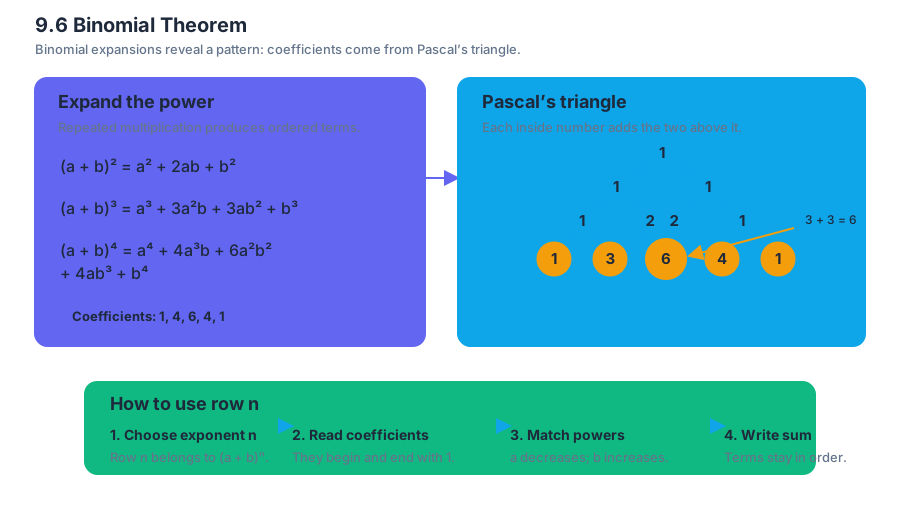
A binomial is a polynomial with two terms, such as $a+b$, $x-2$, or $3x+5$. Expanding a power of a binomial means rewriting it as a sum of individual terms. For small powers, repeated multiplication reveals the pattern:
$$ (a+b)^2=(a+b)(a+b)=a^2+2ab+b^2 $$
$$ (a+b)^3=(a+b)(a+b)(a+b) =a^3+3a^2b+3ab^2+b^3 $$
$$ (a+b)^4=a^4+4a^3b+6a^2b^2+4ab^3+b^4. $$
The numerical coefficients form the rows of Pascal’s triangle:
$$ \begin{array}{ccccccccc} &&&&1&&&&\ &&&1&&1&&&\ &&1&&2&&1&&\ &1&&3&&3&&1&\ 1&&4&&6&&4&&1 \end{array} $$
Each interior entry is obtained by adding the two entries directly above it. For example,
$$ 3+3=6, $$
so the fifth row contains $1,4,6,4,1$. The first and last entry of every row are $1$.
The row used for $(a+b)^n$ is the row corresponding to exponent $n$. Its coefficients appear in order, beginning with $1$ and ending with $1$. The powers of the first term decrease from $n$ to $0$, while the powers of the second term increase from $0$ to $n$.
The Binomial Theorem
The Binomial Theorem gives a direct formula for expanding any nonnegative integer power of a binomial.
Binomial Theorem
For a nonnegative integer $n$,
$$ (a+b)^n=\sum_{k=0}^{n}\binom{n}{k}a^{n-k}b^k. $$
Equivalently, the expansion is
$$ (a+b)^n
\binom{n}{0}a^n +\binom{n}{1}a^{n-1}b +\binom{n}{2}a^{n-2}b^2 +\cdots +\binom{n}{n}b^n. $$
The symbol $\binom{n}{k}$ is read “$n$ choose $k$.” From the counting principles developed earlier, its known formula is
$$ \binom{n}{k}=\frac{n!}{k!(n-k)!}. $$
In practice, the coefficients can be read from Pascal’s triangle or calculated with this formula. The theorem is valuable because it organizes four patterns simultaneously:
- The coefficients are $\binom{n}{0},\binom{n}{1},\ldots,\binom{n}{n}$.
- The exponent of $a$ begins at $n$ and decreases by $1$ each term.
- The exponent of $b$ begins at $0$ and increases by $1$ each term.
- Every term has total degree $n$, because $(n-k)+k=n$.
Expanding a binomial with the theorem
To expand $(a+b)^n$, identify the two terms $a$ and $b$, select the coefficient row for exponent $n$, attach decreasing powers to the first term, attach increasing powers to the second term, and then simplify.
Worked example: expand $(x+2)^4$
The exponent is $4$, so use the coefficients from the fourth row of Pascal’s triangle:
$$ 1,\ 4,\ 6,\ 4,\ 1. $$
The first binomial term is $x$, and the second is $2$. Apply the theorem term by term:
$$ (x+2)^4
\binom{4}{0}x^4(2)^0 +\binom{4}{1}x^3(2)^1 +\binom{4}{2}x^2(2)^2 +\binom{4}{3}x^1(2)^3 +\binom{4}{4}x^0(2)^4. $$
Now substitute the coefficients:
$$ (x+2)^4
1x^4(1) +4x^3(2) +6x^2(4) +4x(8) +1(16). $$
Simplify each term:
$$ 1x^4(1)=x^4, $$
$$ 4x^3(2)=8x^3, $$
$$ 6x^2(4)=24x^2, $$
$$ 4x(8)=32x, $$
$$ 1(16)=16. $$
Therefore,
$$ \boxed{(x+2)^4=x^4+8x^3+24x^2+32x+16}. $$
A useful check is that the expansion contains $n+1=5$ terms, begins with $x^4$, ends with $2^4=16$, and has degree $4$ in every term.
Expanding a binomial involving subtraction
A subtraction can be treated as addition of a negative quantity. For example,
$$ (x-3)^5=(x+(-3))^5. $$
The powers of $-3$ automatically create alternating signs. This is safer than trying to remember a separate subtraction formula.
Worked example: expand $(2x-1)^3$
Here the first term is $2x$, the second term is $-1$, and the exponent is $3$. The coefficients are
$$ 1,\ 3,\ 3,\ 1. $$
Apply the theorem:
$$ (2x-1)^3
\binom{3}{0}(2x)^3(-1)^0 +\binom{3}{1}(2x)^2(-1)^1 +\binom{3}{2}(2x)^1(-1)^2 +\binom{3}{3}(2x)^0(-1)^3. $$
Evaluate the powers and coefficients:
$$ (2x-1)^3
1(8x^3)(1) +3(4x^2)(-1) +3(2x)(1) +1(1)(-1). $$
Simplify each product:
$$ 1(8x^3)(1)=8x^3, $$
$$ 3(4x^2)(-1)=-12x^2, $$
$$ 3(2x)(1)=6x, $$
$$ 1(1)(-1)=-1. $$
Thus,
$$ \boxed{(2x-1)^3=8x^3-12x^2+6x-1}. $$
The signs alternate here because the second term is negative and its powers alternate:
$$ (-1)^0=1,\qquad (-1)^1=-1,\qquad (-1)^2=1,\qquad (-1)^3=-1. $$
A common misconception is that the signs always alternate in every binomial expansion. They do not. Alternation occurs when the second binomial term is negative; if both terms are positive, every term in the expansion is positive.
Finding a particular term
The theorem also identifies an individual term without requiring the entire expansion. The term associated with a particular value of $k$ is
$$ T_{k+1}=\binom{n}{k}a^{n-k}b^k. $$
The index is $k+1$ because $k=0$ produces the first term, $k=1$ produces the second term, and so on.
Worked example: find the fourth term of $(x+2)^6$
The fourth term corresponds to $k+1=4$, so
$$ k=3. $$
Use $a=x$, $b=2$, and $n=6$ in the general term:
$$ T_4=\binom{6}{3}x^{6-3}2^3. $$
Using the known coefficient,
$$ \binom{6}{3}=20, $$
so
$$ T_4=20x^3(8). $$
Therefore,
$$ \boxed{T_4=160x^3}. $$
Structural checks and exam strategy
Before accepting an expansion, check its structure. The expansion of $(a+b)^n$ must have exactly $n+1$ terms. The powers of the first term must decrease by $1$, the powers of the second term must increase by $1$, and the total degree of each term must equal $n$. The first term is $a^n$, and the final term is $b^n$.
For example, an attempted expansion of $(x+1)^4$ with a term such as $6x^3$ is structurally suspicious: the coefficient row is correct, but the power pattern is not. The correct pattern is
$$ x^4,\quad x^3,\quad x^2,\quad x,\quad 1, $$
so
$$ (x+1)^4=x^4+4x^3+6x^2+4x+1. $$
The theorem is especially useful in later probability calculations because binomial coefficients count the ways particular outcomes can occur. Here, however, the immediate algebraic purpose is to expand powers quickly and accurately without multiplying every factor separately.
Practice
-
Expand $(x+3)^3$.
-
Expand $(2x-1)^4$.
-
Find the fifth term of $(x-2)^7$.
Answers
$$ \boxed{(x+3)^3=x^3+9x^2+27x+27} $$
$$ \boxed{(2x-1)^4=16x^4-32x^3+24x^2-8x+1} $$
- The fifth term uses $k+1=5$, so $k=4$:
$$ T_5=\binom{7}{4}x^{7-4}(-2)^4 =35x^3(16) =\boxed{560x^3}. $$
Content adapted from OpenStax College Algebra 2e by Jay Abramson et al., licensed CC BY 4.0.
Source Materials
Study College Algebra on Lykke
This course page is free to open: signed out, you can read its first two sections, and signing in, on any plan, opens the rest. The free Lykke Chrome extension syncs your own Canvas courses, so ChatGPT, Claude and Muse can answer from your classes and deadlines. It only reads Canvas.
Add the free extensionSign in to open every section