From the free course College Algebra on Lykke
7.3 Systems of Nonlinear Equations and Inequalities: Two Variables
Key concepts: Solving systems of nonlinear equations in two variables · Using substitution to reduce a nonlinear system to a single equation · Interpreting solutions of a system as intersection points of graphs · Graphing points in the coordinate plane using their x- and y-coordinates · Solving resulting quadratic equations · Applying the zero-product property by setting each factor equal to zero · Using the discriminant to determine the number and type of quadratic solutions · Checking proposed solutions in the original equation, especially after squaring radical equations · Solving equations in quadratic form containing a binomial · Modeling geometric situations such as rectangular patio dimensions with nonlinear equations
By the end of this section the student can: Solve a system of nonlinear equations using substitution; Solve a system of nonlinear equations using elimination; Graph a nonlinear inequality; Graph a system of nonlinear inequalities
7.3 Systems of Nonlinear Equations and Inequalities: Two Variables
Two curves can meet at several points, one point, or no points at all, so a system of nonlinear equations may have more than one solution. Algebra identifies those points exactly; graphs reveal their geometric meaning.
Solutions as common points
A system of equations is a collection of equations considered simultaneously. A solution to a system in two variables is an ordered pair $(x,y)$ that makes every equation true. For example, if $(2,3)$ satisfies the first equation but not the second, it is not a solution of the system.
Graphically, each equation describes a curve in the coordinate plane. The solutions of the system are precisely the intersection points of the curves. When graphing an ordered pair $(x,y)$, use the $x$-coordinate first: move horizontally from the origin, then use the $y$-coordinate to move vertically. Reversing these coordinates can place the point in an entirely different location.
The solutions of a two-variable system are the ordered pairs that lie on every graph in the system—that is, the common intersection points.
Solving a nonlinear system by substitution
The substitution method solves one equation for one variable and replaces that variable in the other equation. For nonlinear systems, this substitution often produces a quadratic equation. After solving for one coordinate, substitute each result back into an original equation to find the other coordinate.
Consider the system
$$ \begin{cases} y=x^2+1\ x+y=7 \end{cases} $$
The first equation already gives $y$ in terms of $x$, so substitute $x^2+1$ for $y$ in the second equation:
$$ x+y=7 $$
$$ x+(x^2+1)=7 $$
Reorder the terms:
$$ x^2+x+1=7 $$
Subtract $7$ from both sides:
$$ x^2+x-6=0 $$
Factor:
$$ (x+3)(x-2)=0 $$
Applying the zero-product property
The zero-product property states that if a product equals zero, then at least one factor must equal zero:
$$ ab=0 \quad \Longrightarrow \quad a=0 \text{ or } b=0. $$
Apply it to the factored quadratic:
$$ (x+3)(x-2)=0 $$
Set each factor equal to zero:
$$ x+3=0 $$
$$ x=-3 $$
or
$$ x-2=0 $$
$$ x=2 $$
Now substitute each $x$-value into $y=x^2+1$.
For $x=-3$:
$$ y=(-3)^2+1 $$
$$ y=9+1 $$
$$ y=10 $$
This gives the ordered pair $(-3,10)$.
For $x=2$:
$$ y=2^2+1 $$
$$ y=4+1 $$
$$ y=5 $$
This gives the ordered pair $(2,5)$.
Therefore, the system has two solutions:
$$ \boxed{(-3,10)\text{ and }(2,5)} $$
Each ordered pair must satisfy both original equations. The first coordinates arise from the quadratic, while substitution supplies the corresponding second coordinates.
Interpreting the solutions graphically
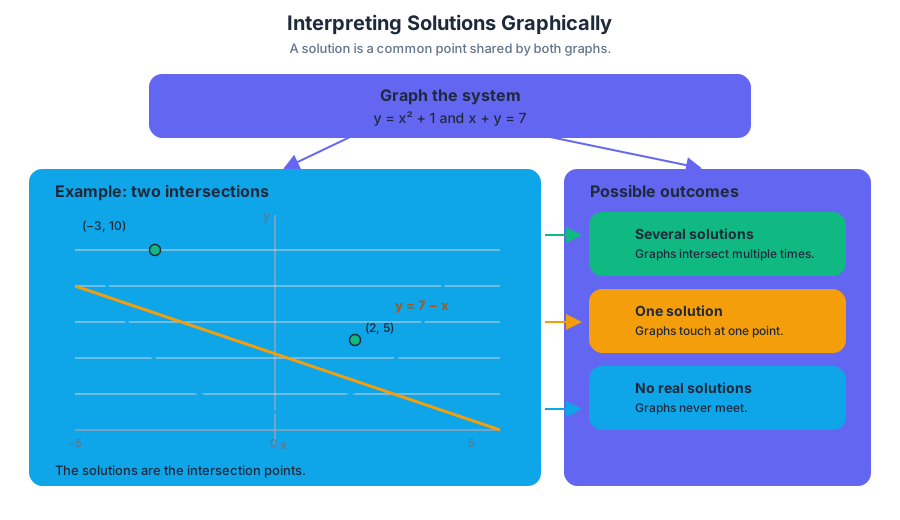
The equation $y=x^2+1$ is an upward-opening parabola, and the equation $x+y=7$, or $y=7-x$, is a line. The two solutions $(-3,10)$ and $(2,5)$ are the two points where the parabola and line intersect. The algebra does not merely produce numbers; it locates the common points of the graphs.
A nonlinear system can have different numbers of real solutions:
- Two graphs may intersect at several points, producing multiple solutions.
- They may touch at one point, producing one solution.
- They may never meet, producing no real solutions.
Using the discriminant before solving
After substitution, a system often leads to a quadratic equation
$$ ax^2+bx+c=0, $$
where $a\neq 0$. The discriminant
$$ \Delta=b^2-4ac $$
predicts the number and nature of the real solutions without requiring the quadratic formula to be completed.
Its interpretation is:
- If $\Delta>0$, the quadratic has two distinct real solutions.
- If $\Delta=0$, the quadratic has one repeated real solution.
- If $\Delta<0$, the quadratic has no real solutions.
For the quadratic from the preceding system,
$$ x^2+x-6=0, $$
we have $a=1$, $b=1$, and $c=-6$. Therefore,
$$ \Delta=b^2-4ac $$
$$ \Delta=1^2-4(1)(-6) $$
$$ \Delta=1+24 $$
$$ \Delta=25 $$
Since $\Delta>0$, the graphs must have two distinct intersection points, which agrees with the two solutions found by factoring.
A system with four solutions
Some nonlinear systems produce more than two intersections. Consider
$$ \begin{cases} x^2+y^2=26\ \dfrac{x^2}{25}+y^2=2 \end{cases} $$
Solve the second equation for $y^2$:
$$ y^2=2-\frac{x^2}{25} $$
Substitute this expression into the first equation:
$$ x^2+\left(2-\frac{x^2}{25}\right)=26 $$
Distribute and combine like terms:
$$ x^2+2-\frac{x^2}{25}=26 $$
Subtract $2$:
$$ x^2-\frac{x^2}{25}=24 $$
Write $x^2$ with denominator $25$:
$$ \frac{25x^2}{25}-\frac{x^2}{25}=24 $$
$$ \frac{24x^2}{25}=24 $$
Multiply by $25$:
$$ 24x^2=600 $$
Divide by $24$:
$$ x^2=25 $$
Thus,
$$ x=5 \quad \text{or} \quad x=-5. $$
For either value of $x$, use $y^2=2-\frac{x^2}{25}$:
$$ y^2=2-\frac{25}{25} $$
$$ y^2=1 $$
Therefore,
$$ y=1 \quad \text{or} \quad y=-1. $$
Combining the possible coordinates gives
$$ \boxed{(5,1),(5,-1),(-5,1),(-5,-1)}. $$
The equations represent two ellipses, and these four ordered pairs are their four intersection points. This example shows why every possible value of $y$ must be considered when solving an equation involving $y^2$.
Radical equations and extraneous solutions
Substitution can also produce radical equations. Squaring both sides may be necessary, but squaring is not a reversible operation in every situation. It can introduce an extraneous solution, which is a proposed solution that satisfies the transformed equation but not the original equation. Consequently, every candidate must be checked in the original system or original equation.
Solve
$$ \sqrt{15-2x}=x. $$
Square both sides:
$$ \left(\sqrt{15-2x}\right)^2=x^2 $$
$$ 15-2x=x^2 $$
Move every term to one side:
$$ 0=x^2+2x-15 $$
Factor:
$$ 0=(x+5)(x-3) $$
$$ x+5=0 \quad \text{or} \quad x-3=0 $$
$$ x=-5 \quad \text{or} \quad x=3. $$
Check $x=-5$ in the original equation:
$$ \sqrt{15-2(-5)}=-5 $$
$$ \sqrt{25}=-5 $$
$$ 5\neq -5. $$
Thus, $x=-5$ is extraneous.
Check $x=3$:
$$ \sqrt{15-2(3)}=3 $$
$$ \sqrt{9}=3 $$
$$ 3=3. $$
Therefore, the valid solution is
$$ \boxed{x=3}. $$
Modeling a rectangle with a system
Geometric information becomes a system when two facts describe the same dimensions. Suppose a rectangle has perimeter $34$ units, and its length is $5$ units greater than its width. Let $L$ represent the length and $W$ represent the width.
Translate the perimeter statement:
$$ 2L+2W=34. $$
Translate the difference statement:
$$ L-W=5. $$
Solve the second equation for $L$:
$$ L=W+5. $$
Substitute into the perimeter equation:
$$ 2(W+5)+2W=34 $$
Distribute:
$$ 2W+10+2W=34 $$
Combine like terms:
$$ 4W+10=34 $$
Subtract $10$:
$$ 4W=24 $$
Divide by $4$:
$$ W=6. $$
Substitute into $L=W+5$:
$$ L=6+5 $$
$$ L=11. $$
The dimensions are
$$ \boxed{L=11\text{ units},\quad W=6\text{ units}}. $$
Check the context:
$$ 2(11)+2(6)=22+12=34, $$
and
$$ 11-6=5. $$
Both conditions hold, and both dimensions are positive, so the solution is meaningful.
Practice problems
Solve each system or application. For systems, give every ordered-pair solution.
1. Solve by substitution:
$$ \begin{cases} y=2x+5\ y=x^2+3 \end{cases} $$
Answer:
Set the expressions for $y$ equal:
$$ 2x+5=x^2+3 $$
$$ x^2-2x-2=0. $$
The quadratic formula gives
$$ x=\frac{2\pm\sqrt{(-2)^2-4(1)(-2)}}{2} $$
$$ x=\frac{2\pm\sqrt{12}}{2} $$
$$ x=1\pm\sqrt{3}. $$
Using $y=2x+5$ produces
$$ \boxed{(1+\sqrt{3},,7+2\sqrt{3})} $$
and
Both quadratic roots produce valid solutions.
2. Determine the number of real solutions without solving:
$$ \begin{cases} y=x^2+4x+1\ y=2 \end{cases} $$
Answer:
Set the equations equal:
$$ x^2+4x+1=2 $$
$$ x^2+4x-1=0. $$
The discriminant is
$$ \Delta=4^2-4(1)(-1)=20>0. $$
Therefore, the system has $\boxed{2}$ real solutions.
3. A rectangle has perimeter $50$ units, and its length is $7$ units greater than its width. Find its dimensions.
Answer:
$$ 2L+2W=50,\qquad L=W+7. $$
Substitution gives
$$ 2(W+7)+2W=50 $$
$$ 4W+14=50 $$
$$ W=9,\qquad L=16. $$
The dimensions are $\boxed{16\text{ units by }9\text{ units}}$.
Content adapted from OpenStax College Algebra 2e by Jay Abramson et al., licensed CC BY 4.0.
Source Materials
Study College Algebra on Lykke
This course page is free to open: signed out, you can read its first two sections, and signing in, on any plan, opens the rest. The free Lykke Chrome extension syncs your own Canvas courses, so ChatGPT, Claude and Muse can answer from your classes and deadlines. It only reads Canvas.
Add the free extensionSign in to open every section