From the free course College Algebra on Lykke
5.1 Quadratic Functions
Key concepts: Quadratic functions · Parabolas and their orientation · Vertex form · The vertex of a parabola · Maximum and minimum values · Domain and range of quadratic functions · Transformations of the parent function y=x^2 · Effect of the coefficient a · Applications involving area and projectile motion
By the end of this section the student can: Recognize characteristics of parabolas; Understand how the graph of a parabola is related to its quadratic function; Determine a quadratic function’s minimum or maximum value; Solve problems involving a quadratic function’s minimum or maximum value
5.1 Quadratic Functions
A ball launched into the air, the area of a garden with a fixed perimeter, and the revenue from selling a product can all be modeled by a quadratic function. Its graph is a smooth, symmetric curve called a parabola, and its most important point—the vertex—reveals a maximum or minimum value.
A quadratic function is a polynomial function of degree $2$. In general form, it is written as
$$ f(x)=ax^2+bx+c,\qquad a\ne 0. $$
The coefficient $a$ determines whether the parabola opens upward or downward. The coefficients $b$ and $c$ affect the location of the parabola. The constant $c$ is the vertical intercept because
$$ f(0)=a(0)^2+b(0)+c=c. $$
Recognizing Characteristics of Parabolas
A parabola is the graph of a quadratic function. Every parabola has a line of symmetry, called the axis of symmetry, that divides the graph into two mirror-image halves. The point where the parabola changes direction is its vertex.
The standard form of a quadratic function is
$$ f(x)=ax^2+bx+c. $$
For $a>0$, the parabola opens upward and its vertex is the lowest point. For $a<0$, the parabola opens downward and its vertex is the highest point.
The vertex form of a quadratic function is
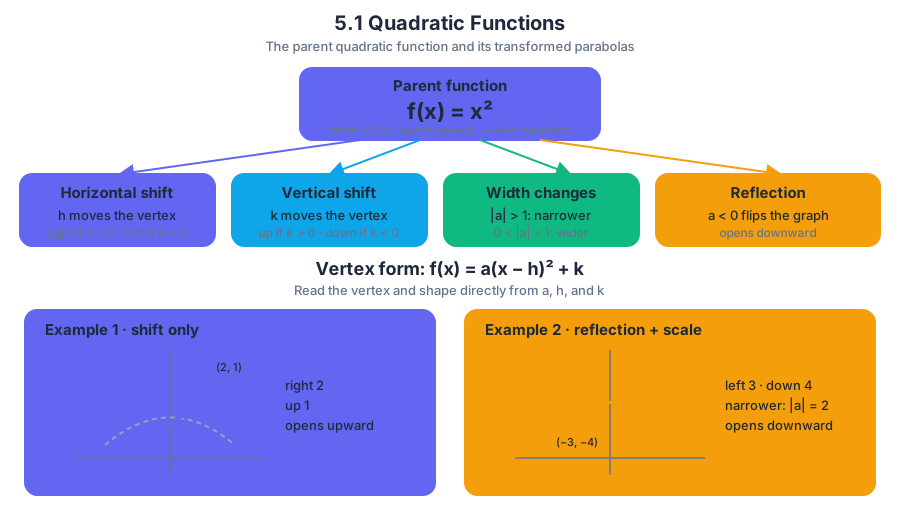
$$ f(x)=a(x-h)^2+k. $$
In this form, the vertex is
$$ (h,k), $$
and the axis of symmetry is
$$ x=h. $$
The parent quadratic function is
$$ f(x)=x^2. $$
Its graph has vertex $(0,0)$, axis of symmetry $x=0$, and opens upward. The value of $a$ controls the orientation and width:
- If $a>0$, the parabola opens upward.
- If $a<0$, the parabola opens downward.
- If $\lvert a\rvert>1$, the parabola is narrower than $y=x^2$.
- If $0<\lvert a\rvert<1$, the parabola is wider than $y=x^2$.
A common misconception is that the sign of $b$ determines whether the parabola opens upward or downward. It does not. Only the sign of $a$, the coefficient of $x^2$, determines the orientation.
Example: Recognizing a Parabola’s Characteristics
Find the vertex, axis of symmetry, orientation, and vertical intercept of
$$ f(x)=2x^2-12x+7. $$
First identify the coefficients in standard form:
$$ a=2,\qquad b=-12,\qquad c=7. $$
Because
$$ a=2>0, $$
the parabola opens upward.
Find the $x$-coordinate of the vertex using
$$ h=-\frac{b}{2a}. $$
Substitute $a=2$ and $b=-12$:
$$ h=-\frac{-12}{2(2)}. $$
Simplify the numerator:
$$ h=\frac{12}{4}. $$
Therefore,
$$ h=3. $$
Now find the corresponding $y$-coordinate by evaluating $f(3)$:
$$ f(3)=2(3)^2-12(3)+7. $$
Evaluate the exponent:
$$ f(3)=2(9)-12(3)+7. $$
Multiply:
$$ f(3)=18-36+7. $$
Combine the terms:
$$ f(3)=-11. $$
Thus, the vertex is
$$ (3,-11). $$
The axis of symmetry is the vertical line through the vertex:
$$ x=3. $$
The vertical intercept is found by setting $x=0$:
$$ f(0)=2(0)^2-12(0)+7=7. $$
Therefore, the vertical intercept is
$$ (0,7). $$
The completed characteristics are: the parabola opens upward, its vertex is $(3,-11)$, its axis of symmetry is $x=3$, and its vertical intercept is $(0,7)$.
Understanding How the Graphs of Parabolas are Related to Their Quadratic Functions
The vertex form
$$ f(x)=a(x-h)^2+k $$
makes the graph’s transformations visible. Starting with the parent function $y=x^2$:
- $h$ shifts the graph horizontally.
- $k$ shifts the graph vertically.
- $a$ stretches, compresses, or reflects the graph.
The expression $(x-h)$ shifts the graph right by $h$ units when $h>0$ and left by $\lvert h\rvert$ units when $h<0$. The value $k$ shifts the graph up when $k>0$ and down when $k<0$.
The horizontal shift can appear counterintuitive because the sign inside the parentheses is opposite the direction stated outside. For example,
$$ y=(x-4)^2 $$
has vertex $(4,0)$ and is shifted right $4$ units, whereas
$$ y=(x+4)^2=(x-(-4))^2 $$
has vertex $(-4,0)$ and is shifted left $4$ units.
The parameter $a$ changes the shape. If $a<0$, multiplication by a negative number reflects the graph across the $x$-axis. If $\lvert a\rvert>1$, the graph becomes narrower; if $0<\lvert a\rvert<1$, it becomes wider.
Example: Writing and Interpreting Vertex Form
Rewrite
$$ f(x)=x^2-6x+11 $$
in vertex form, then identify the vertex, axis of symmetry, and orientation.
Group the quadratic and linear terms:
$$ f(x)=x^2-6x+11. $$
Complete the square for $x^2-6x$. Take half of $-6$:
$$ \frac{-6}{2}=-3. $$
Square this number:
$$ (-3)^2=9. $$
Add and subtract $9$ inside the expression:
$$ f(x)=x^2-6x+9-9+11. $$
The first three terms form a perfect square:
$$ x^2-6x+9=(x-3)^2. $$
Therefore,
$$ f(x)=(x-3)^2-9+11. $$
Combine the constants:
$$ f(x)=(x-3)^2+2. $$
The vertex form is
$$ f(x)=(x-3)^2+2. $$
Comparing this with
$$ f(x)=a(x-h)^2+k, $$
we have
$$ a=1,\qquad h=3,\qquad k=2. $$
Thus, the vertex is
$$ (3,2), $$
$$ x=3. $$
Because
$$ a=1>0, $$
the parabola opens upward. It has the same width and shape as the parent function $y=x^2$, shifted right $3$ units and up $2$ units.
Finding the Domain and Range of a Quadratic Function
The domain is the set of all permitted input values, and the range is the set of all resulting output values. Every quadratic function has domain
$$ (-\infty,\infty), $$
because every real number can be substituted for $x$.
The range depends on the vertex and the orientation of the parabola. For
$$ f(x)=a(x-h)^2+k, $$
the squared quantity satisfies
$$ (x-h)^2\ge 0. $$
Therefore, if $a>0$, then
$$ a(x-h)^2\ge 0, $$
so
$$ f(x)=a(x-h)^2+k\ge k. $$
The range is
$$ [k,\infty). $$
If $a<0$, then
$$ a(x-h)^2\le 0, $$
so
$$ f(x)=a(x-h)^2+k\le k. $$
The range is
$$ (-\infty,k]. $$
To find the domain and range of a quadratic function:
- State that the domain is all real numbers.
- Find the vertex, either from vertex form or by calculating $$ h=-\frac{b}{2a}. $$
- Find the vertex’s output value $k=f(h)$ if necessary.
- Use the sign of $a$ to determine whether the vertex gives a minimum or maximum.
- Write the range using an inequality or interval notation.
Example: Finding the Domain and Range
Find the domain and range of
$$ f(x)=-5x^2+9x-1. $$
Because this is a polynomial function, its domain is all real numbers:
$$ \text{Domain}=(-\infty,\infty). $$
Identify the coefficients:
$$ a=-5,\qquad b=9,\qquad c=-1. $$
Since
$$ a=-5<0, $$
the parabola opens downward. Therefore, its vertex gives the maximum value.
Find the $x$-coordinate of the vertex:
$$ h=-\frac{b}{2a}. $$
Substitute $b=9$ and $a=-5$:
$$ h=-\frac{9}{2(-5)}. $$
Multiply in the denominator:
$$ h=-\frac{9}{-10}. $$
A negative divided by a negative is positive:
$$ h=\frac{9}{10}. $$
Evaluate the function at $h=\frac{9}{10}$:
$$ f\left(\frac{9}{10}\right) =-5\left(\frac{9}{10}\right)^2 +9\left(\frac{9}{10}\right)-1. $$
Square the fraction:
$$ f\left(\frac{9}{10}\right) =-5\left(\frac{81}{100}\right) +\frac{81}{10}-1. $$
Multiply:
$$ f\left(\frac{9}{10}\right) =-\frac{405}{100} +\frac{81}{10}-1. $$
Reduce $\frac{405}{100}$:
$$ f\left(\frac{9}{10}\right) =-\frac{81}{20} +\frac{81}{10}-1. $$
Rewrite all terms with denominator $20$:
$$ f\left(\frac{9}{10}\right) =-\frac{81}{20} +\frac{162}{20} -\frac{20}{20}. $$
Combine the numerators:
$$ f\left(\frac{9}{10}\right) =\frac{-81+162-20}{20} =\frac{61}{20}. $$
The vertex is
$$ \left(\frac{9}{10},\frac{61}{20}\right). $$
Because the parabola opens downward, its maximum output is $\frac{61}{20}$. Therefore,
$$ \text{Range}=\left(-\infty,\frac{61}{20}\right], $$
or equivalently,
$$ f(x)\le \frac{61}{20}. $$
Determining the Maximum and Minimum Values of Quadratic Functions
The output of a quadratic function at its vertex is the function’s maximum or minimum value, depending on the parabola’s orientation.
For
$$ f(x)=a(x-h)^2+k, $$
the vertex is $(h,k)$. If $a>0$, the parabola opens upward, so $k$ is the minimum value. If $a<0$, the parabola opens downward, so $k$ is the maximum value.
When a quadratic function is given in standard form,
$$ f(x)=ax^2+bx+c, $$
find the vertex’s horizontal coordinate with
$$ h=-\frac{b}{2a}, $$
and then calculate
$$ k=f(h). $$
The resulting value $k$ is the maximum or minimum output.
In applications, the variable may represent a quantity such as time, length, or number of items. The mathematical maximum or minimum is meaningful only if it occurs within the allowed real-world domain. For example, a time variable may be restricted to $t\ge 0$, even though the quadratic function itself has domain all real numbers.
Example: Finding a Maximum in an Application
Suppose the height of a launched object is modeled by
$$ h(t)=-16t^2+64t+5, $$
where $t$ is time in seconds and $h(t)$ is height in feet. Find the maximum height.
The coefficients are
$$ a=-16,\qquad b=64,\qquad c=5. $$
Since
$$ a=-16<0, $$
the parabola opens downward, so the vertex gives the maximum height.
Find the time at which the maximum occurs:
$$ t=-\frac{b}{2a}. $$
Substitute $b=64$ and $a=-16$:
$$ t=-\frac{64}{2(-16)}. $$
Multiply the denominator:
$$ t=-\frac{64}{-32}. $$
Simplify:
$$ t=2. $$
Evaluate the height at $t=2$:
$$ h(2)=-16(2)^2+64(2)+5. $$
Evaluate the exponent:
$$ h(2)=-16(4)+128+5. $$
Multiply:
$$ h(2)=-64+128+5. $$
Combine the terms:
$$ h(2)=69. $$
The maximum height is
$$ 69\text{ feet}, $$
and it occurs at
$$ t=2\text{ seconds}. $$
The vertex is therefore
$$ (2,69). $$
The key distinction is between the input where the extremum occurs and the extremal output itself. Here, $t=2$ is the time of the maximum, while $h=69$ is the maximum height.
Practice Problems and Answers
-
Rewrite $$ f(x)=x^2+8x+3 $$ in vertex form. Identify the vertex and axis of symmetry.
Answer: $$ f(x)=(x+4)^2-13. $$ The vertex is $$ (-4,-13), $$ and the axis of symmetry is $$ x=-4. $$
-
Find the domain and range of $$ f(x)=3(x-2)^2-5. $$
Answer:
The domain is
$$ (-\infty,\infty). $$
Since $a=3>0$, the parabola opens upward and has minimum value $-5$. The range is
$$ [-5,\infty). $$
-
Find the maximum value of $$ f(x)=-2x^2+12x-7. $$
Answer:
The vertex’s horizontal coordinate is
$$ x=-\frac{12}{2(-2)}=3. $$
Evaluate:
$$ f(3)=-2(3)^2+12(3)-7 =-18+36-7 =11. $$
The maximum value is
$$ 11, $$
occurring at
$$ x=3. $$
Content adapted from OpenStax College Algebra 2e by Jay Abramson et al., licensed CC BY 4.0.
Source Materials
Study College Algebra on Lykke
This course page is free to open: signed out, you can read its first two sections, and signing in, on any plan, opens the rest. The free Lykke Chrome extension syncs your own Canvas courses, so ChatGPT, Claude and Muse can answer from your classes and deadlines. It only reads Canvas.
Add the free extensionSign in to open every section