From the free course College Algebra on Lykke
1.1 Real Numbers: Algebra Essentials
Key concepts: Natural (counting) numbers · Integers and opposites · Rational numbers · Terminating and repeating decimals · Irrational numbers · Real numbers · Subsets and classification of number systems · Positive, negative, and zero real numbers · Evaluating algebraic expressions · Simplifying algebraic expressions
By the end of this section the student can: Classify a real number as a natural, whole, integer, rational, or irrational number; Perform calculations using order of operations; Use the following properties of real numbers: commutative, associative, distributive, inverse, and identity; Evaluate algebraic expressions; Simplify algebraic expressions
1.1 Real Numbers: Algebra Essentials
Every measurement, price, temperature, distance, and algebraic quantity belongs somewhere on the real number line. The central question is not merely what value does a number have? but also what kind of number is it? Classifying numbers reveals which operations and representations are available.
The hierarchy of number systems
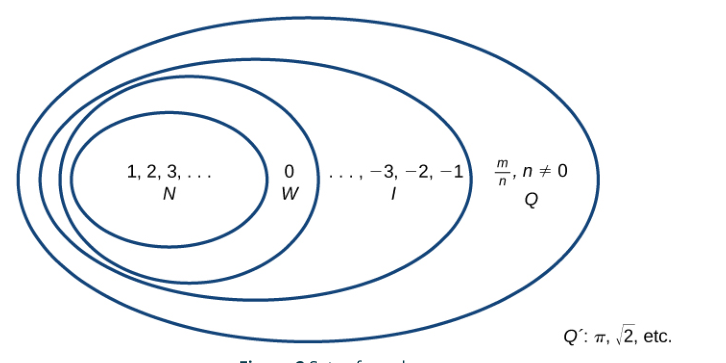
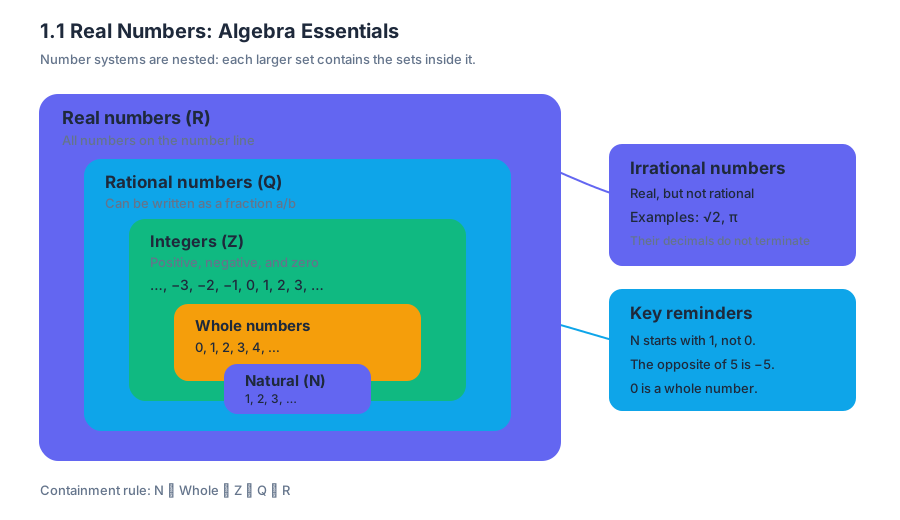
The number systems are nested: natural numbers belong to the integers, integers belong to the rational numbers, and rational numbers belong to the real numbers. Irrational numbers are also real numbers, but they do not belong to the rational-number system.
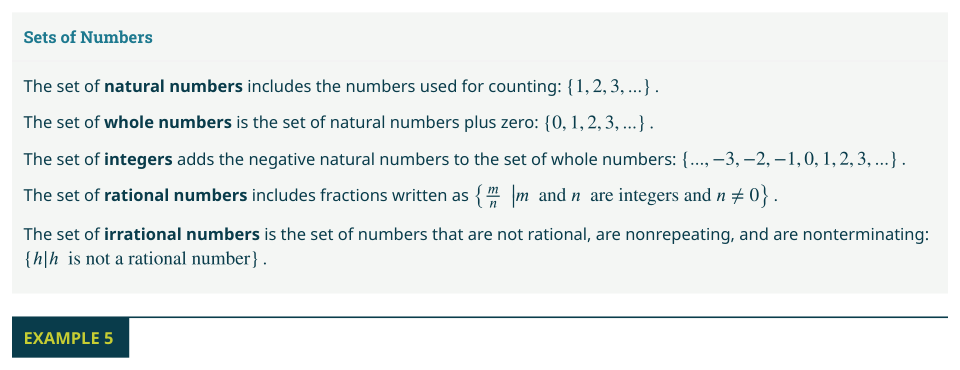
Natural numbers are the counting numbers:
$$ 1,2,3,4,\ldots $$
The natural numbers are commonly denoted by $N$. They begin with $1$, not $0$. In this classification, $0$ is not a natural number.
Whole numbers consist of the natural numbers together with $0$:
$$ 0,1,2,3,4,\ldots $$
Although the main focus here is the broader real-number system, whole numbers help show how the sets are nested.
Integers include the positive counting numbers, $0$, and their opposites, called negative integers:
$$ \ldots,-3,-2,-1,0,1,2,3,\ldots $$
The opposite of $5$ is $-5$, and the opposite of $-5$ is $5$. Zero is its own opposite because the number exactly halfway between a number and its opposite is $0$.
Key relationship: Every natural number is an integer, but not every integer is a natural number. For example, $7$ is both natural and integer, while $-7$ is an integer but not a natural number.
Worked example: Writing an integer as a rational number
Any integer can be written as a fraction with denominator $1$. This demonstrates that every integer is rational.
Write $-6$ as a rational number:
$$ -6=\frac{-6}{1} $$
Both $-6$ and $1$ are integers, and the denominator is nonzero. Therefore,
$$ -6\text{ is rational.} $$
Rational numbers
A rational number is any number that can be expressed as a fraction of two integers with a nonzero denominator:
$$ \frac{m}{n}, \qquad m,n\in\mathbb{Z},\qquad n\neq 0. $$
The letter $Q$ is often used for the set of rational numbers. The requirement $n\neq 0$ matters because division by zero is undefined.
Rational numbers include integers, because an integer $k$ can always be written as $\frac{k}{1}$. They also include ordinary fractions such as $\frac{3}{4}$, negative fractions such as $-\frac{5}{9}$, and decimals such as $2.75$ and $0.363636\ldots$.
Terminating and repeating decimals
Every rational number has a decimal representation that either terminates or repeats. A terminating decimal ends after a finite number of digits. A repeating decimal contains a block of digits that continues forever.
For example,
$$ \frac{15}{8}=1.875 $$
is terminating, while
$$ \frac{4}{11}=0.363636\ldots $$
is repeating. The repeating block is written with a bar:
$$ 0.363636\ldots=0.\overline{36}. $$
The bar means that the digits $36$ repeat indefinitely:
$$ 0.\overline{36}=0.363636363636\ldots $$
To determine whether a rational fraction produces a terminating or repeating decimal, divide the numerator by the denominator. The decimal behavior then identifies the representation.
Worked example: Converting a fraction to a decimal
Determine whether $\frac{15}{8}$ is terminating or repeating.
Divide:
$$ 15\div 8 $$
The first digit after the decimal is found from $15<16$:
$$ 15\div 8=1\text{ remainder }7. $$
Bring down a zero:
$$ 70\div 8=8\text{ remainder }6. $$
Bring down another zero:
$$ 60\div 8=7\text{ remainder }4. $$
Bring down another zero:
$$ 40\div 8=5\text{ remainder }0. $$
The remainder is now $0$, so the decimal ends:
$$ \frac{15}{8}=1.875. $$
Therefore, $\frac{15}{8}$ is rational and has a terminating decimal.
Worked example: Recognizing a repeating decimal
Determine the decimal form of $\frac{4}{11}$.
Divide:
$$ 4\div 11=0.\ldots $$
Because $4<11$, place $0$ before the decimal. Add a zero to obtain $40$:
$$ 40\div 11=3\text{ remainder }7. $$
Bring down a zero:
$$ 70\div 11=6\text{ remainder }4. $$
The remainder has returned to $4$, the original remainder. The same process now repeats:
$$ \frac{4}{11}=0.363636\ldots=0.\overline{36}. $$
Therefore, $\frac{4}{11}$ is rational and has a repeating decimal.
Irrational numbers
An irrational number cannot be expressed as a fraction of two integers. Its decimal representation neither terminates nor repeats.
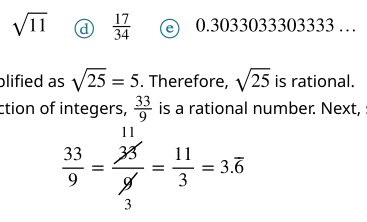
Common examples include $\pi$ and square roots of non-perfect squares, such as $\sqrt{11}$.
A perfect square is the square of an integer:
$$ 1=1^2,\qquad 4=2^2,\qquad 9=3^2,\qquad 16=4^2. $$
The square root of a perfect square is an integer. For example,
$$ \sqrt{36}=6 $$
because
$$ 6^2=36. $$
By contrast, $11$ is not a perfect square. Its square root cannot be written as an integer or as a fraction of integers, so $\sqrt{11}$ is irrational.
Worked example: Classifying square roots
Classify $\sqrt{36}$ and $\sqrt{73}$.
First simplify $\sqrt{36}$:
$$ \sqrt{36}=6 $$
Since $6$ is a natural number, it is also an integer and a rational number:
$$ 6=\frac{6}{1}. $$
Thus,
$$ \sqrt{36}\text{ is natural, whole, integer, rational, and real.} $$
Now consider $\sqrt{73}$. The nearby perfect squares are
$$ 8^2=64 \qquad\text{and}\qquad 9^2=81. $$
Because $73$ is not a perfect square, $\sqrt{73}$ cannot simplify to an integer. Therefore,
$$ \sqrt{73}\text{ is irrational and real.} $$
A decimal approximation may be useful for locating $\sqrt{73}$, but an approximation does not change its exact classification.
Common misconception: A decimal that continues forever is not automatically irrational. The repeating decimal $0.\overline{36}$ continues forever but is rational. Irrational decimals continue forever without repeating a fixed block.
Real numbers and the real number line
The real numbers consist of all rational and irrational numbers together. Every real number corresponds to exactly one point on the real number line, and every point on the line corresponds to exactly one real number.
The number line is ordered from left to right:
$$ \text{negative numbers}\quad\longleftarrow\quad 0\quad\longrightarrow\quad\text{positive numbers}. $$
Real numbers can be classified by their algebraic sign:
- A negative real number is less than $0$.
- Zero is neither negative nor positive.
- A positive real number is greater than $0$.
For example,
$$ -4<0,\qquad 0=0,\qquad 7>0. $$
The sign is determined by the number's location relative to $0$, not by whether the number is rational or irrational. Thus, $-\sqrt{11}$ is a negative irrational number, while $\frac{5}{8}$ is a positive rational number.
Worked example: Complete classification
Classify each number using the most specific applicable sets.
a. $\sqrt{36}$
$$ \sqrt{36}=6 $$
Therefore,
$$ \sqrt{36}\in N,\quad \sqrt{36}\in W,\quad \sqrt{36}\in I,\quad \sqrt{36}\in Q. $$
It is also real.
b. $\frac{8}{3}$
The number is already a fraction of integers with nonzero denominator:
$$ \frac{8}{3}. $$
Therefore,
$$ \frac{8}{3}\in Q. $$
Its decimal form is
$$ \frac{8}{3}=2.\overline{6}, $$
which confirms that it is rational and repeating. It is not an integer, whole number, or natural number.
c. $-6$
Write it as a fraction:
$$ -6=\frac{-6}{1}. $$
Thus,
$$ -6\in I,\qquad -6\in Q. $$
It is negative, but it is not natural or whole.
d. $\sqrt{73}$
Since $73$ is not a perfect square,
$$ \sqrt{73}\text{ is irrational}. $$
Therefore,
$$ \sqrt{73}\in Q', $$
where $Q'$ denotes the irrational numbers. It is positive because $\sqrt{73}>0$.
The most important containment relationships are
$$ N\subset W\subset I\subset Q\subset \mathbb{R}, $$
while the irrational numbers are also contained in the real numbers:
$$ Q'\subset\mathbb{R}. $$
The rational and irrational numbers do not overlap:
$$ Q\cap Q'=\varnothing. $$
Together, they make up all real numbers:
$$ \mathbb{R}=Q\cup Q'. $$
Practice problems
-
Classify $\frac{-9}{4}$ as rational or irrational. If rational, determine whether its decimal terminates or repeats.
-
Classify $\sqrt{49}$ and $\sqrt{11}$ using the number sets $N$, $W$, $I$, $Q$, and $Q'$.
-
State whether each number is negative, zero, or positive: $-\frac{3}{5}$, $0$, and $\sqrt{2}$.
Answers
-
$\frac{-9}{4}=-2.25$, so it is rational with a terminating decimal.
-
$\sqrt{49}=7$, so it belongs to $N$, $W$, $I$, and $Q$. Since $11$ is not a perfect square, $\sqrt{11}$ belongs to $Q'$ and is irrational.
-
$-\frac{3}{5}$ is negative, $0$ is neither negative nor positive, and $\sqrt{2}$ is positive.
Content adapted from OpenStax College Algebra 2e by Jay Abramson et al., licensed CC BY 4.0.



Source Materials
Study College Algebra on Lykke
This course page is free to open: signed out, you can read its first two sections, and signing in, on any plan, opens the rest. The free Lykke Chrome extension syncs your own Canvas courses, so ChatGPT, Claude and Muse can answer from your classes and deadlines. It only reads Canvas.
Add the free extensionSign in to open every section