From the free course College Algebra on Lykke
5.2 Power Functions and Polynomial Functions
Key concepts: Power functions · Polynomial functions · Degree of a polynomial · Leading term and leading coefficient · Writing polynomials in general form · End behavior of polynomial functions · Effect of degree and leading coefficient on graph behavior · Maximum number of turning points · Direct variation involving powers · Inverse variation involving powers
By the end of this section the student can: Identify power functions; Identify end behavior of power functions; Identify polynomial functions; Identify the degree and leading coefficient of polynomial functions
5.2 Power Functions and Polynomial Functions
A graph’s behavior far to the left and far to the right can often be predicted before finding a single zero or turning point. The key is the term with the greatest power of the variable: for a polynomial, that term eventually overwhelms every lower-power term.
Power Functions
A power function is a function of the form
$$ f(x)=kx^p, $$
where $k$ is a nonzero constant and $p$ is a real number. The exponent $p$ controls the basic shape, while $k$ controls its scale and, when negative, reflects the graph across the $x$-axis.
For example,
$$ f(x)=4x^3 $$
is a power function with $k=4$ and $p=3$. Likewise,
$$ g(x)=-\frac{1}{2}x^4 $$
is a power function with $k=-\frac{1}{2}$ and $p=4$.
Power functions also describe variation relationships. In a direct variation, one quantity is a constant multiple of a power of another:
$$ y=kx^p. $$
For example, if $y$ varies directly with $x^2$, then
$$ y=kx^2. $$
In an inverse variation, the variable appears in the denominator, or equivalently with a negative exponent:
$$ y=\frac{k}{x^p}=kx^{-p}. $$
Thus, if $y$ varies inversely with $x^3$, then
$$ y=\frac{k}{x^3}. $$
To find the constant of variation, substitute a known pair of values.
Worked example: direct variation
Suppose $y$ varies directly with $x^2$, and $y=18$ when $x=3$. Find $y$ when $x=5$.
Since the relationship is direct variation,
$$ y=kx^2. $$
Substitute $x=3$ and $y=18$:
$$ 18=k(3)^2. $$
Evaluate the power:
$$ 18=9k. $$
Divide both sides by $9$:
$$ k=2. $$
Therefore, the variation equation is
$$ y=2x^2. $$
Now substitute $x=5$:
$$ y=2(5)^2. $$
$$ y=2(25). $$
$$ y=50. $$
Therefore, when $x=5$,
$$ \boxed{y=50}. $$
A common misconception is that every expression containing a power is a polynomial. The exponent and the placement of the variable matter. For example, $x^5$ is both a power function and a polynomial, but $\frac{x^2}{x^2-1}$ is neither a polynomial nor a single power function because the variable appears in a denominator involving a sum.
Polynomial Functions
A polynomial function is a sum of terms, where each term is a constant multiple of a nonnegative integer power of the variable. In general, a polynomial has the form
$$ f(x)=a_nx^n+a_{n-1}x^{n-1}+\cdots+a_2x^2+a_1x+a_0, $$
where the exponents are nonnegative integers and the coefficients are real numbers.
Examples of polynomial functions include
$$ f(x)=x^5, $$
$$ g(x)=3x^4-2x^2+7x-1, $$
and
$$ h(x)=5x^4+2x^3-x-4. $$
A polynomial may omit powers. For example, the coefficient of $x^2$ in $h(x)$ is $0$, even though the term is not written.
Expressions with negative exponents, variables in denominators, or variables in exponents are not polynomials. For example,
$$ \frac{1}{x}=x^{-1}, \qquad \frac{x^2}{x-1}, \qquad 3^{x+1} $$
are not polynomial functions.
Some expressions require simplification before classification. For instance,
$$ (x^2)^3=x^{2\cdot 3}=x^6, $$
so this expression is a power function and a polynomial function.
Degree, Leading Term, and Leading Coefficient
The degree of a polynomial is the highest exponent of the variable with a nonzero coefficient. The leading term is the term containing that highest power, and the leading coefficient is the coefficient of that term.
Definition: The degree is the highest exponent with a nonzero coefficient. The leading term contains that highest power, and the leading coefficient is its coefficient.
Consider
$$ p(x)=7x^5-3x^2+9x-4. $$
The highest exponent is $5$, so
$$ \text{degree}=5. $$
The term containing $x^5$ is the leading term:
$$ 7x^5. $$
Its coefficient is $7$, so
$$ \text{leading coefficient}=7. $$
The terms do not need to be written in descending order to identify the degree. For example,
$$ q(x)=4-8x^3+x^6-2x $$
still has degree $6$, leading term $x^6$, and leading coefficient $1$.
General Form
A polynomial is in general form when its terms are arranged in descending powers of the variable:
$$ a_nx^n+a_{n-1}x^{n-1}+\cdots+a_1x+a_0. $$
Writing a polynomial in general form makes its degree and leading term immediately visible.
Worked example: writing general form
Write
$$ r(x)=3-2x^4+7x^2-x^5+6x $$
in general form. Then identify its degree, leading term, and leading coefficient.
Arrange the terms from greatest exponent to least exponent:
$$ r(x)=-x^5-2x^4+7x^2+6x+3. $$
$$ \text{degree}=5. $$
The term containing $x^5$ is
$$ -x^5, $$
so the leading term is
$$ -x^5. $$
The coefficient of $-x^5$ is $-1$, so the leading coefficient is
$$ -1. $$
Therefore,
$$ \boxed{r(x)=-x^5-2x^4+7x^2+6x+3} $$
has degree $5$, leading term $-x^5$, and leading coefficient $-1$.
End Behavior of Polynomial Functions
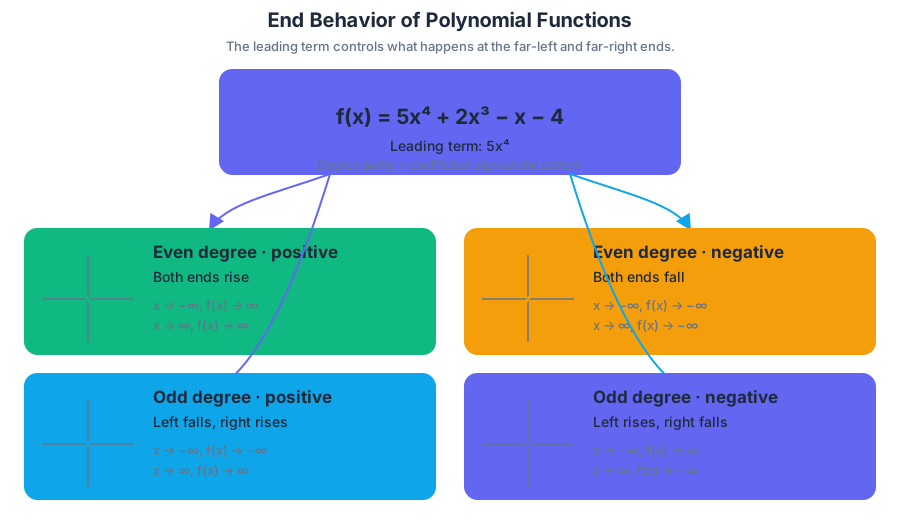
The end behavior of a function describes what happens to $f(x)$ as $x$ becomes extremely large or extremely negative. For a polynomial, the leading term determines the end behavior because its power eventually dominates all lower powers.
For example, in
$$ f(x)=5x^4+2x^3-x-4, $$
the term $5x^4$ controls the far-left and far-right behavior.
The parity of the degree and the sign of the leading coefficient determine the pattern:
- If the degree is even and the leading coefficient is positive, both ends rise.
- If the degree is even and the leading coefficient is negative, both ends fall.
- If the degree is odd and the leading coefficient is positive, the left end falls and the right end rises.
- If the degree is odd and the leading coefficient is negative, the left end rises and the right end falls.
These conclusions can be expressed with limits. For example, an even-degree polynomial with a positive leading coefficient satisfies
$$ \text{as }x\to-\infty,\quad f(x)\to\infty $$
and
An odd-degree polynomial with a negative leading coefficient satisfies
and
Worked example: determining end behavior
Determine the end behavior of
$$ f(x)=-2x^6+3x^4-x+8. $$
The highest exponent is $6$, so the degree is even:
$$ \text{degree}=6. $$
The leading term is
$$ -2x^6, $$
and the leading coefficient is negative:
$$ -2<0. $$
An even power makes $x^6$ positive on both sides of the number line. Multiplication by $-2$ makes the leading term negative on both sides. Therefore,
and
Thus, both ends of the graph fall.
For comparison, consider
$$ g(x)=3x^5-4x^2+1. $$
The degree is odd and the leading coefficient is positive. Therefore,
$$ \text{as }x\to-\infty,\quad g(x)\to-\infty $$
and
The two ends move in opposite directions.
Degree and Turning Points
A turning point is a point where the graph changes direction, such as changing from increasing to decreasing or from decreasing to increasing. A polynomial function of degree $n$ can have at most
$$ n-1 $$
turning points.
For example, a cubic polynomial has degree $3$, so it can have at most
$$ 3-1=2 $$
turning points. Its leading term is identified by locating the term containing the third power of the variable. In
$$ f(x)=-4x^3+6x^2+x-9, $$
the leading term is
$$ -4x^3, $$
and the leading coefficient is $-4$.
The phrase at most matters. A degree-$3$ polynomial may have $2$ turning points, but it could have only $1$ or even $0$. The degree gives an upper limit, not a guarantee.
Practice
For each problem, attempt the work before reading the answer.
- Classify each function as a power function, a polynomial function, both, or neither:
$$ a(x)=x^7, \qquad b(x)=2x(x+1)(x-3)^2, \qquad c(x)=\frac{4}{x^2}, \qquad d(x)=5^{x}. $$
- Write the polynomial in general form and identify its degree, leading term, and leading coefficient:
$$ p(x)=6-3x^4+2x-x^6+5x^2. $$
- Determine the end behavior of
$$ q(x)=-x^8+4x^3-2. $$
Answers:
-
$a(x)=x^7$ is both a power function and a polynomial function. $b(x)=2x(x+1)(x-3)^2$ is a polynomial function; expanding the factors would produce only nonnegative integer powers. $c(x)=4x^{-2}$ is a power function but not a polynomial function. $d(x)=5^x$ is neither a power function nor a polynomial function.
-
Arrange the terms in descending powers:
$$ p(x)=-x^6-3x^4+5x^2+2x+6. $$
Therefore,
$$ \text{degree}=6, \qquad \text{leading term}=-x^6, \qquad \text{leading coefficient}=-1. $$
- The degree is $8$, which is even, and the leading coefficient is negative. Thus,
$$ \text{as }x\to-\infty,\quad q(x)\to-\infty $$
and
Therefore, both ends of the graph fall.
Content adapted from OpenStax College Algebra 2e by Jay Abramson et al., licensed CC BY 4.0.
Source Materials
Study College Algebra on Lykke
This course page is free to open: signed out, you can read its first two sections, and signing in, on any plan, opens the rest. The free Lykke Chrome extension syncs your own Canvas courses, so ChatGPT, Claude and Muse can answer from your classes and deadlines. It only reads Canvas.
Add the free extensionSign in to open every section