From the free course College Algebra on Lykke
9.1 Sequences and Their Notations
Key concepts: Sequences as functions with terms indexed by position · Sequence notation using a variable with a number subscript · Writing terms from an explicit formula · Alternating sequences with positive and negative terms · Piecewise explicit formulas for sequences · Recognizing patterns in numerators, denominators, and signs · Writing a formula from observed sequence patterns · Recursive formulas using preceding term(s) · Initial term(s) required for recursive definitions · Using tables and graphs to analyze sequence terms
By the end of this section the student can: Write the terms of a sequence defined by an explicit formula; Write the terms of a sequence defined by a recursive formula; Use factorial notation
9.1 Sequences and Their Notations
A sequence is an ordered list of numbers, so changing the position of a number changes the sequence even when the same numbers appear. For example, the payment amounts in an annuity, the population recorded each year, or the number of bacteria after each hour can be organized as
$$ a_1,\ a_2,\ a_3,\ a_4,\ldots $$
where each subscript records when or where a term occurs.
Sequences as Functions
A sequence is a function whose domain consists of ordered position values, usually positive integers:
$$ 1,2,3,4,\ldots $$
The outputs of the function are called terms. The notation $a_n$ means “the term in position $n$.” Thus,
$$ a_1=\text{first term},\qquad a_2=\text{second term},\qquad a_3=\text{third term}. $$
The symbol $a_n$ is also called the general term or $n$th term because it describes the term at any position $n$.
Definition: A sequence is a function whose domain is a subset of the positive integers, with the outputs written as terms such as $a_1,a_2,a_3,\ldots$.
A sequence can be finite or infinite. A finite sequence stops after a specified number of terms, such as
$$ 4,\ 7,\ 10,\ 13, $$
while an infinite sequence continues indefinitely:
$$ 4,\ 7,\ 10,\ 13,\ldots $$
The dots indicate that the list continues according to some rule.
Although sequences commonly begin with $a_1$, some problems define the initial term as $a_0$. In that case, the domain includes $0$:
$$ a_0,\ a_1,\ a_2,\ a_3,\ldots $$
Always inspect the stated starting index before substituting values. Beginning with $a_0$ instead of $a_1$ shifts every term’s position.
Explicit Formulas and Sequence Notation
An explicit formula gives a term directly from its position. If
$$ a_n=2n+3, $$
then any term can be found by substituting its index. No earlier terms are needed.
Worked example: Writing terms from an explicit formula
Find the first five terms of the sequence
$$ a_n=2n+3. $$
Substitute $n=1,2,3,4,5$ one at a time:
$$ a_1=2(1)+3=2+3=5, $$
$$ a_2=2(2)+3=4+3=7, $$
$$ a_3=2(3)+3=6+3=9, $$
$$ a_4=2(4)+3=8+3=11, $$
$$ a_5=2(5)+3=10+3=13. $$
Therefore, the first five terms are
$$ \boxed{5,\ 7,\ 9,\ 11,\ 13}. $$
The most common mistake is to treat $a_n$ as multiplication of $a$ and $n$. It is not. The subscript identifies a position: $a_4$ means “the fourth term,” not $4a$.
Alternating Sequences
A sequence is alternating when its signs switch between positive and negative terms. Powers of $-1$ create this behavior because
$$ (-1)^{\text{even}}=1 \qquad\text{and}\qquad (-1)^{\text{odd}}=-1. $$
For example,
$$ (-1)^1=-1,\qquad (-1)^2=1,\qquad (-1)^3=-1,\qquad (-1)^4=1. $$
Thus, a factor such as $(-1)^n$ produces alternating signs as $n$ increases.
Worked example: Writing an alternating sequence
Write the first five terms of
$$ a_n=(-1)^n\frac{n+1}{n}. $$
Evaluate the formula at successive indices:
$$ a_1=(-1)^1\frac{1+1}{1} =-1\cdot\frac{2}{1} =-2, $$
$$ a_2=(-1)^2\frac{2+1}{2} =1\cdot\frac{3}{2} =\frac{3}{2}, $$
$$ a_3=(-1)^3\frac{3+1}{3} =-1\cdot\frac{4}{3} =-\frac{4}{3}, $$
$$ a_4=(-1)^4\frac{4+1}{4} =1\cdot\frac{5}{4} =\frac{5}{4}, $$
$$ a_5=(-1)^5\frac{5+1}{5} =-1\cdot\frac{6}{5} =-\frac{6}{5}. $$
Therefore,
$$ \boxed{-2,\ \frac{3}{2},\ -\frac{4}{3},\ \frac{5}{4},\ -\frac{6}{5}}. $$
When a formula contains $(-b)^n$, the sign alternates while the magnitude is controlled by $b^n$. For example, $(-5)^n$ produces
$$ -5,\ 25,\ -125,\ 625,\ldots $$
when $n$ begins at $1$.
Piecewise-Defined Sequences
A piecewise explicit formula uses different rules for different index values. To evaluate a piecewise sequence, first determine which condition applies to the index, then use only that rule.
Consider
$$ a_n= \begin{cases} n^2, & \text{if } n \text{ is a multiple of } 3,\ 2n+1, & \text{otherwise}. \end{cases} $$
The indices $3,6,9,\ldots$ are multiples of $3$. Every other positive integer uses the second rule.
Worked example: Evaluating a piecewise sequence
Find the first eight terms of
$$ a_n= \begin{cases} n^2, & \text{if } 3\mid n,\ 2n+1, & \text{if } 3\nmid n. \end{cases} $$
Here, $3\mid n$ means that $3$ divides $n$, so $n$ is a multiple of $3$.
Evaluate each index according to its condition:
$$ a_1=2(1)+1=3, $$
because $1$ is not a multiple of $3$.
$$ a_2=2(2)+1=5, $$
because $2$ is not a multiple of $3$.
$$ a_3=3^2=9, $$
because $3$ is a multiple of $3$.
$$ a_4=2(4)+1=9, $$
because $4$ is not a multiple of $3$.
$$ a_5=2(5)+1=11, $$
because $5$ is not a multiple of $3$.
$$ a_6=6^2=36, $$
because $6$ is a multiple of $3$.
$$ a_7=2(7)+1=15, $$
because $7$ is not a multiple of $3$.
$$ a_8=2(8)+1=17, $$
because $8$ is not a multiple of $3$.
Therefore,
$$ \boxed{3,\ 5,\ 9,\ 9,\ 11,\ 36,\ 15,\ 17}. $$
A table makes the pattern easier to see:
| $n$ | $1$ | $2$ | $3$ | $4$ | $5$ | $6$ | $7$ | $8$ |
|---|---|---|---|---|---|---|---|---|
| $a_n$ | $3$ | $5$ | $9$ | $9$ | $11$ | $36$ | $15$ | $17$ |
The third and sixth entries behave differently because they are multiples of $3$. On a graph of the ordered pairs $(n,a_n)$, every third point follows the rule $a_n=n^2$, while the remaining points follow $a_n=2n+1$.
Finding an Explicit Formula from Listed Terms
When only several terms are given, search for independent patterns in the numerators, denominators, and signs. Then test the proposed formula at more than one index. A pattern that matches only the first term is not enough.
Worked example: Separating numerator and denominator patterns
Find an explicit formula for
$$ -\frac{3}{4},\ -\frac{9}{8},\ -\frac{27}{12},\ -\frac{81}{16},\ -\frac{243}{20},\ldots $$
First analyze the numerators:
$$ 3,\ 9,\ 27,\ 81,\ 243
3^1,\ 3^2,\ 3^3,\ 3^4,\ 3^5. $$
The denominator pattern is
$$ 4,\ 8,\ 12,\ 16,\ 20
4(1),\ 4(2),\ 4(3),\ 4(4),\ 4(5). $$
Every term is negative. Therefore, the formula is
$$ \boxed{a_n=-\frac{3^n}{4n}}. $$
Check the formula at several indices:
$$ a_1=-\frac{3^1}{4(1)}=-\frac{3}{4}, $$
$$ a_2=-\frac{3^2}{4(2)}=-\frac{9}{8}, $$
$$ a_5=-\frac{3^5}{4(5)}=-\frac{243}{20}. $$
All three values agree with the listed sequence. The key is to avoid forcing the entire pattern into one part of the expression: the numerator, denominator, and sign each have their own behavior.
Explicit Formulas versus Recursive Formulas
An explicit formula determines $a_n$ directly from $n$. A recursive formula defines each term using one or more preceding terms. For example,
$$ a_1=3,\qquad a_n=2a_{n-1}-1\quad\text{for }n\geq 2 $$
is recursive. It gives the first term and then tells us how to generate each later term.
A recursive formula must include the initial term or terms needed to begin. Using the formula above,
$$ a_1=3, $$
$$ a_2=2a_1-1=2(3)-1=6-1=5, $$
$$ a_3=2a_2-1=2(5)-1=10-1=9, $$
$$ a_4=2a_3-1=2(9)-1=18-1=17. $$
Thus, the sequence begins
$$ \boxed{3,\ 5,\ 9,\ 17,\ldots}. $$
The distinction matters: an explicit formula jumps directly to any requested position, while a recursive formula moves step by step from earlier terms. For example, the Fibonacci sequence begins
$$ 1,\ 1,\ 2,\ 3,\ 5,\ 8,\ 13,\ldots $$
and is defined recursively by
$$ a_1=1,\qquad a_2=1,\qquad a_n=a_{n-1}+a_{n-2}\quad\text{for }n\geq 3. $$
Both initial terms are necessary because each new term uses the two preceding terms.
Practice Problems
- Write the first four terms of
$$ a_n=-\frac{16}{n+1}. $$
- Write the first five terms of
$$ a_n=-(-5)^{n-1}. $$
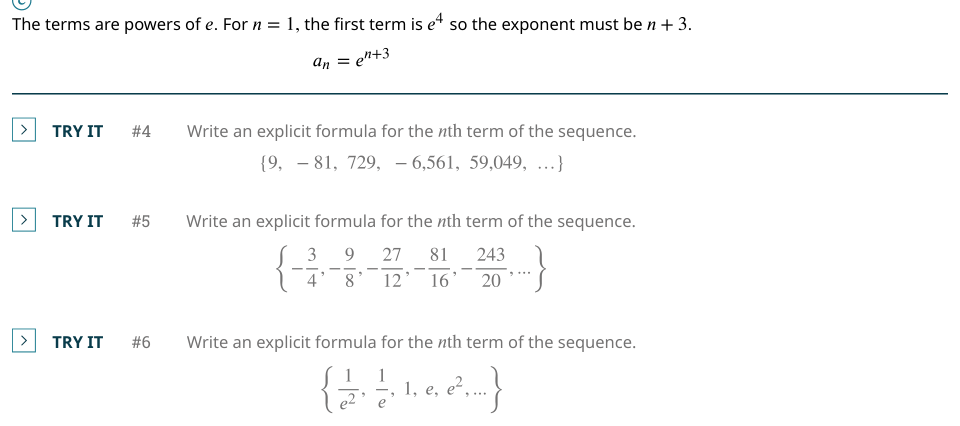
- Find an explicit formula for
$$ \frac{1}{e^2},\ \frac{1}{e},\ 1,\ e,\ e^2,\ldots $$
Answers:
- Substitute $n=1,2,3,4$:
$$ \boxed{-8,\ -\frac{16}{3},\ -4,\ -\frac{16}{5}}. $$
- Substitute $n=1,2,3,4,5$:
$$ \boxed{-1,\ 5,\ -25,\ 125,\ -625}. $$
- The exponents of $e$ are $-2,-1,0,1,2$, so
$$ \boxed{a_n=e^{n-3}}. $$
Content adapted from OpenStax College Algebra 2e by Jay Abramson et al., licensed CC BY 4.0.
Source Materials
Study College Algebra on Lykke
This course page is free to open: signed out, you can read its first two sections, and signing in, on any plan, opens the rest. The free Lykke Chrome extension syncs your own Canvas courses, so ChatGPT, Claude and Muse can answer from your classes and deadlines. It only reads Canvas.
Add the free extensionSign in to open every section