From the free course College Algebra on Lykke
8.1 The Ellipse
Key concepts: Ellipse as a conic section and locus of points whose distances from two fixed foci have a constant sum · Foci, vertices, co-vertices, center, major axis, and minor axis · Standard form of a horizontal ellipse centered at the origin · Standard form of a vertical ellipse centered at the origin · Standard form of a translated ellipse · Relationship among the semi-major axis, semi-minor axis, and focal distance: c^2=a^2-b^2 · Graphing ellipses from their equations · Identifying ellipse orientation from the larger denominator · Real-world applications of ellipses, including whispering chambers, orbits, and lithotripters
By the end of this section the student can: Write equations of ellipses in standard form; Graph ellipses centered at the origin; Graph ellipses not centered at the origin; Solve applied problems involving ellipses
8.1 The Ellipse
An ellipse is the smooth, closed curve traced by a point whose total distance from two fixed points never changes. A stretched circle, an orbit, and the outline produced by a loop of string around two thumbtacks all express the same geometric idea.
An ellipse is a conic section, meaning it can be formed by slicing a cone with a plane. It is also a locus, or set of points satisfying a geometric condition.
Definition: An ellipse is the set of all points in a plane such that the sum of their distances from two fixed points is a constant.
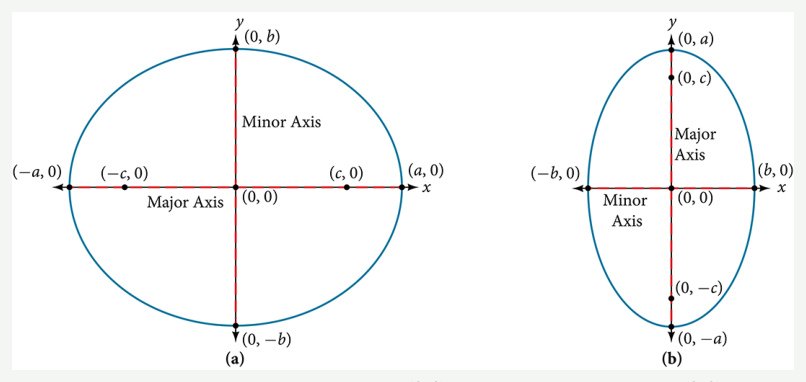
Each fixed point is called a focus; the plural is foci. The longest line segment passing through the center and both foci is the major axis. The shorter perpendicular axis through the center is the minor axis. The endpoints of the major axis are the vertices, and the endpoints of the minor axis are the co-vertices.
Writing Equations of Ellipses in Standard Form
For an ellipse centered at the origin, the standard form depends on whether the major axis is horizontal or vertical. Let $a$ represent the semi-major axis, $b$ represent the semi-minor axis, and $c$ represent the distance from the center to either focus. The quantities satisfy
$$ a>b>0 $$
and
$$ c^2=a^2-b^2. $$
If the major axis is horizontal, the standard form is
$$ \frac{x^2}{a^2}+\frac{y^2}{b^2}=1. $$
The larger denominator, $a^2$, is under the $x^2$ term. The center is $(0,0)$, the vertices are $(\pm a,0)$, the co-vertices are $(0,\pm b)$, and the foci are $(\pm c,0)$.
If the major axis is vertical, the standard form is
$$ \frac{x^2}{b^2}+\frac{y^2}{a^2}=1. $$
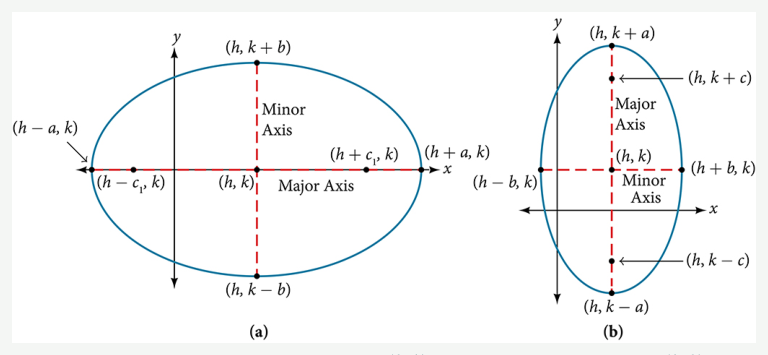
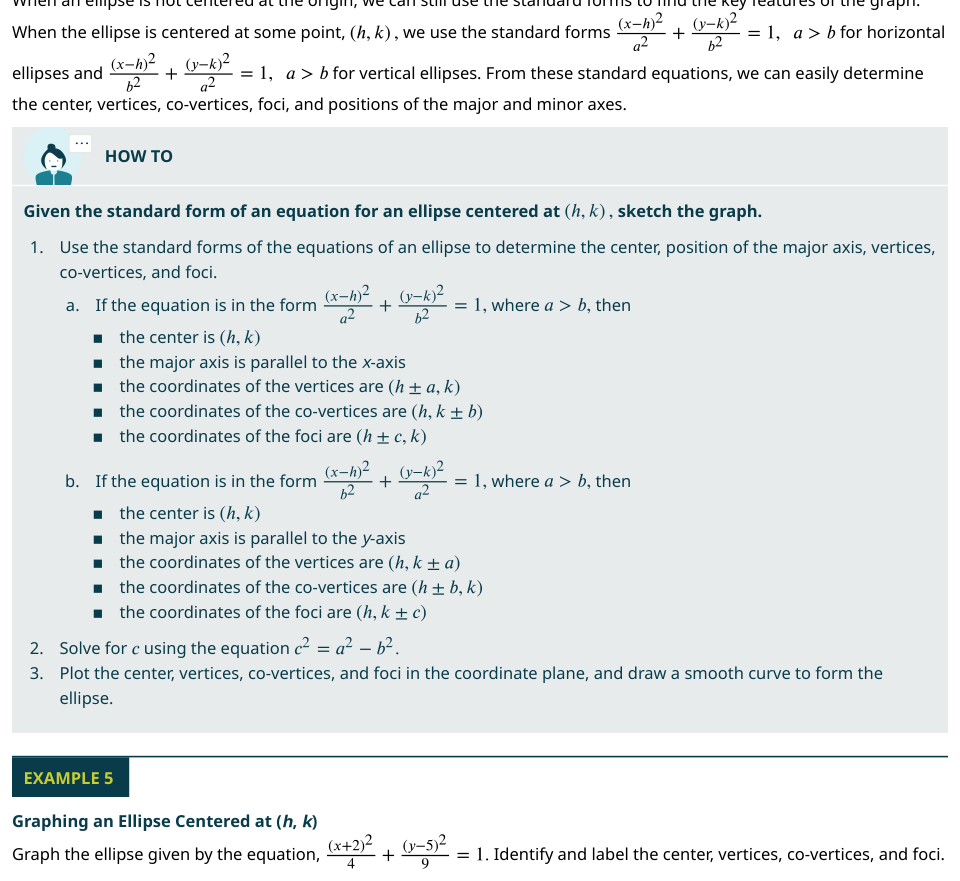
For an ellipse centered at $(h,k)$, replace $x$ by $x-h$ and $y$ by $y-k$. The translated standard forms are
$$ \frac{(x-h)^2}{a^2}+\frac{(y-k)^2}{b^2}=1 $$
for a horizontal ellipse, and
$$ \frac{(x-h)^2}{b^2}+\frac{(y-k)^2}{a^2}=1 $$
for a vertical ellipse.
A common mistake is to identify $a$ and $b$ by looking at the order of the terms rather than the size of the denominators. The larger denominator always identifies $a^2$, and its variable identifies the direction of the major axis.
Example: Write the equation of an ellipse whose vertices are $(\pm 5,0)$ and whose foci are $(\pm 3,0)$.
Because the vertices and foci lie on the $x$-axis, the ellipse is horizontal. Therefore, use
The vertices are $(\pm a,0)$, so
$$ a=5. $$
Squaring gives
$$ a^2=5^2=25. $$
The foci are $(\pm c,0)$, so
$$ c=3. $$
Squaring gives
$$ c^2=3^2=9. $$
Use the relationship among $a$, $b$, and $c$:
$$ c^2=a^2-b^2. $$
Substitute $c^2=9$ and $a^2=25$:
$$ 9=25-b^2. $$
Subtract $25$ from both sides:
$$ 9-25=-b^2. $$
Simplify:
$$ -16=-b^2. $$
Multiply both sides by $-1$:
$$ 16=b^2. $$
Substitute $a^2=25$ and $b^2=16$ into the horizontal standard form:
$$ \frac{x^2}{25}+\frac{y^2}{16}=1. $$
Thus, the equation is
$$ \boxed{\frac{x^2}{25}+\frac{y^2}{16}=1}. $$
Graphing Ellipses Centered at the Origin
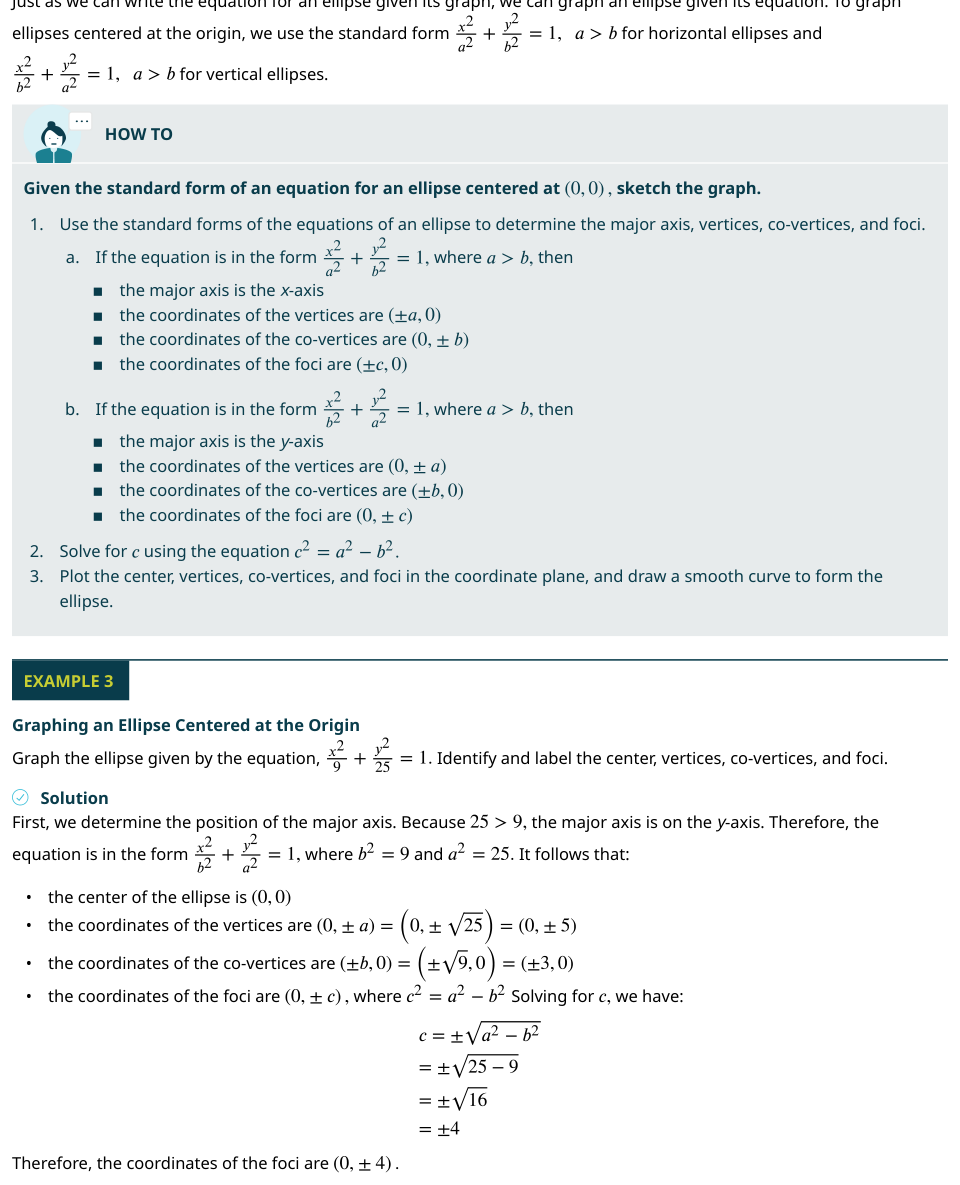
To graph an ellipse centered at the origin, first determine whether the major axis is horizontal or vertical by locating the larger denominator. Then identify the vertices, co-vertices, and foci, plot those points, and draw a smooth curve through the four axis endpoints.
For
where $a>b$, the ellipse is horizontal. Its key features are
$$ \text{center: }(0,0), $$
$$ \text{vertices: }(\pm a,0), $$
$$ \text{co-vertices: }(0,\pm b), $$
and
$$ \text{foci: }(\pm c,0). $$
For
where $a>b$, the ellipse is vertical. Its key features are
$$ \text{center: }(0,0), $$
$$ \text{vertices: }(0,\pm a), $$
$$ \text{co-vertices: }(\pm b,0), $$
and
$$ \text{foci: }(0,\pm c). $$
The major axis has length $2a$, and the minor axis has length $2b$. The foci lie on the major axis between the center and the vertices because $c<a$.
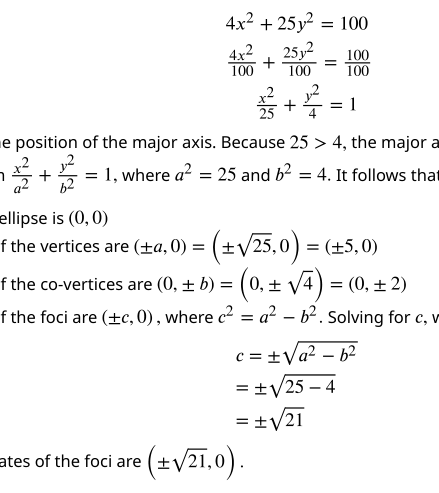
Example: Graph the ellipse
$$ \frac{x^2}{25}+\frac{y^2}{9}=1. $$
The denominators are $25$ and $9$. Since
$$ 25>9, $$
the larger denominator is under $x^2$, so the ellipse is horizontal. Identify $a^2$ and $b^2$:
$$ a^2=25, \qquad b^2=9. $$
Take positive square roots:
$$ a=5, \qquad b=3. $$
Find $c$ using
$$ c^2=a^2-b^2. $$
Substitute:
$$ c^2=25-9. $$
Simplify:
$$ c^2=16. $$
Take the positive square root:
$$ c=4. $$
The center is $(0,0)$. Because the ellipse is horizontal, the vertices are
$$ (\pm a,0)=(\pm 5,0), $$
so the vertices are
$$ (-5,0)\quad\text{and}\quad(5,0). $$
The co-vertices are
$$ (0,\pm b)=(0,\pm 3), $$
so they are
$$ (0,-3)\quad\text{and}\quad(0,3). $$
The foci are
$$ (\pm c,0)=(\pm 4,0), $$
so they are
$$ (-4,0)\quad\text{and}\quad(4,0). $$
Plot the center, vertices, and co-vertices. The vertices show that the ellipse extends farther horizontally, while the co-vertices show its vertical height. Draw a smooth, symmetric curve through the four endpoints. The foci are useful for identifying the geometry but lie inside the ellipse rather than on its boundary.
Graphing Ellipses Not Centered at the Origin
When an ellipse is centered at $(h,k)$ rather than $(0,0)$, the same standard forms apply after translating the coordinates. The expressions $x-h$ and $y-k$ measure horizontal and vertical distance from the new center.
For the horizontal form
the center is $(h,k)$, the vertices are
$$ (h\pm a,k), $$
the co-vertices are
$$ (h,k\pm b), $$
and the foci are
$$ (h\pm c,k). $$
For the vertical form
$$ (h,k\pm a), $$
the co-vertices are
$$ (h\pm b,k), $$
and the foci are
$$ (h,k\pm c). $$
$$ \frac{(x-2)^2}{16}+\frac{(y+1)^2}{25}=1. $$
Rewrite the second squared expression to identify the center:
$$ y+1=y-(-1). $$
Therefore,
$$ h=2, \qquad k=-1. $$
The center is
$$ (2,-1). $$
The larger denominator is $25$, and it is under the $y$ term. Therefore, the ellipse is vertical. Identify the semi-axis squares:
$$ a^2=25, \qquad b^2=16. $$
Take square roots:
$$ a=5, \qquad b=4. $$
Find the focal distance:
$$ c^2=a^2-b^2. $$
Substitute:
$$ c^2=25-16. $$
Simplify:
$$ c^2=9. $$
$$ c=3. $$
Because the ellipse is vertical, its vertices are
$$ (h,k\pm a)=(2,-1\pm 5). $$
Calculate both points:
$$ (2,-1+5)=(2,4), $$
and
$$ (2,-1-5)=(2,-6). $$
Thus, the vertices are $(2,4)$ and $(2,-6)$.
The co-vertices are
$$ (h\pm b,k)=(2\pm 4,-1). $$
Calculate both points:
$$ (2+4,-1)=(6,-1), $$
and
$$ (2-4,-1)=(-2,-1). $$
Thus, the co-vertices are $(6,-1)$ and $(-2,-1)$.
The foci are
$$ (h,k\pm c)=(2,-1\pm 3). $$
Calculate both points:
$$ (2,-1+3)=(2,2), $$
and
$$ (2,-1-3)=(2,-4). $$
Thus, the foci are $(2,2)$ and $(2,-4)$. Plot the center, the four axis endpoints, and then draw a smooth vertical ellipse through them.
Solving Applied Problems Involving Ellipses
Ellipses model rounded rooms, racetracks, planetary orbits, whispering galleries, and boundaries such as garden beds. In an application, the most important translation is between the geometric dimensions and the parameters $a$ and $b$: the full major-axis length is $2a$, and the full minor-axis length is $2b$.
To solve an applied ellipse problem, identify the center, determine whether the major axis is horizontal or vertical, convert full lengths to semi-axis lengths, substitute those values into the appropriate standard form, and use
$$ c^2=a^2-b^2 $$
when focal information is needed.
Example: A garden is $30$ meters long and $18$ meters wide, with its major axis along the $y$-axis. Find an equation modeling its elliptical boundary and identify its vertices and co-vertices.
Assume the garden is centered at the origin. Because the garden is $30$ meters long, its full major-axis length is
$$ 2a=30. $$
Divide both sides by $2$:
$$ a=15. $$
The garden is $18$ meters wide, so its full minor-axis length is
$$ 2b=18. $$
Divide both sides by $2$:
$$ b=9. $$
The major axis is vertical, so use the vertical standard form:
Calculate the squared parameters:
$$ b^2=9^2=81, $$
and
$$ a^2=15^2=225. $$
Substitute these values:
$$ \frac{x^2}{81}+\frac{y^2}{225}=1. $$
Therefore, the garden boundary is modeled by
$$ \boxed{\frac{x^2}{81}+\frac{y^2}{225}=1}. $$
Since the ellipse is vertical, its vertices are
$$ (0,\pm a)=(0,\pm 15), $$
so they are
$$ (0,-15)\quad\text{and}\quad(0,15). $$
Its co-vertices are
$$ (\pm b,0)=(\pm 9,0), $$
so they are
$$ (-9,0)\quad\text{and}\quad(9,0). $$
If the garden’s foci are also required, calculate
$$ c^2=a^2-b^2. $$
Substitute:
$$ c^2=225-81. $$
Simplify:
$$ c^2=144. $$
$$ c=12. $$
Because the major axis is vertical, the foci are
$$ (0,\pm 12). $$
The dimensions must be interpreted as full axis lengths before using the standard form. Using $30$ directly as $a$ and $18$ directly as $b$ would double both dimensions and produce an ellipse that is too large.
Practice problems
- Write the standard form equation of the horizontal ellipse centered at the origin with vertices $(\pm 7,0)$ and co-vertices $(0,\pm 4)$.
Answer:
$$ \boxed{\frac{x^2}{49}+\frac{y^2}{16}=1} $$
- For the ellipse
$$ \frac{(x+3)^2}{36}+\frac{(y-2)^2}{16}=1, $$
identify the center, vertices, co-vertices, and foci.
Answer: The center is $(-3,2)$. Since the larger denominator is under the $x$ term, the ellipse is horizontal. Here,
$$ a=6,\qquad b=4,\qquad c=\sqrt{36-16}=\sqrt{20}=2\sqrt{5}. $$
The vertices are
$$ (-3\pm 6,2), $$
or
$$ (-9,2)\quad\text{and}\quad(3,2). $$
The co-vertices are
$$ (-3,2\pm 4), $$
or
$$ (-3,-2)\quad\text{and}\quad(-3,6). $$
The foci are
$$ (-3\pm 2\sqrt{5},2). $$
- A park is $24$ meters long and $14$ meters wide, centered at the origin, with its major axis along the $y$-axis. Write the equation of its elliptical boundary.
Answer: The full major-axis length is $24$, so
$$ a=\frac{24}{2}=12. $$
The full minor-axis length is $14$, so
$$ b=\frac{14}{2}=7. $$
Because the major axis is vertical, use
Therefore,
$$ \boxed{\frac{x^2}{49}+\frac{y^2}{144}=1}. $$
Content adapted from OpenStax College Algebra 2e by Jay Abramson et al., licensed CC BY 4.0.
Source Materials
Study College Algebra on Lykke
This course page is free to open: signed out, you can read its first two sections, and signing in, on any plan, opens the rest. The free Lykke Chrome extension syncs your own Canvas courses, so ChatGPT, Claude and Muse can answer from your classes and deadlines. It only reads Canvas.
Add the free extensionSign in to open every section