From the free course College Algebra on Lykke
3.1 Functions and Function Notation
Key concepts: Relations as sets of ordered pairs · Domain and range · Input and output values · Independent and dependent variables · Definition of a function · Determining whether a relation represents a function · Function notation · Interpreting function values from tables · Functions represented by tables and mappings · Real-world relationships and predictions
By the end of this section the student can: Determine whether a relation represents a function; Find the value of a function; Determine whether a function is one-to-one; Use the vertical line test to identify functions; Graph the functions listed in the library of functions
3.1 Functions and Function Notation
A function is a rule that assigns exactly one output to every allowed input. For example, a vending machine may accept a particular selection code and return one snack. Different codes may produce the same snack, but one code cannot produce two different snacks at the same time. That distinction—one input, exactly one output—is the central idea behind functions.
Determining Whether a Relation Represents a Function
A relation is a set of ordered pairs. In an ordered pair $(x,y)$, the first coordinate is the input and the second coordinate is the output. The domain is the set of all input values, and the range is the set of all resulting output values.
For example, in the relation
$$ R={(1,4),(2,5),(3,5)}, $$
the domain is
$$ {1,2,3}, $$
and the range is
$$ {4,5}. $$
Repeated output values are listed only once in the range.
A function is a relation in which each input corresponds to exactly one output. An input may not be paired with two different outputs. However, different inputs may share the same output; this is called a many-to-one relationship and is allowed.
A relation is a function if and only if every input value is matched with exactly one output value.
To determine whether a set of ordered pairs represents a function:
- Examine the first coordinates.
- If an input appears more than once, compare its outputs.
- If the repeated input has different outputs, the relation is not a function.
- If every input has exactly one output, the relation is a function.
Example: Determine whether the relation is a function.
Consider
$$ R={(a,b),(c,d),(a,c)}. $$
The first coordinates are
$$ a,\ c,\ a. $$
The input $a$ appears twice. Its associated outputs are $b$ and $c$:
$$ (a,b) \qquad\text{and}\qquad (a,c). $$
Because $b\neq c$, the single input $a$ is assigned two different outputs. Therefore,
$$ \boxed{R\text{ is not a function}.} $$
By contrast,
$$ S={(a,b),(b,c),(c,c)} $$
has first coordinates $a$, $b$, and $c$, each appearing exactly once. Thus every input has exactly one output, so
$$ \boxed{S\text{ is a function}.} $$
A common misconception is that a function must have different outputs for different inputs. That is false: the relation
$$ {(1,7),(2,7),(3,9)} $$
is a function because each input has one output, even though the inputs $1$ and $2$ share the output $7$.
Finding Input and Output Values of a Function
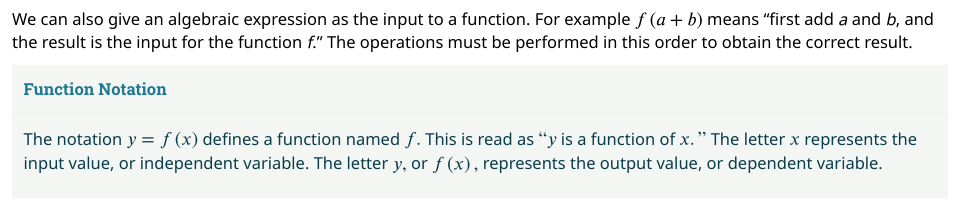
Function notation names the output of a function using the symbol $f(x)$. The expression $f(x)$ is read “$f$ of $x$.” Here, $x$ is the input and $f(x)$ is the corresponding output.
The equation
$$ f(x)=2x+3 $$
does not mean that $f$ is multiplied by $x$. It means that the function named $f$ takes an input $x$, multiplies it by $2$, and adds $3$.
To evaluate a function at a given input:
- Substitute the input value for every occurrence of $x$.
- Use parentheses around the substituted value.
- Simplify according to the order of operations.
Example: Find a function value.
Let
$$ f(x)=2x^2-3x+1. $$
Find $f(3)$.
First substitute $3$ for every $x$:
$$ f(3)=2(3)^2-3(3)+1. $$
Evaluate the exponent:
$$ f(3)=2(9)-3(3)+1. $$
Multiply:
$$ f(3)=18-9+1. $$
Combine the terms:
$$ f(3)=9+1=10. $$
Therefore,
$$ \boxed{f(3)=10}. $$
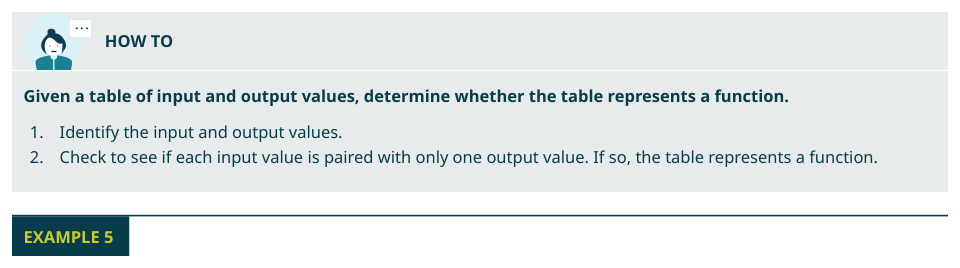
The same idea works with a table. If a table contains the input-output pair $(3,10)$, then the table tells us directly that
$$ f(3)=10. $$
The notation $f(3)$ identifies the output associated with input $3$; it does not mean $f$ multiplied by $3$.
In a function, the independent variable is the input variable, usually $x$. The dependent variable is the output, usually $y$ or $f(x)$, because its value depends on the selected input. In
$$ y=f(x)=2x+3, $$
$x$ is independent and $y$ is dependent.
Determining Whether a Function is One-to-One
A function is one-to-one if each output corresponds to exactly one input. Equivalently, no two different inputs may produce the same output.
A function may be a function without being one-to-one. For example,
$$ f(1)=5 \qquad\text{and}\qquad f(2)=5 $$
does define a function, because each input has one output. It is not one-to-one because two different inputs produce the same output.
To determine whether a function given by ordered pairs is one-to-one:
- List or inspect the output values.
- Check whether any output is repeated.
- If an output is repeated for different inputs, the function is not one-to-one.
- If every output occurs only once, the function is one-to-one.
Example: Determine whether a function is one-to-one.
Consider
$$ f={(-2,4),(0,1),(3,4),(5,7)}. $$
The inputs are
$$ -2,\ 0,\ 3,\ 5, $$
and each input appears once, so the relation is a function.
The outputs are
$$ 4,\ 1,\ 4,\ 7. $$
The output $4$ occurs twice:
$$ f(-2)=4 \qquad\text{and}\qquad f(3)=4. $$
Because the different inputs $-2$ and $3$ have the same output, the function is not one-to-one:
$$ \boxed{f\text{ is a function, but it is not one-to-one}.} $$
The distinction is important: the function test checks repeated inputs, while the one-to-one test checks repeated outputs.
Using the Vertical Line Test
The vertical line test determines whether a graph represents a function. A graph represents a function of $x$ if every vertical line intersects the graph no more than once.
If any vertical line intersects a graph more than once, the graph does not represent a function of $x$.
The reason is that a vertical line has one fixed input value, namely one $x$-coordinate. If it intersects the graph at two points, that one input corresponds to two different output values. This violates the definition of a function.
Example: Apply the vertical line test to a circle.
Consider the relation
$$ x^2+y^2=9. $$
Solve for $y$:
$$ y^2=9-x^2. $$
Take the square root of both sides:
$$ y=\pm\sqrt{9-x^2}. $$
Thus, for an input such as $x=0$, the relation gives
$$ y=\pm\sqrt{9-0^2}. $$
Simplify:
$$ y=\pm\sqrt{9}. $$
Therefore,
$$ y=3 \qquad\text{or}\qquad y=-3. $$
The single input $x=0$ produces two outputs, so the graph fails the vertical line test. Hence,
$$ \boxed{x^2+y^2=9\text{ does not represent }y\text{ as a function of }x.} $$
By contrast, the graph of
$$ y=x^2 $$
passes the vertical line test. For every chosen input $x$, the rule gives exactly one value $y=x^2$.
Using the Horizontal Line Test
The horizontal line test determines whether a function is one-to-one. A function is one-to-one if every horizontal line intersects its graph no more than once.
If a horizontal line intersects the graph more than once, the function is not one-to-one.
A horizontal line represents one fixed output value. If it intersects the graph at two points, then two different inputs produce that same output. That is precisely the failure of the one-to-one condition.
Example: Apply the horizontal line test to a parabola.
Consider
$$ f(x)=x^2. $$
To see whether the function is one-to-one, choose the output value $y=4$ and solve:
$$ x^2=4. $$
$$ x=\pm\sqrt{4}. $$
Therefore,
$$ x=2 \qquad\text{or}\qquad x=-2. $$
The two different inputs $2$ and $-2$ produce the same output:
$$ f(2)=2^2=4, $$
and
$$ f(-2)=(-2)^2=4. $$
Thus the horizontal line $y=4$ intersects the graph twice. The function fails the horizontal line test:
$$ \boxed{f(x)=x^2\text{ is not one-to-one on its full domain}.} $$
The function becomes one-to-one if its domain is restricted to $x\geq 0$ or to $x\leq 0$, because on either side of the vertex each output comes from only one input.
Identifying Basic Toolkit Functions
The basic toolkit functions are familiar functions whose graphs and properties serve as building blocks for more complicated functions. Recognizing their equations helps identify domains, ranges, symmetry, and general graph shape.
The principal toolkit functions include:
| Function | Equation | Domain | Range |
|---|---|---|---|
| Constant | $f(x)=c$ | all real numbers | ${c}$ |
| Identity | $f(x)=x$ | all real numbers | all real numbers |
| Squaring | $f(x)=x^2$ | all real numbers | $y\geq 0$ |
| Cubing | $f(x)=x^3$ | all real numbers | all real numbers |
| Absolute value | $f(x)=\lvert x\rvert$ | all real numbers | $y\geq 0$ |
| Reciprocal | $f(x)=\dfrac{1}{x}$ | $x\neq 0$ | $y\neq 0$ |
| Square root | $f(x)=\sqrt{x}$ | $x\geq 0$ | $y\geq 0$ |
| Cube root | $f(x)=\sqrt[3]{x}$ | all real numbers | all real numbers |
The restrictions arise from the rules of real numbers. For
$$ f(x)=\frac{1}{x}, $$
the denominator cannot equal zero, so $x\neq 0$. For
$$ f(x)=\sqrt{x}, $$
the expression inside an even root must be nonnegative, so $x\geq 0$. A cube root has no such restriction because every real number has a real cube root.
Example: Identify a toolkit function and find its values.
Consider
$$ g(x)=\sqrt[3]{x}. $$
This is the cube-root function. Find $g(-8)$.
Substitute $-8$ for $x$:
$$ g(-8)=\sqrt[3]{-8}. $$
Because
$$ (-2)^3=(-2)(-2)(-2)=4(-2)=-8, $$
it follows that
$$ \sqrt[3]{-8}=-2. $$
Therefore,
$$ \boxed{g(-8)=-2}. $$
The cube-root function is defined for every real input, and its outputs also include every real number. It is also one-to-one: if two cube roots have the same output, cubing both sides gives the same input.
Practice Problems
- Determine whether the relation
$$ {(1,2),(2,3),(1,4)} $$
represents a function.
- Let
$$ f(x)=x^2-4x+1. $$
Find $f(3)$.
- Determine whether
$$ h(x)=\lvert x\rvert $$
is one-to-one on its full domain.
Answers
-
It is not a function because the input $1$ has two outputs, $2$ and $4$.
-
Substitute and simplify:
$$ f(3)=3^2-4(3)+1 $$
$$ =9-12+1 $$
$$ =-2. $$
Thus,
$$ \boxed{f(3)=-2}. $$
- It is not one-to-one because
$$ h(2)=\lvert 2\rvert=2 $$
and
$$ h(-2)=\lvert -2\rvert=2. $$
Different inputs produce the same output.
Content adapted from OpenStax College Algebra 2e by Jay Abramson et al., licensed CC BY 4.0.




Source Materials
Study College Algebra on Lykke
This course page is free to open: signed out, you can read its first two sections, and signing in, on any plan, opens the rest. The free Lykke Chrome extension syncs your own Canvas courses, so ChatGPT, Claude and Muse can answer from your classes and deadlines. It only reads Canvas.
Add the free extensionSign in to open every section