From the free course English Composition I on Lykke
7.7 Evaluation: Effect on Audience
Key concepts: Audience · Rhetorical situation · Purpose · Rhetorical choices · Clarity and coherence · Critical language awareness · Genre and cultural context · Evaluating a text · Thesis and evidence · Explaining a judgment
By the end of this section the student can: Explain how your writing uses common elements of the review genre.; Evaluate reviews for thesis, evidence, rhetorical choices, clarity, and language awareness by using a rubric.
7.7 Evaluation: Effect on Audience
A review succeeds when its judgment gives readers a sound reason to decide whether a work, product, service, or experience deserves their attention. Saying that a film is “good” is not yet an evaluation; a review must show by what standards the work is being judged, what evidence supports that judgment, and why the judgment matters to its intended audience.
Evaluation Is a Rhetorical Act
An evaluation is a reasoned judgment about the quality, effectiveness, value, or significance of something. A review is the genre—the recognizable type of communication—with conventions that help readers know what to expect. Reviews usually combine four elements: a judgment, criteria for making that judgment, evidence from or about the subject, and context that helps readers understand the judgment.
For example, a restaurant review may judge whether a restaurant is worth visiting. Its criteria might include food quality, service, atmosphere, price, and accessibility. A film review may consider acting, directing, structure, visual design, cultural significance, or emotional effect. A product review may focus on reliability, ease of use, durability, and value. The criteria change with the subject, but the review still connects standards to evidence and then to a recommendation.
Genre conventions are not rigid rules. A newspaper review, a scholarly review, a short online rating, and a workplace recommendation may all evaluate something differently because they address different audiences and purposes. A star rating may give readers a quick decision aid, while a longer review explains the reasoning behind the rating. Cultural context can also shape how readers interpret a review’s tone, assumptions, references, and standards. The same phrase or convention may seem persuasive to one audience and unconvincing to another.
A review does more than report what a work contains. It makes an independent judgment and explains why that judgment is justified.
Identifying the Rhetorical Situation
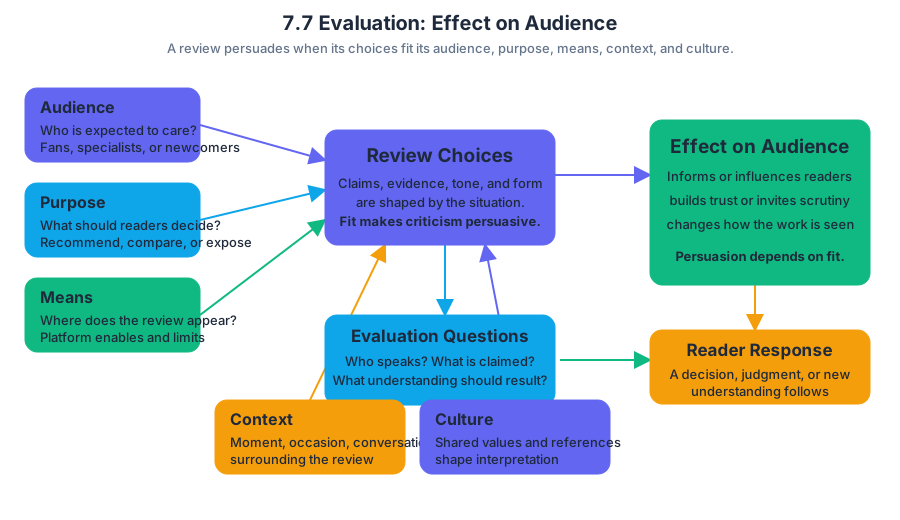
The rhetorical situation consists of the circumstances that shape a piece of communication. To evaluate whether a review is effective, identify its author, message, audience, purpose, means, context, and culture. These elements work together rather than functioning as separate boxes.
The author is the person or publication making the evaluation. Ask what authority, experience, interests, or limitations the author brings. The message is the review’s central claim: not merely “the film includes three main characters,” but “the film’s treatment of those characters makes its social criticism persuasive.” The audience includes the readers the review seeks to inform or influence. They may be casual consumers, devoted fans, specialists, professionals, or people unfamiliar with the subject.
The purpose is what the review wants to accomplish. It may recommend, discourage, compare, interpret, expose a weakness, celebrate an achievement, or help readers decide whether a work deserves their time or money. The means are the channel and form through which the review reaches readers: a newspaper, magazine, academic publication, website, video, social-media post, or another platform. The context includes the circumstances surrounding the review, such as the moment of publication, the occasion, the intended use, and the conversation to which the review responds. Culture includes the shared values, assumptions, practices, and references that affect how the author and audience understand the subject.
A reviewer should therefore ask questions such as: Who is speaking? What is being claimed? Who is expected to care? What decision or understanding should result? What does the platform make possible or limit? What background knowledge does the audience possess? What cultural assumptions does the review rely on? These questions reveal whether the review’s choices fit its situation.
Judging Rhetorical Choices
Rhetorical choices are the deliberate decisions a writer makes about content, organization, evidence, language, tone, and presentation. A choice is effective when it helps the writer achieve the purpose with the intended audience in the given context. There is no universally best tone or level of detail; a choice that suits a professional recommendation may fail in a short consumer review, and a choice that works for specialists may confuse general readers.
Consider this brief model:
The documentary is most persuasive when it follows neighborhood organizers rather than summarizing policy debates. Their first-person accounts turn an abstract issue into a visible pattern of daily choices, although the film’s final claim depends on evidence it never fully supplies.
This passage makes a judgment, identifies a criterion—persuasiveness—and supports the judgment with a specific feature of the documentary: its focus on organizers. It also qualifies the praise by noting a weakness in the evidence. The tone is analytical rather than merely enthusiastic, which suits readers who want reasons for a recommendation. The reviewer does not simply list scenes; the reviewer explains how the documentary’s choices affect its argument.
Evaluate whether a review’s subject, angle, tone, and content engage its intended audience consistently. The subject establishes what is being judged. The angle gives the review a focused perspective rather than an attempt to discuss everything. The tone communicates the reviewer’s attitude through word choice and sentence style. The content supplies the information and evidence readers need. If a review begins as a careful analysis but shifts into unsupported praise, its rhetorical choices become inconsistent.
Clarity and Coherence
Clarity means that readers can understand the writer’s claims and relationships among ideas. Coherence means that those ideas fit together in a meaningful order. A clear and coherent review guides readers from the subject and thesis through criteria and evidence to the final judgment.
A review’s thesis is its central evaluative claim. It should make a judgment that can be supported, not merely identify the topic. “The novel is about migration” is a subject statement. “The novel’s restrained narration makes migration feel like a series of practical decisions rather than a single dramatic rupture” is an evaluative thesis because it makes a claim about effectiveness and indicates the angle of analysis.
Linked concepts and effective transitions help readers move through the text. A reviewer might begin with overall impact, move to characterization, then examine evidence and limitations. Transitions make those relationships visible:
The film’s visual design creates an immediate sense of confinement. That visual strength, however, is not matched by the dialogue, which explains the characters’ conflicts instead of allowing them to emerge through conversation.
The transition “That visual strength, however” links the second judgment to the first while signaling contrast. Without such connections, paragraphs may contain individually interesting observations but fail to form an argument. Readers should be able to tell how each paragraph supports the thesis, how each example illustrates a criterion, and how the final recommendation follows from the analysis.
Evidence, Analysis, and Independent Judgment
Evidence gives an evaluation credibility, but evidence alone does not constitute analysis. A review should use relevant details from the work, quotations when exact language matters, and reliable secondary information when context or comparison requires it. The reviewer must then explain what the evidence demonstrates and why that demonstration matters.
For example, a reviewer might write:
The novel presents translation as both connection and loss. When Lina says that “every translated sentence leaves something behind” (Nguyen 42), the metaphor supports the novel’s larger concern with communication across unequal power relationships.
In this model, the quotation is brief, introduced in the writer’s sentence, and followed by a parenthetical citation. The analysis explains the quotation’s significance instead of leaving readers to guess why it appears. The author and page information in a real citation must match the required documentation style and the source’s publication information.
A strong evaluation does not merely repeat the work’s plot, features, or contents. Summary may establish necessary context, but the reviewer’s central task is judgment. Instead of writing, “The film follows a family returning to its hometown,” the reviewer might write, “The film’s return-home structure is effective because each familiar location reveals a different version of the family’s past.” The second sentence interprets a design choice and evaluates its effect.
Independent judgment does not mean unsupported personal preference. It means reaching a conclusion through stated criteria and evidence. A critic may acknowledge that a work succeeds in one area and falls short in another. Such qualification often makes the judgment more credible because it shows that the reviewer has considered complexity rather than forcing every observation into simple praise or blame.
Critical Language Awareness
Critical language awareness is attention to how language reflects purpose, audience, conventions, power, and cultural assumptions. In a review, it involves more than proofreading. It asks whether the writer’s words accurately represent the subject, whether the tone is appropriate, whether familiar labels carry hidden judgments, and whether the review consciously meets or challenges genre expectations.
A reviewer should notice the difference between precise evaluation and vague dismissal. “The movie is weird” gives readers little usable information. “The movie rejects a conventional plot structure, replacing clear resolution with repeated images and unanswered questions” identifies the feature that may produce the reaction. The second statement allows readers to decide whether that unconventional structure appeals to them.
Critical language awareness also requires attention to audience knowledge and beliefs. A reviewer may need to explain a specialized term, identify a reference, or avoid assuming that all readers share the same standards. At the same time, the reviewer should not flatten a culturally significant work into a familiar formula simply to make it easier to evaluate. Effective language can recognize difference while still making a clear judgment.
Using the Rubric to Evaluate a Review
The evaluation rubric organizes review quality around three connected dimensions: critical language awareness, clarity and coherence, and rhetorical choices. A skillful review consistently follows the task, uses language that lets readers move smoothly through linked ideas and transitions, and makes the rhetorical situation identifiable. Its language is suited to the writer’s purpose and audience, and it shows conscious control over conventional expectations.
An accomplished review generally meets those standards but may contain occasional weaknesses. A capable review demonstrates awareness of the rhetorical situation and generally maintains focus, yet its evidence, transitions, language choices, or control of conventions may be uneven. Lower-performing writing may lack a focused thesis, leave major questions unanswered, provide insufficient evidence, use weak or missing transitions, or show little concern for the audience’s knowledge and perspectives.
Use the rubric diagnostically rather than treating it as a label. Ask whether the thesis makes a genuine judgment, whether every major claim has adequate evidence, whether paragraphs support the thesis, whether transitions show the logic between ideas, and whether the language suits the audience and context. Then revise the weakest connection. A review becomes more persuasive when its criteria, evidence, rhetorical choices, and final recommendation all point in the same direction.
The central test is simple but demanding: can a reader understand not only what the reviewer thinks, but why the reviewer arrived at that judgment and why the judgment should matter to this audience? If so, the review has moved beyond reaction or report and become criticism—an evidence-based evaluation shaped for real readers.
Content adapted from OpenStax Writing Guide with Handbook by Michelle Bachelor Robinson, Maria Jerskey et al., licensed CC BY 4.0.
Source Materials
Study English Composition I on Lykke
This course page is free to open: signed out, you can read its first two sections, and signing in, on any plan, opens the rest. The free Lykke Chrome extension syncs your own Canvas courses, so ChatGPT, Claude and Muse can answer from your classes and deadlines. It only reads Canvas.
Add the free extensionSign in to open every sectionAll sections of English Composition I · Browse more course pages