From the free course English Composition I on Lykke
3.5 Writing Process: Tracing the Beginnings of Literacy
Key concepts: The writing process · Literacy narratives · Audience awareness · Drafting, peer reviewing, and revising · Collaborative and social writing · Productive feedback · Reflection on composing processes · Language structures and conventions · Multilingual writing · Rhetorical choices and narrative development
By the end of this section the student can: Develop a writing project through multiple drafts.; Use composing for inquiry, learning, critical thinking, and communicating in various rhetorical, cultural, and language situations.; Give and act on productive feedback to works in progress.; Benefit from the collaborative and social aspects of writing processes.; Use language structures, including multilingual structures, grammar, punctuation, and spelling, during the processes of composing and revising.
3.5 Writing Process: Tracing the Beginnings of Literacy
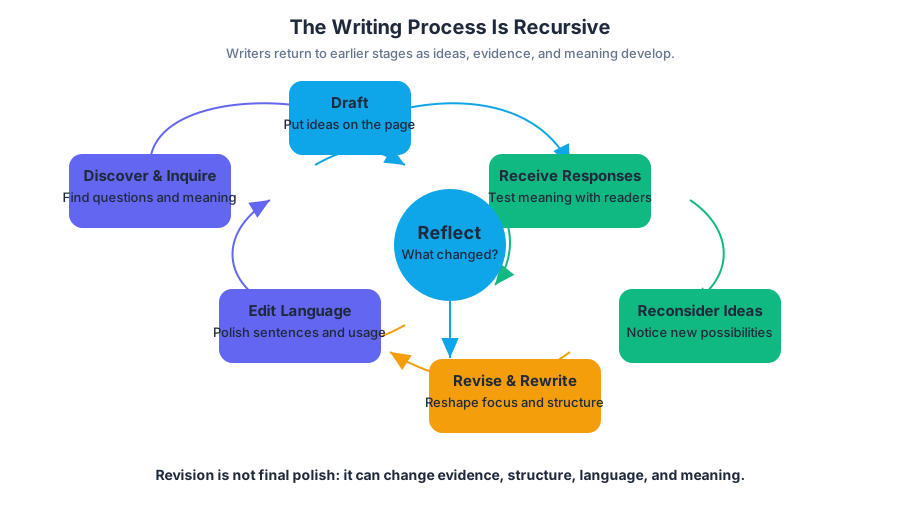
Writing rarely arrives as a finished sentence in the mind; it develops through repeated movement among discovery, drafting, response, and revision. A literacy narrative makes that movement visible by asking a writer to examine how reading, writing, language, or communication became meaningful in the writer’s life.
Summary of Assignment: Independent Literacy Narrative
An independent literacy narrative is a personal account of the experiences through which a writer’s literacy developed. “Literacy” here is broader than learning to read and write in school. It can include discovering a language, learning a family storytelling practice, becoming comfortable with a dialect, interpreting written instructions, using books or music to understand the world, or finding a voice in a community. The goal is not merely to list events but to trace how those experiences shaped the writer’s identities, beliefs, and ways of communicating.
The assignment asks the writer to compose a unique narrative that reflects personal experiences and identities. The development of literacy can take multiple paths, so the narrative does not need to follow a standard school-success story. A writer might describe gaining confidence, confronting linguistic prejudice, learning from an unexpected source, or recognizing that literacy is connected to culture and belonging. The important question is what changed in the writer’s understanding or ability to communicate.
A narrative becomes stronger when it combines a specific event with reflection. The event gives readers something concrete to see and hear; the reflection explains why that moment matters. The writer therefore makes choices about which memories to include, what context readers need, and how the experience connects to language, identity, or culture. Audience awareness matters throughout: personal experience should be shared in a way that respects readers’ different backgrounds and follows principles of inclusivity and anti-racism.
A literacy narrative does more than report what happened; it shows how an experience contributed to the writer’s developing relationship with language and meaning.
Example passage: “At six, I could not read the recipe card my grandmother kept beside the stove. She handed me each ingredient and asked me to name it in Spanish. Years later, when I translated that card for my younger cousin, I understood that my first lessons in literacy had begun in the kitchen.”
This short passage selects two connected moments rather than recounting an entire childhood. The recipe card provides a concrete object, the Spanish vocabulary establishes a cultural and linguistic setting, and the final sentence supplies reflection. The writer also avoids presenting literacy as only English print proficiency. The narrative shows literacy as multilingual, relational, and connected to family knowledge.
Quick Launch: Defining Your Rhetorical Situation, Generating Ideas, and Organizing
Before drafting, define the rhetorical situation: the relationship among the writer, the audience, the purpose, and the circumstances in which the writing will be read. For an independent literacy narrative, the writer is the person interpreting a literacy experience; the audience is the group of readers who may not share that experience; and the purpose is to communicate what the experience meant and how it influenced the writer. These decisions prevent a personal story from becoming either a private memory with no explanation or a general statement with no lived detail.
Generating ideas begins with inquiry. The prompts connected to the assignment can help a writer identify moments when literacy began, changed, or became difficult. Possible starting points include a first encounter with a book, a family member’s instruction, a language shift, an unexpected source of learning, a conflict over pronunciation or dialect, or a moment when reading and writing affected participation in a community. The writer does not need to know the final meaning immediately. Composing is also a way to discover and reconsider ideas.
Observation can make an idea more precise. Ask what was visible, audible, physical, or emotional in the moment: Who was present? What words were spoken? What object, place, or text carries the memory? What did the writer understand then, and what can the writer understand now? These questions help distinguish a significant literacy experience from a broad topic such as “my education.”
Organization gives the emerging narrative a readable shape. A writer may arrange events chronologically, begin with a later realization and return to an earlier memory, or organize several moments around one central change. The best arrangement is the one that makes the transformation understandable to the intended audience. It need not reproduce the exact order in which the writer remembered everything.
Example passage: “I used to think my accent disappeared when I entered school. Then, during a presentation, a classmate repeated one of my words as a joke. I began listening to my voice differently—not because it had changed, but because I had started measuring it against someone else’s idea of correctness.”
The passage establishes a rhetorical purpose: it will examine how school changed the writer’s understanding of language. It begins with a belief, introduces a specific incident, and ends with a realization. That organization creates a clear line of inquiry. The writer could expand it by adding the exact word, the classroom setting, and the response of others, but the central rhetorical situation is already visible.
Drafting: Writing from Personal Experience and Observation
Drafting means producing an initial version that gives ideas, experiences, and observations enough space to develop. The first draft is not expected to be polished from beginning to end. Writers commonly imagine that effective authors compose a complete text in one attempt and make only minor grammar and punctuation corrections. The writing process described here rejects that misconception: writing is typically recursive, meaning that writers return to earlier activities repeatedly and do not always follow the same order.
A draft should therefore prioritize discovery over perfection. Write from remembered experience, but test memory through observation. Specific details—an overheard phrase, the texture of a page, the arrangement of a room, a teacher’s gesture, or the silence after a correction—allow readers to enter the scene. Reflection then interprets those details. The writer moves between what happened and what the event means.
The narrative can also use deliberate language patterns. The textbook’s discussion of Helen Keller identifies reflective diction such as “remember,” “filled with wonder,” and “consider.” These words suggest an inward transformation rather than a merely physical event. A writer developing a literacy narrative can create a similar word bank for a particular change: terms associated with confusion, recognition, resistance, belonging, or confidence.
Example passage: “The letters on the page looked like scattered fence posts. I traced one line with my finger while my father sounded out the words beside me. When the sentence finally made sense, the room did not change, but it seemed to open.”
The passage drafts from sensory observation: the visual comparison, the finger tracing the line, and the father’s voice make the memory concrete. Its final contrast—“the room did not change, but it seemed to open”—communicates a mental transformation without claiming that anything physically moved. The writer can later verify details, deepen the reflection, or change the order. Drafting is a stage for finding that meaning, not proving that the first wording is final.
Because literacy is shaped by social and cultural relationships, drafting need not be solitary in its thinking. Conversations with classmates, instructors, family members, or members of a writing community can help a writer notice meanings that were invisible at first. Collaborative writing practices do not erase individual experience; they help the writer understand how that experience has been formed through language communities and relationships.
Peer Review: Giving Specific Praise and Constructive Feedback
Peer review is a collaborative exchange in which readers respond to a work in progress. Its purpose is not to judge the writer or repair every sentence. It is to help the writer see how the draft is working for an actual audience. Productive feedback identifies effective choices, asks focused questions, and suggests possibilities for development.
Specific praise is more useful than general approval. “This is good” does not tell a writer what to preserve. A helpful response names the feature and its effect: the opening places the reader inside the scene; the repeated language emphasizes uncertainty; the description of a family member makes the cultural context clear; or the final reflection explains why the event matters. Such comments show the writer which rhetorical choices are already succeeding.
Constructive feedback should also be precise and respectful. Instead of declaring that a draft is confusing, a reviewer can identify the point of confusion and ask for context: “I understand that the narrator felt excluded, but I want to know what was said immediately before this moment.” Instead of prescribing a single solution, the reviewer can offer a question or possibility. The writer remains responsible for deciding which feedback fits the narrative’s purpose, audience, and values.
Reviewers should attend to inclusivity and cultural sensitivity. A reader may ask for clarification without treating a different language, dialect, tradition, or identity as a defect. Feedback should distinguish between a genuine rhetorical problem—such as missing context—and a preference for familiar cultural or linguistic forms. This distinction makes peer review a social practice grounded in respect rather than conformity.
Example peer response: “The description of your mother correcting your pronunciation is vivid, especially because we hear the exact word she repeats. I wanted more context about whether her correction felt protective, embarrassing, or both. Adding one sentence about your reaction could make the later reflection on dialect easier to follow.”
This response gives specific praise, identifies a location for development, and explains the likely benefit of revision. It does not rewrite the narrative or assume what the writer felt. Its question leaves room for complexity: the correction may have been both caring and painful. That kind of feedback helps the writer add meaning rather than merely add words.
Revising: Adding and Deleting Information
Revising means re-seeing and reshaping a draft, not simply correcting grammar. Since the writing process is recursive, peer feedback may send the writer back to idea generation, organization, or drafting. Revision can add information that readers need, clarify a relationship between events, sharpen the central reflection, or make the narrative’s cultural and linguistic context more visible.
Adding is valuable when a detail performs rhetorical work. A writer might include a brief explanation of a family practice, identify who was speaking, describe the setting of a literacy event, or explain why a remembered phrase remains important. The test is not whether a detail is personally interesting but whether it helps readers understand the experience and its significance.
Deleting is equally important. A draft may contain repeated explanations, background that does not support the central change, or vivid details that lead readers toward a different story. Removing such material can give the key moment more emphasis. Deletion does not diminish the writer’s experience; it shapes that experience for a particular audience and purpose.
Language choices remain part of revision. Writers may reconsider sentence structure, multilingual expressions, grammar, punctuation, and spelling while also deciding what the narrative should say. Editing correctness is not the whole process, and standard English should not automatically replace meaningful linguistic variation. The writer chooses forms that communicate effectively in the rhetorical situation while preserving the narrative’s cultural and personal voice.
Example revision: Initial version: “My uncle taught me a lot about reading, and it was important because he helped me.” Revised version: “My uncle never defined reading as a school skill. He read bus schedules aloud, circled unfamiliar street names, and showed me that print could help our family move through an unfamiliar city.”
The revision adds concrete observations and deletes the vague phrase “a lot.” It also replaces a general claim—“it was important”—with evidence that lets readers understand the importance themselves. The revised passage makes literacy practical, social, and connected to movement through a city. Across the process, the writer develops the project through multiple drafts, uses composing to discover meaning, receives and acts on feedback, and treats writing as both an individual and collaborative activity.
Content adapted from OpenStax Writing Guide with Handbook by Michelle Bachelor Robinson, Maria Jerskey et al., licensed CC BY 4.0.
Source Materials
Study English Composition I on Lykke
This course page is free to open: signed out, you can read its first two sections, and signing in, on any plan, opens the rest. The free Lykke Chrome extension syncs your own Canvas courses, so ChatGPT, Claude and Muse can answer from your classes and deadlines. It only reads Canvas.
Add the free extensionSign in to open every sectionAll sections of English Composition I · Browse more course pages