From the free course English Composition I on Lykke
7.2 Trailblazer
Key concepts: Evaluation skills in everyday decision-making · The purpose and role of critics · Characteristics of review writing · Evaluation criteria and supporting evidence · Credibility and bias in reviews · Evaluation criteria across different subjects · Reviewing entertainment such as books, TV series, albums, podcasts, plays, and video games · Analyzing horror through effectiveness and techniques · Analyzing images and setting · Drafting review conclusions and using disciplinary formatting conventions
By the end of this section the student can: Read for inquiry, learning, and critical thinking.; Make judgments about the role of credibility and bias in the review genre.; Identify characteristics of review writing, including evaluation criteria and attention to historical context.
7.2 Trailblazer: Consistently Objective
A review is not merely a statement of whether someone liked a work. It is a reasoned judgment about quality, supported by evidence and shaped by clearly chosen criteria. The same habit appears in ordinary decisions: when people buy or use something, select sources for a paper, assess a presentation, evaluate a course, or respond to a peer’s writing, they compare options according to what matters to them. Evaluation, in other words, is a practical form of critical thinking rather than a specialized activity reserved for professional critics.
The central challenge is to make a judgment without disguising personal preference as universal truth. A reviewer must be consistently objective: fair about the work being evaluated, explicit about the standards being used, attentive to evidence, and honest about the perspective from which the judgment is made. Objectivity does not require pretending that the reviewer has no opinions. It requires showing readers how the opinion was formed.
Consistently Objective
The section presents the critic as someone who does two related jobs. Critics judge the overall quality of a work, but they also help readers gain insight into it. A review therefore does more than deliver a verdict such as “good,” “bad,” or “worth seeing.” It explains what the work is doing, identifies the features that matter, and uses those features to support an evaluation.
Michiko Kakutani describes reviewing as “a form of reporting” with the addition of the reviewer’s “carefully considered” judgment. The comparison to reporting is important. A reviewer must attend closely to what actually appears in the work before making claims about it. The reviewer observes, describes, and presents relevant details; then the reviewer interprets those details and reaches a conclusion. Personal reaction belongs in the review, but it should be disciplined by observation and reasoning.
A review combines reporting about a work with a carefully considered judgment about its effectiveness and quality.
Consider the difference between these two statements:
“I hated the film because it was boring.”
This sentence gives a reaction but not an evaluative explanation. It does not identify what “boring” means, offer evidence from the film, or account for the expectations created by the film’s genre. It asks the reader to accept the reviewer’s taste as sufficient proof.
A more objective review might say:
“The film’s suspense depends on long stretches of silence and delayed action. That pacing may suit viewers who expect a slow-building psychological drama, but it weakens the film’s effectiveness as a fast-paced thriller because the central conflict receives little development.”
This passage remains evaluative: it makes a judgment about the film’s effectiveness. However, it makes the judgment traceable. The reviewer identifies a feature—silence and delayed action—explains its effect on the audience, and connects the judgment to the expectations of a particular genre. The phrase “may suit viewers” also avoids presenting one audience’s preference as the only legitimate standard.
Objectivity Is a Method, Not the Absence of Perspective
A common misconception is that an objective reviewer must eliminate all personal response. The section’s treatment of criticism points in a more useful direction. Reviews necessarily include judgment, and critics are expected to evaluate a work. The goal is not to become emotionless; the goal is to make the basis of the judgment visible and defensible.
A reviewer’s perspective can influence which features receive attention. Someone familiar with a subject may notice technical details that another reader misses. Someone approaching a work as a member of its intended audience may judge it according to different expectations. These perspectives do not automatically invalidate a review. They become a problem when the reviewer hides them, treats them as universal, or allows them to replace evidence.
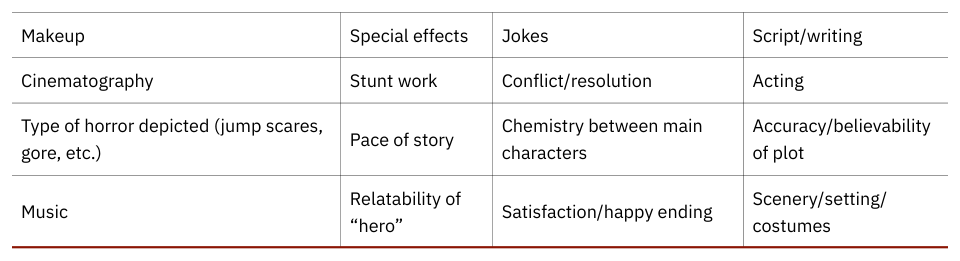
For example, a reviewer who dislikes horror films should not claim that a horror film fails simply because it is frightening. The relevant question is whether the film achieves the purposes associated with its particular genre. In a slasher-horror review, possible criteria include how effectively the killer creates fear, how the images and setting produce a creepy atmosphere, and how convincingly the victims display fear. A reviewer may still dislike the genre, but the review becomes more credible when it evaluates the film according to appropriate expectations rather than personal taste alone.
Criteria Make Judgment Consistent
An evaluation criterion is a standard used to judge a work. Criteria turn a general reaction into a set of answerable questions. Instead of asking only “Did I like it?” a reviewer asks questions such as: How effectively does the work achieve its purpose? How well does it meet the expectations of its audience? What qualities distinguish it within its genre? How convincing, coherent, or skillful is it?
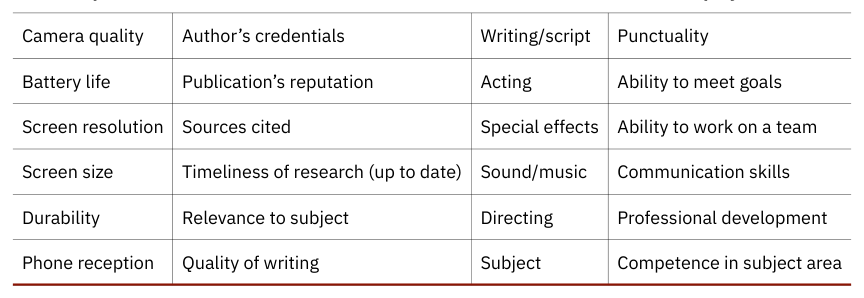
The reviewer does not use exactly the same criteria for every subject. The criteria must fit both the work and the audience’s expectations. A film review may consider acting, setting, pacing, or suspense; a review of a book may emphasize the quality of its writing, its ideas, or the writer’s competence in the subject area. Even within film, criteria change according to genre and subgenre. Audiences expect different things from a horror movie and a romantic comedy, so a reviewer must select standards appropriate to the work being discussed.
This choice is an act of reasoning. If a reviewer evaluates a romantic comedy only by asking whether it frightens the audience, the review is not rigorous; it uses an irrelevant standard. Likewise, judging a horror film solely by the standards of a light romantic comedy would miss the work’s intended effects. Appropriate criteria allow the reviewer to assess whether the work succeeds at what it attempts to do.
A concise example shows how criteria guide a judgment:
“The novel creates a convincing historical setting through its descriptions of work, clothing, and social expectations. Its dialogue, however, often uses modern expressions that weaken the impression of the period.”
The reviewer applies at least two criteria: historical effectiveness and language. The passage does not merely announce that the novel feels “real” or “unreal.” It identifies specific features that support both praise and criticism. This balance makes the evaluation more credible because the reviewer is willing to recognize strengths as well as limitations.
Evidence Connects the Criterion to the Judgment
Evidence is the concrete material that allows readers to test an evaluation. In a review, evidence may come from the work itself: a scene, image, character, passage, performance, design choice, or other specific detail. The reviewer may also use secondary sources when appropriate. The important relationship is between criterion, evidence, and judgment: the criterion states what matters, the evidence shows how the work performs, and the judgment explains the significance of that performance.
Without evidence, a review becomes an unsupported preference. With evidence but no criterion, it may become a list of observations that never develops into an evaluation. Strong review writing connects the parts. For instance, a reviewer might identify a film’s setting as a criterion, describe how the filmmakers create a threatening environment, and then explain how that environment increases the audience’s fear.
The reviewer should also distinguish between describing what happens and evaluating how well it works. “The victims scream and run through the house” is description. “The victims’ repeated, panicked attempts to escape make their fear convincing” is evaluation because it explains the effect of the detail. The second claim still needs evidence, but it shows the movement from observation to judgment.
Credibility Requires Fairness and Awareness of Bias
Credibility means that readers have good reason to trust a reviewer’s judgment. In this genre, credibility grows from careful attention to the work, relevant criteria, specific evidence, fair treatment of strengths and weaknesses, and appropriate awareness of audience expectations. A confident tone alone cannot create credibility. Readers must be able to follow the reasoning that leads from the work’s features to the reviewer’s conclusion.
Bias is a preference or predisposition that can influence judgment. Bias may arise from personal taste, prior knowledge, loyalty to a creator, unfamiliarity with a genre, or expectations about what a work should be. Bias does not mean that every conclusion is false. It means that the reviewer’s perspective may affect selection, emphasis, and interpretation. A credible reviewer manages this influence by acknowledging relevant expectations and grounding claims in evidence.
For example, a reviewer who strongly prefers realistic fiction may be tempted to dismiss a fantasy novel because its events are impossible. A more objective approach asks whether the novel establishes convincing rules for its imagined world, develops its characters, and fulfills the expectations of its genre. The reviewer’s preference can remain part of the perspective, but it should not substitute for evaluation.
Historical Context Prevents Present-Minded Judgment
Consistent objectivity also requires attention to historical context. A work belongs to a particular time, culture, genre, and set of artistic expectations. Evaluating it without considering those conditions can produce a distorted judgment. Historical context does not require excusing every weakness. It requires understanding what audiences, creators, and conventions shaped the work before deciding how effectively it operates.
A reviewer might examine an older work’s language, values, or representations and explain how they reflect its period. The reviewer can still identify harm, limitations, or artistic weaknesses, but the judgment should distinguish between the reviewer’s present expectations and the work’s historical circumstances. This distinction helps readers understand the work rather than reducing it to a reaction formed entirely from today’s assumptions.
The consistently objective reviewer therefore performs a careful balancing act: report accurately, choose criteria that fit the subject and audience, use specific evidence, recognize personal perspective, consider historical context, and reach a judgment that readers can examine. Objectivity is not the disappearance of the critic. It is the discipline that makes the critic’s voice useful.
Content adapted from OpenStax Writing Guide with Handbook by Michelle Bachelor Robinson, Maria Jerskey et al., licensed CC BY 4.0.

Source Materials
Study English Composition I on Lykke
This course page is free to open: signed out, you can read its first two sections, and signing in, on any plan, opens the rest. The free Lykke Chrome extension syncs your own Canvas courses, so ChatGPT, Claude and Muse can answer from your classes and deadlines. It only reads Canvas.
Add the free extensionSign in to open every sectionAll sections of English Composition I · Browse more course pages