From the free course English Composition I on Lykke
3.7 Evaluation: Self-Evaluating
Key concepts: First-person narration · Sequential actions · Navigating around another person · Spatial positioning at a sidewalk edge · Walking pace and movement · Locating and using a key · Inserting a key into a lock · Opening a door · Turning on a hall light · Entering an apartment
By the end of this section the student can: Gain experience negotiating variations in genre conventions.; Learn common formats and design features for different kinds of texts.; Identify how genre conventions for structure, paragraphing, tone, and mechanics vary.
3.7 Evaluation: Self-Evaluating
Self-evaluation is the deliberate process of judging your own writing against its purpose, audience, genre, organization, tone, and mechanics. It is not the same as asking whether you “like” a draft. A writer evaluates what the draft is trying to do, checks whether each part actually helps it do that work, and revises where the writing is unclear, incomplete, or mismatched to its genre.
What self-evaluation looks for
A useful self-evaluation treats a draft as a series of choices. Why is the narrator speaking in the first person? Why are the actions arranged in this order? Does the reader know where the narrator is standing and moving? Does the wording make the pace feel brisk, hesitant, or ordinary? Are the mechanics clean enough that the reader can follow the scene without stopping to decode it?
The central question is not simply Is this sentence grammatically correct? It is Does this sentence perform the job the passage requires? A sentence can be mechanically correct but poorly placed, too vague, too slow, or inconsistent with the passage’s tone. Conversely, a short fragment such as “Phew!” may be purposeful if the writing uses it to reveal the narrator’s immediate reaction.
Self-evaluation connects local choices—words, sentences, and transitions—to the larger purpose and conventions of the text.
Genre conventions are the recognizable expectations associated with a kind of writing. They influence structure, paragraphing, tone, mechanics, and design. A first-person action narrative normally emphasizes a narrator’s experience as it unfolds. An evaluation or review, by contrast, normally makes a judgment and supports it with reasons. A proposal organizes a problem and a solution differently from an analytical report. Self-evaluation means recognizing which conventions your draft has adopted and checking whether you use them consistently.
Evaluating first-person narration
First-person narration presents events through the speaker’s “I.” It can make a sequence immediate because the reader receives actions and perceptions from the narrator’s position: “I step,” “I see,” “I fumble,” and “I insert.” The form is especially effective when the writing needs to show what the narrator notices, does, or feels rather than describe events from a distant viewpoint.
When evaluating first-person narration, check whether the point of view remains stable. Ask:
- Is the narrator clearly the person performing or experiencing the actions?
- Does the passage report only what this narrator could reasonably know or observe?
- Do the verbs maintain a consistent relationship between the narrator and the events?
- Does the first-person voice add immediacy, or does “I” appear repeatedly without contributing meaning?
A common misconception is that using “I” automatically creates a strong personal narrative. It does not. First person is a perspective, not a substitute for detail. The writing becomes effective when the perspective controls what the reader sees: the approaching man, the sidewalk edge, the key, the lock, the open doorway, and the cold, congealed pizza on the counter.
Evaluating sequence and action
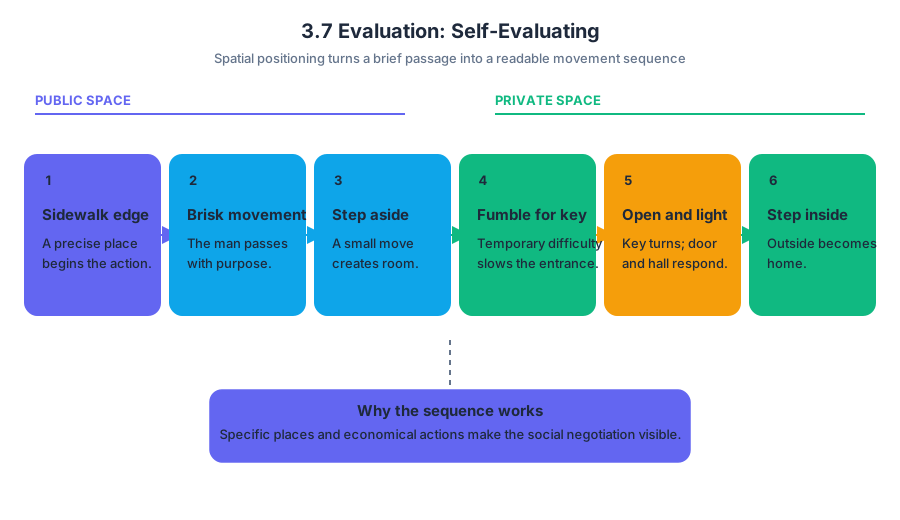
A sequential action passage presents events in the order they occur. The order matters because readers build a mental film from one movement to the next. In the scene, the narrator first makes room for another pedestrian, then reaches the apartment, searches for the key, unlocks the door, turns on the hall light, and enters. The sequence gives the reader a path through both time and space.
A self-evaluation should test whether any action has been skipped or placed ambiguously. For example, a complete entrance sequence might read:
I fumble for the key, locate it, align it with the lock, and insert it fully before turning it. I turn the key, push the door open, switch on the hall light, and step inside.
This version makes the physical chain explicit. The narrator does not merely possess a key and somehow arrive indoors. The passage shows locating the key, aligning it with the lock, inserting it, turning it, opening the door, turning on the light, and entering. During evaluation, the writer should ask whether a reader could reproduce the movement from the sentences alone.
Sequential writing does not require every microscopic motion. It requires enough of the necessary actions to prevent confusion. “I unlocked the door and entered” may be efficient when the mechanics of entry do not matter. But if the purpose is to narrate the experience closely, omitting the insertion of the key or the opening of the door creates a gap. The correct level of detail depends on the passage’s purpose.
Evaluating spatial positioning
Action also depends on spatial relationships. The narrator steps to the edge of the sidewalk so a man can walk briskly past. That detail does more than decorate the scene: it explains how two people avoid colliding and shows the narrator’s position relative to the other person. Without it, “I let a man pass” communicates the result but not the movement that produced it.
When evaluating spatial clarity, locate the people and objects before judging the prose. Ask:
- Where is the narrator?
- Where is the other person?
- Which direction is each person moving?
- What does “to the side” or “inside” refer to?
- Can the reader understand the movement without guessing?
Spatial positioning should remain economical. The passage does not need a map of the sidewalk, but it does need the decisive orientation: the narrator moves toward the sidewalk’s edge, allowing the man to pass. This is a useful example of evaluating detail by function. A detail earns its place when it clarifies action, develops the narrator’s experience, or contributes to the scene’s tone.
Evaluating pace and movement
Pace is the speed at which a passage seems to move for the reader. Sentence length, verb choice, and the number of actions grouped together all affect pace. “Walk briskly past” conveys faster movement than “move slowly by.” “I fumble for the key” slows the entrance and suggests difficulty or fatigue, while a series of direct verbs—“turn,” “push,” “switch,” “step”—can make the final movement feel quick and continuous.
Self-evaluation should compare the passage’s intended pace with the pace created by its sentences. If the narrator is meant to sound hurried, long explanations may interrupt the movement. If the narrator is meant to sound tired or distracted, the hesitation in “I fumble” may be important. The question is not whether fast writing is always better; it is whether the rhythm matches the event and the narrator’s experience.
Read the action aloud during revision. Listen for accidental jolts, missing transitions, or a string of identical sentence openings. Then identify the verbs carrying the movement. Strong action verbs make the sequence visible, but precision matters more than drama: “step,” “walk,” “fumble,” “insert,” “turn,” “push,” “see,” and “step inside” are effective because each names a recognizable action.
Evaluating tone and immediate response
Tone is the attitude or emotional quality conveyed by the writing. The exclamation “Phew!” interrupts the physical sequence with the narrator’s reaction. It may suggest relief after allowing the man to pass, relief at reaching the apartment, or simple breathlessness. During self-evaluation, determine whether such a word fits the surrounding voice and whether its meaning is sufficiently supported by the action.
Tone should not be judged by a universal rule such as “formal writing cannot use exclamations.” Different genres and purposes call for different conventions. A personal narrative can use conversational language and immediate reactions; a formal analytical report generally requires a more restrained tone. Effective self-evaluation asks whether the tone fits the genre, audience, and situation rather than treating one style as correct everywhere.
A practical self-evaluation pass
Evaluate a draft in separate passes instead of trying to fix everything at once. First, identify its purpose and genre. Then inspect the larger structure: does the passage begin where the action begins, proceed in a logical order, and end at a meaningful stopping point? Next, examine paragraphing and sentence boundaries. Finally, edit mechanics such as spelling, punctuation, capitalization, and verb consistency.
For the action passage, a focused evaluation might produce these judgments:
- Point of view: The repeated “I” establishes a first-person account and keeps the events attached to one narrator.
- Sequence: The sidewalk encounter precedes the apartment entrance; the entrance itself should show locating, aligning, inserting, and turning the key.
- Spatial clarity: Stepping to the sidewalk’s edge explains how the narrator navigates around the man.
- Movement and pace: “Briskly” gives the passerby speed, while “fumble” slows the narrator at the lock.
- Completion: “I turn the key, push the door open, and step inside” makes the transition into the apartment explicit.
- Tone and mechanics: “Phew!” conveys an immediate response, while punctuation and verb forms keep the sequence readable.
The final check should ask whether revision has improved the reader’s experience rather than merely increased the number of words. Good self-evaluation preserves purposeful details, removes accidental ambiguity, and adjusts the draft to the conventions of its genre. A writer who can explain why each major choice is present—and what would break if it were removed—is evaluating, not merely proofreading.
Source Materials
Study English Composition I on Lykke
This course page is free to open: signed out, you can read its first two sections, and signing in, on any plan, opens the rest. The free Lykke Chrome extension syncs your own Canvas courses, so ChatGPT, Claude and Muse can answer from your classes and deadlines. It only reads Canvas.
Add the free extensionSign in to open every sectionAll sections of English Composition I · Browse more course pages