From the free course English Composition I on Lykke
6.2 Trailblazer
Key concepts: Proposal writing about problems and solutions · Defining a problem and proposing a solution · Using evidence to support problems and solutions · Critical evaluation of sources and bias · Persuasive writing for practical change · Human error in medical care · Checklists as a problem-solving tool · Central-line-associated infections in intensive care units · The Pronovost checklist experiment · The World Health Organization surgical checklist
By the end of this section the student can: Describe a particular problem and a proposed solution; Discuss the process of identifying a problem and proposing a solution; Articulate how proposals to solve problems reach their intended audience.
6.2 Trailblazer
A five-step checklist helped doctors prevent infections caused by central venous lines, showing how a simple procedural change can address a serious medical problem when writers define the problem precisely and prove that the solution works.
Medical Problem Solver
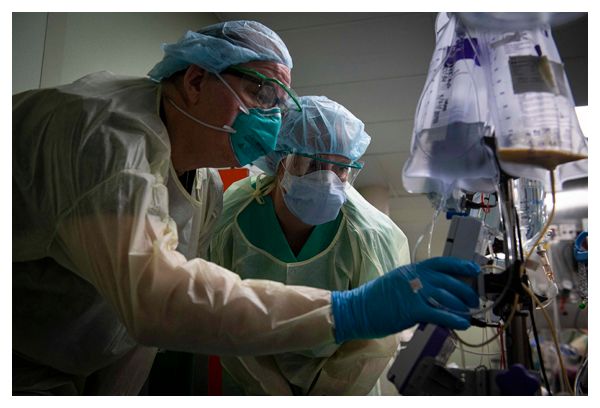
Doctors in intensive care units were developing infections after central venous lines were inserted. A central venous line is a tube placed into a large vein so that medical staff can deliver medication, fluids, or other treatment. The procedure is common and often necessary, but an infection can create additional illness, lengthen a hospital stay, and endanger a patient’s life. The important writing problem is therefore not merely “some patients get infections.” It is a preventable medical complication connected to a routine procedure.
Dr. Peter Pronovost identified human error as a central cause of the problem. Medical professionals may know the correct steps yet fail to complete one of them consistently, especially in a busy intensive care unit. Pronovost proposed a five-step checklist for inserting central venous lines. The checklist translated professional knowledge into a brief, repeatable procedure: rather than relying entirely on memory, the medical team could verify each important action.
Pronovost tested the checklist in an intensive care unit, where it successfully reduced infections. The significance of the test lies in the connection between problem, intervention, and result: the problem was preventable infection; the solution was a checklist designed to reduce procedural mistakes; and the evidence was a measurable reduction in infections after the checklist was used. Other checklists addressed additional intensive-care problems, demonstrating that the method could apply beyond one procedure.
Dr. Atul Gawande extended this problem-solving approach to surgery. Working with a World Health Organization team, he helped develop a surgical checklist aimed at preventing complications and deaths that could occur during operations. The checklist reduced surgical complications and deaths by an average of more than $35%$, with no additional costs. The proposal was persuasive because it presented both a serious problem and a practical intervention whose benefits could be measured.
Defining a Problem and Proposing a Solution
A proposal does more than announce that something is wrong. It explains what the problem is, who or what it affects, why it matters, and what change could address it. A useful problem statement narrows a broad concern into a specific situation that research can investigate.
A strong proposal establishes that a problem is real, significant, and in need of a solution.
Pronovost’s problem definition is stronger than a vague claim such as “hospitals need improvement.” It identifies a particular setting, a particular procedure, a particular harm, and a cause that can be addressed: patients in intensive care units were developing infections after central venous lines were inserted, and inconsistent human performance contributed to the danger. That definition makes a checklist appear relevant rather than arbitrary.
A solution claim should be equally specific. “Doctors should be more careful” places responsibility on individuals without giving them a reliable method. “Medical teams should use a five-step checklist when inserting central venous lines” identifies an action that can be implemented and evaluated. The difference is crucial: a proposal must move from concern to an intervention, not simply express dissatisfaction.
Problems in proposals are often complex even when a solution looks simple. Human error may involve time pressure, communication, hierarchy, training, workplace habits, and assumptions about who is responsible for checking a procedure. A checklist does not eliminate every cause of infection, but it can address one important cause. Effective proposal writing acknowledges that distinction instead of claiming that one tool solves an entire system.
A useful working model is:
- Problem: What is happening, and to whom?
- Significance: What harm or cost results?
- Cause or contributing condition: Why does the problem occur?
- Solution: What action addresses that cause?
- Evidence: What shows that the problem exists and that the solution is promising?
- Audience concern: What might readers question, resist, or value differently?
For example, a writer might transform research into this compact argument: “In intensive care units, patients can develop infections after central venous lines are inserted. Because medical teams may omit essential steps during a complicated procedure, a short checklist can make those steps visible and repeatable. Pronovost’s ICU test found that the checklist reduced infections, supporting its use as a low-cost safety measure.” Each sentence performs a different job: defining the harm, identifying a cause, proposing an action, and connecting the action to evidence.
Using Evidence to Support Problems and Solutions
Pronovost and Gawande had to persuade doctors who might reasonably doubt that a simple checklist could improve sophisticated medical care. Their proposals therefore relied on more than personal conviction. They used articles in medical journals and evidence from their experiments. Medical-journal articles supplied research and professional context; the experiments showed what happened when the proposed procedures were used in practice.
Evidence in a proposal must support both sides of the argument. Evidence about infections or surgical deaths can establish that the problem is serious, but it does not automatically prove that a checklist will help. Evidence about a successful checklist can support the solution, but it does not by itself show that every hospital will experience identical results. A careful writer matches each piece of evidence to the claim it actually supports.
Evaluating the Medical Evidence
Critical evaluation means asking how evidence was produced, not merely repeating an impressive number. Pronovost’s account describes a practical test of a checklist in an intensive care unit. The intervention was the checklist, and the outcome was a reduction in infections. This is useful evidence because it observes a change in a real medical setting rather than discussing the idea only in theory.
At the same time, a critical reader should identify what the account does not establish. The description does not provide the exact number of patients, the length of the study, the comparison method, or every condition that might have changed during the test. If the test occurred in one ICU, its results may not automatically apply to every hospital. Infection rates might also be affected by staff training, supplies, leadership, patient conditions, or other safety improvements introduced at the same time.
The WHO surgical-checklist result offers broader support because it reports an average reduction of more than $35%$ across the participating settings described by the project. Yet “average” matters: individual hospitals may have experienced different results. A writer should ask how complications and deaths were measured, whether the participating hospitals represented other hospitals, and whether the results were tracked long enough to show a durable effect. The reported lack of additional cost strengthens the practical case, but it does not answer every question about implementation or staff workload.
Possible bias also deserves attention. Pronovost and Gawande were advocates for checklists, so they had a professional reason to emphasize successful outcomes. A hospital that volunteered for a checklist project might already have unusually motivated staff. Medical journals may give more attention to successful interventions than to unsuccessful ones. These possibilities do not make the evidence worthless; they indicate why a proposal should look for corroboration in additional studies, hospitals, or medical organizations rather than treating one favorable result as final proof.
When evaluating a source, ask:
- What is the source’s purpose: to inform, persuade, report research, or promote a program?
- What facts, measurements, and observations does it provide?
- What opinions or interpretations does it add?
- What language does it emphasize, and what information might it minimize?
- Who conducted or funded the work, and what interests might shape the presentation?
- What are the study’s sample, setting, comparison, and measures?
- Do other credible sources support, complicate, or challenge the finding?
These questions apply the critical-reading practices of distinguishing fact from opinion and recognizing bias. A source can contain accurate facts and still present them selectively. “Complications fell by more than $35%$” is a reported result; “therefore every hospital must adopt the checklist immediately” is a recommendation that requires further reasoning. Keeping those statements distinct prevents a proposal from turning evidence into exaggeration.
Persuasive Writing for Practical Change
Persuasion in a practical proposal depends on readers’ circumstances and values. Doctors may worry that a checklist questions their expertise, slows urgent care, or creates unnecessary paperwork. Nurses may view the checklist differently, especially if it gives them a recognized role in confirming that each step has been completed. Administrators may focus on cost, patient safety, liability, and implementation. The same evidence can therefore produce different reactions among different readers.
A persuasive writer anticipates those reactions instead of treating resistance as ignorance. The proposal can explain that the checklist is not a replacement for medical judgment; it is a memory and communication aid for a procedure whose essential steps should not be skipped. It can also address the practical concern that the intervention adds no additional cost in the surgical example. Responding to audience concerns makes the proposal more credible because it demonstrates awareness of trade-offs.
The doctors’ challenge was rhetorical as well as medical: they needed to persuade professionals with substantial authority that a simple procedural change could improve expert practice. Their success came from combining a clearly defined problem, a workable solution, relevant research, and results from real experiments. The lesson for any proposal writer is not that simple solutions are always sufficient. It is that a simple solution can be persuasive when it targets a specific cause and is supported by trustworthy evidence.
For a proposal about a campus or community problem, use the same discipline. Do not select only statistics that favor the desired solution. Explain the problem’s scope, identify the people affected, investigate competing explanations, evaluate the credibility and limitations of sources, and state what the evidence can—and cannot—prove. Readers are more likely to accept a recommendation when the writer treats them as decision-makers who deserve accurate information rather than as an audience to be pressured.
Discussion Questions
- How did Pronovost and Gawande define the problems they were trying to solve? What details made those problems specific rather than vague?
- What evidence supported their proposed solutions? Which evidence established that the problems were real, and which evidence addressed whether the checklists worked?
- What limitations might affect how confidently the ICU and WHO findings can be generalized to other medical settings?
- What possible professional or institutional biases could shape how doctors, nurses, hospitals, or medical journals respond to checklist evidence?
- Who was the audience for the doctors’ proposals, and why might some audience members have resisted the checklist?
- In what ways is the problem both simple and complex? How does a short checklist address only part of a larger system of medical care?
Content adapted from OpenStax Writing Guide with Handbook by Michelle Bachelor Robinson, Maria Jerskey et al., licensed CC BY 4.0.
Source Materials
Study English Composition I on Lykke
This course page is free to open: signed out, you can read its first two sections, and signing in, on any plan, opens the rest. The free Lykke Chrome extension syncs your own Canvas courses, so ChatGPT, Claude and Muse can answer from your classes and deadlines. It only reads Canvas.
Add the free extensionSign in to open every sectionAll sections of English Composition I · Browse more course pages