From the free course English Composition I on Lykke
6.4 Annotated Student Sample: “Slowing Climate Change” by Shawn Krukowski
Key concepts: Evidence: facts, statistics, and information based on research or original thought · Thesis as the main idea conveyed in a proposal · Developing ideas across proposal paragraphs · Using and citing evidence to build credibility · Identifying evidence sources within a text and in source citations · Annotated student sample titled “Slowing Climate Change” by Shawn Krukowski · Proposal presentation title slide · Problem slide addressing the effects of climate change · Numerical callouts as visual summaries of climate and weather statistics · Visual structure using a light grey-blue background divided into sections
By the end of this section the student can: Identify the features common to proposals.; Analyze the organizational structure of a proposal and how writers develop ideas.; Articulate how writers use and cite evidence to build credibility.; Identify sources of evidence within a text and in source citations.
6.4 Annotated Student Sample: “Slowing Climate Change” by Shawn Krukowski
A proposal becomes persuasive when its central claim, paragraph-level ideas, evidence, and source citations all point in the same direction. Shawn Krukowski’s “Slowing Climate Change” makes that alignment visible by presenting a climate problem through organized claims, numerical evidence, visual design, and source information.
Introduction
The proposal was written by first-year composition student Shawn Krukowski. Its subject is climate change, and its form is a proposal presentation: it identifies a problem, presents evidence that the problem deserves attention, and moves toward possible responses. The sample gives readers an opportunity to study not only what a proposal says but also how its ideas develop and how its evidence earns credibility.
A thesis is the main idea a writer conveys in a proposal. It should guide every paragraph or major presentation section. A thesis is not merely a topic such as “climate change” or “extreme weather.” It makes a claim about that topic and gives the proposal a direction.
Thesis: The main idea conveyed in a proposal and the idea to which all paragraphs in the paper should relate.
For example, “Climate change affects the weather” identifies a subject but does not clearly propose an argument. A more focused thesis might be: “Because climate change contributes to increasingly dangerous extreme-weather conditions, communities should combine emissions reductions with adaptation planning.” The second statement gives later sections work to do: establish the problem, explain its consequences, and support a response.
Each paragraph or slide should connect visibly to that governing idea. A topic sentence states the main idea of a paragraph. In a written proposal, a topic sentence might read, “Recent hurricane statistics show why extreme weather requires immediate attention.” That sentence prepares readers for evidence about storms and hurricanes, while also linking the paragraph to the proposal’s larger claim.
A common misconception is that a thesis must appear only once, usually at the beginning. In practice, the thesis should continue to control the proposal even when it is not repeated word for word. Readers should be able to ask of every paragraph, slide, or visual: How does this develop the proposal’s main idea?
Evidence and Credibility
Evidence consists of facts, statistics, and information based on research or original thought. Evidence gives a proposal more than a personal reaction. It allows readers to see the basis for the writer’s interpretation and to judge whether the recommended response is reasonable.
Evidence can take several forms. A fact reports information that can be checked. A statistic expresses information numerically, often making a pattern or scale easier to see. Research-based information comes from a source such as a government agency or scientific organization. Original thought can also function as evidence when the writer contributes careful reasoning, observations, or analysis rather than simply asserting an unsupported opinion.
The distinction between evidence and opinion matters because proposals ask readers to accept a problem as significant and a solution as worthwhile. “Extreme weather is frightening” expresses a reaction. “The 2018 hurricane season broke records” presents a claim that requires supporting information. Krukowski’s presentation strengthens the second kind of claim by pairing it with numerical callouts and a source citation.
Writers build credibility when they use appropriate evidence and identify where it comes from. Credibility means that readers have reason to regard the writer and the argument as trustworthy. A confident tone alone cannot create credibility. Readers are more likely to trust a proposal when its claims are specific, its numbers are connected to a source, and its evidence clearly supports the point being made.
Developing Ideas Across Proposal Paragraphs
A proposal develops ideas by moving from a general claim to organized supporting points. The thesis establishes the proposal’s overall direction; topic sentences establish the direction of individual paragraphs or sections; evidence then supports those smaller claims. The result should feel cumulative rather than like a collection of unrelated facts.
For instance, a proposal about slowing climate change might develop in this order: first, it establishes that climate change produces serious effects; next, it explains why those effects matter to people and communities; finally, it presents mitigation and adaptation as responses. Each stage answers a different question while remaining connected to the thesis.
Krukowski’s presentation uses this kind of progression. The problem slide, titled “The Effects of Climate Change,” concentrates on evidence that makes the problem visible. The later “Mitigation and Adaptation” slide shifts from documenting the problem to presenting responses. That movement is important: a proposal should not jump to solutions before readers understand what problem the solutions address.
Annotated Student Sample
Another Lens: Reading the Proposal as a Visual Argument
Because Krukowski presents the proposal visually, design choices help organize the reasoning. Large numbers attract attention quickly, short statements provide context, and citations identify the basis for important claims. The slides therefore do more than decorate the words. Their arrangement tells viewers what to notice first and how individual pieces of information relate to the larger argument.
1. Title Slide
The title slide identifies the proposal as “Slowing Climate Change” and names Shawn Krukowski as its author. This information establishes the presentation’s subject and gives the audience an immediate sense of its scope. A title should orient readers without trying to make the entire argument at once; the supporting slides then develop the proposal’s problem and possible responses.
2. Problem Slide: “The Effects of Climate Change”
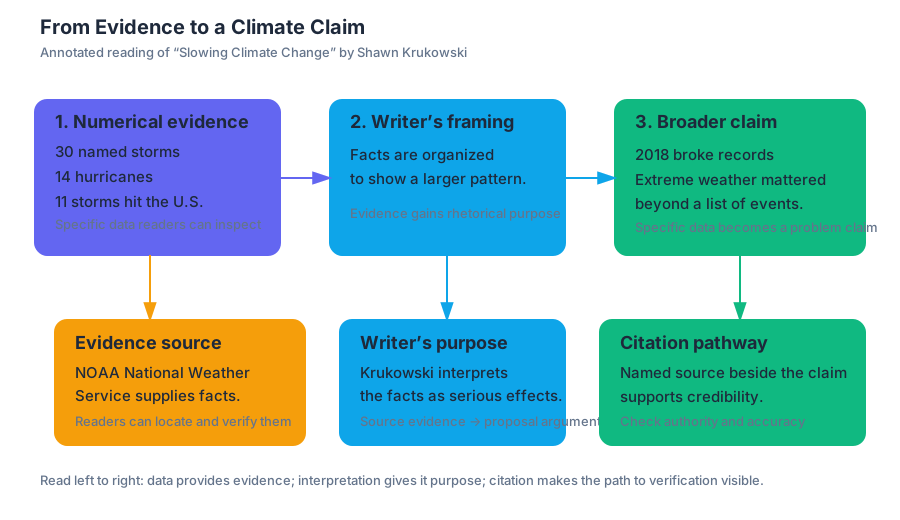
The problem slide uses a light grey-blue background divided into two main sections. On the left, a grid of numerical callouts summarizes climate and weather statistics. On the right, a text callout states, “EXTREME WEATHER: The 2018 hurricane season broke records,” followed by a citation to the NOAA National Weather Service.
The left-side grid includes the claims that 11 storms hit the U.S. coastline, that there were 30 named storms, and that there were 14 hurricanes. It also displays additional figures, including 10 named storms that formed in September, 7 major hurricanes, and 10 rapidly intensifying storms sampled. Presenting these figures as separate callouts lets viewers absorb the scale and variety of the evidence quickly.
The design also creates a relationship between numbers and interpretation. The numbers provide evidence; the right-side statement explains what the evidence means rhetorically: the season was not merely a list of weather events but an example of extreme weather that had broken records. The visual arrangement thus moves from specific data to a broader problem claim.
A useful annotation of the slide would read: The claim “11 storms hit the U.S. coastline,” along with the figures for 30 named storms and 14 hurricanes, supplies statistical evidence for the larger statement that the 2018 hurricane season broke records. The adjacent citation names the NOAA National Weather Service as the source. Because readers can use that source identification to locate and verify the reported information, the citation strengthens the presentation’s credibility.
This annotation demonstrates how to identify an evidence source in two places. First, inspect the evidence itself: the numerical callouts are the data being used. Second, inspect the citation beside the interpretive claim: the NOAA National Weather Service is the named source. A citation is not merely a formality after a sentence. It creates a path for readers to check the information, understand its authority, and determine whether the writer has represented it accurately.
Readers should also distinguish the source’s information from Krukowski’s interpretation. NOAA National Weather Service supplies the reported weather statistics or related factual information. Krukowski organizes those facts and uses them to argue that climate change has serious effects. The source provides evidence; the writer gives that evidence a purpose within the proposal.
3. Solutions Slide: “Mitigation and Adaptation”
The solutions slide, titled “Mitigation and Adaptation,” divides the light grey-blue space between a graph on the left and a text block on the right. The graph is titled “Global Carbon Emissions” and plots fossil-fuel carbon emissions in $GtC/yr$ from 1900 to 2100 under different scenarios.
The graph includes a higher scenario, labeled RCP8.5 and represented by a red line, and a lower scenario, labeled RCP4.5 and represented by an orange line. These contrasting lines help viewers compare possible future patterns rather than treating the future as a single guaranteed outcome. The visual supports the proposal’s movement from identifying a problem to considering choices and consequences.
Identifying Sources Within Text and Citations
When analyzing a proposal, locate evidence in the writer’s sentences, headings, tables, graphics, and numerical displays. Then locate the citation connected to that evidence. Ask three questions: What exactly is being claimed? What evidence supports it? Where did that evidence come from? These questions prevent readers from confusing an impressive-looking number with a verified fact.
In Krukowski’s problem slide, “30 named storms” and “14 hurricanes” are specific statistical claims. The NOAA National Weather Service citation identifies the source associated with the extreme-weather statement and its supporting data. That source information allows readers to verify the claim rather than relying solely on the presentation’s authority.
Strong proposal writing therefore depends on alignment: the thesis gives the argument its direction, topic sentences or slide headings organize its stages, evidence supports its claims, and citations show readers how to evaluate that evidence. Krukowski’s “Slowing Climate Change” demonstrates this alignment through both written language and visual presentation.
Content adapted from OpenStax Writing Guide with Handbook by Michelle Bachelor Robinson, Maria Jerskey et al., licensed CC BY 4.0.
Source Materials
Study English Composition I on Lykke
This course page is free to open: signed out, you can read its first two sections, and signing in, on any plan, opens the rest. The free Lykke Chrome extension syncs your own Canvas courses, so ChatGPT, Claude and Muse can answer from your classes and deadlines. It only reads Canvas.
Add the free extensionSign in to open every sectionAll sections of English Composition I · Browse more course pages