From the free course English Composition I on Lykke
4.2 Trailblazer
Key concepts: Memoir · Personal narrative · Emotional authenticity · Universal lessons from personal experience · First-person point of view · Exposition · Dialogue · Conflict and tension · Mood · Cultural depiction through language and detail
By the end of this section the student can: Read for inquiry, learning, and critical thinking to determine how authors develop personal narratives and memoirs; Identify composition techniques for personal writing in various rhetorical and cultural contexts.
4.2 Trailblazer
Memoir and personal narrative turn lived experience into meaning by showing not only what happened, but how the event was remembered, felt, and understood.
Memoir or Personal Narrative
A memoir is nonfiction writing about a part of the author’s own life, shaped by memory and reflection. The word comes from the French mémoire, meaning “memory.” A memoir does not promise to record every detail exactly as a camera would. Instead, it selects experiences that reveal the emotional truth or significance of a period, relationship, event, or lesson.
A personal narrative is nonfiction writing that typically centers on one major event or incident from the writer’s life. Through that event, the narrator reveals thoughts, feelings, related experiences, and a larger understanding. Both memoirs and personal narratives usually develop familiar narrative elements: setting, where and when the experience occurs; plot, the sequence of events; characterization, the presentation of people’s qualities and changes; and dialogue, the spoken interaction that helps scenes unfold.
Memoir focuses on how an author remembers part of a life. Personal narrative usually focuses on one significant event and what that event comes to mean.
The distinction is one of emphasis rather than an absolute boundary. A memoir might cover several connected experiences across a period of years, while a personal narrative might concentrate on a single afternoon, conversation, journey, or crisis. In either form, the writer narrows the material. A complete record of everything that happened would often become dry and tedious. Effective personal writing chooses details that support the experience’s core sentiment—the central feeling or emotional meaning the writer wants readers to understand.
For example, a writer recalling a family evacuation could list the time of departure, the route, the meals, and the weather. Those facts establish what happened, but they do not yet create an engaging narrative. A more purposeful selection might show a child guarding a paper photograph, a parent translating emergency instructions, and the family eating a makeshift meal in a crowded shelter. Each detail helps readers feel uncertainty, care, displacement, or resilience. The writing remains truthful while arranging memory for significance.
A common misconception is that personal writing should be “just about me.” The writer is the source of the experience, but the subject should lead toward something larger: a universal understanding, a lesson learned, or a common human experience. A story about one family, neighborhood, or difficult decision becomes meaningful when readers can recognize concerns such as fear, belonging, responsibility, loss, or courage. Specificity creates that connection; vague statements about “hard times” usually do not.
Emotional Authenticity and Larger Meaning
Emotional authenticity means presenting the core feeling of an experience honestly and convincingly. It does not require reporting every remembered detail, nor does it mean expressing emotion through exaggerated declarations. Instead, the writer selects concrete actions, sensations, thoughts, and interactions that allow readers to experience the situation with the narrator.
Consider the difference between these approaches:
I was extremely nervous about entering the interview.
This sentence names the emotion directly, but it gives readers little to imagine. A more vivid version might read:
I read the first question three times, although I had already memorized it, and kept my hand pressed against the folder so the papers would stop trembling.
The second version communicates anxiety through physical behavior. The repeated reading and trembling papers make the feeling observable. This is not emotional display for its own sake; it is evidence of the narrator’s inner state. Strong personal writing engages readers because it combines reflection with scene, allowing an experience to feel immediate without becoming melodramatic.
The larger meaning should emerge from the relationship between event and reflection. A narrator might describe failing to ask for help, then recognize that independence had been confused with isolation. Another might recount learning a family tradition and realize that cultural memory depends on ordinary acts of preservation. The event supplies the story; the reflection identifies why the story matters.
The Cultural Aspect
Culture—shared values, customs, arts, and traits of a social group—can be central to memoir and personal narrative. Personal writing offers a way to show how cultural practices shape daily life rather than treating culture as an abstract category. A family meal, a religious observance, a neighborhood gathering, a language choice, or a remembered historical event can reveal a community’s values and relationships.
Writers can depict cultural context through historical information, anecdotes, vivid details, and a specific, relevant variety of English. Historical information can explain why an event matters. Anecdotes can show how cultural knowledge is transmitted through particular people and moments. Vivid details can make customs, places, food, clothing, sounds, and gestures tangible. A relevant English variety can preserve the way people actually speak and can express identity, community, and belonging.
Language variety should serve the experience rather than appear as decoration. A narrator might retain a family expression, regional phrase, or community-specific term when its meaning and sound help readers understand the people involved. The writer can provide enough surrounding context for readers to follow the passage without treating the variety as an error that must be erased. This choice can deepen empathy because readers encounter culture through lived language, not merely through explanation.
For instance, a narrative about a grandmother teaching a traditional recipe might combine a brief explanation of the dish’s history, an anecdote about when it was prepared, sensory details of its texture and smell, and the grandmother’s actual phrasing. These elements work together: history supplies context, anecdote supplies human focus, detail creates immediacy, and language conveys relationship. Cultural writing becomes most powerful when it connects the particular practice to a broader human experience such as care, inheritance, adaptation, or home.
First-Person Point of View
First-person point of view tells the story through the narrator’s perspective, using pronouns such as “I” and “me.” Because memoir and personal narrative arise from the writer’s life, first person gives readers direct access to the narrator’s perceptions, limitations, emotions, and developing understanding. It does not mean the narrator knows everything. The writer can report what the narrator saw, heard, believed, feared, or misunderstood at the time.
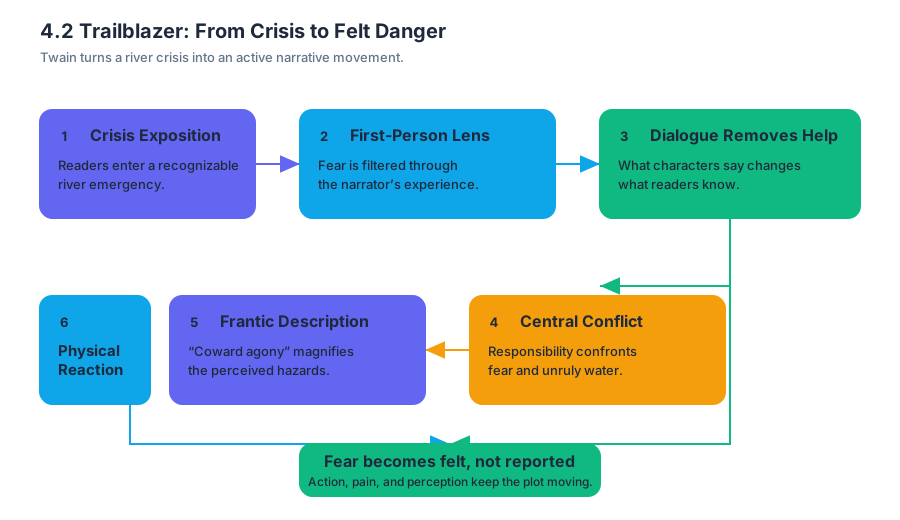
Mark Twain’s river-piloting passage demonstrates the energy of this point of view. The narrator recounts the experience as something happening to him, using first-person pronouns while describing his growing anxiety and physical attempts to control the boat. Readers do not receive an impersonal report about river navigation; they experience the danger through the consciousness of the person facing it.
First person also permits a useful contrast between past perception and present reflection. The narrator may show what he thought during the event and what he understands later. That distance creates depth: memory preserves the frightened or confused self, while reflection interprets the experience. A first-person narrator is therefore not merely a camera recording events but a consciousness selecting and making sense of them.
Exposition, Dialogue, and Conflict in Twain’s Passage
Twain’s passage begins with exposition, the introductory information that establishes a situation, context, or point of entry. The anecdote comes from the middle of a larger work, yet it opens in a way readers can follow. It introduces a recognizable problem—someone suddenly needs information or assistance during a dangerous situation—before developing the full pressure of river piloting. Exposition does not have to begin at the earliest moment in chronological history. It needs to orient readers well enough to understand the scene.
The passage then uses dialogue to move the action forward. The brief exchange “Where is Mr. Bixby?” followed by “Gone below, sir” is not ornamental conversation. It supplies information, interrupts the narrator’s uncertainty, and increases tension because the person who might help is unavailable. Dialogue advances plot when what characters say changes what the narrator or reader knows.
The dialogue also defines the central conflict: the narrator’s growing anxiety confronts the physical dangers of piloting the river. He must appear capable while facing conditions he cannot fully control. The river is not merely a setting in the background; it creates an active pressure that exposes the gap between responsibility and confidence.
Twain intensifies that conflict through description. Imagined shallow water, dangers that seem to multiply, and the phrase “coward agony” create a frazzled, frantic mood. The narrator’s mind does not calmly catalogue hazards. It magnifies them as fear takes hold. This demonstrates how description can reveal a character’s emotional state: the external world is filtered through the narrator’s distressed perception.
Physical reactions make the danger even more immediate. The narrator climbs the wheel “like a squirrel,” and the violent motion nearly dislocates every joint. The comparison gives readers a quick visual image of awkward, desperate movement, while the bodily consequences make the risk concrete. Instead of merely declaring that the narrator is terrified, Twain shows fear through frantic action, imagined threats, and physical pain.
Together, these choices form a compact narrative movement:
- Exposition places readers inside a recognizable crisis.
- First-person narration limits the scene to the narrator’s experience.
- Dialogue removes assistance and raises uncertainty.
- Conflict pits professional responsibility against fear and danger.
- Vivid description creates a frantic emotional atmosphere.
- Physical reactions make the danger felt rather than merely reported.
The result is personal writing that remains active and readable. Twain does not pause to explain every fact about the river or provide a complete biography of the narrator. He chooses the details that communicate the core sentiment: the terror and pressure of learning to pilot under dangerous conditions. The passage’s lesson is carried by the scene itself—through voice, movement, conversation, and sensation.
Writing Personal Experience with Purpose
When shaping a memoir or personal narrative, begin with the experience but do not stop at chronology. Ask what changed, what was revealed, what conflict became visible, or what readers might recognize in the event. Then choose the details that make that meaning credible: a telling object, a precise action, a line of dialogue, a sensory impression, or a physical response.
A focused narrative does not need to explain every emotion in abstract language. Let the narrator’s first-person perspective establish what was perceived; let exposition orient the reader; let dialogue alter the situation; let conflict create pressure; and let concrete details carry emotional authenticity. These techniques keep personal writing from becoming a dry inventory of memories while preserving the distinctive life and voice from which the story comes.
Content adapted from OpenStax Writing Guide with Handbook by Michelle Bachelor Robinson, Maria Jerskey et al., licensed CC BY 4.0.


Source Materials
Study English Composition I on Lykke
This course page is free to open: signed out, you can read its first two sections, and signing in, on any plan, opens the rest. The free Lykke Chrome extension syncs your own Canvas courses, so ChatGPT, Claude and Muse can answer from your classes and deadlines. It only reads Canvas.
Add the free extensionSign in to open every sectionAll sections of English Composition I · Browse more course pages