From the free course English Composition I on Lykke
1.5 Writing Process: Thinking Critically About a “Text”
Key concepts: Critical rhetorical analysis of everyday digital texts · Evaluating and verifying information from posts · Audience, purpose, and rhetorical situation · Cultural awareness in rhetorical communication · Genre conventions and their effects on structure, paragraphs, tone, and mechanics · Calls to action in digital communication · Researching specific claims to deepen discussion · Analyzing social-media texts such as Twitter/X threads · Using observation and background research as evidence · Adapting proposals to primary and secondary stakeholders and presentation formats
By the end of this section the student can: Develop and implement flexible strategies for reading and rereading.; Articulate how organizational features function for different audiences, creating cultural awareness within rhetorical situations.; Determine how genre conventions for structure, paragraphs, tone, and mechanics vary.; Identify common formats and design features for different kinds of text.; Read and write critically within social media platforms.
1.5 Writing Process: Thinking Critically About a “Text”
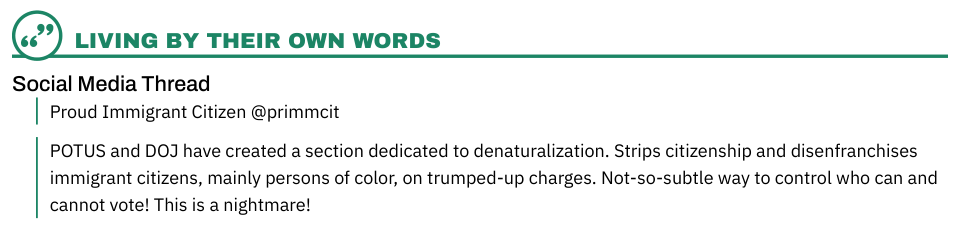
A social-media post is a text even when it is brief, informal, visual, or conversational. A thread, hashtag, comment, image caption, or reply makes choices about language, evidence, audience, tone, arrangement, and action. Critical reading begins when you stop asking only What does this say? and ask How does it work, for whom, and in what situation?
Critical Rhetorical Analysis of Everyday Digital Texts
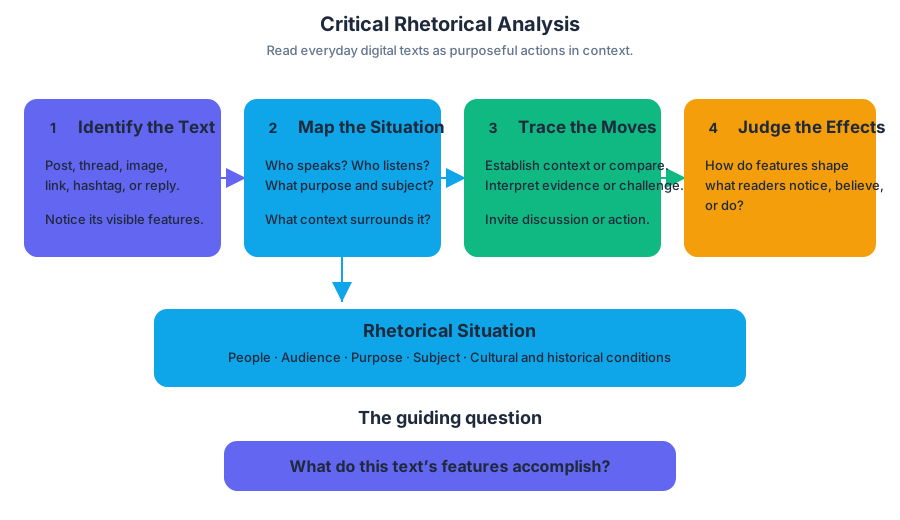
Critical rhetorical analysis means examining how a text’s features function within a particular rhetorical situation. A rhetorical situation includes the people communicating, the audience receiving the message, the purpose motivating it, the subject under discussion, and the cultural and historical conditions surrounding it. The same phrase, image, or hashtag can produce different effects for different audiences because readers bring different knowledge, experiences, assumptions, and expectations.
A casual digital text may look spontaneous, but it still performs rhetorical work. A Twitter/X thread, for example, might connect a historical event to a present political problem, infer a conclusion from available evidence, and end by asking readers to act. Its short posts, replies, images, links, hashtags, and sequence are not merely containers for information. They shape how readers encounter the argument and what they are invited to do with it.
One useful way to analyze a digital text is to separate its moves: the recognizable actions it performs. A post may establish context, make a comparison, interpret evidence, challenge an assumption, invite discussion, or issue a call to action. These moves often occur in compressed form. A writer may use one sentence to connect the past and present, another to draw an inference, and a hashtag to direct readers toward participation.
The important question is not whether a post sounds formal. The question is what its features accomplish. A conversational tone may make a message accessible and encourage replies. A historical reference may give a current claim greater depth. A photograph may create emotional force, while a link may provide supporting evidence. A hashtag may gather separate posts into a public conversation or tell readers how to find related information.
Reading and Rereading Digital Texts
Critical reading requires flexible strategies for reading and rereading. On a first reading, identify the apparent subject and main claim. On a second reading, examine the evidence, word choices, visual elements, organization, implied audience, and requested response. A third reading may test the post against outside information: Which statements are factual? Which are interpretations? Which details are missing? What would confirm or deny the information provided?
For example, imagine a post stating: “The rules changed again, and many voters are being forced to wait in line for hours.” A careful reader should not immediately treat every part of the statement as equally established. The claim may contain a verifiable fact about a rule, an observation about waiting times, and an implied judgment about voter suppression. The reader might research the relevant election authority, compare reporting from reliable sources, check the date and location, and look for evidence about who was affected.
Critical analysis should produce specific research questions rather than vague suspicion. Useful questions might include: What rule changed? When did it change? Which communities were affected? What evidence shows that the waiting time was unusual? Who has documented the experience? What historical patterns make this claim significant? These questions help a writer engage with and further a discussion instead of merely agreeing or disagreeing.
Evaluating and Verifying Information
Readers should identify what they learned from posts and determine how to confirm or deny the information provided. Verification is not simply searching for a repeated statement. It involves tracing a claim to evidence, checking its context, comparing accounts, and distinguishing what a source directly establishes from what a reader infers.
A practical analysis can sort a post’s content into three categories:
- Information: a claim that can potentially be checked, such as a date, location, policy, quotation, or event.
- Inference: a conclusion drawn from information, such as interpreting a pattern as evidence of discrimination.
- Call to action: an invitation to respond, share, contact someone, attend an event, vote, or otherwise become involved.
These categories may overlap, but separating them makes reasoning more precise. A reader might verify that a policy exists while continuing to investigate whether its effects were intentional, widespread, or unequal. Verification therefore strengthens discussion; it does not eliminate interpretation.
A common misconception is that digital informality makes critical analysis unnecessary. In fact, speed and familiarity can make analysis more necessary. A post that resembles ordinary conversation may still influence public opinion, spread unverified information, or mobilize a community. Its informal appearance should not be mistaken for neutrality.
Audience, Purpose, and Rhetorical Situation
A text’s meaning depends partly on its audience. The audience is not simply “everyone online.” It may include people already familiar with the issue, people who need background information, opponents, journalists, policymakers, community members, or people directly affected by the problem. Each audience may notice different features and respond differently to the same message.
Purpose also shapes rhetorical choices. A writer may want to inform readers, persuade them to adopt an interpretation, invite them into a discussion, or move them toward action. A post designed to alert a community may use urgency and brevity. A post designed to explain a complicated history may need links, definitions, and several connected entries. Analysis asks whether the text’s choices fit the purpose and the audience’s needs.
The hashtag #StayInLine illustrates how a digital text can function as a call to action against voter suppression. It does more than label a topic. It encourages people to remain in line when they might otherwise be discouraged from voting and helps connect individual experiences to a larger public response. The call assumes that the relevant audience understands—or can find out—what the hashtag means and how to become involved.
That assumption is rhetorically important. A hashtag may be immediately meaningful to people who know the political context but confusing to outsiders. A writer addressing a broader audience may need to explain the phrase, provide practical information, or link to organizations and election resources. The effectiveness of a call to action depends partly on whether readers know what action is being requested and believe they can take it.
Cultural Awareness in Rhetorical Communication
Rhetorical communication always occurs within culture. Cultural awareness means recognizing that language, symbols, historical references, humor, urgency, and acceptable forms of participation do not mean exactly the same thing to all readers. A message can feel obvious to one community and incomplete, offensive, or inaccessible to another.
This does not mean that writers must avoid making clear claims. It means they should examine the assumptions beneath those claims. Who is expected to understand the reference? Whose experience is treated as representative? Who is invited to participate, and who may be left out? What historical knowledge does the message assume? These questions make analysis more attentive to power, identity, and unequal access to information.
Cultural awareness also affects research. A writer investigating a public space, for instance, should not rely only on an official description of that space. Observation-based inquiry might involve visiting the location, conducting an hour-long observation, and researching its history. The writer could compare what the space appears to communicate now with how different communities have used, experienced, or contested it over time.
Genre Conventions and Their Effects
A genre convention is an expected feature of a kind of communication. Conventions may govern structure, paragraphing, tone, evidence, visual design, and mechanics. They help readers recognize what sort of text they are encountering and how to use it. A social-media thread, a proposal, a formal report, and a personal reflection do not organize information in the same way because they serve different rhetorical situations.
Genre conventions influence structure. A thread may divide one developing idea across multiple short posts. A proposal may identify a problem, explain why it requires attention, and recommend a viable solution. A formal academic text may use an introduction, focused body paragraphs, transitions, and documented evidence. These patterns are not arbitrary decorations; they guide readers through the writer’s reasoning.
Conventions also affect paragraphs. Digital posts may use short units because readers encounter them on small screens and move quickly through a feed. A proposal may use longer paragraphs to explain causes, effects, stakeholders, and evidence. A report may organize paragraphs around factual claims and their significance. Paragraph length should therefore serve the audience and purpose rather than follow a universal rule.
Tone and mechanics vary as well. A social-media post may use abbreviations, emojis, informal punctuation, or compressed syntax to create immediacy and community. A proposal intended for institutional decision-makers may require a more measured tone, complete explanations, and careful proofreading. Neither informal nor formal writing is automatically better; the relevant question is whether the choices fit the rhetorical situation.
When writing a proposal, audience analysis is especially important. The proposal should be shaped by its audience, including primary stakeholders, who may evaluate or approve it, and secondary stakeholders, who may be affected by it even if they do not make the final decision. Their knowledge, interests, concerns, and authority influence the proposal’s evidence, vocabulary, organization, and tone.
Presentation format should also be selected deliberately. A written proposal may be appropriate when readers need a detailed record, careful evidence, or a document they can review later. In another situation, visuals, charts, photographs, audio, video, or a different medium may communicate more effectively. Format is therefore part of rhetorical analysis, not an afterthought.
Calls to Action in Digital Communication
A call to action asks an audience to do something. The action may be public and collective, such as sharing information or joining a campaign, or practical and individual, such as contacting an official, remaining in a voting line, attending a meeting, or researching a local issue.
An effective call to action connects a problem to a possible response. In the #StayInLine example, the message identifies voter suppression as a threat and presents continued participation as one way people can resist it. The call depends on audience knowledge, but it can become stronger when the writer explains the issue and makes the next step clear.
When analyzing a call to action, ask four questions: What action is requested? Who is expected to take it? What information or cultural knowledge does the request assume? What evidence or emotional appeal makes the action seem necessary? These questions reveal whether a message merely expresses concern or gives readers a meaningful way to participate.
Critical rhetorical analysis ultimately turns reading into inquiry. Readers verify claims, identify assumptions, study genre conventions, attend to cultural context, and ask what a text enables its audience to understand or do. Writers then use those observations to make deliberate choices about evidence, organization, tone, mechanics, format, and action—the choices that allow communication to work in the world.
Content adapted from OpenStax Writing Guide with Handbook by Michelle Bachelor Robinson, Maria Jerskey et al., licensed CC BY 4.0.
Source Materials
Study English Composition I on Lykke
This course page is free to open: signed out, you can read its first two sections, and signing in, on any plan, opens the rest. The free Lykke Chrome extension syncs your own Canvas courses, so ChatGPT, Claude and Muse can answer from your classes and deadlines. It only reads Canvas.
Add the free extensionSign in to open every sectionAll sections of English Composition I · Browse more course pages