From the free course English Composition I on Lykke
2.8 Portfolio: Decolonizing Self
By the end of this section the student can: Write a reflection of your composition process and how it affects your work.; Apply the composing processes as a means to discover and reconsider ideas.
2.8 Portfolio: Decolonizing Self
A portfolio titled Decolonizing Self asks a demanding question: How have language, culture, and social power shaped the person you understand yourself to be? The question is not limited to ancestry or personal preference. It includes the stories you inherited, the languages and dialects you use, the communities that recognize you, the assumptions you have absorbed, and the systems that have taught you whose knowledge counts.
To decolonize the self, in this context, means to examine inherited ideas of cultural superiority and to make room for identities, languages, histories, and ways of knowing that dominant systems have ignored or devalued. It does not mean rejecting every aspect of a dominant culture, nor does it mean treating cultures as sealed, pure categories. It means noticing how power has influenced what appears “normal,” “educated,” “professional,” or “correct,” and then responding with greater awareness, respect, and agency.
Decolonizing yourself is an ongoing practice of recognizing how identity and knowledge have been constructed—and deciding more consciously how you will participate in that construction.
The Portfolio as a Collection of Cultural Evidence
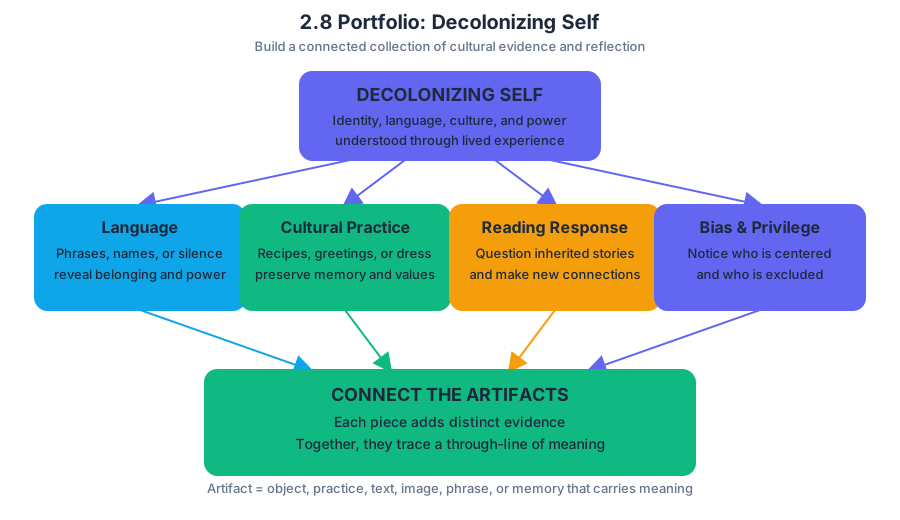
A portfolio gathers several pieces of writing or other artifacts so that, together, they reveal a developing understanding. In Decolonizing Self, the artifacts may include personal stories, reflections on language, observations of cultural practice, responses to readings, or analyses of bias and privilege. Each piece should contribute something distinct, but the collection should also have a through-line: a central understanding of how identity, language, culture, and power interact in your life.
An artifact is an object, practice, text, image, phrase, memory, or other piece of cultural evidence that carries meaning. A family recipe can be an artifact because it preserves history through food. A greeting, religious practice, song, item of clothing, photograph, nickname, or multilingual expression can also function as an artifact. The important question is not whether the object looks traditionally “cultural.” The important question is what it reveals about belonging, memory, values, exclusion, adaptation, or resistance.
For example, a student might choose a grandparent’s handwritten recipe, a childhood photograph, and a phrase used by relatives. The artifacts would not merely decorate the portfolio. The student might explain how the recipe records migration, how the photograph reflects a public expectation about family, and how the phrase signals membership in a particular linguistic community. The portfolio becomes persuasive through the connections among the artifacts and the student’s interpretation of them.
Writing as Your Artifact
Writing itself is one of the most important artifacts in this portfolio. The way you describe yourself, your family, your community, and other people reveals assumptions about whose perspective deserves authority. Your diction, tone, organization, examples, and choice of language all communicate values. A personal reflection can therefore be both an account of experience and evidence of how you have learned to interpret that experience.
The assignment’s suggested form extends the chapter’s use of trailblazer profiles. If several stories have been written, they can be collected into a class book with illustrations and a short quotation from the point of view of each artifact. This structure treats the artifact as more than an object being described. It gives the artifact a position from which to speak, while requiring the writer to make careful decisions about representation.
A short imagined quotation might read, “I traveled folded inside my mother’s suitcase, carrying a recipe she refused to translate.” The sentence is brief, but it establishes movement, memory, and resistance. It does not claim that the object literally thinks; it uses personification to make the artifact’s cultural significance vivid. The surrounding prose must then clarify whose interpretation the quotation represents and what evidence supports it.
Selecting an Artifact and Finding Its Significance
Choose an artifact that allows you to investigate a meaningful relationship among identity, language, and culture. Avoid selecting an object only because it seems visually interesting. Ask what it has done in a life or community. Has it preserved a language? Marked a boundary between insiders and outsiders? Helped someone adapt to a new place? Carried a religious, political, familial, or historical memory? Become embarrassing in one setting but valuable in another?
A useful selection process moves from observation to interpretation:
- Describe the artifact concretely. Record its appearance, sound, material, origin, use, and setting.
- Locate it socially. Identify who uses, owns, teaches, displays, avoids, or controls it.
- Trace its history. Ask what migration, conflict, tradition, discrimination, or adaptation surrounds it.
- Identify its tension. Look for a conflict between public judgment and private meaning, or between cultural preservation and pressure to assimilate.
- State its significance. Explain what the artifact helps you understand about identity and power.
Sequoyah’s Cherokee syllabary offers a powerful example of cultural significance. A written system was not simply a collection of symbols. It created a way for Cherokee speakers to communicate in writing, preserve knowledge, and strengthen identity and unity. The artifact’s importance came from the social work it performed. Likewise, a student’s artifact becomes meaningful when the portfolio explains what it preserves, challenges, enables, or makes visible.
Language, Identity, and Cultural Preservation
Language is not only a tool for transmitting information. It can preserve history, express belonging, and protect a community’s distinctive way of understanding the world. A shared language may connect people across distance and generations, as the Cherokee syllabary helped do. When a language or dialect is dismissed as inferior, the judgment can affect the people who speak it by treating their identity and knowledge as inferior as well.
Decolonizing writing therefore requires more than inserting a cultural reference into an otherwise conventional essay. It requires examining the standards used to judge communication. A writer may choose a formal academic register in one situation and a home language, dialect, or multilingual expression in another. The choice should be purposeful and rhetorically effective, not forced by the belief that one variety is inherently more intelligent or legitimate.
Consider the difference between these approaches:
My family stopped using our home language after moving because they wanted us to succeed.
This sentence identifies a change but leaves its pressures unexplored. A more analytical version might read:
After moving, my family used English in public and reserved our home language for private gatherings, a choice shaped both by practical opportunity and by the fear that other people would judge our speech.
The second version avoids presenting language shift as a simple personal choice. It acknowledges structural pressure, audience, public judgment, and family agency. Its purpose is not to accuse every individual listener, but to show how social expectations influence intimate decisions.
Examining Privilege, Bias, and Intersectionality
A decolonizing portfolio must examine not only marginalization but also privilege. Privilege is an unearned advantage or reduced obstacle associated with membership in a socially favored group. Privilege does not mean that a person has never struggled. It means that some aspect of identity may make particular opportunities, assumptions, or forms of credibility more available.
Intersectionality describes how identities and systems of power overlap. A person does not experience language, race, gender, class, religion, nationality, disability, or sexuality separately in neat compartments. These dimensions interact, producing experiences that cannot be understood by considering only one category at a time. A portfolio should therefore resist explanations that reduce a complex life to a single label.
Self-examination becomes stronger when it identifies specific moments rather than making broad declarations. Instead of writing, “I am open-minded,” describe a moment when you misunderstood someone’s speech, assumed a cultural practice was unusual, or recognized that an institution treated one group’s knowledge as standard. Then explain what shaped your first reaction, what challenged it, and what you understand differently now.
The goal is not to perform guilt or claim perfect awareness. The goal is to make assumptions visible so they can be questioned. A credible reflection distinguishes intention from effect: you may not have intended to exclude someone, yet your words or actions may still have repeated a harmful judgment. That distinction allows reflection to become responsibility rather than self-defense.
Representing Other People Ethically
When a portfolio includes family members, classmates, elders, or cultural communities, the writer becomes responsible for representation. Do not turn another person into a symbol whose only purpose is to teach the writer a lesson. Preserve complexity. Include the person’s own words when appropriate, explain the limits of your knowledge, and avoid claiming to speak for an entire culture based on one experience.
Personifying an artifact can make a portfolio imaginative, but it also requires care. The quotation from the artifact should illuminate the writer’s interpretation rather than replace the voices of living people. A caption, interview, family explanation, or historical source can help distinguish documented information from creative invention. If an artifact has a painful history, vivid language should serve understanding rather than turn suffering into decoration.
The same principle applies to cultural practices that are not your own. Describe them accurately, acknowledge who taught you about them, and avoid presenting unfamiliarity as evidence that a practice is irrational or backward. Ask whether your wording preserves the community’s dignity and whether your conclusions exceed the evidence available to you.
Shaping the Portfolio’s Arrangement and Voice
A portfolio needs an organizing principle. You might arrange artifacts chronologically to show change across generations, spatially to trace movement between places, or conceptually to move from language to family to institutions. The arrangement should help readers see relationships rather than encounter disconnected entries.
A concise portfolio introduction can establish the controlling idea:
The objects in this collection show how migration changed not only where my family lived but also which parts of our language we carried into public life. Together, they reveal that assimilation was neither complete nor voluntary; it was negotiated differently at home, at school, and at work.
This introduction makes an arguable claim and previews the portfolio’s pattern. The entries that follow should provide concrete description and reflection rather than merely repeat the claim. A conclusion can return to the central idea with greater complexity, explaining what remains unresolved and what the writer now notices in language, culture, and power.
The portfolio’s voice may combine personal directness with analytical precision. First person is appropriate when you are examining your own experience, but “I” should not become a substitute for evidence. Specific scenes, remembered words, objects, observations, and researched history give the reflection authority. The strongest voice is not the one that sounds most formal; it is the one that makes deliberate choices for its audience and purpose.
What a Successful Portfolio Makes Visible
A successful Decolonizing Self portfolio makes visible the forces that are often mistaken for personal preference. It shows how people learn which accents are rewarded, which histories are centered, which customs are treated as ordinary, and which identities are asked to explain themselves. It also shows agency: people preserve, adapt, remix, reclaim, and create culture rather than merely receive it.
The portfolio should leave readers with a more complicated understanding of identity. Culture is not a museum object frozen in the past; it is practiced and revised. Language is not merely correct or incorrect; it carries histories and relationships. Authenticity is not the absence of change; it can involve making conscious choices about what to inherit, what to question, and what to transform.
When writing becomes an artifact of that process, the portfolio does more than describe a self. It records a self learning to see the systems, stories, and words that helped make it—and learning to participate in cultural life with greater justice and care.
Content adapted from OpenStax Writing Guide with Handbook by Michelle Bachelor Robinson, Maria Jerskey et al., licensed CC BY 4.0.
Source Materials
Study English Composition I on Lykke
This course page is free to open: signed out, you can read its first two sections, and signing in, on any plan, opens the rest. The free Lykke Chrome extension syncs your own Canvas courses, so ChatGPT, Claude and Muse can answer from your classes and deadlines. It only reads Canvas.
Add the free extensionSign in to open every sectionAll sections of English Composition I · Browse more course pages