From the free course English Composition I on Lykke
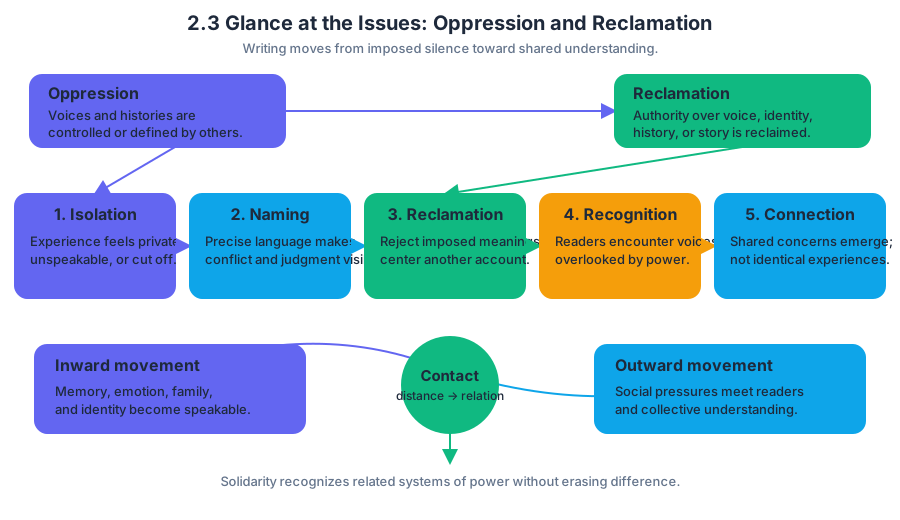
2.3 Glance at the Issues: Oppression and Reclamation
Key concepts: oppression · reclamation · isolation · Hong’s writing · people of color
By the end of this section the student can: Articulate how language conventions shape and are shaped by readers’ and writers’ practices and purposes.; Define oppression and explain its effects.; Define inclusion and summarize ways to write inclusively.
2.3 Glance at the Issues: Oppression and Reclamation
Language can make a person visible, reduce a person to a stereotype, or give a person room to define themselves. The words writers choose therefore do more than communicate information: they participate in relationships of power. Writing about identity and culture can turn personal experience into storytelling, and storytelling can become a purposeful message with meaningful rhetorical impact.
What Is Oppression?
Oppression is the unjust exercise of power that restricts people’s opportunities, dignity, freedom, or ability to represent themselves. It is not limited to one openly hostile action by one individual. Oppression can operate through institutions, social expectations, cultural habits, and language conventions that repeatedly advantage some groups while disadvantaging others.
Oppression occurs when power is used to limit another group’s humanity, choices, participation, or access to resources.
A useful distinction is the difference between interpersonal prejudice and systemic oppression. Prejudice is a biased belief or attitude held by an individual. Oppression is broader: it can continue even when no single person announces an intention to harm. For example, a workplace may describe one communication style as “professional” while treating the language practices of racial, ethnic, or cultural minorities as deficient. The convention appears neutral, but its effects are not neutral if it consistently rewards one group and pressures others to abandon part of their identity.
Language conventions are shaped by readers’ and writers’ practices and purposes. A convention is a commonly recognized way of using language—such as a vocabulary choice, grammatical pattern, pronunciation, genre, or tone. Conventions help readers interpret a text, but they also reflect whose language has historically been treated as authoritative. Writers must therefore ask not only, “Is this grammatically acceptable?” but also, “Who established this expectation, whom does it serve, and what happens to people who do not or cannot follow it?”
Oppression produces effects beyond immediate exclusion. It can create isolation, silence, fear, internalized shame, and the feeling that one’s experiences do not belong in public language. People may begin monitoring their accents, names, bodies, histories, or emotional responses to avoid punishment or ridicule. A writer addressing oppression can make these hidden pressures visible by showing how an apparently ordinary interaction carries unequal consequences.
For example, consider this short passage:
“The teacher corrected Maya’s pronunciation before asking what she meant. By the time Maya reached the important part of her story, the class had learned to listen for mistakes instead of meaning.”
The passage does not merely label the teacher as biased. It uses sequence and contrast to show the effect of the language convention: correction comes before understanding, and attention shifts from Maya’s ideas to her perceived errors. The writer’s choice to name Maya and describe the class’s changing attention restores her individuality while exposing the mechanism of exclusion.
Reclaiming Humanity
Reclamation is the process of taking back language, identity, history, or representation from forces that have distorted or denied it. A person or community reclaims humanity by insisting on being seen as complex, self-defining, and fully human rather than as a stereotype, problem, category, or object of someone else’s description.
Reclamation does not mean pretending oppression never occurred. It means refusing to let oppression provide the only available story. A writer may reclaim humanity by naming an experience directly, correcting a dominant description, preserving a cultural practice, using a community’s own terminology, or presenting a person’s contradictions and aspirations. These choices shift authority: the subject is no longer merely being observed but is participating in defining what the experience means.
The section connects reclamation with storytelling. Writing about identity and culture gives authors a vehicle for sharing personal experiences, but the goal is not simply confession. A personal story can make a larger argument about belonging, power, isolation, or recognition. The writer selects details, establishes context, addresses an audience, and arranges events so that an individual experience produces a meaningful rhetorical effect.
The discussion of Hong’s writing emphasizes how a writer can overcome isolation by turning a private or culturally specific experience into language that invites recognition without flattening difference. Hong’s approach demonstrates that writing can resist the pressure to assimilate completely or remain separated from readers. The writer can explain unfamiliar experiences, challenge assumptions, and create contact between people while retaining the specificity of the speaker’s identity.
A reclamation passage might read:
“They called my grandmother’s language broken. At home, it carried recipes, arguments, jokes, and the names of people we loved. I learned that a language judged by strangers could still be a complete world.”
The writer reclaims humanity through specific evidence rather than an abstract declaration. “Recipes, arguments, jokes” shows the language functioning across ordinary and intimate situations; it is not reduced to a symbol of ethnic difference. The final sentence changes the evaluative frame: the problem is not that the language is incomplete, but that outsiders have judged it by a narrow standard. The passage also builds connection with readers by beginning with a recognizable experience—being judged—while preserving the cultural meaning of the grandmother’s language.
Reclamation can involve difficult rhetorical choices. A writer may quote a hurtful term to expose its history, but must decide whether repeating it clarifies the argument or reproduces harm. A writer may explain cultural references for readers unfamiliar with them, but should avoid treating those readers as entitled to every private detail. A writer may use a community term that challenges mainstream usage, then provide enough context for readers to understand its significance. In each case, purpose and audience guide the choice.
Anti-racism as Inclusion
Inclusion means creating language and practices that recognize people’s presence, dignity, differences, and participation rather than treating one group as the unmarked norm. Inclusive writing does not simply add diverse names to an otherwise unchanged discussion. It examines whose perspectives are missing, which assumptions organize the text, and whether the language allows people to appear as agents with varied experiences.
The section presents anti-racism as an important form of inclusion. Anti-racism is active opposition to racial prejudice and to the structures, habits, and representations that maintain racial inequality. It requires more than claiming not to be racist. A writer practicing anti-racism pays attention to unequal power, avoids stereotypes, represents people of color as complex individuals, and questions language conventions that define whiteness as the default human experience.
Writing inclusively begins with accurate, respectful naming. Writers should use the terms people and communities use for themselves when those terms are known and appropriate. They should not assume that people of color share one culture, history, political view, or experience. “People of color” can identify the effects of racialization across groups, but it does not erase distinctions among those groups. Precision matters: a writer should name a particular community when the argument concerns that community rather than using a broad category as a substitute for research.
Inclusive writing also depends on agency. Compare these two sentences:
“The program gave a voice to people of color who had been ignored.”
“Residents organized a neighborhood archive and used it to document histories that local institutions had ignored.”
The first sentence may intend to praise the program, but it makes the program the actor and suggests that people of color had no voice until an outside institution supplied one. The second sentence gives residents agency: they organize, use, and document. It also identifies the institutions responsible for ignoring those histories. The writer’s grammatical choices therefore express an ethical and political judgment about who acts and who receives action.
Inclusive writing does not require avoiding every difficult subject or using vague language. It requires examining the consequences of a choice. Writers should provide relevant context, avoid presenting stereotypes as facts, distinguish an individual’s actions from an entire group, and represent people beyond accounts of suffering. Inclusion is strongest when people of color appear as thinkers, workers, artists, neighbors, experts, and narrators—not only as victims or evidence for someone else’s argument.
A common misconception is that anti-racist writing is less objective because it acknowledges identity and power. The section instead treats rhetorical awareness as a condition of responsible writing. Every writer chooses what to name, whose words to quote, what background to explain, and which perspective to center. Pretending that these choices are neutral can conceal exclusion; examining them makes the writing more accurate and accountable.
Exploring the Issues
The section’s exploration of oppression and reclamation brings together reading, interpretation, and writing. Readers are asked to notice how a text represents people, what forms of isolation it describes, and how its language either repeats or resists dominant assumptions. The question about Hong’s writing—how it works to overcome isolation—directs attention to rhetoric: the writer’s purpose, audience, choices of language, and arrangement of experience.
When analyzing a passage, begin by identifying the power relationship. Who speaks? Who is described? Who is treated as the audience, authority, problem, or norm? Then examine the language itself. Look for labels, pronouns, metaphors, passive constructions, cultural assumptions, and moments when a writer explains or refuses an expectation. Finally, connect those choices to effects: does the passage isolate, stereotype, invite recognition, restore agency, or challenge a hierarchy?
For example, a reader might analyze this passage:
“At the meeting, my name moved from one mouth to another until it became a joke. I wrote it on the sign-in sheet again, carefully, and introduced myself before anyone could rename me.”
The passage presents oppression through a small social event rather than through a general definition. The repeated movement of the name suggests public humiliation and loss of control. The final actions—writing the name and introducing oneself—reclaim agency. The writer’s use of first person keeps the experience embodied, while the concrete details allow readers to understand how a seemingly minor act can produce isolation. The passage does not claim that one encounter represents every person of color; it presents one experience whose implications readers can examine.
A strong response to the issues should connect language to purpose. If a writer wants to expose an exclusionary convention, direct description and carefully chosen examples may be effective. If the purpose is to build solidarity, a personal narrative may connect private experience to shared recognition. If the purpose is to propose change, the writer must identify the harmful practice, explain its effects, and describe a more inclusive alternative. In all three cases, the writer’s choices should preserve complexity rather than turning people into symbols.
The central practice is deliberate representation. Writers can ask: Does this language allow the people being discussed to define themselves? Does it acknowledge difference without treating difference as deficiency? Does it show both structural conditions and individual agency? Does it invite readers into understanding without demanding that one person speak for an entire group? These questions connect the section’s three outcomes: oppression names the unequal use of power, reclamation resists dehumanizing representation, and inclusion changes writing practices so more people can participate as full human subjects.
Content adapted from OpenStax Writing Guide with Handbook by Michelle Bachelor Robinson, Maria Jerskey et al., licensed CC BY 4.0.
Source Materials
Study English Composition I on Lykke
This course page is free to open: signed out, you can read its first two sections, and signing in, on any plan, opens the rest. The free Lykke Chrome extension syncs your own Canvas courses, so ChatGPT, Claude and Muse can answer from your classes and deadlines. It only reads Canvas.
Add the free extensionSign in to open every sectionAll sections of English Composition I · Browse more course pages