From the free course English Composition I on Lykke
7.5 Writing Process: Thinking Critically About Entertainment
Key concepts: Evaluative writing and film or television reviews · Critical analysis of representation and cultural perspective · Using claims, explanations, examples, direct quotations, and secondary sources as evidence · Evaluating how secondary sources support or weaken a review · Audience identification and the value of relatable characters · Entertainment as both enjoyable and educational · Revision strategies for eliminating repetition and strengthening emotion · Giving and applying productive feedback during the writing process · Adapting composing processes to different technologies and modalities · Organizing body paragraphs and conclusions in an evaluative essay
By the end of this section the student can: Compose a review based on a thesis supported by analysis and evaluation.; Demonstrate the steps of the writing process: invention, drafting, revising, and editing.; Participate in the collaborative and social aspects of writing processes.; Give and act on productive feedback to works in progress.; Adapt composing processes for a variety of technologies and modalities.
7.5 Writing Process: Thinking Critically About Entertainment
A film or television review does more than report whether a reviewer enjoyed a work: it makes a debatable judgment and supports that judgment with analysis. Evaluative writing is writing that assesses a subject according to meaningful criteria, such as characterization, representation, cultural perspective, storytelling, or audience appeal. A strong review can recognize that entertainment is enjoyable while also asking what it teaches audiences to notice, value, or overlook.
The writing process moves from invention to drafting, peer response, revising, and editing. At every stage, the writer makes choices: what to examine, what claim to make, which evidence to use, how to address an audience, and which suggestions to accept. The goal is not merely to summarize a film or show, but to compose a review based on a thesis supported by analysis and evaluation.
Summary of Assignment: Review of Primary Media Source
The assignment asks the writer to compose an original review of a primary media source—the film or television show being evaluated. Reviews can address many kinds of subjects, including books, films, television shows, restaurants, cars, and services. Here, the primary source is entertainment, but the review still performs the central work of the genre: it gives readers a reasoned basis for deciding whether, why, or for whom the subject is worth experiencing.
A review should therefore do more than retell a plot. Plot summary may orient readers who have not seen the work, but evaluation requires the writer to interpret what the work is doing and judge how effectively it does it. The reviewer might examine a character’s construction, the treatment of race or gender, the cultural perspective shaping the story, or the relationship between the work and its intended audience.
The section’s examples show how entertainment can be both pleasurable and educational. A review of Crazy Ex-Girlfriend can acknowledge its “catchy songs” and “clever dialogue” while also evaluating Rebecca Bunch as intense, extreme, relatable, and sympathetic. A discussion of Black Panther can consider the film’s entertainment value alongside its representation of Black identity, history, and culture. Enjoyment and criticism are not opposites: pleasure can be one criterion, while cultural meaning and representation can be others.
A useful review also identifies its audience. Readers may want to know whether a show suits viewers who enjoy romantic comedy, musical numbers, complex protagonists, or stories that challenge familiar representations. Audience matters because a work’s strengths and weaknesses do not affect every viewer in the same way. The question is not simply “Is this good?” but “How well does this work achieve its effects, and for which audience?”
Example passage: “Crazy Ex-Girlfriend combines romantic-comedy conventions with sharp songs and psychologically complicated choices, making it a strong recommendation for viewers who want humor without a perfectly virtuous heroine.”
This short passage summarizes only the minimum premise needed for context, then evaluates the show through criteria: genre, musical style, characterization, and audience. Its final phrase turns the judgment into a recommendation rather than an unsupported statement of personal taste. The writer’s task is not to hide personal response, but to connect that response to reasons readers can assess.
Quick Launch: Developing Evaluative Criteria
Before drafting, the writer develops evaluative criteria, or standards used to judge the primary source. Criteria prevent a review from becoming a sequence of impressions. Instead of beginning with “I liked it” or “I hated it,” the writer asks what features matter for this particular work and what evidence would show success or failure.
The criteria should grow from the chosen subject and angle. A review of a romantic comedy might examine whether the central relationship is convincing, whether the female lead is treated as a full character, or whether the comedy depends on familiar stereotypes. A review of a film such as the 1961 version of A Raisin in the Sun might focus on how Lena Younger is depicted, including the critical description of her as a “tyrant.” The important move is to select a specific feature rather than attempt to evaluate everything at once.
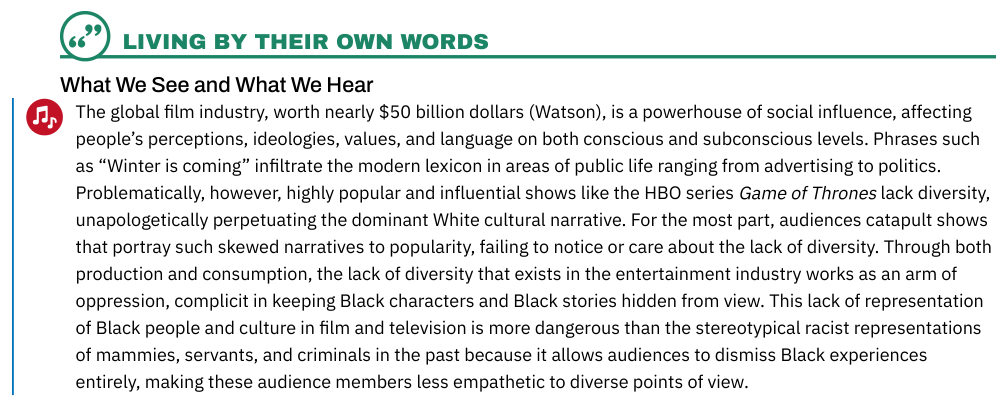
Critical analysis of representation requires especially careful criteria. The writer can ask who receives narrative attention, how a character’s identity shapes the story, whether the work repeats or challenges cultural assumptions, and what perspective the work makes visible. The discussion of Number 37, for example, connects violence, an African setting, and a paralyzed Black protagonist to a larger social narrative about poor Black people after apartheid in South Africa. The film’s plot becomes evidence for a claim about representation rather than an end in itself.
Criteria also include audience and relatability. A character may be compelling because audiences recognize parts of their own experience, but a work need not make every character familiar or comfortable to be valuable. The reviewer should explain whether relatability deepens sympathy, limits the story to a narrow perspective, or invites viewers to understand lives different from their own. A thoughtful review can compare the advantages and disadvantages of characters audiences can and cannot easily relate to.
Example passage: “The film succeeds not because every viewer can identify with its protagonist, but because its unfamiliar perspective asks viewers to reconsider whose fear, ambition, and vulnerability deserve attention.”
The passage uses representation and audience perspective as criteria. It avoids treating relatability as the only measure of quality; instead, it argues that distance from a character can produce a worthwhile educational effect. That distinction matters because entertainment may offer recognition, challenge assumptions, or do both.
Drafting: Thesis Statement, Analysis, and Supporting Examples
Drafting turns selected criteria into a thesis, a debatable main argument about the primary source. The section describes the thesis as one sentence, sometimes two, that clearly states the argument. A thesis is not merely the subject—“This review discusses Crazy Ex-Girlfriend”—or a reaction—“I liked the show.” It takes a position that readers could reasonably question.
The section’s model argues that Rebecca Bunch is “flawed and not virtuous,” and that her shortcomings make her more engaging than traditional romantic-comedy female leads. This thesis makes a comparison, identifies a characteristic, and explains why that characteristic matters. It gives the body paragraphs a direction: each paragraph can analyze a specific flaw, convention, scene, or contrast that supports the larger judgment.
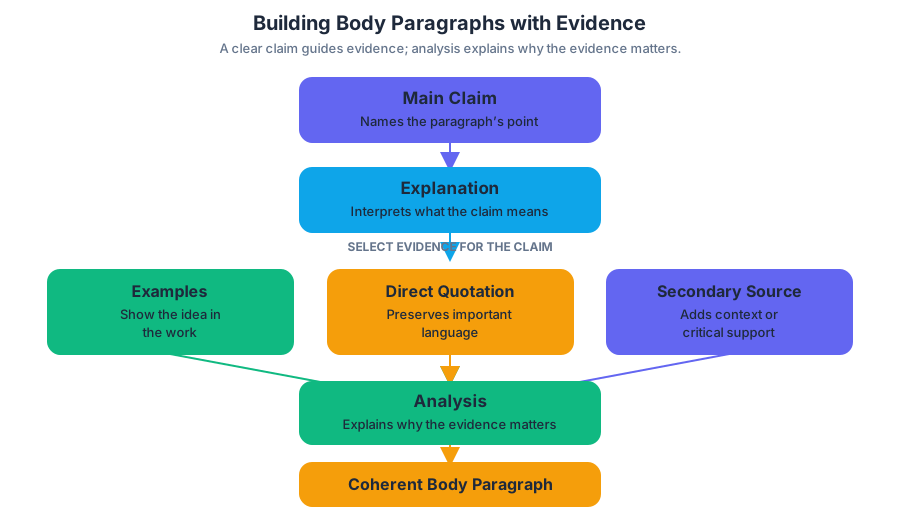
Analysis explains how evidence supports the thesis. A body paragraph may begin with a claim, develop an explanation of that claim, offer a concrete example from the film or show, and incorporate a direct quotation or secondary source when useful. Secondary sources are outside materials—such as criticism, scholarship, interviews, or cultural commentary—that help a writer interpret or contextualize the primary source. They do not replace the writer’s own analysis.
The writer must evaluate secondary sources as carefully as the entertainment being reviewed. A source can strengthen a review by supplying historical context, a critical perspective, or language for identifying a pattern. It can weaken the review when it is irrelevant, unreliable, misrepresented, or used as a substitute for explanation. The writer should make clear why the source belongs and how it supports—or complicates—the review’s claim.
Example passage: “The film’s repeated focus on the protagonist’s isolation makes the violence more than a suspense device: it shows how social exclusion shapes what he can see and how he responds. When he watches the murder through the window, the scene turns his observation into a desperate attempt to solve a problem created by his isolation.”
The first sentence makes an analytical claim about the function of violence. The second supplies a specific plot example and explains its significance. Notice that the passage does not assume that mentioning the window or murder proves the argument; it interprets the example. This claim-explanation-example pattern is the basic structure of persuasive review writing.
A direct quotation should receive the same treatment. Quoting a line from a character or a critic is evidence only when the writer introduces it, explains its relevant words, and connects it to the thesis. Similarly, a plot detail should be chosen for its argumentative value, not included merely because it happened. Strong drafting continually asks: What does this example show, and why does that matter to my evaluation?
A conclusion can gather the criteria and return to the audience. The model conclusion for Crazy Ex-Girlfriend brings together the romantic-comedy premise, catchy songs, clever dialogue, and Rebecca’s extreme but sympathetic personality before ending with a recommendation. That structure gives readers both a final judgment and a practical answer about whether the work may be worthwhile for them.
Peer Review: Conferencing with a Partner
Peer review is a collaborative conference about a work in progress. The writer shares a draft, and a partner responds as a real reader rather than acting as a proofreader who searches only for grammar mistakes. The most productive discussion addresses whether the review has a clear thesis, whether its criteria are understandable, and whether its examples and explanations actually support its evaluation.
A partner can also test audience awareness. Can a reader unfamiliar with the film understand enough of the premise to follow the analysis? Does the review explain who might value the work? Does it distinguish personal preference from a reasoned judgment? Questions such as these reveal places where the writer’s intentions have not yet reached the page.
Feedback should be specific and usable. “Add more detail” is less helpful than “Explain how this scene demonstrates the claim about cultural perspective.” “The thesis is unclear” becomes more useful when paired with a possible location of the problem: perhaps the opening summarizes the plot but does not yet state a debatable judgment. The writer can then decide which suggestions will improve the argument.
Example conference exchange: “I understand that you think the character is relatable, but I am not yet sure which scene proves it. Could you name one moment and explain what makes it recognizable to the audience?”
This response does not rewrite the draft or impose a new thesis. It identifies a gap between claim and evidence and asks the writer to supply the missing reasoning. Peer review works best when partners describe their reading experience, ask focused questions, and respect the writer’s authority over the developing argument.
Revising: Maintaining Ownership
Revision means re-seeing and reshaping the argument, not merely correcting sentences. After peer review, the writer may narrow the angle, clarify the thesis, reorder examples, add analysis, integrate a secondary source, or revise the recommendation for a more specific audience. Editing—checking wording, grammar, punctuation, and format—comes after the larger decisions have been addressed.
Maintaining ownership means treating feedback as information rather than commands. The writer should consider every comment, but does not have to accept every suggestion. A partner may misunderstand the intended audience, prefer a different criterion, or recommend a change that would move the review away from its central purpose. The writer remains responsible for deciding what the review means and how it will argue.
Revision can also adapt to different technologies and modalities. A writer may compose, discuss, and revise in print, shared documents, comments, or spoken conferences, but the essential decisions remain rhetorical: preserve the thesis, strengthen the evidence, clarify the audience, and make the evaluation fair and convincing.
Example revision: “This show is relatable” becomes “Although Rebecca’s choices are extreme, the show makes her recognizable by portraying the insecurity and self-deception beneath those choices.”
The revision preserves the writer’s original idea while making it more precise. It replaces a broad assertion with a qualified claim, identifies the apparent contradiction between extremity and relatability, and explains the mechanism that connects character behavior to audience response. That is ownership in practice: feedback or self-questioning improves the writer’s argument without erasing the writer’s judgment.
A finished review therefore joins enjoyment, education, evidence, and audience awareness. It tells readers what the entertainment is, analyzes how it works, evaluates what it represents or teaches, and offers a recommendation grounded in a thesis rather than impulse.
Content adapted from OpenStax Writing Guide with Handbook by Michelle Bachelor Robinson, Maria Jerskey et al., licensed CC BY 4.0.
Source Materials
Study English Composition I on Lykke
This course page is free to open: signed out, you can read its first two sections, and signing in, on any plan, opens the rest. The free Lykke Chrome extension syncs your own Canvas courses, so ChatGPT, Claude and Muse can answer from your classes and deadlines. It only reads Canvas.
Add the free extensionSign in to open every sectionAll sections of English Composition I · Browse more course pages