From the free course English Composition II: Rhetorical Methods–Based on Lykke
9.8 Spotlight on … Business and Law
Key concepts: Persuasive rhetoric in legal and business communication · Characteristics of legal English: consistent, complete, valid, and formal · Audience awareness in legal writing · Legal briefs and court-required writing templates · Historical roots of American legal English in England and Roman influence · Plain English and reducing legal jargon · The legal meaning of “consideration” as payment or settlement · Clear formatting with short sentences and paragraphs · Professional business letters and referral-based openings · Block-format business letter conventions and persuasive alignment
By the end of this section the student can: Identify factors that influence the ways that work is designed, documented, and disseminated.; Apply methods and technologies commonly used for communication in various fields.; Write an effective résumé and accompanying cover letter.; Interpret legal language and rewrite it in plain English.
9.8 Spotlight on … Business and Law
A persuasive legal or business document does more than communicate information: it guides a specific audience toward a decision, agreement, action, or interpretation. A tenant disputing a charge, a company negotiating a contract, a lawyer addressing a court, and an applicant seeking an internship all rely on rhetorical choices—especially credibility, clarity, evidence, and audience awareness.
Rhetoric in Business
In business communication, rhetoric means using language strategically to influence what readers think or do. The goal may be to win a dispute, obtain approval, clarify responsibilities in a contract, request a meeting, or persuade an employer to offer an interview. These situations differ in subject matter, but each requires a writer to understand the audience’s expectations and respond to them directly.
Persuasive rhetoric matters in legal professions because legal writing regularly asks readers to accept one interpretation over another. It also matters outside the legal profession. Everyday disagreements about a bill, lease, workplace policy, purchase, or service agreement can involve legality and therefore require careful explanation. A strong complaint does not merely announce, “I am right.” It identifies the relevant facts, explains why those facts matter, and makes a reasonable request to the person or institution with authority to respond.
For example, compare these two approaches:
“You charged me incorrectly. Fix it.”
The first version expresses frustration but gives the reader little basis for action. A more persuasive version establishes the situation, points to evidence, and states a specific remedy:
“My statement dated March 3 includes a $75 late fee, although my payment was received on February 28, before the deadline listed in the agreement. I have attached the payment confirmation and request that the fee be removed.”
The revised passage uses ethos, or credibility, by referring to a specific agreement and payment record; logos, or reasoning, by connecting the date received with the stated deadline; and a controlled form of pathos, or emotional appeal, by presenting the problem calmly rather than angrily. Its final sentence gives the reader a clear action to take. Persuasion is therefore not the same as forcefulness. A professional tone can be more influential than an emotional demand because it makes the requested response appear reasonable and manageable.
Audience Awareness in Legal Communication
Legal writing must be shaped for its audience. A letter to a company’s customer-service department, a contract between two businesses, and a brief submitted to a court cannot use exactly the same structure or level of explanation. The writer must ask who will read the document, what authority that reader has, what information the reader needs, and what conventions the reader expects.
Audience awareness becomes especially important because legal readers may interpret words according to specialized meanings. A writer who uses a familiar word casually may create confusion if the word has a technical legal meaning. The reader’s expectations can also determine the document’s form. Courts may require particular headings, organizational patterns, filing information, or arguments in a prescribed sequence. Ignoring those expectations can weaken an otherwise sound position.
Language in Law
Legal English aims to be consistent, complete, valid, and formal. Consistent language uses the same term for the same idea instead of shifting among near-synonyms. Complete language includes the information necessary to understand the obligation, event, or claim. Valid language expresses a legally enforceable or supportable position. Formal language maintains the seriousness and precision appropriate to legal communication.
Legal English must correspond to what the relevant court expects.
That final requirement connects correctness with situation. A sentence can be grammatically correct and still be unsuitable if it fails to meet a court’s rules or leaves its meaning open to competing interpretations. Legal writing therefore tries to avoid unnecessary ambiguity—language that permits two valid interpretations without a clear resolution. In ordinary conversation, flexibility may be helpful; in a legal document, unresolved flexibility can produce conflict.
Legal Briefs and Court Templates
A legal brief is a document written for a court to persuade the court to agree with the writer’s position. The writer may represent a plaintiff, who brings a claim, or a defendant, who responds to that claim. A brief does not simply retell events. It presents a position in a form that connects relevant facts, legal reasoning, and the result the writer wants the court to reach.
Because courts have established procedures, lawyers and legal writers often adapt templates that are familiar to and required by a particular court. A template is not a substitute for thinking. It supplies an expected structure so that the writer can concentrate on the case’s facts and reasoning without violating requirements about organization or presentation. The rhetorical choice is therefore both argumentative and institutional: the writer must persuade while demonstrating knowledge of the court’s conventions.
Historical Roots of American Legal English
American legal English has historical roots in the legal language of England, which the United States adopted. English legal terminology also carries the influence of Roman rulers and later French invaders. As a result, many legal terms still used today are hundreds of years old. Their historical survival helps explain why legal documents can sound unlike contemporary everyday English.
One example is shall. In legal writing, “The plaintiff shall …” functions as an imperative: it expresses a binding and unconditional requirement. In ordinary modern English, however, “shall” can sound uncertain or conversational, as in “Shall I do that?” The same word therefore carries different force depending on context. Legal readers learn to interpret it within the conventions of legal English rather than relying only on everyday usage.
The word consideration provides another important example. In a legal document, consideration means a sum of money or settlement to be paid—not “the act of caring.” In a sentence such as “The land shall be transferred for a consideration of …,” the term identifies the payment connected to the transfer. Misreading this specialized meaning could cause a reader to misunderstand the agreement’s central obligation.
Traditional Legal Writing and Plain English
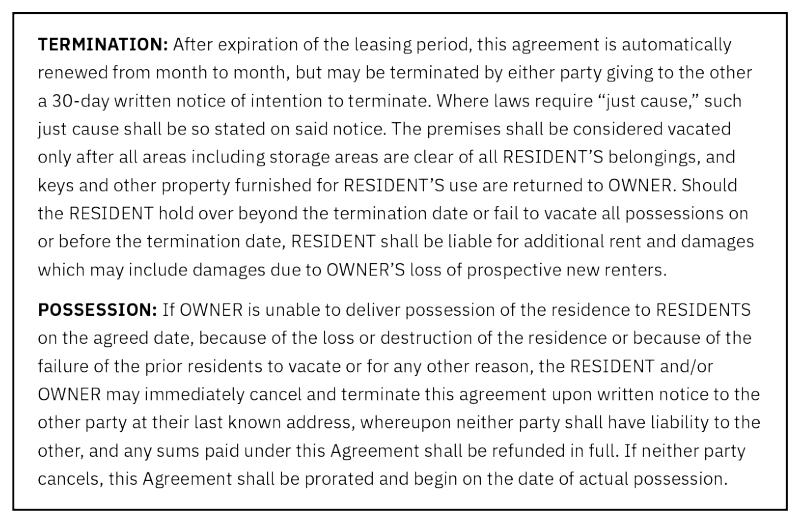
Traditional legal writing is often associated with long, dense paragraphs, limited spacing, minimal punctuation, antiquated expressions, Latin terms, and paired phrases. Expressions such as heretofore, forthwith, until such time that, party of the first part, and party of the second part can make a document feel distant from ordinary readers. Latin expressions such as pro bono, pro se, ad hoc, bona fide, and de facto also remain common in legal contexts.
Legal documents may double concepts in phrases such as null and void, breaking and entering, pain and suffering, and legal and binding. Some paired terms have historical or technical purposes, but unnecessary repetition can make a sentence heavier without making its meaning more precise. The common misconception is that difficult language automatically sounds more authoritative. In practice, dense wording can discourage reading and prevent people from understanding rights, duties, deadlines, and procedures that affect them.
Plain English is the movement toward avoiding unnecessary legal jargon and excess. It reforms and simplifies terminology so that people outside the legal profession can understand the document readily. Plain English does not mean careless or informal English. It means choosing familiar words when they are accurate, separating ideas clearly, and making the document usable by the people who must read and act on it.
Short sentences and paragraphs usually improve clarity because each unit carries a manageable amount of information. Compare a crowded statement that combines an obligation, an exception, a deadline, and a penalty in one uninterrupted paragraph with a sequence that gives each matter its own sentence. The shorter version helps readers locate the rule, identify its exception, and remember the action required. Clarity is especially important when readers are not lawyers and cannot rely on professional assistance to interpret every phrase.
The federal student-aid document illustrates this purpose of plain English. Rather than burying students in dense language and regulations, it explains procedures clearly and presents the steps in a way that makes readers feel able to complete them. Its effectiveness comes from accessibility: readers can understand what they must do without becoming mired in a complicated verbal structure. Plain English thus serves both rhetoric and fairness because a procedure cannot truly guide people if its language prevents comprehension.
Business Letters as Persuasive Documents
A business letter persuades through structure as well as wording. In a cover letter, the writer’s immediate purpose is often to secure an interview, so the letter should complement the résumé, not contradict it. It should be tailored to the particular position and function as a selling tool rather than as a generic statement that could be sent to any employer.
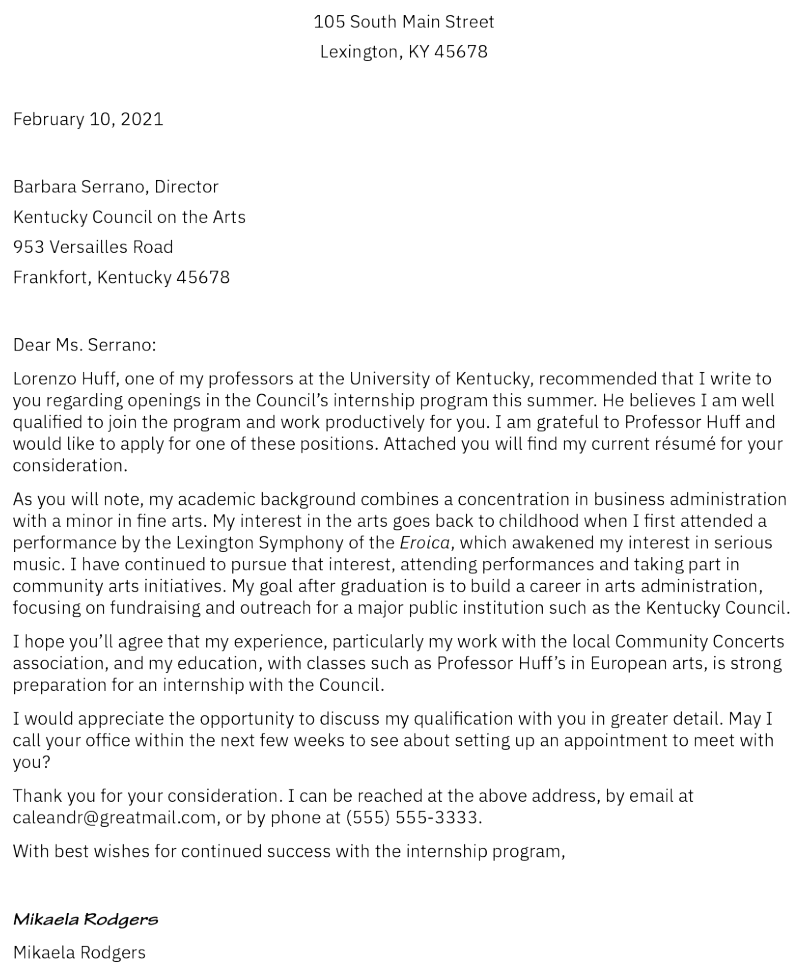
A recommendation or job lead can provide a natural opening because it establishes credibility immediately. In the model letter, the student begins by naming Professor Lorenzo Huff of the University of Kentucky, who recommended her for a summer internship with the Kentucky Council on the Arts. This referral gives the reader a reason to continue reading: the applicant is not presenting herself without context but arrives with a credible connection.
The letter uses standard block format, in which each element begins at the left margin and paragraphs are separated by blank space rather than indentation. Its conventional elements are arranged as follows:
- The sender’s address appears first.
- The date follows.
- The recipient’s name, title, organization, and address identify the destination.
- A professional salutation, such as “Dear Ms. Serrano:,” addresses the reader.
- The body paragraphs explain the purpose, qualifications, and requested next step.
- A professional closing expresses respect and thanks.
- Contact information and the typed name make follow-up possible and identify the writer.
The model’s body develops in a persuasive sequence. After the referral, the writer connects her business-administration major and fine-arts minor to the council’s work in fundraising and outreach. She then adds relevant qualifications: experience with the local Community Concerts association and coursework in European arts. These details are selective rather than merely biographical. Each one answers the employer’s implied question: How might this applicant contribute to this organization?
The final paragraph supplies a call to action by expressing interest in discussing the qualifications further and establishing a timeline for arranging an interview. The closing thanks the recipient, provides an email address and telephone number, and ends with a professional sign-off and signature. The result is concise but not bare: it gives the reader credibility, relevance, evidence of preparation, and an easy next step.
A strong business letter therefore applies the same principle that governs persuasive legal writing: language must fit its audience and purpose. Courts need precise, formally structured arguments; employers need clear evidence of fit and a practical invitation to respond. In both settings, effective rhetoric replaces needless complexity with deliberate choices.
Content adapted from OpenStax Writing Guide with Handbook by Michelle Bachelor Robinson, Maria Jerskey et al., licensed CC BY 4.0.



Source Materials
Study English Composition II: Rhetorical Methods–Based on Lykke
This course page is free to open: signed out, you can read its first two sections, and signing in, on any plan, opens the rest. The free Lykke Chrome extension syncs your own Canvas courses, so ChatGPT, Claude and Muse can answer from your classes and deadlines. It only reads Canvas.
Add the free extensionSign in to open every sectionAll sections of English Composition II: Rhetorical Methods–Based · Browse more course pages