From the free course English Composition II: Rhetorical Methods–Based on Lykke
15.2 Trailblazer
Key concepts: Human-subjects research guidelines · Ethical conduct of case studies · Connections between brain, mind, and body · Phantom limb pain · Ramachandran’s theory of phantom-limb pain · Mirror-box therapy · Amputated limbs · Chronic pain
By the end of this section the student can: Apply critical thinking and communication in varying rhetorical and cultural contexts; Identify and describe the genre conventions and rhetorical situation of case studies.
15.2 Trailblazer
A missing limb can still feel present because the brain does not simply erase its representation when the body changes. Some people who have undergone amputation report sensations—or even severe pain—in a phantom limb, a limb that is no longer physically attached but remains part of the person’s felt bodily experience. Neuroscientist Vilayanur S. Ramachandran investigated this striking problem through case studies that connected the brain, mind, and body.
Case Study Ethics
Research involving people requires more than an interesting question. Universities commonly provide specific guidance for research involving human subjects, and they often maintain strict rules for case studies. Those rules determine whether a project may proceed, how participants must be treated, and what kinds of information may be collected or shared. For an informal student case study, the instructor is the appropriate resource for determining which institutional policies apply.
The important ethical issue here is not merely whether a researcher has permission to ask questions. It is also how the researcher represents a participant’s experience. A case study writer should describe what a participant reports—such as “the participant described pain in the missing hand”—rather than turning that report into an unsupported diagnosis. The writer should not claim that one person’s experience proves how all amputees think or feel.
This distinction protects both the participant and the quality of the research. A participant’s account is valuable evidence, but it is evidence about that participant’s experience. The writer must preserve that limited scope when interpreting it. A careful case study might say, “This account is consistent with the possibility that the brain retains an active representation of the missing limb.” It should not say, “Amputation causes the brain to imagine pain in everyone.”
Ethical conduct therefore shapes interpretation, not just data collection. The researcher must avoid exposing unnecessary personal information, sensationalizing pain, or treating a person as a specimen rather than as a participant. In Ramachandran’s work, the reports of patients’ phantom-limb pain became evidence for investigating a scientific question, but the reports did not automatically settle that question. The case studies had to be interpreted cautiously and tested against further observation.
Case Study Trailblazer: Vilayanur S. Ramachandran
Vilayanur Subramanian Ramachandran, a neuropsychologist born in Tamil Nadu, India, became known for investigating unusual relationships between perception and the nervous system. His phantom-limb research began with a problem that was both intensely personal for patients and scientifically underexplored: how could a person feel pain in a limb that had been amputated?
Ramachandran approached the problem by connecting three ideas that are often treated separately: the brain, the mind, and the body. The body supplies sensory information, the brain processes and organizes that information, and the mind experiences sensations such as pain. Phantom-limb pain shows that these elements do not always correspond in a simple way. A physical limb may be absent while the brain and mind continue to produce a vivid sense of its presence.
His reasoning illustrates how a case study can begin with a theory and develop a research question. Drawing on existing literature about neural plasticity, the brain’s ability to reorganize itself, Ramachandran theorized that the brain might be “tricked” into treating the missing limb as if it were still present. If the brain could reorganize its representation of the body, perhaps the pain could be reduced.
The sequence matters:
- A puzzling observation appears: some patients feel pain in an amputated limb.
- A theoretical explanation is proposed: the brain may retain or reorganize a representation of that limb.
- A research question follows: can changing the brain’s visual and sensory information reduce the pain?
- Case studies test the possibility through observation and intervention.
This is critical thinking rather than guesswork. Ramachandran did not begin by assuming that the pain was imaginary or that the body was irrelevant. Instead, he treated the reported experience as real while investigating the mechanisms that might produce it. The case study became a way to connect firsthand patient reports with a broader scientific theory.
Phantom Limb Pain
Phantom-limb pain is pain experienced as located in a limb after that limb has been amputated. The term “phantom” does not mean that the patient is pretending or that the pain is unreal. It identifies a mismatch between the physical body and the person’s continuing sensory experience.
A report of phantom pain can include more than a general statement that “something hurts.” The participant may describe the location, intensity, or character of the pain. In a case study, these details must be presented as the participant’s account. For example:
“The participant reported a cramping sensation in the fingers of the amputated hand and said that the pain intensified when attempting to move them.”
This sentence makes several disciplined choices. It attributes the experience to the participant, identifies the sensation without diagnosing its cause, and distinguishes the attempted movement from an actual physical movement of the missing hand. A less careful sentence—“The patient’s nerves created a false hand movement”—would claim more than the observation establishes.
A common misconception is that phantom-limb pain must be purely psychological because the limb is gone. Ramachandran’s approach challenges that simplification. The pain involves the relationship among physical nerves, brain organization, visual perception, and conscious experience. Calling it “imaginary” would erase the very brain-body relationship the case study investigates.
Ramachandran’s Theory of Phantom-Limb Pain
Ramachandran theorized that the brain could continue to act as though the limb were present. The brain’s map of the body does not necessarily update instantly or perfectly after amputation. Neural plasticity allows the brain to reorganize, but that reorganization can also produce confusing or painful signals. In this account, phantom pain is not evidence that the patient misunderstands reality; it is evidence that perception depends on how the brain organizes sensory information.
The theory also explains why visual information might affect pain. If the brain receives a convincing visual signal that a missing limb is present and under control, that signal may conflict with the painful or unresolved messages associated with the absent limb. Changing the visual input could help the brain revise its interpretation.
The theory remains a theory because it makes a claim that must be examined through evidence. A case study can reveal an important pattern, generate a hypothesis, and show how an intervention works for a particular participant. It cannot, by itself, establish that every patient experiences phantom pain in the same way or that one treatment will work universally. Ethical limits and evidentiary limits reinforce each other: careful representation prevents the writer from making claims broader than the participant’s experience supports.
Mirror-Box Therapy
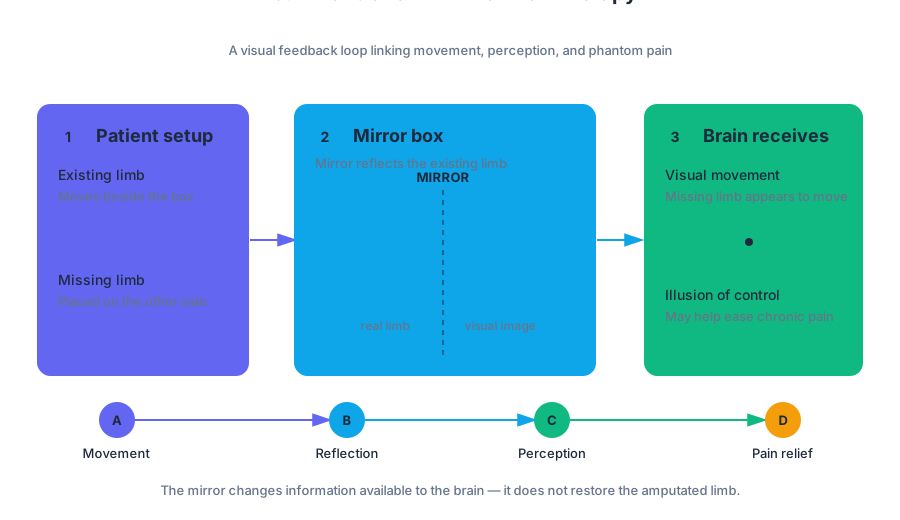
To test the connection among visual perception, the brain, and phantom pain, Ramachandran created a mirror box. The box contains a mirror positioned so that it reflects the patient’s existing limb. When the patient moves the existing limb, the mirror creates the visual impression that the missing limb is moving.
The arrangement is simple but conceptually powerful:
- The patient places the existing limb on one side of the box.
- The missing limb is positioned on the other side.
- The mirror reflects the existing limb.
- The patient sees a visual image where the missing limb appears to be.
- The patient moves the existing limb and sees what appears to be movement of the missing one.
The mirror does not restore the amputated limb. Instead, it changes the information available to the brain. The reflection may create an illusion of control, as though the missing limb can move again. This visual feedback was intended to help ease chronic pain experienced on one side of the body by allowing the brain to reorganize its interpretation of the affected side.
The significance of mirror-box therapy lies in its crossing of boundaries. A visual perception can influence a bodily sensation; a bodily sensation can reflect brain activity; and a patient’s subjective report can lead to a testable scientific hypothesis. The case study established a link between visual perception and nerve transmission and contributed to an approach that has brought relief from phantom-limb pain for some people.
The phrase “for some people” is essential. The treatment’s reported benefit should not be converted into a universal promise. A rhetorically responsible account preserves the difference between a promising case-study result and a conclusion supported across a large population. Ramachandran’s trailblazing contribution was not simply the invention of a box with a mirror. It was the use of careful observation to ask how the brain, mind, and body cooperate—and sometimes conflict—in producing human experience.
Content adapted from OpenStax Writing Guide with Handbook by Michelle Bachelor Robinson, Maria Jerskey et al., licensed CC BY 4.0.


Source Materials
Study English Composition II: Rhetorical Methods–Based on Lykke
This course page is free to open: signed out, you can read its first two sections, and signing in, on any plan, opens the rest. The free Lykke Chrome extension syncs your own Canvas courses, so ChatGPT, Claude and Muse can answer from your classes and deadlines. It only reads Canvas.
Add the free extensionSign in to open every sectionAll sections of English Composition II: Rhetorical Methods–Based · Browse more course pages