From the free course English Composition II: Rhetorical Methods–Based on Lykke
11.5 Writing Process: Reasoning Supported by Evidence
Key concepts: Integrating evidence from sources · Critical thinking about claims and ideas · Rhetorical devices: parallelism, repetition, and rhetorical questions · Using evidence to give ideas strength or credibility · Cause-and-effect reasoning · Cause-to-effect and effect-to-cause organizational patterns · Analogy as a reasoning strategy · Statistical data as evidence · Transitions and signal phrases for integrating evidence · Evaluating and explaining a stance on a quotation or claim
By the end of this section the student can: Use organizational and reasoning strategies to compose texts that integrate the writer’s ideas with those from appropriate sources.; Implement varying language structures in the process of composing.; Develop flexible strategies for drafting and revising.
11.5 Writing Process: Reasoning Supported by Evidence
Academic writing becomes persuasive when a writer’s ideas are connected to evidence through visible reasoning: the reader can see what a source says, what the writer claims, and why the evidence supports that claim. Evidence is not decoration added after the “real” writing. It helps a writer explore a topic, define or illustrate an idea, explain or prove a point, encourage critical thought, and give an idea strength or credibility.
A useful analogy is a bridge. The writer’s claim is on one side, the source’s information is on the other, and reasoning forms the supports that connect them. A quotation or statistic alone is only a piece of material; the writer must explain its relevance. Without that explanation, readers may recognize the evidence but still wonder, “So what does this show?”
Reasoning supported by evidence connects a writer’s ideas with appropriate ideas from others so that readers can follow, assess, and trust the conclusion.
A common misconception is that using more sources automatically makes an argument stronger. In fact, sources strengthen writing only when the writer chooses appropriate evidence and makes the relationship between evidence and claim clear. The process therefore involves recognizing an audience, identifying points, structuring reasoning strategies, drafting, and checking whether the reasoning is valid.
Quick Launch: Structural Paragraph Frames
A structural paragraph frame is a planned pattern that gives a paragraph a logical shape. The frame does not write the paragraph for the writer; it helps the writer decide what kind of relationship to establish among ideas. The section identifies patterns such as comparison and contrast, problem and solution, and definition. Cause-and-effect reasoning provides another important pattern, with two possible directions: cause-to-effect and effect-to-cause.
Before drafting, a writer asks what relationship the paragraph must make visible. If the purpose is to show how two subjects resemble or differ from each other, comparison and contrast is appropriate. If the purpose is to identify an undesirable situation and propose a response, problem and solution supplies the structure. If readers need to understand a term or concept before they can follow the argument, definition may be the best frame.
Signal words and phrases help readers recognize the chosen structure. These are verbal directions that show how one idea connects with another, how one paragraph connects with the next, whether one point supports or refutes another, what will come next, or which similarities, differences, and illustrations deserve emphasis. Words such as similarly, in contrast, as a result, for example, however, and therefore are useful only when they accurately describe the relationship being made.
The frame should serve the reasoning rather than force every paragraph into an identical mold. A writer chooses a pattern because it clarifies the intended movement of thought. A definition paragraph may include an example; a problem-and-solution paragraph may use cause-and-effect reasoning to explain why the problem exists; and a comparison may end by showing why a difference matters. The frame is a launch point for drafting, not a substitute for analysis.
Example passage: “Public transportation and bicycle commuting both reduce the number of cars on city streets. However, buses can serve longer routes and more passengers, while bicycles require less energy but depend on safe lanes. For this reason, a city seeking cleaner transportation should expand both systems rather than treat them as interchangeable.”
This paragraph uses comparison and contrast. The opening sentence establishes a similarity, while however signals the important differences. The final sentence interprets those differences and connects them to a recommendation. The writer does not merely list two transportation methods; the structural frame moves from shared feature, to contrast, to significance. The evidence in a longer version of this paragraph could define public transportation, illustrate accident or emissions data, or cite a transportation study, but the reasoning would still need to explain why the evidence matters.
Drafting: Reasoning Strategies
During drafting, writers integrate their own ideas with ideas from appropriate sources. Sources may help explore a topic, define or illustrate an idea, explain or prove a claim, invite readers to think critically, or provide credibility. The writer remains responsible for the paragraph’s central point: evidence should be selected and framed to serve that point rather than allowing quotations to control the direction of the writing.
Critical thinking about claims means examining what an idea asserts, what assumptions it makes, and what evidence would support or challenge it. A writer should distinguish an observation from an interpretation and an interpretation from a conclusion. For example, “the number of accidents increased” reports a pattern, while “the intersection became unsafe” interprets that pattern, and “a traffic signal was necessary” draws a practical conclusion. Each step requires appropriate support.
One especially useful strategy is analogy, a comparison that explains an unfamiliar or abstract idea through a more familiar one. An analogy can make a difficult concept accessible, but the writer must also recognize its limits. Two things may resemble each other in one important respect without being identical in every respect. A responsible analogy explains the relevant similarity rather than pretending that the comparison proves more than it does.
Writers also vary language structures to emphasize relationships among ideas. Parallelism uses matching grammatical forms for related points. Repetition deliberately returns to a word or phrase so that a central idea remains prominent. A rhetorical question is asked for emphasis or reflection rather than to obtain a literal answer. These devices can make reasoning memorable, but they should clarify emphasis rather than replace evidence.
For example, parallelism can make a sequence easier to follow: “The policy reduces waste, lowers costs, and protects public resources.” Repetition can build emphasis: “The issue affects workers, affects families, and affects the community.” A rhetorical question can focus the reader’s attention: “If the danger is documented, why should the city wait?” In each case, the device shapes the presentation of reasoning; it does not establish the truth of the claim by itself.
Cause-and-effect reasoning requires special care because events may be connected without one event causing the other. A writer should identify the relevant cause, explain the mechanism by which it produces an effect, and avoid treating mere sequence as proof of causation. The effect may have several causes, and one cause may produce several effects. Evidence can establish that a condition occurred, while the writer’s explanation must show why the connection is reasonable.
The section presents two organizational directions for cause-and-effect paragraphs. Cause-to-effect begins with the reasons or conditions and ends with the result. Effect-to-cause begins with the result and then traces backward to the conditions that produced it. The choice depends on emphasis: cause-to-effect highlights why an action or outcome occurred, while effect-to-cause can foreground a serious result and then explain why a response became necessary.
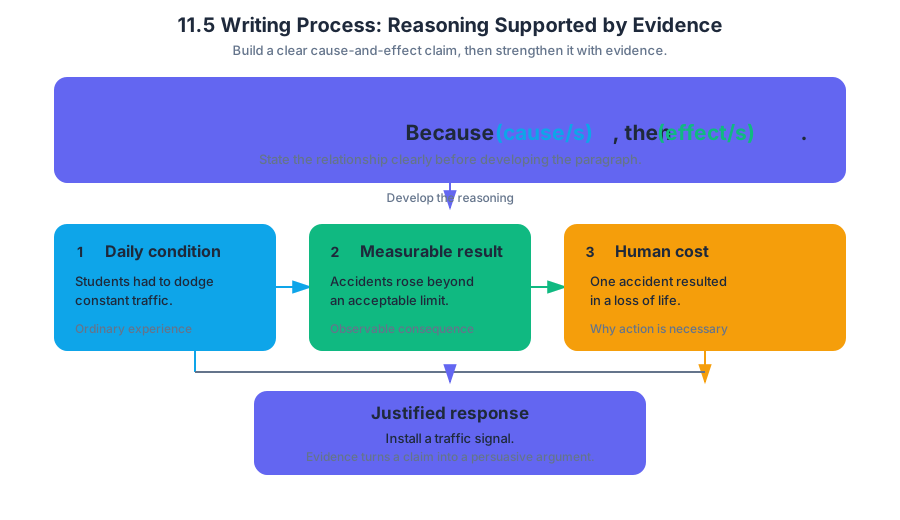
The traffic-signal example illustrates both possibilities. Students needed to travel between campus locations, but they had to move through constant traffic; accidents rose beyond an acceptable limit, and one accident caused a loss of life. Organized cause-to-effect, the paragraph could begin with speeding and pedestrian danger before arriving at the need for a signal. Organized effect-to-cause, it could begin with the unacceptable accidents and then explain the traffic conditions that produced them.
Example passage: “Traffic near the campus crossing became dangerous because drivers accelerated through the intersection, pedestrians had to dodge moving cars, and accidents increased. As a result, the city installed a signal to protect people crossing the road.”
This passage uses the cause-to-effect pattern. The writer presents three conditions, uses because to mark their causal relationship, and uses as a result to signal the consequence. The final sentence identifies an action that responds to the effect. A source could provide accident records or an official safety report; the writer would then explain how those records support the conclusion that a signal addressed the documented danger.
Drafting is flexible: a writer may begin with a frame, a source, a question, or a provisional claim and revise the organization as the reasoning develops. The important choice is not to preserve the first arrangement at all costs. If the paragraph’s evidence points toward a different relationship, the writer should change the topic sentence, signal words, order of information, or explanation so that the structure accurately reflects the thought.
Checking Validity
Checking validity means testing whether the reasoning actually supports the claim. A valid line of reasoning has a defensible connection among claim, evidence, and explanation. The writer asks whether the source is appropriate, whether the evidence represents what the writer says it represents, whether the conclusion goes beyond the evidence, and whether another explanation could account for the same facts.
The first check concerns the claim itself. Is it specific enough to support, and is it genuinely an idea rather than a vague announcement? The second concerns the evidence: does it define, illustrate, explain, prove, or lend credibility in the way the paragraph requires? The third concerns the warrant—the reasoning that explains why the evidence bears on the claim. Even credible evidence can be misused when the writer leaves this connection unstated or assumes it is obvious.
A writer should also inspect causal language. Words such as because, therefore, and as a result make strong commitments. They should appear only when the evidence justifies a causal relationship. If the evidence shows association but not cause, a more careful sentence might say is connected with, may contribute to, or coincides with. This is not weak writing; it is accurate control of the claim’s strength.
Signal words require the same scrutiny. However should introduce a genuine contrast, similarly should identify a meaningful resemblance, and for example should introduce an instance that illuminates the point. A transition cannot create a relationship that the ideas do not possess. Revising misplaced or overstated signals often reveals a deeper organizational problem.
Example passage: “A survey found that students who use the library frequently earn higher grades. Therefore, library visits cause academic success.”
The evidence may support a relationship, but the conclusion is too strong unless the study establishes causation. Students who visit the library may already differ in preparation, study time, or access to academic support. A more valid revision would be: “A survey found that frequent library users earn higher grades, suggesting that library use is associated with academic success.” The revised claim preserves the useful evidence while avoiding an unsupported cause-and-effect conclusion.
Finally, checking validity includes checking balance and credibility. A writer should consider evidence that complicates the preferred conclusion, acknowledge meaningful limits, and ensure that rhetorical devices do not create an illusion of proof. Parallel structure can sharpen a point, repetition can emphasize it, and a rhetorical question can invite reflection, but none can substitute for appropriate sources and explicit reasoning. Strong writing makes its claims neither weaker nor stronger than the evidence permits.
The finished paragraph should therefore allow a reader to trace a clear path: the writer’s point, the source’s contribution, the relationship between them, and the conclusion that follows. That path is the practical measure of reasoning supported by evidence.
Content adapted from OpenStax Writing Guide with Handbook by Michelle Bachelor Robinson, Maria Jerskey et al., licensed CC BY 4.0.

Source Materials
Study English Composition II: Rhetorical Methods–Based on Lykke
This course page is free to open: signed out, you can read its first two sections, and signing in, on any plan, opens the rest. The free Lykke Chrome extension syncs your own Canvas courses, so ChatGPT, Claude and Muse can answer from your classes and deadlines. It only reads Canvas.
Add the free extensionSign in to open every sectionAll sections of English Composition II: Rhetorical Methods–Based · Browse more course pages