From the free course English Composition II: Rhetorical Methods–Based on Lykke
10.5 Writing Process: Creating a Position Argument
By the end of this section the student can: Demonstrate brainstorming processes and tools as means to discover topics, ideas, positions, and details.; Apply recursive strategies for organizing drafting, collaborating, peer reviewing, revising, rewriting, and editing.; Compose a position argument that integrates the writer’s ideas with those from appropriate sources.; Give and act on productive feedback to works in progress.; Apply or challenge common conventions of language or grammar in composing and revising.
10.5 Writing Process: Creating a Position Argument
A position argument uses reasons and evidence to persuade readers that a particular position is valid and worthy of support. The argument does not merely announce an opinion; it develops a defensible claim, anticipates resistance, and guides readers through the reasoning that connects evidence to the claim. Aristotle called this activity rhetoric: “working with a set of reasons and evidence” to persuade an audience.
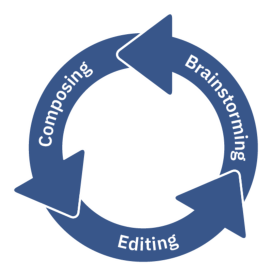
A useful way to picture the process is to imagine preparing a case for a public decision. First, you discover what you actually think. Then you arrange the case so readers can follow it, support it with appropriate evidence, listen seriously to objections, and revise when the reasoning or presentation is weak. The process is recursive rather than strictly linear: brainstorming may reveal a better thesis, peer review may expose an overlooked counterclaim, and revision may require reorganizing the entire argument rather than merely correcting sentences.
Quick Launch: Working Thesis Frames and Organization of Ideas
A position argument begins with discovery. Before drafting a polished thesis, a writer brainstorms topics, questions, positions, reasons, and details. Brainstorming is not a preliminary performance in which the writer must immediately produce a perfect idea. It is a way to make possibilities visible so the writer can identify an issue that has genuine tension and a position that can be supported.
A working thesis is a provisional statement of the argument. “Working” means that the statement gives the draft direction while remaining open to change. The writer uses it to decide what information belongs, what order will make sense, and what kind of evidence is needed. A working thesis should therefore be specific enough to organize the essay but flexible enough to develop as the writer learns more.
Thesis frames help a writer move from a broad subject to an arguable position. A frame can identify the issue, acknowledge another view, and state the writer’s claim. For example, a writer might begin with a structure such as: although some people argue that one position is preferable, the evidence suggests that another position is more effective because of particular reasons. The frame is not a formula that replaces thought; it is a temporary scaffold for discovering the relationship among the issue, the competing positions, and the reasons.
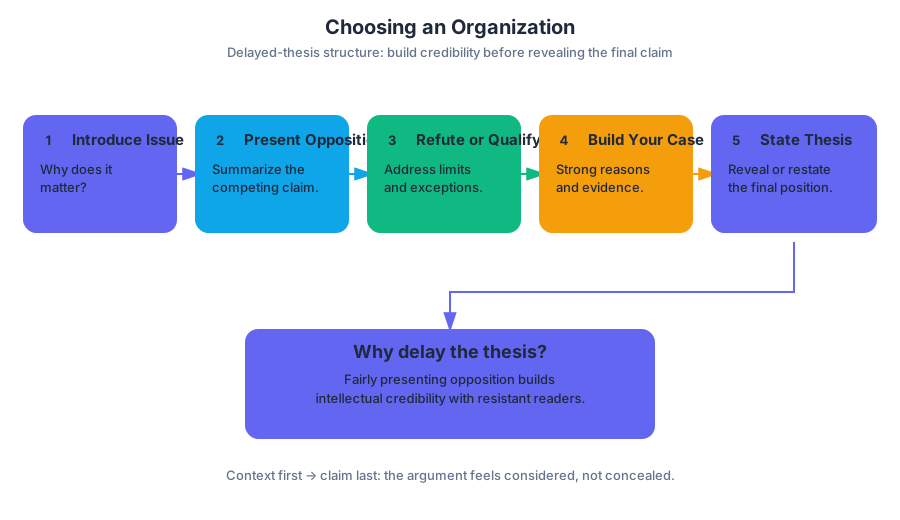
Organization follows the choices made during brainstorming. The classical Aristotelian argument commonly moves from an introduction of the issue to a position, supporting reasons and evidence, consideration of opposing claims, and a conclusion. The section also presents a delayed-thesis organization, in which the writer first introduces the problem, summarizes and responds to opposing claims, develops the strongest reasoning and evidence for the writer’s position, and states or restates the thesis in the conclusion. This structure can be useful when readers need to understand the controversy before they are ready to accept the writer’s final claim.
The delayed-thesis pattern does not mean that the writer hides the issue or manipulates the audience. It means that the argument earns its conclusion by establishing context and engaging the opposition before presenting the final synthesis. The writer must still make the direction of the discussion clear through transitions and accurate representation of competing views.
A brief example shows how a working thesis and delayed organization can cooperate:
Many students wait weeks for an appointment at a college counseling center. Some administrators argue that adding counselors is too expensive, but long delays can leave students without timely support. Colleges should expand counseling access by combining additional counselors with telehealth and referral partnerships.
The opening sentence introduces the problem rather than beginning with an unsupported command. The second sentence supplies an opposing concern—cost—without dismissing it. The final sentence gives a working position and previews a practical response. As research and drafting continue, the writer might narrow “expand counseling access,” change the proposed solutions, or discover a stronger reason. Those changes are signs of recursive thinking, not failure.
The section’s student example similarly begins with a concrete situation: “Tapping her foot nervously, Serena looked at her watch again.” The scene makes the issue of delayed counseling tangible before the argument turns to claims and evidence. Organization is therefore not decoration. It controls when readers encounter the problem, the opposition, the evidence, and the thesis.
Drafting: Rhetorical Appeals and Types of Supporting Evidence
Drafting turns the working thesis into a sequence of claims, reasons, and evidence. Each paragraph should contribute to the argument rather than merely repeat the topic. The writer makes rhetorical choices according to audience: readers need to understand the issue, trust the writer’s treatment of it, recognize why it matters, and see why the evidence supports the position.
The three classical rhetorical appeals are ethos, pathos, and logos. Ethos appeals to credibility and responsible judgment. A writer develops ethos by representing sources accurately, acknowledging limitations, using an appropriate tone, and demonstrating knowledge of the issue. Pathos appeals to readers’ emotions and values. Logos appeals to reasoning through claims, relationships, examples, facts, and evidence. Strong position arguments usually coordinate the appeals rather than relying on only one.
An emotional example can make an issue vivid, but pathos alone does not establish that a policy will work. Statistics can provide logical support, but logos without attention to human consequences can make an argument seem detached. Ethos is also more than announcing expertise: credibility is built through fair treatment of opposing views and careful use of evidence.
Supporting evidence may take several forms. A writer can use facts and statistics to establish conditions or patterns; examples to clarify how a claim works in a particular case; personal experience or observation to show what an issue looks like in lived practice; and expert testimony or information from appropriate sources to provide specialized knowledge. The choice depends on the claim. A personal observation may illustrate a problem, while a larger factual pattern may be needed to show that the problem is widespread.
Evidence does not support a claim automatically. The writer must explain the reasoning that connects the evidence to the position. This explanation is sometimes called the warrant: the underlying logic that tells readers why the evidence matters. A paragraph that supplies a statistic and then immediately changes subjects leaves the reader to perform the argument’s central work.
Consider this short example:
At Powell College South, students may wait three hours for a counseling appointment. That delay can prevent a student from receiving help before work, class, or a personal crisis becomes more difficult to manage. Because timely access is part of effective support, the college should add appointment capacity rather than treat long waits as an ordinary inconvenience.
The first sentence offers a concrete fact about the situation. The second interprets its human consequence, creating pathos without exaggeration. The final sentence makes the reasoning explicit: if effective support requires timely access, then appointment capacity is relevant to the proposed solution. The passage also avoids claiming that one fact proves every aspect of the policy. It uses the evidence for the narrower conclusion that delay is a serious problem requiring institutional action.
During drafting, writers should also make organizational decisions. A paragraph may present one reason and its evidence, compare competing positions, or explain why a source supports the claim. Transitions show relationships such as contrast, cause, sequence, and addition. In a delayed-thesis argument, transitions are especially important because the reader moves from the opposition to the writer’s reasoning. The section emphasizes that revising transitions can make the logical movement among paragraphs clearer.
Peer Review: Critical Thinking and Counterclaims
Peer review is a collaborative stage in which readers respond to a work in progress and writers use that response to think more critically about the argument. The purpose is not to approve or reject a classmate’s opinion. It is to identify how the draft works for an actual reader: what position seems to be presented, what reasons appear strongest, where the evidence is insufficient, and where the organization becomes difficult to follow.
Critical thinking in peer review means examining assumptions, distinctions, evidence, and consequences. A reviewer asks whether the claim is arguable rather than merely factual, whether the reasons actually support it, whether the evidence is relevant and credible, and whether the draft treats complexity honestly. Productive feedback is specific. “This paragraph is confusing” gives the writer little direction; “I cannot tell whether this statistic supports adding counselors or only shows that students are dissatisfied” identifies a reasoning problem the writer can address.
A counterclaim is a claim that challenges, limits, or qualifies the writer’s position. Counterclaims are not obstacles to be ignored. They reveal the issue’s genuine controversy and give the writer an opportunity to demonstrate fairness and stronger reasoning. A writer should distinguish a counterclaim from a caricature of the opposition. Summarizing an opposing position accurately builds ethos; reducing it to an obviously foolish statement weakens credibility.
Peer reviewers should look for missing counterclaims as well as poorly answered ones. If an argument recommends more counselors, reasonable objections might concern cost, staffing, unequal demand, or the possibility that another service would be more effective. The writer then decides whether to concede part of the objection, qualify the thesis, answer it with evidence, or explain why it does not outweigh the main reasons.
A concise example demonstrates respectful counterclaim work:
Some administrators may argue that hiring counselors would divert funds from academic programs. That concern is reasonable, especially when colleges face limited budgets. However, a combination of additional counselors, telehealth appointments, and community referrals could expand access without requiring every need to be met by one campus office.
The passage first states the opposing concern clearly. It then concedes its reasonableness instead of pretending that funding is irrelevant. Finally, it qualifies the response: the writer does not claim that one office must solve every problem, but proposes several ways to address access. Peer review could help the writer test whether this response needs financial evidence, a clearer definition of “expand access,” or acknowledgment of limitations.
The Aristotelian organization described in the section gives counterclaims a purposeful place. The writer may introduce the issue, summarize the opposing position, refute or qualify that position, and then present the strongest reasoning and evidence for the writer’s own claim. This sequence encourages readers to see that the argument has considered more than one side before reaching its conclusion.
Revising: Reviewing a Draft and Responding to Counterclaims
Revision means re-seeing the argument, not merely correcting spelling. A writer reviews whether the draft has a clear position, whether each paragraph advances that position, whether evidence is explained, whether the order fits the audience, and whether the conclusion synthesizes the argument. Rewriting may involve moving paragraphs, replacing a working thesis, adding a missing reason, narrowing an overbroad claim, or changing the response to a counterclaim.
A useful review begins with the argument’s large-scale structure. The writer can identify the introduction of the issue, the treatment of opposing claims, the main reasons and evidence, and the conclusion. If a paragraph performs two unrelated jobs, it may need to be divided. If a reason appears before readers understand the problem it addresses, the order may need to change. If the thesis promises more than the evidence can establish, the thesis must be narrowed or the support strengthened.
Revision also examines the quality of responses to counterclaims. A response may refute an opposing claim by showing that its reasoning or evidence is inadequate. It may concede a point by acknowledging that the opposition is partly correct. It may qualify the writer’s own position by limiting when or how it applies. These choices are more persuasive than simply declaring the opposition wrong because they show control of the issue’s complexity.
Consider a revised response:
Adding counselors would require new funding, and no college can ignore that cost. Yet the choice is not limited to hiring a large full-time staff. The college could begin with peak-hour appointments, telehealth partnerships, and referrals to local providers. These steps would not eliminate every wait, but they would make timely support more available.
This revision responds directly to the financial counterclaim, concedes the reality of cost, and qualifies the proposed solution. The phrase “the choice is not limited” changes the debate from an all-or-nothing decision to a set of possible actions. The final sentence avoids overclaiming: the proposal improves access but does not promise to eliminate every delay. That precision strengthens both logos and ethos.
At the sentence and paragraph level, revision improves transitions, clarity, emphasis, and tone. A writer may replace vague references with precise terms, add a transition that signals contrast, or move a key sentence so the paragraph’s point is unmistakable. Editing conventions matter, but they come after the writer has addressed meaning and organization. Correct grammar cannot rescue an unsupported claim, while a well-reasoned argument can be made substantially clearer through deliberate editing.
The finished position argument integrates the writer’s ideas with appropriate source material, represents opposing views responsibly, and makes its reasoning visible. Its thesis may change from the first working frame, because discovery, drafting, collaboration, peer review, and revision are connected stages in an ongoing process. The goal is not to make disagreement disappear; it is to give readers sound reasons to regard the writer’s position as valid and worthy of support.
Content adapted from OpenStax Writing Guide with Handbook by Michelle Bachelor Robinson, Maria Jerskey et al., licensed CC BY 4.0.
Source Materials
Study English Composition II: Rhetorical Methods–Based on Lykke
This course page is free to open: signed out, you can read its first two sections, and signing in, on any plan, opens the rest. The free Lykke Chrome extension syncs your own Canvas courses, so ChatGPT, Claude and Muse can answer from your classes and deadlines. It only reads Canvas.
Add the free extensionSign in to open every sectionAll sections of English Composition II: Rhetorical Methods–Based · Browse more course pages