From the free course English Composition II: Rhetorical Methods–Based on Lykke
12.5 Writing Process: Integrating Research
Key concepts: Integrating research into persuasive writing · Developing a working thesis · Considering audience and rhetorical reasoning strategies · Using evidence to support a thesis · Exploring and refuting an opposing position · Research questions and focused inquiry · Evaluating sources · Writing and presenting research findings
By the end of this section the student can: Identify characteristics of and formulate a strong thesis.; Evaluate sources to decide what to include in a research essay.; Synthesize information from outside sources with your own ideas in research writing while retaining a writerly voice.; Distinguish between a quotation, summary, and paraphrase and use each appropriately.; Draft an argumentative research essay.; Experience the collaborative and social aspects of writing processes.; Give and act on productive feedback to works in progress.
12.5 Writing Process: Integrating Research
A persuasive research essay must do two things at once: make an original argument and show how that argument grows from other people’s knowledge. That tension is productive. A writer does not simply collect quotations and arrange them like evidence in a storage box; the writer chooses, interprets, connects, challenges, and reshapes research so that it advances a clear position.
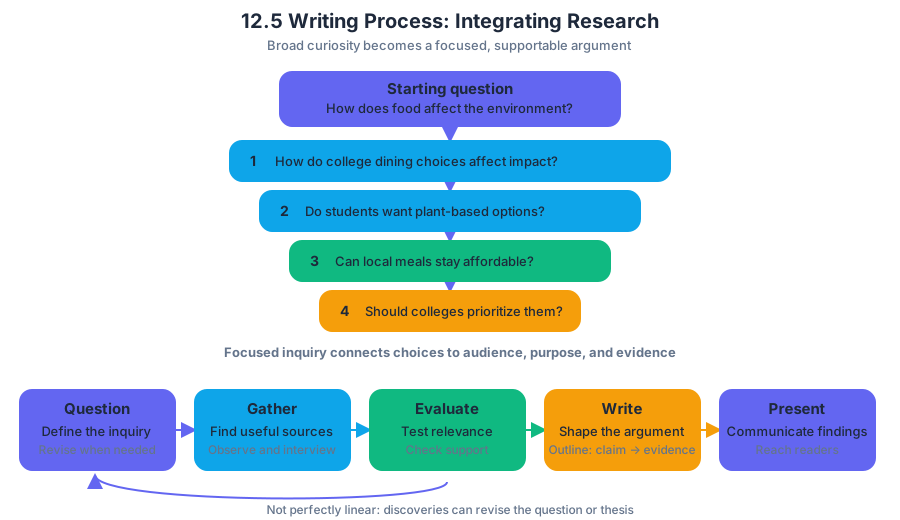
The process begins with a focused inquiry. A broad subject such as sustainable food, public health, or cultural representation becomes manageable only when the writer asks a question narrow enough to investigate and debatable enough to answer. The eventual thesis is the essay’s stance—its direction and destination. Like a map, it gives the research a destination while allowing the writer to discover the route.
A working thesis is a provisional statement of the position or focus that guides a research paper while the writer continues investigating.
“Working” matters because research can change a writer’s understanding. The thesis should be specific enough to organize inquiry but flexible enough to be refined when evidence reveals a complication, a stronger reason, or a credible opposing position. A writer also considers audience: what readers already know, what they may question, which terms need explanation, and which rhetorical reasoning strategies—such as cause and effect, comparison, definition, or evaluation—will make the position convincing.
Quick Launch: Thesis Frames
A thesis frame gives a writer a sentence structure for turning an area of interest into an arguable claim. The frame is not a finished thesis and should not replace thinking. It is a launch point: the writer fills in the central issue, the relationship between ideas, the reason for the claim, or the action an audience should take.
The section offers these frames for developing a working thesis:
- Because
________, [someone] should________. ________saves________, reduces________, and saves________.- The lack of
________shows________. ________influences________and by extension________.________accurately (inaccurately) portrays________because________.________is a result of________,________, and________.- Although some argue that
________, a close examination shows________. ________and________prove that________.
Each frame encourages a different kind of rhetorical reasoning. “Because” invites a causal explanation and a recommendation. “Saves,” “reduces,” and “saves” organize several benefits into a practical argument. “The lack of” directs attention to absence as evidence. “Influences” establishes a relationship between an initial force and a broader consequence. “Although some argue” explicitly leaves room for a counterclaim, or an opposing position that the essay must acknowledge and answer.
For example, a writer investigating sustainable food systems might begin with the frame “Because ________, [someone] should ________” and draft this working thesis:
Because industrial food systems can damage environmental health while failing to provide consistently healthy diets, communities should invest in sustainable food systems that reduce environmental impact and improve access to nutritious food.
The passage makes a choice about audience and purpose. It does not merely announce that sustainable food is interesting; it identifies a problem and recommends action. It also contains two connected concerns—environmental impact and healthy diets—so later research can test whether those concerns belong in the same argument. The claim remains provisional: evidence may lead the writer to narrow the audience from “communities” to local governments, define “sustainable,” or emphasize one consequence over another.
A useful thesis therefore does more than name a topic. It states a debatable position, suggests the reasoning the essay will develop, and gives research a selection test: information belongs when it helps explain, support, qualify, or challenge the thesis. A common misconception is that a thesis must be discovered fully formed before research begins. The frame-based approach instead treats thesis writing as an early decision that research can strengthen and revise.
Drafting: Working with Sources
Drafting a research essay requires a deliberate combination of the writer’s original thinking with other people’s research. At first, this may seem contradictory. If the essay depends on experts and authorities, how can it still be original? The answer is that originality does not mean writing without influence. It means making a significant contribution through the way research is selected, interpreted, organized, and connected to the writer’s own claim.
The section describes this responsibility through paired demands:
| Your argumentative research essay writing assignment may require that you ... | While also ... |
|---|---|
| develop a topic based on what has already been said and written | writing something new and original |
| rely on experts’ and authorities’ opinions and facts to support your ideas | engaging with borrowed materials by improving upon or disagreeing with those same opinions |
| attribute credit meticulously to previous researchers | finding a way to develop your own significant contribution |
| adapt your language to fit the discipline of your topic by building upon what you hear and read | finding a way to incorporate your own words and your own voice |
These pairings establish the writer’s central drafting problem: research must be visible, but it must not take over. A paragraph should not become a string of quotations with the writer’s argument hidden between them. Instead, the writer introduces a source, presents a quotation, summary, or paraphrase when appropriate, and then explains how that material bears on the thesis.
A quotation repeats a source’s exact words and is useful when the wording itself matters—for example, when a definition, memorable claim, or especially precise statement deserves attention. A summary condenses the main point of a longer passage or source. A paraphrase restates a particular passage in new wording while retaining roughly its level of detail. Both summaries and paraphrases still require attribution because changing the words does not make the underlying idea the writer’s own.
Consider this short example:
Sustainable food systems are not merely agricultural alternatives; they connect dietary health with environmental responsibility. Because these systems seek “healthy diets with minimal environmental impact,” they give communities a way to address both concerns through one coordinated policy.
The first sentence supplies synthesis: it combines two related ideas into the writer’s own interpretive claim. The brief quotation preserves a compact phrase whose wording efficiently expresses the relationship. The second sentence explains why the quoted language matters instead of leaving it to speak for itself. The quotation is therefore evidence within an argument, not decoration. In a complete essay, the writer would identify the source accurately and use the required documentation format.
Drafting also benefits from an outline that connects claims, reasoning, and evidence. The section’s paragraph organizer places the working thesis above three columns: Topic Sentence, Reasoning Strategy, and Supporting Researched Evidence. For example, its working thesis states that “the human race must turn to sustainable food systems that provide healthy diets with minimal environmental impact, starting now.” A writer can then make each paragraph answer three questions: What is this paragraph claiming? How will the reasoning persuade readers? Which researched material supports that claim?
This structure protects the writer’s voice because evidence enters the draft with a job. A source may establish a fact, illustrate a consequence, reveal a cause, or represent an opposing view, but the writer decides how that function advances the thesis. Research is integrated when the paragraph’s topic sentence, reasoning, and evidence work together rather than appearing as separate layers.
Peer Review: Switch Sides
An argumentative essay becomes stronger when its writer temporarily stops defending the thesis and examines the issue from an opponent’s position. “Switching sides” means asking what a reasonable reader who disagrees would say, what evidence supports that position, and what assumptions the writer’s own argument may be overlooking. The goal is not to abandon the thesis. It is to test whether the thesis can withstand serious scrutiny.
The section presents opposing views as a collaborative activity: pairs can debate the issue while one person speaks, another listens, and both examine the movement of the argument. This kind of peer work makes writing social rather than purely private. A reviewer is not merely correcting sentences; the reviewer supplies the perspective of an actual reader who can identify unclear reasoning, missing context, weak evidence, or an unanswered counterclaim.
For the sustainable-food thesis, a reviewer might raise this objection: sustainable systems can cost more, require changes in infrastructure, or remain inaccessible to communities with limited resources. A responsible writer does not dismiss this concern simply because it complicates the preferred position. The writer investigates it, represents it fairly, and decides whether to qualify the thesis, answer the objection with evidence, or explain why the objection does not defeat the larger claim.
A short example of a switched-side revision might look like this:
Some critics argue that sustainable food systems are too expensive for communities already facing food insecurity. That concern is significant, but it does not justify maintaining systems that produce long-term environmental and health costs; instead, it shows why public investment must make sustainable food more accessible.
The passage first grants that the opposing concern is significant. That concession builds credibility because the writer does not misrepresent or evade the objection. The next sentence then turns the objection into a reason for a more precise response: public investment. The writer has not merely added the phrase “some critics argue”; the counterclaim changes the policy implication and gives the argument a more audience-aware shape.
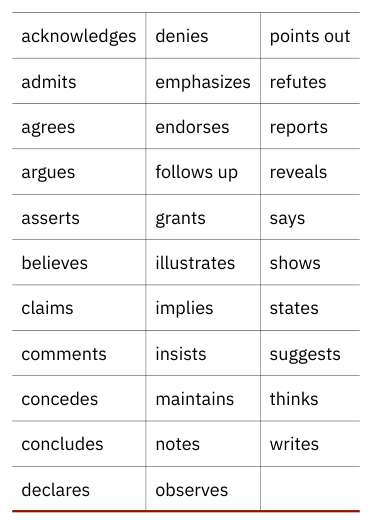
Productive peer review should therefore ask questions about rhetorical effectiveness: Is the thesis debatable and clear? Does each paragraph relate directly to it? Is the evidence credible and sufficient? Does the writer explain quotations and paraphrases? Can readers recognize the opposing position, and does the response address that position rather than a weaker substitute? Feedback is most useful when it identifies a specific effect on a reader and suggests a possible revision.
Revising: Who’s Game?
Revision asks the writer to determine what is at stake in the argument and who is affected by its outcome. “Who’s game?” directs attention toward the people, institutions, values, and consequences involved in a debate. A writer revises more effectively when the essay’s audience is not an abstract crowd but a group with particular knowledge, interests, concerns, and reasons to resist the claim.
This question also helps the writer evaluate evidence. A fact may be accurate yet unpersuasive if it does not address what the intended audience values. A quotation may sound authoritative yet contribute little if the writer never explains its relevance. Revising means checking whether the essay balances source information, analysis, synthesis, and original thought—qualities emphasized in the section’s evaluation criteria.
Imagine that an early draft claims:
Everyone must support sustainable food systems because they are better for the planet.
The sentence has a position, but it is broad and assumes that environmental benefit alone will persuade every reader. A revision shaped by “Who’s game?” might say:
Local governments should fund sustainable food systems because doing so can connect environmental protection with residents’ need for healthy, affordable diets.
The revised sentence identifies an audience capable of taking the proposed action, names two interests that may motivate that audience, and narrows the claim to a defensible policy choice. It also gives the writer clearer research needs: evidence about environmental effects, dietary health, affordability, and the role of local government.
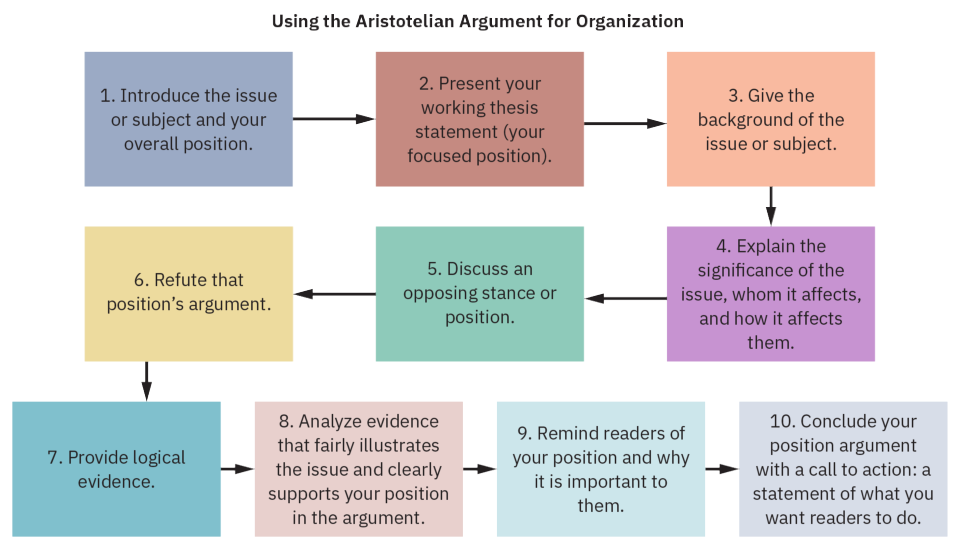
At this stage, the writer revisits the whole argument rather than polishing sentences in isolation. The thesis should remain clear and debatable. Topic sentences should guide paragraphs toward it. Research should be credited meticulously and used through well-chosen quotation, summary, and paraphrase. The writer’s voice should interpret the evidence, acknowledge limitations, and respond to opposing positions. Transitions and headings should help readers follow the reasoning, while language and background explanation should fit the intended audience.
The most important revision may be a change in scope. Research can reveal that a claim is too large, that an opposing view is stronger than expected, or that a proposed solution requires qualification. Such changes are not failures of the process. They show that inquiry has done its work: the writer’s original thinking has developed through responsible engagement with evidence and readers.
Content adapted from OpenStax Writing Guide with Handbook by Michelle Bachelor Robinson, Maria Jerskey et al., licensed CC BY 4.0.



Source Materials
Study English Composition II: Rhetorical Methods–Based on Lykke
This course page is free to open: signed out, you can read its first two sections, and signing in, on any plan, opens the rest. The free Lykke Chrome extension syncs your own Canvas courses, so ChatGPT, Claude and Muse can answer from your classes and deadlines. It only reads Canvas.
Add the free extensionSign in to open every sectionAll sections of English Composition II: Rhetorical Methods–Based · Browse more course pages