From the free course English Composition II: Rhetorical Methods–Based on Lykke
9.1 Breaking the Whole into Its Parts
Key concepts: Ethos · Logos · Pathos · Kairos · Rhetorical fallacies · Bandwagon · Ad hominem · Hyperbole · Personification · Sensory language in advertising
By the end of this section the student can: Identify and explain ethos, logos, pathos, and kairos.; Identify and analyze logical fallacies used in persuasion.; Explain how rhetorical strategies are used in real-life situations.
9.1 Breaking the Whole into Its Parts
A persuasive message rarely depends on one reason alone. When roommates try to convince someone to eat at Emiliano’s pizzeria, they combine credibility, logic, emotion, timing, vivid description, and even faulty reasoning. Rhetorical analysis breaks that whole message into its parts so a listener can ask not merely What decision should I make? but also How is this message trying to make me decide?
Rhetoric is the craft of persuading through writing or speaking. Communication can inform, express emotion, respond to others, or persuade people to think or act in particular ways; rhetoric focuses especially on the persuasive dimension. Deconstructing rhetoric means identifying the strategies a speaker uses and evaluating whether the reasoning is sound, incomplete, manipulative, or deceptive.
Learning Outcomes
A careful rhetorical reader should be able to identify and explain ethos, logos, pathos, and kairos; recognize and analyze logical fallacies; and explain how rhetorical strategies operate in real-life situations. The goal is not to reject every emotional or persuasive appeal. Instead, the goal is to see how a message works so that acceptance or rejection becomes an informed choice.
Rhetorical Strategies
The three central building blocks of rhetoric are ethos, logos, and pathos. Ethos is an appeal based on credibility: the speaker presents a believable, authoritative, or trustworthy voice. Logos is an appeal based on reasoning: the speaker uses evidence, explanation, or a logical connection between ideas. Pathos is an appeal to emotion: the speaker tries to make the audience feel sympathy, fear, excitement, anger, affection, or some other emotion that supports the desired response.
A fourth strategy, kairos, concerns timing and circumstance. Kairos is the use of an appropriate or opportune moment, context, or situation for persuasion. A message can be credible, logical, and emotionally powerful yet ineffective if it arrives at the wrong time or ignores the situation in which an audience must decide.
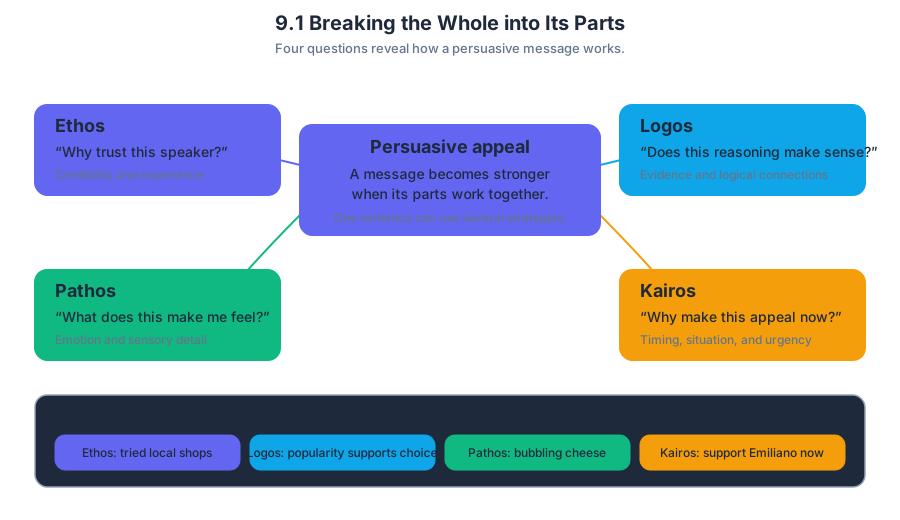
Ethos asks, “Why should I trust this speaker?” Logos asks, “Does this reasoning make sense?” Pathos asks, “What does this message make me feel?” Kairos asks, “Why is this appeal being made now, in this situation?”
In the pizza example, the roommates build ethos by explaining that they have tried the other pizzerias in town. Their experience presents them as informed judges rather than people making a random recommendation. They use logos when they connect the restaurant’s popularity, especially on Thursdays, with the claim that it is a worthwhile place to eat. They use pathos through the sensory description of lasagna: its brilliant color, appealing taste, bubbling cheese, and inviting smell. They invoke kairos when they frame the decision as urgent and socially meaningful—this is the moment to support Emiliano and his staff.
These appeals often work together. A restaurant recommendation may seem more persuasive when the speakers appear experienced, offer reasons, create appetite, and emphasize that the decision matters immediately. A common misconception is that an appeal must belong to only one category. In practice, one sentence can use several strategies at once. A description of bubbling cheese is sensory and emotional, while a statement about having sampled every local pizzeria establishes credibility.
Sensory Language
Sensory language uses details connected to sight, taste, smell, sound, or touch. It makes an abstract recommendation feel physically present. Saying that a lasagna has “brilliant color,” bubbling cheese, a delicious taste, and an inviting smell does more than provide information; it encourages the audience to imagine experiencing the food.
Consider the difference between these two sentences:
Emiliano’s serves lasagna on Thursdays.
On Thursdays, Emiliano’s serves lasagna with brilliant color, bubbling cheese, and a smell that reaches the doorway.
The first sentence gives a basic fact. The second uses sensory language to create desire. It therefore contributes strongly to pathos, although it could also support logos if the writer is demonstrating what makes the restaurant distinctive. Sensory detail is not automatically evidence of quality; it is a persuasive device whose effectiveness and accuracy still require evaluation.
Personification
Personification gives an inanimate object human traits or abilities. In the roommates’ example, the bubbling cheese is described as if it were calling to the listener to eat. Cheese cannot literally call, but the personification makes the food seem active, tempting, and almost impossible to resist.
Personification can be subtle. An advertisement might describe a product as “welcoming,” “honest,” or “working hard,” transferring human character to an object or business. The strategy encourages audiences to form a relationship with something that cannot actually speak or feel. It can strengthen pathos and sometimes ethos by making a product appear friendly or dependable.
Logical Fallacies
Persuasion becomes problematic when it relies on logical fallacies, which are flawed or deceptive patterns of reasoning. Fallacies often sound persuasive because they appeal to emotion, social pressure, or personal judgment while avoiding the actual question. Identifying one does not automatically prove that the conclusion is false; it shows that the reasoning used to reach the conclusion is unreliable or irrelevant.
The roommates’ argument includes several “sneakier” strategies that divert attention from the actual choice. Their claim that “everyone” goes to Emiliano’s, especially on Thursdays, illustrates the bandwagon fallacy. Bandwagon reasoning argues that because everyone is doing something, the audience should do it too.
The argument has this structure: many people eat at Emiliano’s; therefore, you should eat there as well. Popularity may provide useful information—perhaps many customers return because the food is good—but popularity alone does not establish quality. The repeated appeal to “everyone” replaces an evaluation of the restaurant with pressure to conform.
The roommates also make an ad hominem attack. Ad hominem means “against the person.” Instead of addressing the actual argument, the speaker attacks or labels a person associated with it. Their accusation that refusing to go might mean being hostile to immigrants shifts the issue away from whether the restaurant is desirable. It attempts to make the listener feel morally guilty rather than answering the listener’s possible concerns.
The accusation is especially deceptive because it creates a false choice: either support Emiliano and his Haitian and Dominican staff by eating there, or reveal hostility toward immigrants. A person might decline the restaurant for many unrelated reasons—cost, distance, dietary needs, or simply a preference for another meal. None of those reasons proves hostility toward anyone.
Hyperbole
Hyperbole is deliberate exaggeration. Describing a meal as tasting “like heaven” or implying that refusing one dinner will determine whether a family can make a living intensifies the audience’s reaction beyond what the literal facts establish. Hyperbole can add humor and energy, but it can also inflate a minor decision into a moral emergency.
A useful analytical question is: What would remain if the exaggeration were removed? The underlying claim might be that the restaurant deserves support or that the staff faces economic competition. Those claims can be considered on their own evidence. The exaggerated language should not be mistaken for proof.
Bandwagon and Ad Hominem Together
Fallacies frequently work in combination. The bandwagon appeal says, “Everyone goes there,” while the ad hominem accusation says, in effect, “If you do not go, you may be a bad or prejudiced person.” The first applies social pressure; the second threatens the audience’s self-image. Neither addresses whether the restaurant’s food, price, location, or service actually meets the listener’s needs.
This distinction matters because rhetorical analysis is not the same as simply labeling a message “good” or “bad.” A reader should identify the strategy, explain how it affects the audience, and judge whether it is relevant and fair. Emotional appeals can be legitimate, and popularity can be relevant evidence, but neither should substitute for reasoning when the argument requires more than feeling or conformity.
The Workings of Rhetorical Analysis
To deconstruct a persuasive message, move from observation to interpretation. First, identify the claim: what does the speaker want the audience to believe or do? Next, locate the appeal: is the speaker building trust, offering reasons, creating emotion, choosing a timely moment, or using several strategies? Then examine the support. Does the evidence actually connect to the claim? Finally, look for distortions such as exaggeration, personal attacks, or appeals to popularity.
For example, a short analysis might read:
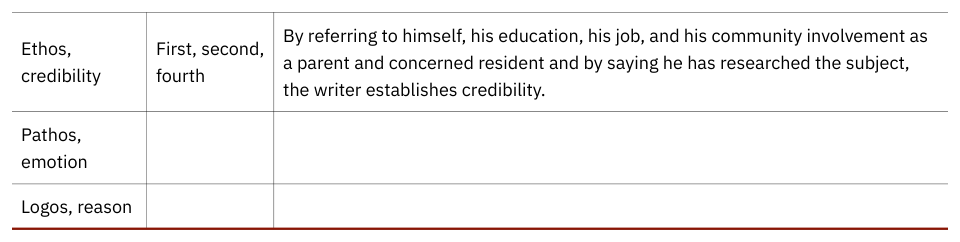
The roommates establish ethos by presenting themselves as experienced diners, then use sensory language to create pathos around the lasagna. Their repeated claim that everyone eats at Emiliano’s uses bandwagon reasoning, while the accusation about hostility toward immigrants is an ad hominem diversion. The message is emotionally forceful, but those fallacies do not prove that the restaurant is the best choice.
This analysis does more than list vocabulary. It names specific choices, explains their effects, and evaluates the quality of the reasoning. That movement—from what appears in the message to how it works to whether it deserves acceptance—is the core of rhetorical analysis.
Rhetorical Strategies in Advertising and Public Policy
Advertising makes rhetorical strategies especially visible because advertisements combine multiple modes of communication. A multimodal advertisement may use visuals, carefully crafted text, dialogue, and voice-over at the same time. Each element can contribute a different appeal, and the elements often reinforce one another.
M&M Advertisements
M&M advertisements combine sweetness, sight, personification, and a subtle bandwagon appeal. The candy’s visual presentation makes it attractive; language and voice-over shape how the audience interprets the image; and personified candies behave like characters with human attitudes and voices. The advertisement does not merely show a product. It turns the product into a social presence that can entertain, speak, and invite identification.
The appeal to sweetness and sight supports pathos by producing pleasure and desire. Personification gives the candy human traits, making an inanimate product seem familiar and engaging. The subtle bandwagon appeal suggests that M&Ms belong in shared social experiences: the audience is invited to join a recognizable world in which others already enjoy them. The advertisement’s effectiveness comes from coordination among image, wording, dialogue, and sound rather than from any single sentence.
Smokey Bear and Public Safety
The Smokey Bear image uses a different rhetorical situation: public education about environmental safety and cooperation. The playful bear cub, letters from people, and humanlike presentation make Smokey a believable voice. Although he is an animal, he appears capable of speaking for a public cause, which makes the message approachable rather than bureaucratic.
The image builds ethos by presenting Smokey as a recognizable, trustworthy representative of environmental responsibility. The letters from people suggest a relationship between the public and the character, strengthening the sense that the message belongs to a cooperative community. The playful visual design creates pathos by making safety memorable and emotionally accessible. The public-policy purpose remains serious, but the humanlike presentation lowers resistance and encourages people to listen.
The same analytical method applies to both commercial and public-service messages. Ask who is speaking, what the message wants, how its visual and verbal elements work together, what emotions it creates, what evidence it offers, and whether any reasoning is misleading. Rhetorical analysis reveals that persuasion is not limited to formal speeches or essays: it appears wherever language, images, sound, timing, and social pressure guide an audience toward belief or action.
The most important habit is to separate the force of an appeal from the truth of its conclusion. A message may be vivid without being accurate, popular without being sound, emotional without being fair, or authoritative without addressing the real issue. Once the parts are visible, the audience can decide which strategies to accept, which to question, and which to reject.
Content adapted from OpenStax Writing Guide with Handbook by Michelle Bachelor Robinson, Maria Jerskey et al., licensed CC BY 4.0.



Source Materials
Study English Composition II: Rhetorical Methods–Based on Lykke
This course page is free to open: signed out, you can read its first two sections, and signing in, on any plan, opens the rest. The free Lykke Chrome extension syncs your own Canvas courses, so ChatGPT, Claude and Muse can answer from your classes and deadlines. It only reads Canvas.
Add the free extensionSign in to open every sectionAll sections of English Composition II: Rhetorical Methods–Based · Browse more course pages