From the free course English Composition II: Rhetorical Methods–Based on Lykke
14.4 Writing Process: Informing and Analyzing
Key concepts: Annotated bibliography · Explanatory and analytical annotations · Summarizing, assessing, and reflecting on sources · Evaluating source validity, reliability, and bias · Source authority and hierarchy · Peer review · Scholarly research and evidence · Research logs and research processes · Observational fieldwork · Library research and CQ Researcher
By the end of this section the student can: Successfully apply citation conventions to your writing, understanding the ideas of intellectual property that motivate their use.; Evaluate research materials for credibility, sufficiency, accuracy, timeliness, and bias.; Compose to discover and reconsider ideas.; Compose an annotated bibliography that uses correct style conventions and integrates the writer’s ideas with ideas from related sources.
14.4 Writing Process: Informing and Analyzing
A research source is not ready for serious use merely because it has an impressive title or appears near the top of a search result. An annotated bibliography turns a list of sources into an informed record of what each source says, how trustworthy it is, and how it may contribute to an argument. The writer therefore does more than collect information: the writer summarizes, evaluates, and reflects.
An annotated bibliography combines a source citation with an annotation that helps readers determine the scope and credibility of the research.
The process also treats writing as a way to discover and reconsider ideas. As writers compare sources, notice agreements and disagreements, and assess evidence, their thesis may become more precise. Citation conventions support this process by acknowledging intellectual property: readers can distinguish a writer’s ideas from ideas, language, evidence, and conclusions drawn from other people’s work.
Summary of Assignment: Annotated Bibliography
An annotated bibliography is a collection of sources in which each source has a complete citation followed by an annotation, a brief discussion of the source. The assignment may serve several purposes: reviewing literature related to an argument, helping formulate a thesis, demonstrating the amount and quality of research, presenting available information on a topic, or supplying useful publications to other readers and researchers.
Each annotation ordinarily addresses three related tasks. First, the writer summarizes the source’s relevant content. Second, the writer assesses the source by considering its authority, accuracy, reliability, timeliness, sufficiency, and possible bias. Third, the writer reflects on the source’s usefulness: what role can it play in the writer’s research, and how does it connect to the developing argument? The assignment is therefore not simply a bibliography with extra sentences attached.
For example, a writer researching restaurant employment might write: “The report projects that some food-preparation jobs will decline while combined food-service occupations will grow. Published by the U.S. Bureau of Labor Statistics, it provides current employment data and projections. I will use it to support my claim that changes in restaurant work involve both job loss and occupational restructuring.” The first sentence summarizes, the second evaluates authority and scope, and the third explains usefulness.
A common misconception is that the longest annotation is automatically the best one. Length should instead match the source and the assignment. A complex scholarly book may require more explanation than a short report, but every sentence should help readers understand the source or its research value.
Quick Launch: Organizing Information
Before drafting polished annotations, the writer organizes information about each source. A useful organizer records the source citation, intended audience, main ideas, evidence, unique features, evaluation, and possible usefulness. This arrangement prevents a familiar research problem: remembering a source’s general topic but forgetting precisely what it claims, whom it addresses, or why it matters.
The section recommends beginning with a summary of approximately one to three sentences for a typical source. A longer or more complicated source may require a longer summary. After summarizing, the writer discusses distinctive features of the content, evaluates the source, and reflects on how it may contribute to the research. The organizer is not the finished annotation; it is a place to collect and arrange the thinking needed to write one.
For instance, an organizer entry might record: “Audience: students and policy researchers. Main idea: employment projections show different effects across food-service occupations. Evidence: labor statistics and future projections. Evaluation: authoritative government publisher and clearly identified data. Use: evidence for a claim about changing work.” Recording these points first gives the writer material for a focused annotation instead of encouraging unsupported impressions.
Organization also makes comparison possible. When several entries use the same categories, the writer can see which sources overlap, which provide different evidence, and which gaps remain. That comparison may reveal that the initial research question is too broad or that the proposed thesis needs reconsideration.
Thesis
A thesis is the central claim or controlling idea that directs a piece of writing. In an annotated-bibliography process, the thesis may not exist in final form at the beginning. Compiling and analyzing sources can help the writer formulate it. The bibliography is therefore part of thinking, not merely documentation completed after the “real” writing.
A useful thesis must be connected to the evidence the sources can actually provide. The writer asks whether the sources are sufficient, credible, accurate, timely, and relevant to the intended claim. A source can be valuable without proving every part of an argument, but the writer must recognize what it can and cannot support.
Suppose the initial idea is “Restaurant jobs are disappearing.” After examining employment data, the writer might revise it to: “Changes in restaurant employment are uneven: some food-preparation jobs are projected to decline, while broader or combined food-service occupations may grow.” The revised thesis is more defensible because it reflects the source’s distinctions rather than forcing the evidence into an oversimplified claim.
This example illustrates why composing can lead to discovery and reconsideration. The writer does not merely search for quotations that confirm a finished opinion. The writer allows credible sources, conflicting evidence, and careful evaluation to reshape the argument.
Citations and Annotations
A citation identifies a source according to a recognized documentation style. It gives readers the information needed to locate the work and acknowledges the source’s intellectual ownership. Citation conventions are therefore both practical and ethical: they enable verification while avoiding the presentation of another person’s language or ideas as the writer’s own.
In an annotated bibliography, the citation comes first, followed by the annotation. The citation should use the style required for the assignment, including the appropriate information about the author, title, publication, date, and location or access details. The annotation then integrates the writer’s thinking with the source’s ideas rather than replacing the citation or repeating it.
An annotation might begin: “Bureau of Labor Statistics. Employment Projections for Food-Service Occupations. 2024.” It could continue: “The report presents employment data, wage information, and future projections for related occupations. Because the report comes from the federal agency that gathers and publishes these statistics, it is a strong source for current labor trends, although its projections describe expected patterns rather than guaranteed outcomes.” The citation identifies the work; the annotation summarizes and evaluates it.
Citation is not required only when a writer copies exact wording. Paraphrased ideas, summarized findings, distinctive information, and borrowed evidence also require acknowledgment. Quotation marks identify copied language, while accurate paraphrase preserves the source’s meaning in the writer’s own words. In either case, the annotation must make the boundary between source material and the writer’s judgment clear.
Evaluation should consider source authority, meaning the author’s or publisher’s expertise and standing; reliability, meaning whether the information and method deserve trust; validity, meaning whether the evidence supports the claims made; timeliness, meaning whether the information remains current for the topic; and bias, meaning a perspective or interest that may shape what the source includes or concludes. No single feature settles every question. A government report may be authoritative for employment statistics but not necessarily for every interpretation of those statistics.
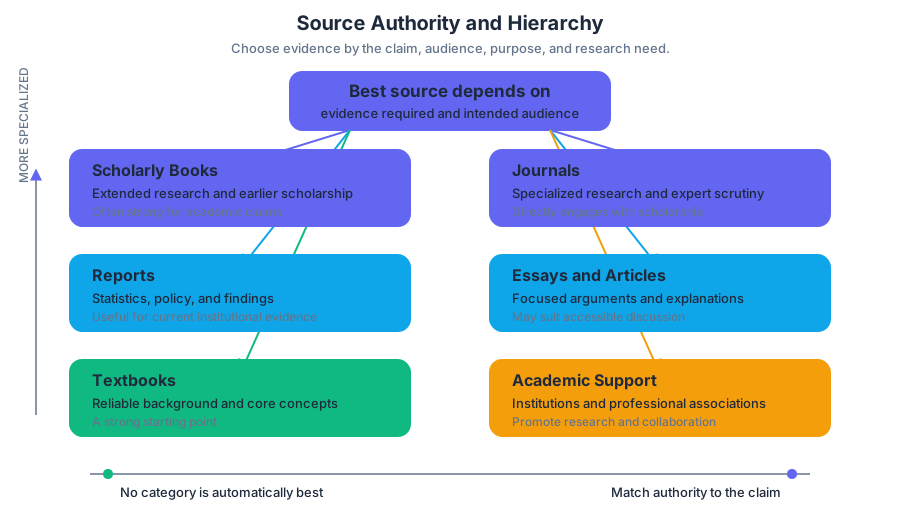
Source hierarchy also matters. Textbooks, scholarly books, academic journal articles, reports, and essays often provide stronger evidence because they reflect research and disciplinary scrutiny. Academic publications commonly undergo peer review, a process in which experts in the field examine work before publication. Peer review strengthens confidence in a scholarly source, but it does not make the source infallible; the writer still evaluates its methods, evidence, date, purpose, and relevance.
Drafting
Drafting turns organized notes into connected prose. A strong annotation usually moves from what the source says to what the writer notices about it and finally to how the source may function in the research. This sequence keeps evaluation grounded in the source instead of allowing vague praise or criticism to dominate.
The writer should summarize accurately before evaluating. Summary identifies the source’s principal claim, evidence, audience, or scope without reproducing every detail. Evaluation then asks whether the source is credible and appropriate. Reflection considers how the source supports, complicates, limits, or changes the writer’s developing argument.
For example: “The article argues that public transportation reduces household transportation costs and supports the claim with survey data from three cities. Its methods are described clearly, but the study’s limited geographic range makes its conclusions less applicable to rural communities. I will use the article for evidence about urban households while looking for another source on rural transportation.” The draft progresses from summary to assessment to a specific research decision.
Drafting may expose problems in the research. If the writer cannot explain a source without copying its language, the source may not yet be understood. If the evaluation contains only adjectives such as “good” or “bad,” the writer needs reasons. If every source appears to support the same claim, the writer should check for selective research and seek relevant disagreement or missing perspectives.
Formatting
Formatting makes the structure of the annotated bibliography visible and consistent. Each entry contains a citation in the assigned documentation style, followed by its annotation. Entries should be presented according to the required style’s rules for order, spacing, indentation, punctuation, capitalization, and publication information. The writer should not combine conventions from different styles.
The format also separates the source’s identifying information from the writer’s discussion. Readers should be able to see where one entry ends and the next begins, locate a source from its citation, and follow the annotation’s prose without confusion. Correct formatting is not decoration: it supports access, verification, and ethical attribution.
A properly structured entry might place the complete citation on its first line and the annotation in one or more paragraphs beneath it. The writer then applies the assigned style consistently to every entry rather than formatting familiar sources one way and unfamiliar sources another. When a citation generator is used, its output still requires checking against the actual source and the required style; automated formatting does not guarantee accuracy.
For example, a writer may discover that a generated citation gives the wrong publication date or omits an organization as author. Correcting those details demonstrates the purpose of formatting: the entry must represent the source accurately, not merely resemble a citation.
Descriptive/Informative and Analytical/Critical Annotations
A descriptive or informative annotation tells readers what a source contains. It may identify the source’s subject, central argument, evidence, intended audience, scope, or distinctive features. Its primary question is, “What does this source say or provide?” A concise summary of a source’s conclusions is the core of this type of annotation.
An analytical or critical annotation goes further by judging the source and explaining its research value. It asks whether the source is authoritative, reliable, valid, current, sufficient, and biased, and whether its evidence fits the writer’s purpose. Its central questions are, “How well does this source do what it claims to do?” and “How will it help, limit, or reshape my research?”
For example, a descriptive sentence might say: “The report describes employment levels, wages, and projected changes in food-service occupations.” An analytical sentence might add: “Because the report is produced by a specialized government agency and identifies its statistical scope, it is useful for employment trends, although its projections should not be treated as certain outcomes.” The first sentence informs; the second evaluates and qualifies.
Many annotations combine both kinds. The writer first gives readers enough information to understand the source, then explains its credibility and usefulness. That combination is especially important when the annotated bibliography will help formulate a thesis: a source’s content matters, but so do its authority, limitations, perspective, and relationship to other sources.
The finished annotation should therefore leave readers able to answer three questions: What is this source about? Can its claims and evidence be trusted for this purpose? How does it contribute to the research? Answering all three transforms a bibliography from a record of reading into a reasoned account of research.
Content adapted from OpenStax Writing Guide with Handbook by Michelle Bachelor Robinson, Maria Jerskey et al., licensed CC BY 4.0.

Source Materials
Study English Composition II: Rhetorical Methods–Based on Lykke
This course page is free to open: signed out, you can read its first two sections, and signing in, on any plan, opens the rest. The free Lykke Chrome extension syncs your own Canvas courses, so ChatGPT, Claude and Muse can answer from your classes and deadlines. It only reads Canvas.
Add the free extensionSign in to open every sectionAll sections of English Composition II: Rhetorical Methods–Based · Browse more course pages