From the free course English Composition II: Rhetorical Methods–Based on Lykke
9.4 Annotated Student Sample: “Rhetorical Analysis: Evicted by Matthew Desmond” by Eliana Evans
Key concepts: rhetoric and rhetorical analysis · ethos, pathos, and logos · audience, purpose, and persuasion · storytelling as persuasion · ethnography · rhetorical questions · bait-and-switch fallacy · hyperbole · Matthew Desmond’s Evicted · rhetorical language and social change
By the end of this section the student can: Identify the ways a student writer has analyzed the rhetorical strategies in a persuasive text.; Demonstrate critical thinking and problem-solving when reading a rhetorical analysis.
9.4 Annotated Student Sample: “Rhetorical Analysis: Evicted by Matthew Desmond” by Eliana Evans
Eliana Evans begins by treating Matthew Desmond’s authority as part of his argument, not as background decoration. Desmond is a sociologist and Princeton University professor whose books address poverty and racial inequality in American life. By identifying those qualifications, Evans analyzes how Evicted establishes ethos, an appeal to credibility or expertise, before examining what the book argues and how it affects readers.
That distinction matters: a person who persuades is making rhetorical choices, while a rhetorical analyst examines those choices, their intended audience and purpose, and their persuasive effects. Evans is not simply repeating Desmond’s ideas. She is explaining how his professional identity, research method, examples, language, and organization encourage readers to take his claims seriously.
Introduction
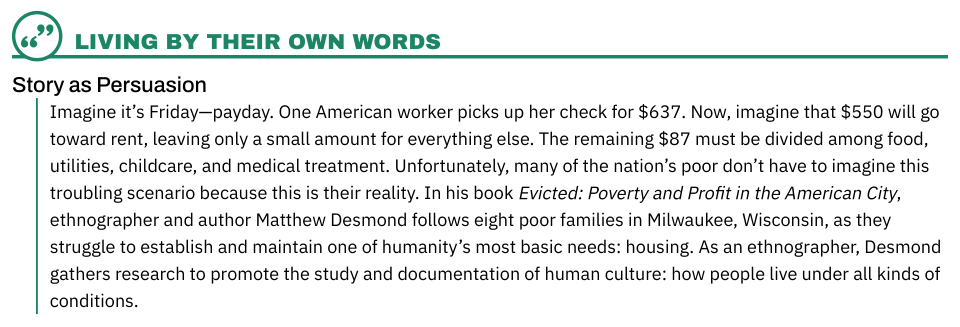
Desmond’s Evicted follows eight poor families in Milwaukee, Wisconsin, as they struggle to establish and maintain housing, one of humanity’s most basic needs. Desmond works as an ethnographer, a researcher who gathers evidence by studying and documenting how people live under particular conditions. Evans uses this fact to connect Desmond’s subject matter with his authority: he is not commenting casually on poverty from a distance but presenting research grounded in close attention to people’s lives.
The audience for Evans’s analysis includes readers who may be unfamiliar with Evicted and who need to understand why Desmond’s account deserves attention. Her purpose is therefore twofold. She introduces the book’s central concern—housing insecurity—and evaluates the rhetorical methods Desmond uses to persuade readers about poverty, inequality, and possible public responses. A strong rhetorical analysis does not ask only, “What does the author believe?” It also asks, “How does the author lead readers toward that belief?”
Ethos
Evans identifies Desmond’s status as an ethnographer as an appeal to ethos. His expertise gives readers a reason to regard his interpretations as informed and responsible. The appeal is especially important because Evicted addresses a complicated social issue that many readers may know only through statistics, political arguments, or general assumptions. Desmond’s research position signals that the book is based on sustained investigation.
Ethos does not mean that a writer automatically becomes correct because of a job title. It means that credibility becomes part of the persuasive situation. Readers may consider a writer’s training, experience, methods, fairness, and relationship to the subject. In the familiar pizza example, roommates establish expertise by explaining that they have tried several other pizzerias; their experience gives weight to their judgment. Evans applies the same principle more substantially to Desmond: his professional experience and ethnographic method support his authority.
Introductory Anecdote
Evans also points to Desmond’s use of real-life stories. Evicted does not present housing insecurity as an abstract policy question alone. It follows named families through the pressures of finding shelter, paying rent, facing eviction, and trying to preserve stability. This storytelling gives readers concrete people and circumstances to remember.
Storytelling can function as persuasion because it makes social conditions vivid. A general statement such as “housing instability harms families” communicates an idea, but a family’s repeated moves, financial pressures, and difficult choices allow readers to imagine what that harm feels like. This is an appeal to pathos, the use of emotion to influence an audience. Evans recognizes that Desmond combines emotional experience with research rather than treating feeling and evidence as opposites.
Living by Their Own Words
The phrase “living by their own words” captures an important ethical and rhetorical feature of Desmond’s method: the families’ experiences become central evidence. Their stories help readers encounter poverty as something people live through, not merely as a category imposed by researchers or policymakers. The choice can build trust because the subjects’ struggles appear in concrete situations and voices.
At the same time, Evans’s analysis invites readers to examine how representation works. Desmond selects which families and events to include, arranges them within a larger argument, and presents their experiences to a public audience. The stories are real, but they are also rhetorically organized. A rhetorical analyst therefore considers both the human reality being represented and the choices that shape how readers interpret it.
Multiple Anecdotal Examples
Evans explains that Desmond supports his argument with multiple anecdotes illustrating the roots of cyclical poverty. One example follows Kamala, a middle-aged mother of three, as she leaves her home. The example gives the larger argument a recognizable human situation: economic hardship is shown as a cycle involving housing, family responsibility, limited choices, and repeated instability.
These anecdotes contribute to logos, the appeal to reasoning, even though they also create pathos. A single story cannot mathematically represent every poor family in Milwaukee. However, several carefully connected cases can help readers identify patterns and understand how Desmond’s claim works. The reasoning develops through accumulation: one family’s experience becomes part of a broader pattern, and the pattern supports the argument that poverty is produced and maintained by social conditions rather than by isolated personal failure.
Audience, Purpose, and Persuasion
Evans emphasizes that Desmond writes toward readers who may be moved to reconsider common explanations of poverty. His purpose is not simply to describe eviction but to show how housing insecurity contributes to continuing poverty and why public action may be necessary. The book’s audience therefore matters: readers must be informed, emotionally engaged, and encouraged to see housing as a social responsibility.
Evans identifies Desmond’s support for housing vouchers and rent regulation as part of this persuasive purpose. She notes that Desmond strongly presents the voucher system as a main point in his argument. That wording helps her analyze stance: Desmond is not neutrally listing policy options; he is guiding readers toward the conclusion that government should help provide stable housing when society recognizes housing as a basic need.
The effectiveness of this persuasion comes from the interaction of appeals. Ethos makes Desmond credible; pathos makes the families’ experiences matter emotionally; logos connects individual cases to a claim about policy and social structure. No single appeal does all the work. The argument becomes stronger because the appeals reinforce one another.
Rhetorical Questions and Language Use
A rhetorical question is a question not asked to receive a direct answer. Instead, it can create emphasis, challenge an assumption, or produce a dramatic pause. The question “Has it occurred to you to ask why the economy …” illustrates this use. It pushes readers to stop accepting a familiar explanation and to consider a deeper cause.
Rhetorical questions can be especially effective when an author wants readers to feel that they have overlooked something important. The question appears to invite participation, but the writer controls the direction of thought. In an analysis, the important issue is not simply identifying the question; it is explaining its effect on the audience and its connection to the writer’s purpose.
Evans also notices emphatic language. Desmond’s presentation of the voucher system as a “main point” signals conviction and tells readers how to rank the idea within the argument. Other rhetorical devices can intensify language as well. When Emiliano says that a restaurant has “a million things on the menu,” the expression is hyperbole, an intentional exaggeration used for emphasis rather than a literal numerical claim. Such language can make abundance, frustration, or excitement feel immediate.
Logical Fallacies as a Caution
Persuasion is not automatically sound simply because it is vivid or confident. A logical fallacy is faulty reasoning that can make an argument appear stronger than it is. The bait-and-switch fallacy begins with an appealing claim that an audience accepts and then changes the terms after agreement has been gained. An advertisement might attract buyers by promising inexpensive phones and later reveal conditions that substantially alter what “inexpensive” means.
This example clarifies what rhetorical analysis must evaluate. The analyst should ask not only whether language attracts attention but also whether the reasoning remains consistent. Desmond’s emotional stories and strong policy position should therefore be considered alongside the logic connecting evidence to conclusions. Evans’s analysis praises the combination of facts, figures, and emotional appeals, but critical thinking still requires readers to test whether the support actually warrants the claims.
Conclusion and Thesis Statement Reaffirmed
Evans concludes by praising Desmond’s rhetorical ability to appeal to readers in different ways. Her final judgment is that his logical approach, including facts and figures, works together with emotional appeals to make the argument persuasive. She also connects this effectiveness to the possibility of public action: readers who understand the causes and human consequences of poverty may be more willing to support candidates and policies aimed at reducing inequality.
The conclusion reaffirms the analysis’s central claim rather than merely repeating the book’s plot. Evans has shown how Desmond establishes credibility through expertise, uses ethnographic storytelling to create emotional investment, and develops a logical case from individual experiences toward broader policy conclusions. Her student sample demonstrates the central task of rhetorical analysis: explain not just what a writer says, but how deliberate choices shape what an audience understands, feels, and may decide to do.
Jamil Smith’s writing about Black experiences in America offers a related reminder that rhetorical analysis must attend to audience and cultural context. His discussions of Black Panther, King T’Challa, and unequal opportunities use contemporary cultural references to make arguments about racial inequality accessible and urgent. Like Desmond, Smith persuades through a combination of credibility, emotional resonance, and reasoning; Evans’s analysis shows how those choices can be identified and evaluated in a focused student essay.
Content adapted from OpenStax Writing Guide with Handbook by Michelle Bachelor Robinson, Maria Jerskey et al., licensed CC BY 4.0.


Source Materials
Study English Composition II: Rhetorical Methods–Based on Lykke
This course page is free to open: signed out, you can read its first two sections, and signing in, on any plan, opens the rest. The free Lykke Chrome extension syncs your own Canvas courses, so ChatGPT, Claude and Muse can answer from your classes and deadlines. It only reads Canvas.
Add the free extensionSign in to open every sectionAll sections of English Composition II: Rhetorical Methods–Based · Browse more course pages