From the free course English Composition II: Rhetorical Methods–Based on Lykke
11.2 Trailblazer
Key concepts: Critical thinking · Credible information and evidence · Reasoning strategies · Analogy · Cause and effect · Classification and division · Comparison and contrast · Problem and solution · Definition · Critical reading and writing
By the end of this section the student can: Read for inquiry, learning, and critical thinking.; Identify reasoning strategies and explain their functions.
11.2 Trailblazer
A persuasive judgment is only as strong as the thinking and evidence used to reach it. If someone claims that a service dog is ready for public work, for example, a responsible reader asks what evidence supports that claim, how the training was conducted, and whether the conclusion follows from the facts. Critical thinking means examining a topic carefully, locating credible information, considering relevant perspectives, and basing judgments on sound reasoning and evidence.
Critical Thinking
Critical thinking is not simply “being critical” or finding fault. It is the disciplined process of examining an issue before deciding what to believe or what action to take. A critical thinker separates observation from assumption, tests claims against evidence, considers more than one side, and asks whether the reasoning actually supports the conclusion.
A common misconception is that critical thinking requires emotional detachment or automatic skepticism. In practice, critical thinking does not mean rejecting every claim. It means giving claims the amount of trust they have earned. A well-supported conclusion may deserve acceptance; a dramatic but poorly supported claim may deserve caution.
Critical reading, critical writing, and critical thinking are closely connected. A reader examines how an argument is built. A writer selects and organizes evidence so that readers can follow the reasoning. Both activities require examining all sides of an issue before making a decision. The goal is not to pretend that every side is equally convincing, but to understand competing positions well enough to judge them fairly.
Credible Information and Evidence
Evidence is information used to support a claim. It may include observations, examples, facts, expert statements, descriptions, or other information appropriate to the subject. Credible information is information that can reasonably be trusted because its source, accuracy, relevance, and presentation withstand examination.
Imagine a writer arguing that a social-media platform should monitor repeat violators more aggressively. The writer cannot establish the argument merely by saying that online abuse is “obviously” harmful. Stronger support might identify repeated violations, explain how current monitoring fails, and show why increased monitoring could address the problem without creating an even greater concern, such as unfair removal of legitimate speech.
Evidence must fit the claim it supports. A personal example may illustrate a problem, but one example cannot automatically prove that the problem is universal. A large number of observations may show a pattern, but the writer still needs to explain what the pattern means. Critical thinkers therefore ask two questions: Is this information trustworthy? and Does it actually support this conclusion?
Reasoning Strategies
A reasoning strategy is a recognizable pattern for organizing thought and developing an explanation or argument. Writers use these patterns in nonfiction, including textbooks and how-to books, and in fiction, including novels and short stories. Recognizing the pattern helps readers understand how a text moves from information to meaning or from a claim to a conclusion.
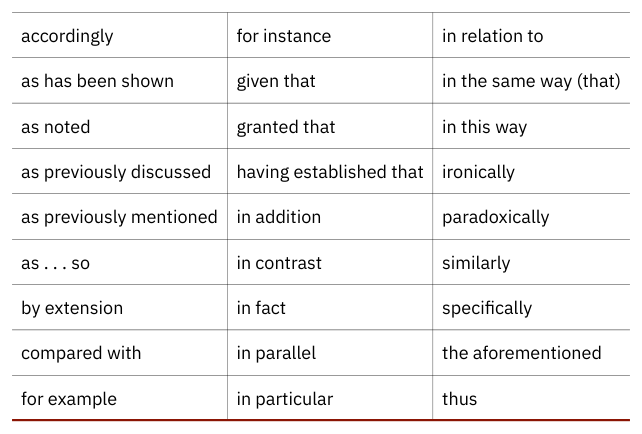
The six reasoning strategies presented here are analogy, cause and effect, classification and division, comparison and contrast, problem and solution, and definition. These strategies are not rigid containers. A single paragraph or essay may use more than one. For example, a writer might classify types of online violations, explain their causes, and then propose a solution.
The writer’s audience, purpose, situation, personal views, and cultural background influence which strategy seems most useful. A writer explaining a technical process may rely on classification and division. A writer urging an institution to change a policy may emphasize problem and solution. Choosing a strategy is therefore a rhetorical decision: the pattern must help the intended readers understand why the claim matters and why the evidence is relevant.
Analogy
An analogy explains or analyzes an unfamiliar subject by comparing it with something more familiar. The comparison does not claim that the two subjects are identical. Instead, it highlights a shared feature that makes the unfamiliar subject easier to understand.
For example, examining the COVID-19 pandemic can be compared with examining a robbery spree. In both cases, investigators look for patterns across events, identify connections, and ask what conditions allowed the events to occur. The analogy helps readers understand the process of analyzing a widespread crisis by linking it to the more familiar task of investigating connected crimes. The writer must still clarify where the comparison stops; a pandemic and a robbery spree differ greatly in causes, scale, and consequences.
A useful analogy is selective. It focuses attention on a meaningful similarity rather than piling up superficial resemblances. A weak analogy can mislead readers when the shared feature is too narrow or when important differences undermine the comparison.
Cause and Effect
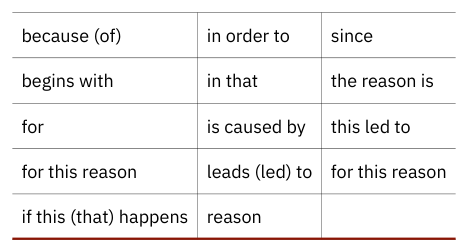
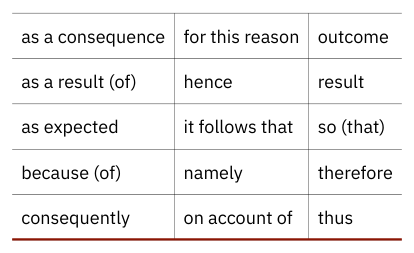
Cause-and-effect reasoning examines why something happens, what results from it, or how several conditions interact to produce an outcome. A cause is a factor that contributes to an event; an effect is a result or consequence. Careful writers avoid assuming that because one event follows another, the first event necessarily caused the second.
Consider the example of small hardware retailers competing with a superstore. Customers at Artie’s Hardware, Cradle, and Teen often received personal attention, but the smaller stores offered less variety. The superstore offered lower prices and more choices, even when its products did not match the quality of the smaller retailers’ products. The reasoning connects conditions—price, variety, personal service, and quality—to an effect: small retailers often lose customers to superstores.
A strong cause-and-effect explanation distinguishes a contributing cause from the only cause. A writer might argue that lower prices contribute to the superstore’s success without claiming that price alone explains every customer’s decision. This distinction makes the reasoning more accurate and credible.
Classification and Division
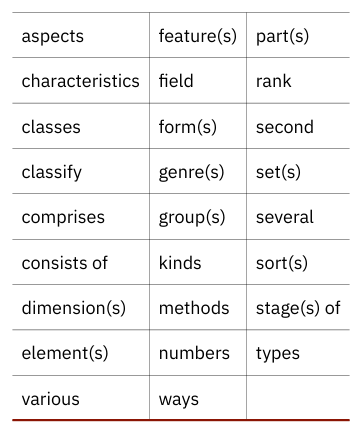
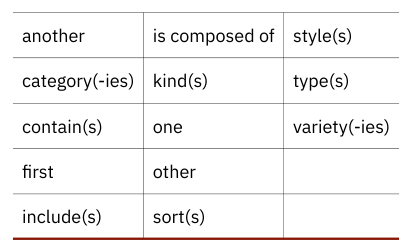
Classification and division are closely related strategies. Classification organizes one subject or group into categories. Division separates a single subject into its parts. Both strategies make a complex subject easier to examine by showing how its elements relate to the whole.
A writer discussing hardware-store customers might classify them according to what they value most: low price, product quality, expert advice, or convenience. A writer using division might examine the store experience by separating it into product selection, service, pricing, and location. Classification answers, “What kinds are present?” Division answers, “What parts make up this whole?”
The categories must be meaningful and reasonably complete. If a writer classifies customers only as “price-conscious” and “quality-conscious,” the categories may overlap because many customers care about both. A thoughtful classification explains the organizing principle and acknowledges complexity rather than forcing every subject into an artificial box.
Comparison and Contrast
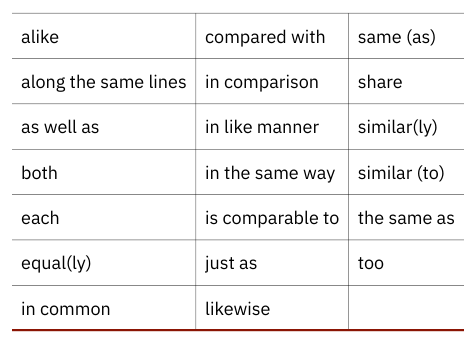
Comparison and contrast examines similarities and differences between two or more subjects. Comparison emphasizes what subjects share; contrast emphasizes how they differ. Writers use the strategy to clarify both subjects, not merely to declare one better.
A comparison of Romantic-period poetry and 1980s rap might examine how both artistic genres express identity, challenge social expectations, or use distinctive rhythms and voices. The contrast would then consider their different historical settings, forms, audiences, and cultural conditions. The point is not that the genres are interchangeable, but that studying their similarities and differences reveals how artistic expression responds to its context.
The same strategy can compare fast-food restaurants by examining price, menu variety, speed, service, and quality. A useful comparison establishes common criteria. Without shared criteria, the writing becomes a list of unrelated observations rather than a reasoned analysis.
For instance, a writer might say: “Virtual and face-to-face learning differ in how students maintain attention, but both depend on student responsibility.” The sentence gives readers a clear basis for comparison: methods of attention and responsibility. It also avoids the false choice that one environment must be entirely better than the other.
Problem and Solution
Problem-and-solution reasoning identifies a difficulty and proposes or evaluates one or more ways to address it. The problem may be practical, social, institutional, or personal. The solution must be connected to the stated problem and should be judged for feasibility, effectiveness, costs, and possible consequences.
A writer can organize a problem-and-solution paragraph in two basic ways: identify the problem first and then explain a solution, or present the solution first and then identify the problem that requires it. For example, a paragraph may begin by describing repeated violations on a social-media platform and then argue for increased monitoring. Alternatively, it may begin by proposing stronger monitoring and then explain the repeated violations that make the proposal necessary.
The second structure is persuasive only if the writer makes the connection explicit. “Increase monitoring” is not enough by itself. The writer should explain who would monitor violations, how repeat offenders would be identified, what action would follow, and how the platform could protect users from inconsistent or unfair enforcement.
A proposed solution can create new problems. Increased monitoring might reduce abuse but also raise concerns about privacy, mistaken penalties, or excessive control. Considering these consequences demonstrates critical thinking because it examines the solution rather than treating it as automatically successful.
Definition
Definition explains what a term, idea, condition, or experience means. A definition may begin with a common meaning and then refine, expand, or challenge it. Writers often use definition when disagreement depends on what a key word actually includes.
Consider the idea of patriotism. Many people define patriotism as showing devotion to one’s country. A writer may offer a more personal or specific definition, such as conducting oneself in ways that respect everyone. The new definition shifts attention from public declarations to behavior and gives readers a standard for evaluating claims about patriotic conduct.
Definitions are therefore not always neutral dictionary entries. In an argument, defining a term can shape how readers understand the entire issue. A writer who defines “success” as high income will reason differently from one who defines it as meaningful work and community well-being. The writer should make the definition clear and support it with explanation or examples.
Using Reasoning Strategies Together
Reasoning strategies are building blocks of logical writing. A paragraph about service-dog training might classify stages of training, compare public and home behaviors, explain how certain training practices cause reliable responses, and define what “ready for service” means. The strategies work together because each answers a different question about the subject.
Recognizing these common formats helps readers analyze arguments and helps writers create more logical, persuasive ones. When a claim feels confusing, identify the pattern underneath it: Is the writer comparing two subjects, tracing causes, dividing a whole, proposing a solution, explaining an unfamiliar idea through analogy, or defining a disputed term? Once the pattern is visible, readers can evaluate whether the evidence fits and whether the conclusion follows.
The strongest reasoning does not hide behind a familiar format. It explains the relationships among claims, evidence, and conclusions, acknowledges relevant differences, and considers the issue from more than one side. That is the central discipline of critical thinking: not merely having an opinion, but showing why the opinion is justified.
Content adapted from OpenStax Writing Guide with Handbook by Michelle Bachelor Robinson, Maria Jerskey et al., licensed CC BY 4.0.
Source Materials
Study English Composition II: Rhetorical Methods–Based on Lykke
This course page is free to open: signed out, you can read its first two sections, and signing in, on any plan, opens the rest. The free Lykke Chrome extension syncs your own Canvas courses, so ChatGPT, Claude and Muse can answer from your classes and deadlines. It only reads Canvas.
Add the free extensionSign in to open every sectionAll sections of English Composition II: Rhetorical Methods–Based · Browse more course pages