From the free course English Composition II: Rhetorical Methods–Based on Lykke
12.1 Introducing Research and Research Evidence
Key concepts: Argumentative research · Research evidence · Primary sources · Secondary sources · Firsthand accounts · Experiments · Original data collection · Debatable issues · Research process · Synthesizing research evidence
By the end of this section the student can: Articulate how research evidence and sources are key rhetorical concepts in presenting a position or an argument.; Locate and distinguish between primary and secondary research materials.; Implement methods and technologies commonly used for research and communication within various fields.
12.1 Introducing Research and Research Evidence
A persuasive position becomes stronger when it is supported by evidence that readers can examine, question, and connect to the writer’s reasoning. Research is therefore not simply the act of collecting information. It is the purposeful use of evidence to develop and defend a viewpoint about an issue on which reasonable people may disagree.
Argumentative Research
The writing tasks associated with this chapter and the next two chapters are based on argumentative research: research conducted to help a writer present and support a position. An argument does not merely announce what someone believes. It gives readers reasons to accept the validity of that viewpoint, using evidence appropriate to the subject, audience, purpose, and genre.
A debatable issue is an issue with more than one possible perspective and therefore subject to disagreement. “What year did the treaty take effect?” is primarily a factual question. “Did the treaty create a fair solution?” is debatable because readers may interpret fairness differently and may weigh the treaty’s effects in different ways. Research for an argumentative project must help a writer enter that disagreement rather than pretend that no alternative position exists.
A useful argumentative research question often begins broadly and becomes more focused as the researcher learns. For example, a writer might begin with “How does public transportation affect communities?” Research may lead to a narrower question such as “Should a city expand evening bus service in neighborhoods with limited car ownership?” The second question identifies a decision, a population, and a point of disagreement. Those details make it possible to seek evidence that can actually support an argument.
Research can support arguments in many forms. A final project might be a traditional essay, but it could also be a poster, performance, story, art exhibit, or architectural design. The genre changes the way evidence is presented, but the rhetorical responsibility remains: the creator must communicate a perspective on a debatable issue and persuade an audience that the perspective is valid.
A common misconception is that “research” means finding quotations that agree with an opinion already formed. Effective argumentative research does more. It helps the writer understand the issue, identify competing perspectives, test assumptions, and decide what kinds of evidence will be most convincing. Evidence is not decoration added after the argument; it helps shape the argument itself.
Research Evidence
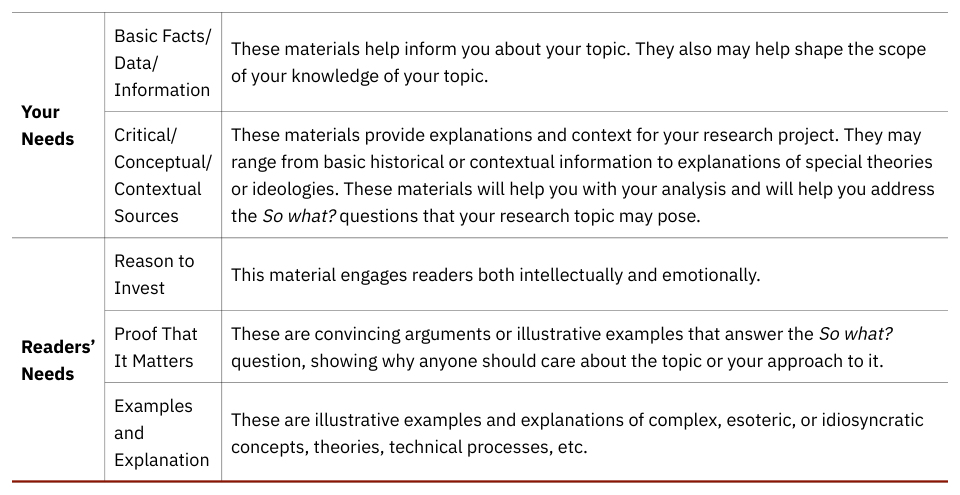
Research evidence, also called data, is information used to support an interpretation, explanation, or position. Evidence may consist of written documents, observations, interviews, official records, experimental results, or other materials. It is not always presented in the same genre, so researchers may need to gather evidence from different kinds of sources.
For instance, a project about whether a city should create a protected bicycle lane might use several forms of evidence: an official transportation report, newspaper coverage of recent crashes, interviews with residents, observations of traffic patterns, and an experiment or survey measuring how drivers and cyclists respond to different roadway designs. Each source contributes something different. The official report may provide statistics, an interview may reveal lived experience, and observation may show what actually happens in a particular location.
The point is not to collect the greatest possible number of sources. The point is to assemble evidence that answers the research question and allows the writer to reason carefully. A source’s usefulness depends on what it can establish, what it cannot establish, and how it relates to other evidence. One personal account may illuminate an experience, for example, but it may not establish how every resident feels. A statistical report may show a broad pattern, but it may not explain why individuals behave as they do.
Research evidence also has a rhetorical role. Readers ask whether the evidence is relevant, sufficient, and appropriately interpreted. A writer who presents a source without explaining its significance leaves the audience to perform the reasoning alone. A stronger passage connects the evidence to the claim:
A neighborhood survey found that many residents supported later bus service, while interviews explained why: evening workers often faced long walks after the final route. Together, these findings suggest that the transportation problem is not only a matter of convenience but also of access to employment.
The example uses two kinds of evidence and explains their relationship. The survey indicates a pattern of support; the interviews provide context for that pattern. The writer does not merely list the sources but synthesizes them, or combines them to develop a more meaningful conclusion.
The Research Process
Although research processes differ according to discipline and rhetorical situation, they share important features. The researcher develops interest in a topic, asks questions, gathers evidence, and gradually refines an understanding of the issue. These activities are not always strictly separate or completed only once. New evidence may change the question, and a better question may require searching for different evidence.
Interest
Research begins with genuine interest in a topic. Interest may come from a personal concern, a community problem, a professional question, or an unexpected observation. Some assignments allow researchers to choose issues that matter personally; others require researchers to develop interest by investigating the subject before they fully understand it.
Curiosity cannot always be manufactured instantly, but it can be developed. A researcher might begin with a practical concern—such as the difficulty of finding affordable housing—and discover related questions about zoning, transportation, wages, or public policy. Following those connections turns a familiar concern into an issue that can be investigated from multiple perspectives.
Questions
Researchers ask questions, usually beginning with broad questions and moving toward more specific ones. Early questions help the researcher explore the territory: What is happening? Who is affected? What explanations have been offered? As the researcher learns more, the questions become narrower and more useful for an argument.
Consider the progression “Why are some students absent from class?” to “How do unreliable morning bus routes affect attendance for students who commute from neighborhoods without reliable car access?” The second question is not automatically the final research question, but it identifies possible causes, a population, and a context. It also points toward the kinds of evidence the researcher may need, including transportation data, attendance information, and firsthand accounts.
A strong research question remains open to investigation. If the answer is already contained in the wording, research becomes a search for confirmation. If the question is impossibly broad, the researcher may gather disconnected information without developing a clear position. The most productive questions create room for evidence, interpretation, and disagreement.
Types of Research Evidence
The two central categories introduced here are primary sources and secondary sources. The distinction concerns how closely a source is connected to direct experience or observation. It is not a simple ranking in which primary sources are always better than secondary sources. Each type serves a different purpose, and effective research usually includes both.
Primary Research Sources
Primary data sources are generally firsthand accounts: texts or other materials produced by someone drawing from direct experience or observation. Primary sources provide original evidence connected closely to an event, person, activity, or investigation.
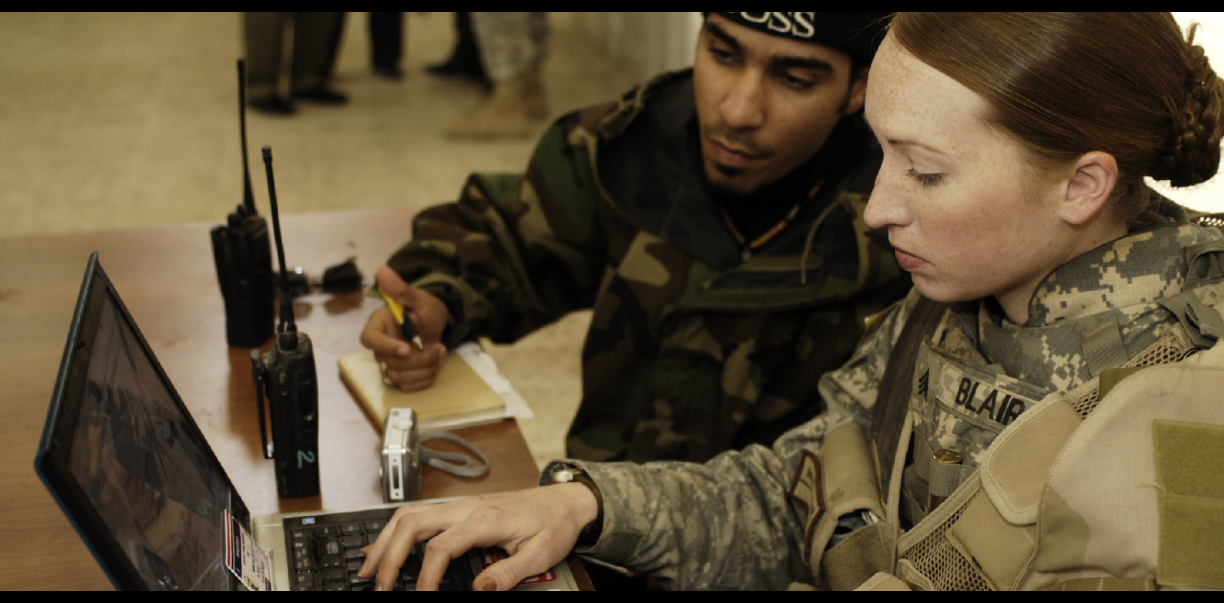
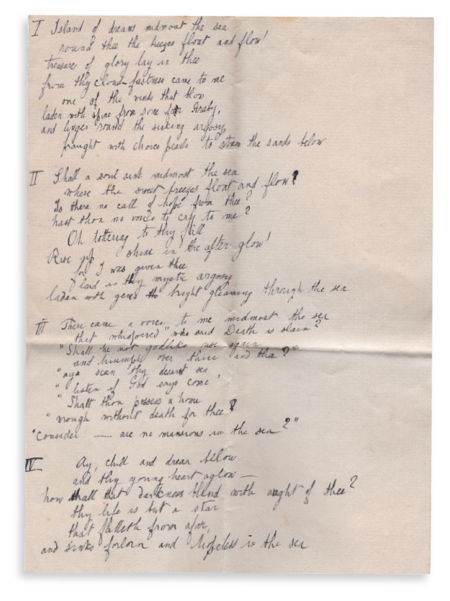
Examples include personal narratives and diaries, eyewitness accounts, interviews, original documents such as treaties and official certificates, government documents detailing laws or acts, speeches, newspaper coverage published at the time an event occurred, observations, and experiments. A diary entry written during a crisis is primary evidence of the writer’s experience and perspective. A speech delivered during a political campaign is primary evidence of what the speaker said at that moment.
Experiments are another example of primary data. An experiment produces original information through an investigation designed and conducted to observe results. A researcher testing how different amounts of light affect plant growth, for example, collects measurements directly from the investigation. Those measurements are primary evidence because they originate in the researcher’s own process rather than in someone else’s summary.
Primary-source data is original and is conducted or collected primarily by the researcher. This definition does not mean that every primary source must be created from nothing by the person writing the final paper. A researcher studying a historical event may examine an eyewitness letter created by someone else. The letter is still primary because it records a firsthand connection to the event.
Secondary Research Sources
Secondary sources are at least one step removed from direct experience. They rely on sources other than direct observation or firsthand experience and commonly interpret, analyze, explain, or summarize information gathered elsewhere.
Examples include most books, online articles, database articles, and textbooks. Textbooks are sometimes classified as tertiary sources because their main purpose may be to summarize or condense information, much as encyclopedias and other reference works do. The categories can vary somewhat by discipline, but the central distinction remains useful: secondary and tertiary works generally mediate information rather than presenting a direct firsthand record.
Secondary sources regularly cite and build on primary sources to provide perspective and analysis. A historian might examine government documents, speeches, newspaper reports, letters, and diaries, then use those materials to explain why an event unfolded as it did. The historian’s work is secondary because it interprets earlier evidence, even though it may offer valuable expertise and a carefully supported argument.
Effective use of researched evidence usually includes both primary and secondary sources. Primary sources give a researcher direct or original material to examine. Secondary sources help place that material in context, connect it to broader patterns, and show how other researchers have interpreted it. Using only a primary source may produce an incomplete or overly narrow account; using only secondary sources may prevent the writer from engaging directly with the evidence behind those interpretations.
How the Source Types Work Together
Historical writing demonstrates the relationship especially clearly. Historical works often draw on a wide range of primary and secondary sources by citing, analyzing, and synthesizing them. A historian may cite an original speech, analyze its language and historical circumstances, compare it with newspaper coverage from the same period, and then use later scholarship to explain its significance.
The same pattern works in contemporary argumentative research. A writer investigating workplace conditions might use interviews and observations as primary evidence, then consult books and database articles as secondary evidence. The interviews reveal firsthand experiences; the observations document what the researcher directly sees; the secondary sources provide concepts and analysis that help the writer interpret those findings responsibly.
The most important question is not simply “Is this source primary or secondary?” It is “What work can this source do in my argument?” Classifying sources helps researchers locate and use them appropriately, but classification alone does not establish credibility or relevance. A strong argument explains how each source contributes to understanding a debatable issue and how multiple sources work together to support the writer’s position.
Content adapted from OpenStax Writing Guide with Handbook by Michelle Bachelor Robinson, Maria Jerskey et al., licensed CC BY 4.0.

Source Materials
Study English Composition II: Rhetorical Methods–Based on Lykke
This course page is free to open: signed out, you can read its first two sections, and signing in, on any plan, opens the rest. The free Lykke Chrome extension syncs your own Canvas courses, so ChatGPT, Claude and Muse can answer from your classes and deadlines. It only reads Canvas.
Add the free extensionSign in to open every sectionAll sections of English Composition II: Rhetorical Methods–Based · Browse more course pages