From the free course English Composition II: Rhetorical Methods–Based on Lykke
10.2 Trailblazer
Key concepts: Culture as constantly changing and evolving · Cultural variation among groups and subgroups · Critical thinking in varying rhetorical and cultural contexts · Analyzing rhetorical and cultural contexts in reading · The allegory of the prisoners’ reaction to light · Cause-and-effect reasoning in the prisoner example · Plot summary · Problem-solution paragraph structure · Working topic sentences for problem-solution reasoning · Text-messaging style and response habits
By the end of this section the student can: Demonstrate critical thinking when reading in varying rhetorical and cultural contexts.; Articulate and analyze rhetorical and cultural contexts in reading.; Distinguish relationships between the interplay of verbal and nonverbal elements, and explain how these features function for different audiences and situations.
10.2 Trailblazer
Trendsetter
Culture is not a fixed container that people simply inherit; it is constantly changing and evolving as people encounter new knowledge, behaviors, technologies, values, and circumstances. A gesture, phrase, image, or argument can mean something different as a community changes—and it can mean something different to another group at the same moment. Rhetorical analysis therefore begins with a deceptively difficult question: What does this communication mean here, for these people, at this time?
The word culture refers to the shared patterns through which a group makes meaning, including its language, customs, assumptions, values, behaviors, and forms of expression. Because culture changes, a rhetorical choice cannot be judged only by whether it would work in the writer’s own community. A writer or reader must consider the cultural setting in which a text was produced and the setting in which it is being interpreted.
Culture also varies greatly from group to group. A large society may contain many subgroups, or communities within the larger culture that have distinctive experiences and expressions. The section points to minorities within a majority population as one example. These subgroups may use language, symbols, styles, or forms of persuasion differently from the dominant group. A rhetorical practice that seems natural or persuasive to one audience may seem confusing, inappropriate, or even offensive to another.
The important consequence is that no rhetorical analysis is completely detached from time and place. When analysis approaches the language of a particular culture, questions arise about who is best equipped to perform the analysis and what criteria should be used. Someone familiar with a community’s history, language, and conventions may notice meanings that an outsider misses. At the same time, familiarity does not automatically make an interpretation correct. Critical thinking requires the analyst to identify the evidence and assumptions supporting an interpretation rather than treating cultural membership as a substitute for reasoning.
Critical thinking here means examining how context affects meaning instead of accepting a first impression as universal. The reader asks why a choice might have made sense to its original audience, what the choice assumes about that audience, and whether a later audience brings different assumptions. The goal is not to declare every interpretation equally valid. The goal is to make interpretations more responsible by connecting them to rhetorical and cultural evidence.
A rhetorical context is the situation surrounding communication: the author or speaker, the intended audience, the purpose, the subject, the occasion, and the available methods of persuasion. A cultural context is the network of shared beliefs, practices, histories, and values that shapes how people understand that communication. These contexts overlap. An author’s purpose influences the strategies chosen, while cultural expectations influence whether an audience recognizes those strategies as credible, respectful, emotional, humorous, or urgent.
Writers analyzing rhetoric should therefore ask questions such as these:
- What are the goals of the author of the text?
- What factors may have influenced the author’s choice of rhetorical strategies?
- What time and place shaped the text?
- What cultural knowledge does the author assume?
- Which audience is being addressed, and what might that audience value or expect?
- How might another group or subgroup interpret the same verbal or nonverbal choices?
- What evidence supports the interpretation?
These questions prevent a common misconception: that rhetorical analysis is merely a search for devices such as repetition, metaphor, emotional appeal, or formal diction. Identifying a device is only the beginning. The analyst must explain what the choice does in a particular situation and why it might function differently for different audiences. A raised hand, a pause, a photograph, a color, or a carefully chosen word can communicate, but its force depends on the people and circumstances involved.
Verbal and nonverbal meaning
Verbal elements are communicated through words, whether spoken or written. Nonverbal elements include physical actions, facial expressions, images, layout, silence, tone, gesture, and other meaning-making features that do not depend entirely on words. The section’s learning outcome emphasizes distinguishing the relationship between these elements. They may reinforce one another, complicate one another, or conflict with one another.
For example, the words “I am listening” may suggest attention, but a speaker who avoids eye contact and repeatedly checks a phone sends competing nonverbal signals. An audience may interpret the behavior as boredom or disrespect, even though the verbal message claims attentiveness. In another cultural context, however, sustained eye contact might not carry the same meaning. The analyst must avoid assuming that one community’s interpretation is universal.
The same principle applies to written texts. A bold heading, a photograph, an empty space, or the arrangement of information can guide readers even though these elements are not sentences. A rhetorical analysis should explain how verbal and nonverbal features work together for a particular audience and situation. It should also recognize that the audience’s cultural expectations help determine what those features mean.
The prisoners and the difficulty of seeing differently
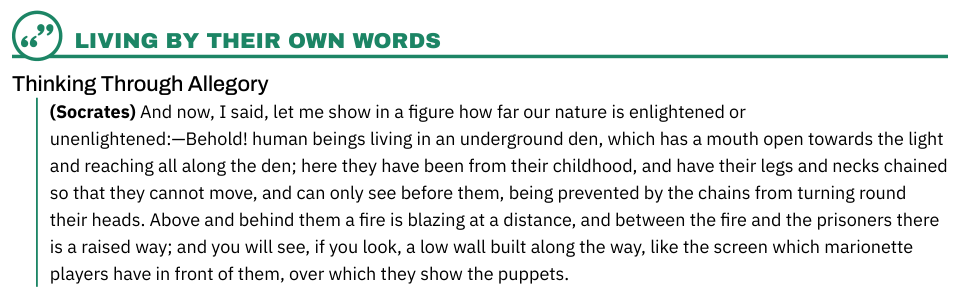
The section uses the allegory of the prisoners’ reaction to light to illustrate how people respond when their understanding is challenged. In Plato’s dialogue, prisoners have been confined so that they see shadows rather than the objects producing them. When one prisoner is released and exposed to the reality behind the shadows, the experience is not immediately liberating in a comfortable sense. The prisoner is physically and mentally distressed.
The dialogue describes the prisoner being “reluctantly dragged” up a steep and rugged ascent and then brought into the presence of the sun. The brief phrase captures resistance as well as difficulty: the prisoner does not eagerly volunteer to abandon the familiar world. The movement from darkness to light represents a movement from limited understanding toward a wider reality, but the allegory does not portray learning as instant recognition.
The prisoner’s eyes are dazzled and cannot immediately see what the dialogue calls realities. The prisoner’s first response is pain, confusion, and irritation—not confident agreement. This reaction matters rhetorically because it shows that an audience may resist a message not simply because the message is poorly presented, but because the message disrupts the audience’s established way of understanding the world.
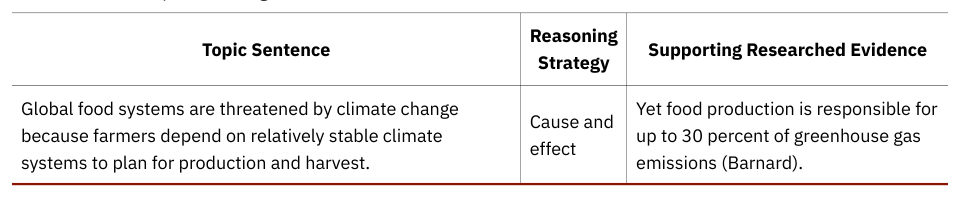
The example also demonstrates cause-and-effect reasoning. Cause-and-effect reasoning explains how one event produces, contributes to, or helps account for another event. The chain in the prisoner example can be represented as follows:
- The prisoner is released from the chains and forced to move.
- The sudden physical change causes pain and discomfort.
- The prisoner looks directly toward the light.
- The brightness causes eyestrain and dazzlement.
- The prisoner cannot immediately recognize the new objects as reality.
- Confusion and mental anguish cause the prisoner to turn back toward what had previously seemed real.
The reasoning is more precise than simply saying that the prisoner “does not like the truth.” Each effect follows from a specific condition: forced movement produces bodily pain; sudden exposure to brightness produces eyestrain; unfamiliar evidence produces confusion; confusion encourages retreat toward familiar beliefs. The allegory therefore helps readers analyze how audiences respond when a rhetorical message asks them to revise their assumptions.
The cause-and-effect relationship should not be reduced to a mechanical rule that every audience reacts identically. The allegory presents a particular imagined situation. In actual rhetorical contexts, an audience’s response may also depend on trust in the speaker, cultural background, prior knowledge, social position, and the manner in which the information is presented. Critical thinking requires distinguishing what the example directly shows from what an analyst is adding as interpretation.
Reading the allegory in context
A careful reader asks what the allegory is trying to accomplish and how its choices guide the audience. The prisoners, shadows, chains, ascent, and sunlight are not merely plot details; they are arranged to make an argument about knowledge and perception. The dialogue form also matters. Socrates asks questions and Glaucon responds, so the reasoning develops through an exchange rather than through a direct declaration. The audience is led to follow the causal sequence and agree step by step.
The allegory’s rhetorical effect may vary across audiences. A reader who values philosophical inquiry may see the movement toward light as an admirable search for truth. A reader focused on the prisoner’s forced treatment may notice the violence of the process and question whether knowledge obtained through coercion can be called freedom. Both responses require analysis of the text’s details, not merely personal reaction. The relevant rhetorical and cultural context helps explain why different readers may emphasize different features.
A short analytical example
The city’s new public-health poster shows a family standing beneath a bright sunrise beside the words “Protect What We Share.” Its warm colors and collective pronoun appeal to community responsibility, while the image makes vaccination appear ordinary and familiar rather than frightening. For an audience that values family welfare, the visual and verbal elements reinforce one another; for an audience that distrusts official campaigns, the same polished image may seem like an attempt to manage emotion.
This passage makes several deliberate choices. It identifies the poster’s purpose—encouraging vaccination—without assuming that the message will affect every audience in the same way. It connects the verbal phrase “What We Share” with the nonverbal image of a family and explains how both appeal to communal responsibility. It also acknowledges cultural and rhetorical variation: family-centered imagery may persuade some viewers, while institutional distrust may cause others to interpret the same imagery skeptically. The analysis does not ask only whether the poster is effective. It asks for whom, under what conditions, and why.
The central lesson of Trendsetter is that meaning develops through interaction among language, nonverbal features, audiences, cultures, and situations. Culture changes; groups and subgroups interpret communication differently; and unfamiliar ideas may produce resistance before understanding. A strong rhetorical reader traces those relationships carefully, uses cause-and-effect reasoning when the evidence supports it, and explains how an author’s choices function within a specific rhetorical and cultural context.
Content adapted from OpenStax Writing Guide with Handbook by Michelle Bachelor Robinson, Maria Jerskey et al., licensed CC BY 4.0.
Source Materials
Study English Composition II: Rhetorical Methods–Based on Lykke
This course page is free to open: signed out, you can read its first two sections, and signing in, on any plan, opens the rest. The free Lykke Chrome extension syncs your own Canvas courses, so ChatGPT, Claude and Muse can answer from your classes and deadlines. It only reads Canvas.
Add the free extensionSign in to open every sectionAll sections of English Composition II: Rhetorical Methods–Based · Browse more course pages