From the free course English Composition II: Rhetorical Methods–Based on Lykke
14.1 Compiling Sources for an Annotated Bibliography
Key concepts: Annotated bibliography · Compiling and evaluating research sources · Primary sources · Secondary sources · Tertiary sources · Research process and research logs · Scholarly conversation · Bibliographies, References, and Works Cited · Narrowing a research topic, thesis, or argument · Integrating sources with original ideas
By the end of this section the student can: Integrate your ideas with ideas from related sources.; Locate, compile, and evaluate primary, secondary, and tertiary research materials related to your topic.
14.1 Compiling Sources for an Annotated Bibliography
A strong research argument is built not from the largest pile of sources, but from the most purposeful conversation among them. A source may support your claim, complicate it, provide essential background, or reveal that your original question needs revision. An annotated bibliography helps you see those relationships before you draft the finished argument.
Annotated Bibliography
A bibliography is a formal list of the sources used in a research project. It identifies information such as an author, title, publisher, and publication date. Depending on the citation style, the list may be called References or Works Cited. Each documented source, whether listed at the end of a paper or identified within its body, has a citation.
An annotated bibliography expands the ordinary bibliography by adding commentary about each source. An annotation does more than record where a source came from: it summarizes the source’s content, analyzes its reliability and usefulness, and explains how it relates to the research question, thesis, or argument.
An annotated bibliography requires you to locate, analyze, compile, and document sources related to a topic or argument.
The annotation turns source collection into active thinking. Instead of merely saying, “I found six articles,” you ask: What does each source contribute? What assumptions does it make? Whom does it represent? What evidence does it use? Does it strengthen my claim, challenge it, or help me qualify it?
Annotated bibliographies are especially useful for argumentative and scientific research because they demonstrate the authority of selected sources and explain why those sources belong in the project. They help you build knowledge, narrow a topic or thesis, and understand how your claims fit into a broader scholarly conversation. They also allow readers to investigate the topic further and show respect for the authors whose ideas, evidence, or language you use.
A useful annotation might contain three connected moves:
- Summary: Identify the source’s main subject, claim, evidence, or findings.
- Evaluation: Judge the source’s credibility, relevance, limitations, and perspective.
- Application: Explain how the source will support, challenge, complicate, or redirect your own argument.
For example, imagine a project asking whether colleges should expand mental-health services for students. A weak annotation would say only that an article “discusses counseling.” A stronger annotation would explain that the article presents survey data about student stress, was written for a scholarly audience, supports the claim that demand for services has increased, but does not address whether expanded services improve academic outcomes. That final limitation tells you what additional evidence you need.
Compiling and Evaluating Research Sources
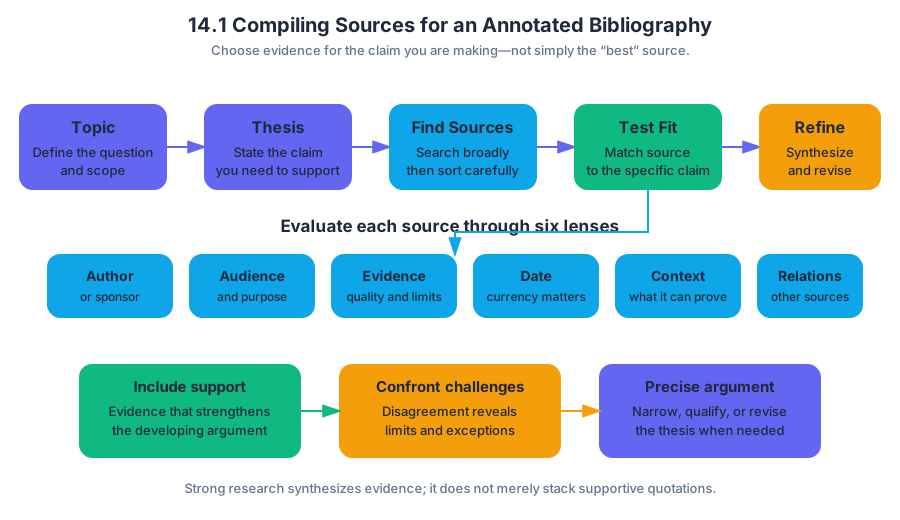
Research projects, particularly argumentative or position papers, require writers to collect sources, develop a thesis, and support that thesis through analysis of evidence. Because the Internet and academic libraries offer an abundance of information, the central difficulty is rarely finding something about a topic. The harder task is sorting through available materials and choosing sources that genuinely serve the project.
Source selection should follow the topic, thesis, and intended argument. A source that is excellent for historical background may be inappropriate as proof of a current scientific trend. A personal interview may reveal lived experience but cannot automatically establish how common that experience is. A textbook may clarify a complex concept but may not provide the newest evidence. The question is not simply whether a source is “good”; it is whether the source is suitable for the particular claim you are making.
Evaluation also requires intellectual openness. Sources should not all repeat your position. Research becomes stronger when you locate evidence that both enhances and challenges your claim. Contradictory evidence may force you to narrow a general statement, distinguish among cases, acknowledge a limitation, or revise the thesis entirely. Confronting disagreement allows you to synthesize ideas rather than merely stack supportive quotations.
Consider a claim such as “Online classes improve college learning.” One source might provide evidence of improved access, another might report lower participation in particular courses, and a third might explain how course design affects both outcomes. Together, these sources could lead to a more precise argument: online courses can improve access and learning under particular instructional conditions, but they do not produce the same results for every student or subject.
When evaluating a source, consider its author or sponsoring organization, intended audience, purpose, evidence, publication date, and relationship to other sources. Ask whether the source distinguishes evidence from opinion and whether its conclusions actually follow from the information presented. Evaluation is not the same as rejecting a source because it disagrees with you. A source may be valuable precisely because it represents a perspective your argument must answer.
Primary Sources
A primary source provides a firsthand account of an event, experience, creative work, or historical period. Primary sources are typically created close to the time represented, although the important feature is their direct relationship to the subject rather than a simple rule about age.
Examples include journal or diary entries, newspaper articles reporting events as they occurred, manuscripts, original poetry, images, recorded performances, and data collected through interviews or surveys. A student-conducted interview or survey can be a primary source because the student gathers original information directly from participants. Digital archives such as the Library of Congress can provide access to primary documents, images, recordings, and other historical materials.
The same object can function differently depending on the research question. A recording of a live concert is a primary source for research on the performance itself. A critical review of that concert published in a magazine is a secondary source because it interprets the performance. Native American pottery is a primary source for a study of the artifact, while a newspaper article discussing the importance of honoring Native American art is secondary.
Primary sources do not automatically provide neutral truth. A diary records one person’s perspective; a newspaper article reflects the conventions and interests of its time; an interview depends on memory, wording, and the relationship between interviewer and participant. Evaluate a primary source by asking who created it, when and why it was created, what firsthand access the creator had, and what the source leaves out. Its value often lies in what it reveals about a particular perspective, moment, or artifact.
Secondary Sources
A secondary source analyzes, explains, or interprets primary sources and other evidence. It may clarify a historical document, examine the significance of a scientific discovery, or interpret a work of creative art. Scholarly articles, critical reviews, historical studies, and analytical essays commonly function as secondary sources.
Secondary sources can give you concepts and context that a primary source cannot provide by itself. A historian may compare several diary entries and place them within a larger political movement. A critic may explain how a poem’s imagery contributes to its meaning. A scientific researcher may analyze data from experiments and explain what the results suggest.
Evaluate a secondary source by examining the quality of its evidence, the clarity of its reasoning, the author’s expertise, and the publication’s standards. Identify which primary materials or studies the author uses and whether the interpretation accounts for competing explanations. A secondary source is not valuable merely because it sounds academic; its conclusions must be supported by evidence and reasoning that you can examine.
Secondary sources can also disagree with one another. That disagreement is useful. Comparing interpretations may reveal different methods, assumptions, or definitions of the problem. Your research may then move beyond repeating one expert’s conclusion and instead explain why one interpretation better fits the evidence or how several interpretations can be combined.
Tertiary Sources
A tertiary source collects, condenses, and organizes information drawn from primary and secondary sources. Textbooks, encyclopedias, dictionaries, handbooks, indexes, and broad reference works are common examples. They are often useful at the beginning of research because they introduce key terms, major people, historical periods, and competing areas of inquiry.
Tertiary sources can help you discover vocabulary for searching and identify important primary and secondary works through their bibliographies. For example, a textbook may explain a theory in accessible language and point you toward the researchers who developed or debated it. This makes tertiary material valuable for orientation and background, even when it is not the strongest evidence for a specialized claim.
Evaluate tertiary sources for authority, currency, scope, and the transparency of their supporting references. A general encyclopedia may be reliable for a basic definition but too broad for a detailed argument. A textbook may summarize an established view while leaving out a newer controversy. Whenever possible, trace an important claim from the tertiary source back to the primary or secondary work that supports it.
The three categories are related rather than ranked. Tertiary sources can help you enter a subject, secondary sources can help you understand and interpret evidence, and primary sources can give you material for your own analysis. The appropriate balance depends on your topic, thesis, audience, and intended use of the material.
Research Process and Research Logs
A research log is an organized record of the sources you locate, the information you take from them, and the decisions you make as your project develops. It prevents the common problem of finding a useful idea but later being unable to remember where it came from, what the author actually claimed, or how you intended to use it.
For each source, record its complete citation information, source type, main claim, relevant evidence, intended audience, and possible use in your project. Also note questions, limitations, contradictions, and connections to other sources. If you quote or closely paraphrase, record the page number or other location information immediately. Accurate records support ethical documentation and reduce accidental misrepresentation or plagiarism.
A brief research-log entry might look like this:
Source: Scholarly article on student counseling access
Type: Secondary source
Main contribution: Interprets survey data from several universities
Useful evidence: Shows unequal access by location and income
Limitation: Does not measure long-term academic outcomes
Project use: Supports the access portion of the claim; requires another source for effectiveness
The log also supports synthesis. When several entries address the same issue, you can compare their claims and evidence rather than treating each source as an isolated quotation. You may discover that sources agree about a problem but disagree about its cause, or that a primary source complicates the interpretation offered by a secondary source. Those relationships often become the structure of the eventual argument.
Finally, research logs make revision possible. If your sources repeatedly fail to address the original question, the problem may be the question rather than the research. You might narrow a broad topic, redefine a key term, or revise the thesis to account for contradictory evidence. An annotated bibliography records that intellectual movement: it shows not just what you found, but how examining sources changed what you understand and what you can reasonably claim.
Content adapted from OpenStax Writing Guide with Handbook by Michelle Bachelor Robinson, Maria Jerskey et al., licensed CC BY 4.0.
Source Materials
Study English Composition II: Rhetorical Methods–Based on Lykke
This course page is free to open: signed out, you can read its first two sections, and signing in, on any plan, opens the rest. The free Lykke Chrome extension syncs your own Canvas courses, so ChatGPT, Claude and Muse can answer from your classes and deadlines. It only reads Canvas.
Add the free extensionSign in to open every sectionAll sections of English Composition II: Rhetorical Methods–Based · Browse more course pages