From the free course English Composition II: Rhetorical Methods–Based on Lykke
9.7 Evaluation: Rhetorical Analysis
Key concepts: Rhetorical analysis · Mixed sentence constructions · Clarity and coherence · Rhetorical choices · Critical language awareness · Thesis-driven argumentation · Transitions and logical organization · Textual evidence · Consistent voice and rhetorical situation · Personification
By the end of this section the student can: Evaluate the elements of a rhetorical analysis.; Identify and correct errors involving mixed sentence structures.; Evaluate an essay for clarity, coherence, and language.
9.7 Evaluation: Rhetorical Analysis
A rhetorical analysis succeeds when it explains not only what a writer says but how the writer’s choices influence an audience. Like examining a bridge, you inspect the parts—the claim, evidence, appeals, language, organization, and voice—and then explain how those parts work together to carry readers toward a conclusion.
Rhetorical analysis is the study and evaluation of the strategies a writer or speaker uses to communicate persuasively. A strong analysis therefore does more than label a device as “pathos” or “repetition.” It identifies the choice, describes how it functions in the particular rhetorical situation, and explains what effect it is likely to have on the intended audience.
Rhetorical analysis asks: What choice did the writer make, why was that choice useful here, and how did it shape the audience’s understanding or response?
Learning Outcomes
An effective evaluation checks two connected abilities: control of language and control of argument. At the sentence level, the writer must identify and correct mixed sentence constructions. At the essay level, the writer must evaluate clarity, coherence, evidence, rhetorical choices, and awareness of language.
These abilities are connected rather than separate. A confusing sentence can hide an important analytical point; weak transitions can make strong evidence appear unrelated; and imprecise descriptions of rhetorical strategies can cause the entire thesis to lose force. The goal is not merely grammatical correctness but communication that is logically shaped for its audience and purpose.
Rhetorical Choices and Critical Language Awareness
A rhetorical choice is a deliberate decision about language, evidence, structure, tone, or emphasis. Writers may use personification, which gives an inanimate or nonhuman object human characteristics so that it seems alive and relatable. For example, saying, “The virus packed its bags and spread across the ocean,” presents the virus as if it were a traveler making a decision. The phrasing makes an abstract biological process vivid, mobile, and threatening.
Other language choices include repetition, the recurrence of a word or phrase to build emphasis, and a rhetorical question, a question not genuinely expected to receive an answer. Repetition can make a sequence memorable and establish rhythm. A rhetorical question can direct readers toward an implied conclusion or expose a problem without stating the conclusion directly.
A precise analysis does not stop at recognition. Consider the difference between these two comments:
“The writer uses personification.”
and:
“By describing the virus as if it could ‘pack its bags,’ the writer turns an invisible biological threat into an active traveler. That image makes the spread across national borders easier to imagine and may create urgency in readers who otherwise view the virus as distant or abstract.”
The second comment makes a rhetorical argument. It names the device, explains the image, and connects the language to audience response. Its precision comes from showing the mechanism of persuasion rather than treating a device label as an explanation.
Critical Language Awareness
Critical language awareness means recognizing how language follows conventions while also understanding that conventions can be used purposefully. At the sentence level, the writer should maintain consistent grammatical paths: subjects, verbs, complements, and modifiers should fit together logically. At the rhetorical level, the writer should notice how word choices position people, events, causes, and responsibilities.
For instance, “The virus packed its bags” assigns human action to a nonhuman subject. That construction is grammatically clear because the personification is intentional and understandable. Critical language awareness does not require eliminating every unusual expression. Instead, it asks whether the language achieves a deliberate rhetorical effect or creates accidental confusion.
A writer may also consciously meet or challenge conventional expectations. A formal analysis generally requires an academic voice, but academic does not mean lifeless. The writer can use vivid verbs, carefully chosen descriptions, and direct explanations while maintaining a consistent voice appropriate to the audience, purpose, and subject.
Clarity and Coherence
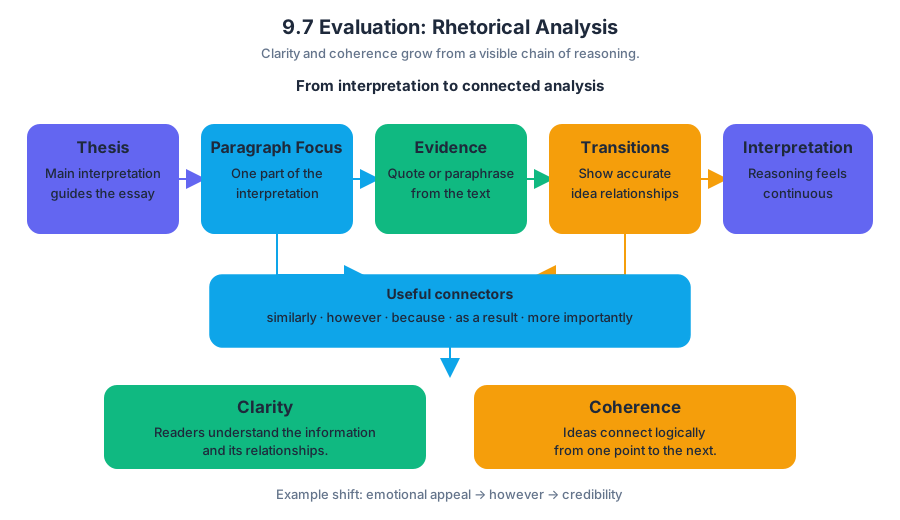
Clarity means that readers can understand the information and relationships the essay presents. Coherence means that those ideas connect in a way that feels logical and continuous. An essay may contain accurate observations yet remain difficult to follow if its paragraphs do not establish how one point leads to the next.
A clear rhetorical analysis usually moves through a recognizable chain of reasoning:
The thesis establishes the main interpretation. Each body paragraph then develops one part of that interpretation, using quoted or paraphrased evidence from the text being analyzed. Transitions make the relationships visible. Words such as similarly, however, because, as a result, and more importantly are useful only when they accurately describe the relationship between ideas.
For example, a paragraph might begin by examining a speaker’s use of emotional appeal and then shift to credibility:
“The speech first creates concern by describing the families affected by the policy. However, the speaker does not rely on emotion alone; references to professional experience then establish credibility and present the proposed action as informed rather than impulsive.”
Here, however signals a meaningful shift from one persuasive method to another. The paragraph does not merely list pathos and ethos. It explains how the strategies work together and why the second choice matters after the first.
Maintaining Focus on the Thesis
A thesis-driven analysis maintains a consistent focus on its central claim. Every major paragraph should help answer the thesis, not simply provide another observation about the text. If the thesis argues that a speech persuades by combining emotional stories with evidence of expertise, a paragraph about an unrelated metaphor may belong only if the metaphor contributes to that combination.
A useful revision question is: If this paragraph were removed, would the essay lose support for its thesis? If the answer is no, the writer may need to cut the paragraph, connect it more explicitly to the thesis, or revise the thesis to account for the essay’s actual direction.
Supporting Claims with Evidence
Claims must be fully supported with quoted or paraphrased evidence. Evidence is not decoration placed after an interpretation; it is the material that allows readers to test the interpretation. A quotation should be short enough to keep the analysis in control, and a paraphrase should accurately represent the original idea without replacing it with the writer’s own unsupported version.
A strong evidence pattern is:
- Claim: identify the rhetorical strategy or language choice.
- Evidence: quote or paraphrase the relevant passage.
- Analysis: explain how the choice works and why it matters.
- Connection: relate the point back to the thesis.
For example:
“The repeated references to ‘the first cause,’ ‘the second cause,’ and ‘the third cause’ organize the issue into a memorable sequence. This repetition gives the argument forward movement while emphasizing that the problem has several connected sources, supporting the thesis that the writer presents the issue as systemic rather than accidental.”
The passage is brief, but the analysis explains both structure and implication. Simply writing “This is repetition, and it persuades the audience” would leave the central reasoning incomplete.
Evaluating an Essay with the Rubric
A rubric turns broad expectations into visible criteria. It can be used after the first draft and again during revision. The highest standard is not perfection in every sentence; it is purposeful control of language, organization, evidence, and rhetorical interpretation.
| Criterion | Skillful performance | Questions for evaluation |
|---|---|---|
| Critical language awareness | The writing controls mixed constructions and maintains consistent grammatical paths while using language deliberately. | Are sentences logically constructed? Do unusual expressions appear intentional and effective? |
| Clarity and coherence | Information is presented clearly and logically; transitions connect paragraphs and sections; the thesis remains the essay’s focus. | Can a reader follow the reasoning? Does each paragraph advance the thesis? |
| Rhetorical choices | The writer identifies strategies with precision and insight, maintains a consistent voice, and understands the rhetorical situation. | Does the analysis explain how choices affect this audience in this context? |
A score at the “accomplished” level generally means the essay meets these expectations with only occasional slips. A “capable” essay may identify most strategies and support its claims, but it may stray from the thesis, use transitions less effectively, or show less insight into the rhetorical situation. These distinctions help the writer revise specific weaknesses instead of treating a grade as an unexplained judgment.
Applying Sentence-Level Review to Rhetorical Analysis
Once the rhetorical argument is developed, audit the analysis for mixed constructions without losing sight of its larger purpose. Check whether each sentence gives its subject, verb, complement, and modifiers roles that logically fit together. The goal is not to repeat isolated grammar drills; it is to ensure that sentence structure does not obscure the interpretation.
The mixed construction “A feeling of accomplishment is finishing revising a paper” combines a noun phrase with a form that does not logically complete it. A clearer revision is:
“I feel a sense of accomplishment when I finish revising a paper.”
The revision gives the sentence a clear subject—“I”—and expresses the time relationship with “when.” In a rhetorical analysis, the same principle protects the reader’s ability to follow complex claims about audience, language, and effect.
After revising sentences, return to the rhetorical analysis and audit it in context. Mark sentences whose logical subjects do not match their predicates, whose modifiers seem attached to the wrong idea, or whose transitions promise a relationship the paragraph does not deliver. Then ask whether each corrected sentence makes the thesis, evidence, and reasoning easier to see. Sentence clarity is valuable because it strengthens the argument’s path, not because editing is separate from rhetorical thinking.
Final Evaluation: Precision, Voice, and Situation
The strongest rhetorical analyses maintain a consistent voice and an awareness of the rhetorical situation. The writer should sound like an analyst: attentive to evidence, cautious about claims, and willing to explain effects rather than simply announce opinions. Precision matters especially when discussing audience response. A writer should avoid claiming that a strategy always persuades; it is more accurate to explain how the choice may influence the intended audience under the circumstances.
Before considering the analysis finished, evaluate its full chain of communication:
- Does the thesis make a focused claim about rhetorical strategies?
- Does each paragraph develop that claim?
- Are quoted or paraphrased passages followed by analysis?
- Do transitions clarify the relationships among ideas?
- Are rhetorical devices explained rather than merely named?
- Is the voice consistent with the audience and purpose?
- Are sentences clear enough that grammatical problems do not hide the argument?
A rhetorical analysis becomes persuasive when its own writing practices model the qualities it identifies: deliberate choices, logical arrangement, precise language, and attention to audience. The essay does not merely describe rhetoric; through its thesis, evidence, organization, and voice, it demonstrates rhetorical control.
Content adapted from OpenStax Writing Guide with Handbook by Michelle Bachelor Robinson, Maria Jerskey et al., licensed CC BY 4.0.
Source Materials
Study English Composition II: Rhetorical Methods–Based on Lykke
This course page is free to open: signed out, you can read its first two sections, and signing in, on any plan, opens the rest. The free Lykke Chrome extension syncs your own Canvas courses, so ChatGPT, Claude and Muse can answer from your classes and deadlines. It only reads Canvas.
Add the free extensionSign in to open every sectionAll sections of English Composition II: Rhetorical Methods–Based · Browse more course pages