From the free course English Composition II: Rhetorical Methods–Based on Lykke
13.6 Spotlight on … Ethical Research
Key concepts: ethical research documentation · field research data and research logs · electronic note cards · field observation · participant interviews and recording answers · scientific case study analysis · Paul Broca’s case study of Tan/Leborgne · interdisciplinary research · intellectual property · research evidence and completeness
By the end of this section the student can: Participate effectively in collaborative processes involving field research in a variety of disciplines.; Develop projects using the characteristic processes of various disciplines.; Analyze and make informed decisions about intellectual property based on the concepts that motivate them.; Apply citation conventions systematically.
13.6 Spotlight on … Ethical Research
Ethical research begins with a deceptively simple question: What do I owe the people and sources that make my research possible? A responsible researcher protects human participants, records observations accurately, respects privacy, and gives credit whenever another person’s words or ideas shape the work. These duties apply across disciplines, from observing language use in a family setting to analyzing a nineteenth-century medical case.
Ethical treatment has two closely related dimensions. Researchers must treat participants fairly, respecting privacy and, when required, anonymity. They must also respect the work of other researchers by attributing borrowed information. Ethical documentation therefore includes both a record of field-research data and a research log for secondary sources. The first preserves what the researcher observed or heard; the second makes clear where information, interpretations, quotations, paraphrases, and summaries came from.
Working with Human Participants and Institutional Review Boards
Research involving people requires more than curiosity and a good set of questions. A participant is a person whose words, actions, experiences, or personal information become part of a research project. Ethical research treats that person fairly rather than as a source of extractable data. The researcher’s choices must protect privacy and, when the circumstances require it, anonymity—keeping a participant’s identity from being revealed.
An Institutional Review Board, or IRB, is a committee that reviews research involving human participants to determine whether the plan treats those participants ethically. The IRB’s presence reflects a basic principle: a researcher should consider possible effects on participants before collecting information, not merely after writing the results. The writer must therefore make deliberate choices about what to ask, what to record, where to observe, how to identify participants, and how to present the findings.
Privacy concerns the participant’s personal space and information; anonymity concerns whether the participant can be identified. These ideas overlap but are not identical. A writer might privately collect a participant’s name while promising not to publish it, preserving anonymity in the final project. In another project, even a first name, workplace, unusual experience, or recognizable quotation might reveal the person’s identity. Ethical writing asks not only, “Do I have this information?” but also, “Should I include it, and could its inclusion harm or embarrass someone?”
Documenting field research
Field research gathers information in a real setting rather than only from published sources. The researcher should keep a record of all field-research data and maintain a research log for secondary sources. This documentation separates what happened from what the researcher later concludes about it. A field note might record a participant’s exact words, the setting, and observable actions; a later log entry can identify the article, book, or other source that helped interpret those observations.
A research log also prevents a common failure: remembering an idea but forgetting where it came from. For each secondary source, a writer should record enough bibliographic information to locate it again and should distinguish direct quotations, paraphrases, and summaries. That distinction matters because changing the wording does not change the obligation to credit the original source.
A useful field note records concrete details before interpretation. For example:
“At 4:10 p.m., Maya paused twice while explaining the directions, then rephrased ‘turn left at the shop’ as ‘you know, by the red sign.’ I did not interrupt.”
This short entry separates observation from judgment. It records time, words, pauses, and the researcher’s own action without claiming that Maya was confused or anxious. The writer chooses precise description because later analysis should be grounded in evidence rather than in an impression formed during the event. If the participant’s identity requires protection, the writer can use a pseudonym or remove identifying details in the published project while retaining the necessary research record securely.
Electronic note cards
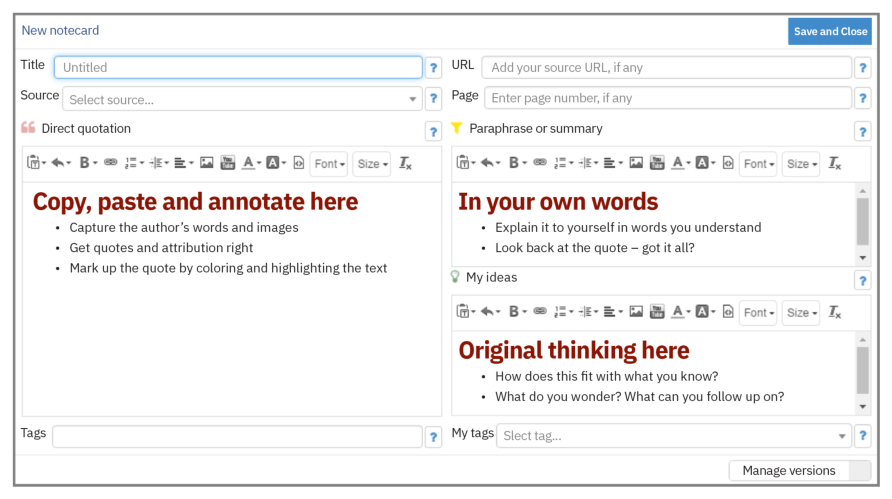
Electronic note cards organize research information while preserving its origin. A note card can hold one quotation, paraphrase, summary, observation, or idea, together with the source or field-note reference. The point is not the device or format; the point is disciplined separation. A quotation should remain visibly different from the researcher’s own prose, and a paraphrase should not be allowed to drift into unattributed copying.
For example, an electronic note card might contain:
Observation: In a group conversation, the participant used “we” when describing family decisions.
Researcher’s note: This may indicate that the participant frames responsibility collectively.
Source or location: Field observation, March 3, 4:10 p.m.
The choices in this card protect the project’s accuracy. The first line preserves data; the second labels interpretation as the researcher’s own; and the final line makes the evidence traceable. A writer who later uses the interpretation can test it against the original observation instead of presenting a memory or assumption as fact.
Participant interviews and recording answers
Interview research requires careful preparation and faithful recording. The researcher begins by developing a list of questions and writes the participant’s answers directly on the page. Recording answers as they are given reduces the risk that the researcher will unconsciously improve, shorten, or reinterpret what the participant said. It also creates a reliable record for later analysis.
The wording of a question shapes the evidence it produces. An open question such as “How do you usually use language at work?” invites the participant to describe experience. A leading question such as “You speak differently at work, don’t you?” pressures the participant toward the researcher’s assumption. Ethical interviewing therefore involves both fair treatment and methodological care: the participant should have room to answer, and the researcher should not manufacture agreement through the question itself.
A short interview record might read:
Question: “Can you describe a time when you changed how you spoke with a customer?”
Answer: “I stopped using slang because I wanted the customer to feel that I was taking the problem seriously.”
The writer preserves the participant’s answer rather than replacing it with a conclusion such as “the participant becomes formal with customers.” That conclusion may eventually be part of the analysis, but it must remain distinguishable from the participant’s own words. If an interview is recorded through audio, video, messaging, or another medium, the researcher must still consider privacy, permission, storage, and whether the final report needs every identifying detail.
Field observation
Observation should take place in a setting where the participant uses language naturally in the relevant context. The researcher therefore chooses a setting that fits the research question. Observing a student playing a video game would not show natural gaming language if the student is not actually a gamer. The setting must provide a good view of the behavior being studied rather than merely being convenient.
Observation can occur in person or through communication technologies such as a messaging application or video chat. The method changes the researcher’s access to the setting, but it does not remove the ethical obligation to treat the participant fairly. Detailed notes should be taken during the observation, including what the participant says and does, the surrounding context, and any interruptions or unusual conditions that may affect interpretation.
Consider this observation:
“During a family video chat, Leo used technical terms with his brother but replaced them with explanations when his grandmother joined the conversation.”
The passage records a contrast in audience and language without claiming to know Leo’s motive. The writer chooses observable behavior—terms, explanations, and changes in audience—because those details can support later analysis. The writer should not quietly turn an observation into a public portrait of the participant; privacy, anonymity, and the possible consequences of publication remain part of the research decision.
Scientific case study analysis
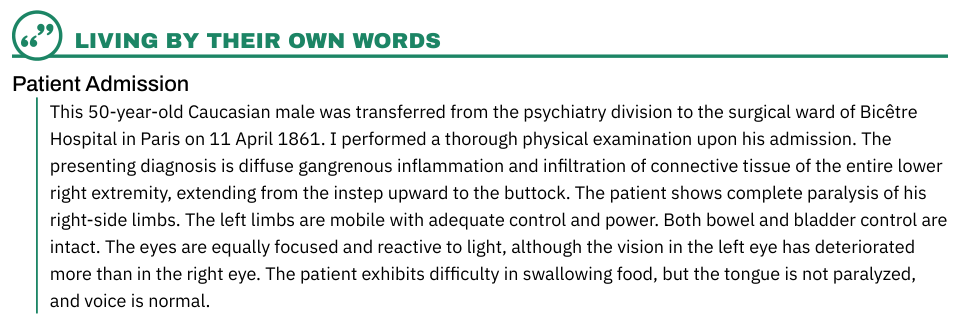
A scientific case study examines one person, event, or instance in depth in order to contribute to broader knowledge. The section’s example centers on Paul Broca’s analysis of Louis-Victor Leborgne, whose limited speech led others to call him “Tan.” Broca studied Leborgne’s condition and, after examining his brain, hypothesized that a malformation was connected to the part of the brain related to speech.
The case study does not become persuasive merely because it contains a dramatic individual example. Its analysis connects observations to a claim, places that claim in a discussion of competing explanations, and shows how the case advances knowledge. Broca’s presentation at the Société d’Anthropologie de Paris on April 18, 1861, generated controversy. Jean-Baptiste Bouillaud had argued for localization of language in the frontal lobes, while Louis Pierre Gratiolet argued that the brain functions as a whole. Ernest Auburtin also defended the possibility that specific brain areas have specific functions while challenging aspects of the explanation.
A concise case-study analysis might say:
“Broca’s observations of Leborgne supported a connection between a frontal-lobe malformation and speech, but the controversy surrounding the case shows that evidence must be interpreted against competing explanations.”
This passage makes three careful choices. It identifies the evidence as observations, states the interpretation as a connection rather than an absolute certainty, and includes the competing views that made the case scientifically significant. The final purpose is not simply to retell one patient’s history. Broca uses the case study to contribute to research on brain functions. Ethical analysis also requires respect for the person behind the case: the participant is not merely an instrument for proving the researcher’s theory.
Plagiarism
Plagiarism is presenting another person’s words or ideas as one’s own by failing to give appropriate credit. It is not limited to copying a sentence word for word. A writer can also plagiarize by borrowing an idea, closely following an author’s phrasing in a paraphrase, or using information from a source without attribution. The ethical principle is the same as in human-participant research: respect what belongs to others.
Citation conventions make that respect visible. A direct quotation requires quotation marks and a citation. A paraphrase restates the source’s meaning in genuinely different language and still requires a citation. A summary condenses the source’s central point and also requires a citation. The writer’s research log and electronic note cards support these distinctions by preserving the original wording alongside the writer’s developing notes.
For example, suppose a source argues that Broca’s case mattered because it connected an individual brain injury to a wider debate about localization. A responsible paraphrase would be:
Broca used Leborgne’s condition to enter a larger dispute about whether particular brain functions can be linked to particular areas.
This paraphrase changes the sentence structure and wording while preserving the source’s central idea, so it still needs attribution. Without a citation, the sentence falsely suggests that the insight originated with the student. If the source’s exact wording is especially important, the writer should quote it briefly instead of disguising it as a paraphrase.
Plagiarism often results from poor documentation rather than deliberate deception: a writer copies notes, later forgets which words came from the source, and submits them as original prose. The remedy is systematic recordkeeping. Mark quotations as quotations immediately, label paraphrases and summaries, record source details, and keep field observations separate from interpretations. These habits protect intellectual property and make the final project easier to verify.
A final ethical research decision is therefore a decision about boundaries. The writer must show where participant evidence ends and interpretation begins, where a source’s contribution ends and the writer’s contribution begins, and what information should remain private. Fair treatment, accurate documentation, and consistent citation are not separate decorations added after research; together they make research trustworthy.
Content adapted from OpenStax Writing Guide with Handbook by Michelle Bachelor Robinson, Maria Jerskey et al., licensed CC BY 4.0.
Source Materials
Study English Composition II: Rhetorical Methods–Based on Lykke
This course page is free to open: signed out, you can read its first two sections, and signing in, on any plan, opens the rest. The free Lykke Chrome extension syncs your own Canvas courses, so ChatGPT, Claude and Muse can answer from your classes and deadlines. It only reads Canvas.
Add the free extensionSign in to open every sectionAll sections of English Composition II: Rhetorical Methods–Based · Browse more course pages