From the free course English Composition II: Rhetorical Methods–Based on Lykke
13.5 Research Process: Making Notes, Synthesizing Information, and Keeping a Research Log
Key concepts: Research as a process of seeking answers from people, print, and other media · Consulting librarians and other knowledgeable professionals · Testing and experimentation in research · Using evidence to support conclusions · Taking organized research notes · Summarizing versus synthesizing information · Synthesizing and responding to claims · Keeping a research log · Using research in everyday decisions as well as academic projects · Evaluating statistics and other forms of evidence
By the end of this section the student can: Employ the methods and technologies commonly used for research and communication within various fields; Practice and apply strategies such as interpretation, synthesis, response, and critique to compose texts that integrate the writer’s ideas with those from appropriate sources; Analyze and make informed decisions about intellectual property based on the concepts that motivate them; Apply citation conventions systematically.
13.5 Research Process: Making Notes, Synthesizing Information, and Keeping a Research Log
A research log turns scattered discoveries into usable evidence by recording what a source says, where it says it, how it connects to the writer’s argument, and what the writer may do with it. Without such a record, a promising source can become difficult to locate, remember, cite, or distinguish from the writer’s own ideas.
Research is a process of seeking answers from people as well as from print and other media. A researcher may consult a librarian or another knowledgeable professional, conduct field research, observe conditions directly, test an idea through experimentation, or examine published information. The purpose is not merely to collect facts but to use evidence to support carefully reasoned conclusions.
A common misconception is that research notes are simply quotations copied into a notebook. Effective notes do more: they preserve bibliographic information, distinguish quotation from paraphrase and summary, identify possible uses, connect evidence to a thesis or main point, and record relationships among sources. Those choices protect the writer from confusion and make synthesis possible.
Summary of Assignment: Research Log
The research-log assignment asks the writer to record research in an organized form while developing an argumentative research paper. The log is not a finished essay and not merely a bibliography. It is a working record of evidence and thinking that grows as the writer asks questions, finds sources, evaluates information, and decides how each source may contribute to the argument.
The researcher seeks answers from several kinds of people and media. Librarians and other professionals can help answer questions, suggest useful directions, and identify resources that a general search might miss. Field research adds another possibility: the researcher can ask experts, observe directly, experience a situation, or generate original information. Testing and experimentation can likewise produce evidence when the research question requires examining what happens under particular conditions.
The central choice is therefore what kind of evidence will answer the question. A writer investigating food sustainability might consult a librarian for scholarly sources, interview a food-systems professional, observe a local market, and compare published production statistics. Each method contributes differently: an expert offers informed judgment, observation supplies firsthand detail, and statistics help support a conclusion about scale or change.
A short example shows why the log matters:
“Milk production is expected to increase by 58 percent and meat production by 73 percent by 2050.”
If this is copied into a log, the writer should identify the source and page, mark it as a direct quotation or paraphrase, and explain its argumentative use: the projected increase shows pressure on food systems and supports a claim that more sustainable systems will be needed. The evidence becomes useful because the log preserves both the information and its relationship to the writer’s developing argument.
Quick Launch: Beginning Questions
Research begins with questions rather than with random collecting. Beginning questions give the writer a direction for searching and help identify what kind of information is needed. They can ask what is happening, why it is happening, who is affected, what evidence demonstrates it, what solutions have been proposed, or what objections a reasonable reader might raise.
A useful beginning question is open enough to require investigation but focused enough to guide it. “Is sustainability good?” is too broad to organize a research project. “How might rising meat and milk production affect the sustainability of food systems?” gives the writer a subject, a possible cause, and a problem that evidence may clarify.
Beginning questions also help the writer choose research methods. A question about public opinion may call for interviews or surveys; a question about historical claims may require print and digital sources; a question about what happens in a particular setting may invite observation; and a question about effects under controlled conditions may require testing or experimentation. The researcher should not assume that one source type can answer every question.
For example:
“What evidence shows that current food-production practices may require more sustainable alternatives?”
This question avoids assuming the conclusion while still establishing a direction. The phrase “what evidence shows” signals that the writer must investigate rather than merely announce an opinion. “Current food-production practices” defines the area of inquiry, while “may require” leaves room for evidence that complicates or qualifies the claim.
As research proceeds, beginning questions can become more precise. A writer may discover that the most important issue is not production alone but the pressure created by projected demand, resource use, or environmental effects. The research log should preserve these changes because they show how the writer’s thinking develops.
Creating the Research Log
A research log should make each piece of information traceable and interpretable. For every entry, the writer records the date, identifies the source through a brief bibliographic description, records the information, explains its connection to the thesis or main points, and adds notes, cross-references, or synthesis ideas. A source citation should remain attached to the information it supports.
The model research log organizes entries under headings such as Information, Connection to Thesis/Main Points, and Notes/Cross-References/Synthesis, with a Source/Citation record. The headings impose a useful discipline: the writer does not stop at “What did I find?” but also asks “Why does it matter?” and “How does it relate to what I have found elsewhere?”
A strong entry may therefore contain four connected decisions:
- Identify the information. Record the relevant fact, idea, quotation, paraphrase, or summary.
- Locate it. Include the author and title, and note the page number when the information appears in a paginated source.
- Connect it. State which thesis, reason, or main point the information supports, complicates, or challenges.
- Develop it. Add possible uses, cross-references to other entries, questions, or a synthesis idea.
Separating entries is especially important when a source contains several useful ideas. One entry should not become a crowded page of unrelated quotations. Separate entries make it easier to retrieve a particular claim, check its location, and avoid attributing one idea to the wrong source.
Example log entry:
Information: A source estimates that milk production will increase by 58 percent and meat production by 73 percent by 2050.
Connection to Thesis/Main Points: The projected growth indicates increasing pressure on food systems.
Notes/Cross-References/Synthesis: Compare with sources on resource use; consider a graph showing projected increases.
Source/Citation: Chai, [title], page [number]; date recorded: 6/06/2021.
The first line preserves the evidence. The second interprets its rhetorical function rather than leaving the reader to infer it. The third connects the entry to other research and suggests a possible visual or organizational use. The final line supports later citation and protects against accidental plagiarism. The example also demonstrates that a log records the writer’s thinking, not just the source’s words.
Types of Research Notes
The section distinguishes bibliographic notes from informational notes. Bibliographic notes identify the source: author, title, publication details, and other information needed to locate and document it. Informational notes record the actual ideas, evidence, quotations, paraphrases, or summaries gathered from that source.
Good note-taking makes research easier because it helps the writer locate, remember, and use sources effectively. A project involving only a few sources may appear easy to track, but projects involving more than a few sources are managed more effectively when bibliographic and informational notes are kept carefully and consistently.
The writer must also label the relationship between the note and the original wording. The principal forms are quotation, paraphrase, and summary:
- A quotation reproduces the source’s exact words and requires quotation marks in the notes so those words are not later mistaken for the writer’s own.
- A paraphrase restates a specific passage in the writer’s own words while preserving its meaning and approximately similar level of detail.
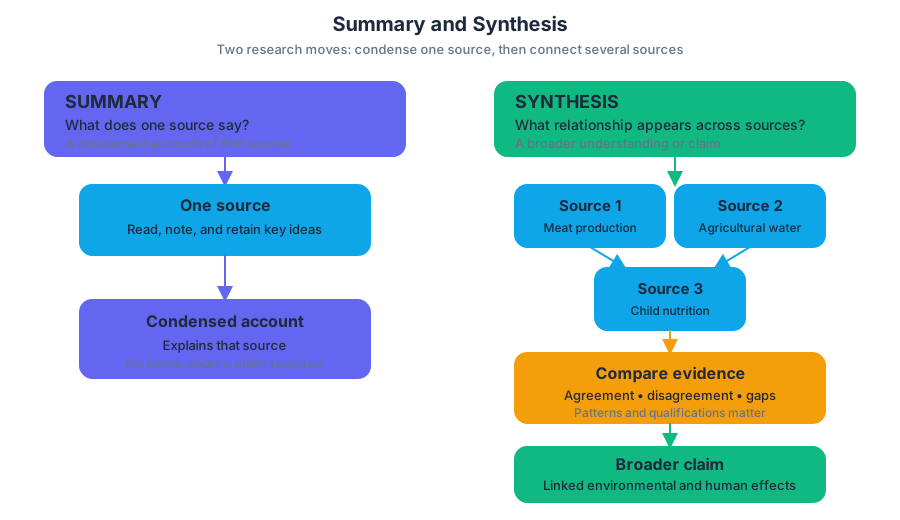
- A summary condenses the main idea or essential points of a larger passage, article, or discussion.
Paraphrasing and summarizing are not citation-free alternatives to quotation. Both still represent another writer’s ideas and therefore require source identification when used in the paper. The research log should make the distinction visible before drafting begins.
Consider three notes based on the same evidence:
Quotation: “Milk production will increase by 58 percent and meat production by 73 percent by 2050.”
Paraphrase: Chai projects substantial increases in both milk and meat production by 2050.
Summary: Food-production demand is expected to grow sharply.
The quotation preserves exact wording and numerical detail. The paraphrase keeps the specific claim but changes its language. The summary compresses the point and omits the exact percentages because the broader implication is more important than the individual figures. Each choice serves a different purpose, and labeling the choice in the log prevents accidental patchwriting or unattributed borrowing.
Personal notes are also valuable. A writer may record an idea for using the evidence, a question that needs further research, a connection to another source, or a possible counterargument. These notes should remain visibly distinct from source material. Doing so allows the writer to synthesize information without confusing personal interpretation with a source’s claim.
Other Systems for Organizing Research Logs and Digital Note-Taking
A research log does not have to use one physical format. Writers may organize research with a table, separate cards or entries, an outline, a set of folders, or a digital note-taking system. The format can vary, but the essential functions remain the same: identify the source, preserve the information accurately, connect it to the argument, and make relationships among sources visible.
A table is useful when the writer wants to compare evidence across sources. Its columns can place information beside its connection to the thesis and its possible synthesis. Separate cards or entries can be useful when each quotation, paraphrase, or idea must be rearranged into categories or sections. An outline can organize notes according to the paper’s developing claims rather than according to the order in which sources were found.
Digital note-taking can make searching, sorting, cross-referencing, and revising easier, especially in a large project. However, digital convenience does not replace careful intellectual organization. Each note still needs a source, location, date when useful, label identifying quotation or paraphrase, and explanation of its possible role. A collection of unmarked copied passages is not a research log merely because it is stored electronically.
For example, a writer might maintain digital entries grouped under “food-system pressure,” “possible solutions,” and “counterarguments.” Within each entry, the writer records the source and page, distinguishes exact wording from paraphrase, and links related evidence. The categories help reveal synthesis: several sources may address the same problem, while differing sources may offer competing explanations or solutions.
The best system is the one that reduces confusion at the moment of drafting. If a writer can answer “Where did this idea come from?”, “What exactly did the source say?”, “How does it support my thesis?”, and “How does it relate to my other evidence?”, the system is doing its job. The organization should serve accurate citation, responsible use of intellectual property, and a clear movement from gathered information to the writer’s own reasoned conclusion.
Content adapted from OpenStax Writing Guide with Handbook by Michelle Bachelor Robinson, Maria Jerskey et al., licensed CC BY 4.0.


Source Materials
Study English Composition II: Rhetorical Methods–Based on Lykke
This course page is free to open: signed out, you can read its first two sections, and signing in, on any plan, opens the rest. The free Lykke Chrome extension syncs your own Canvas courses, so ChatGPT, Claude and Muse can answer from your classes and deadlines. It only reads Canvas.
Add the free extensionSign in to open every sectionAll sections of English Composition II: Rhetorical Methods–Based · Browse more course pages