From the free course AP Computer Science A on Lykke
4.9 ArrayList Traversals
Key concepts: ArrayList traversals
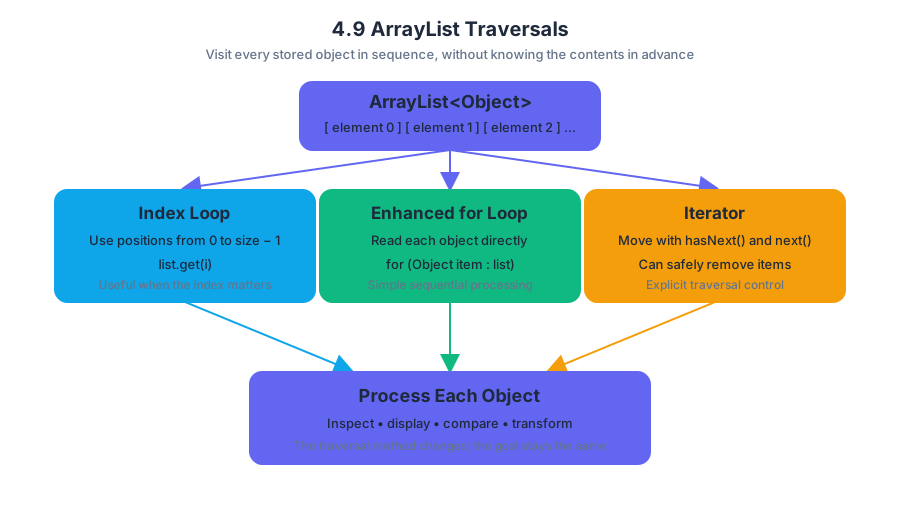
An ArrayList traversal visits the elements of an ArrayList in sequence so that a program can inspect, display, compare, or process each stored object. The central question is simple: How can a program examine every element without knowing the list’s contents in advance?
4.9 ArrayList Traversals
An ArrayList traversal visits the elements of an ArrayList in sequence so that a program can inspect, display, compare, or process each stored object. The central question is simple: How can a program examine every element without knowing the list’s contents in advance?
The traversal pattern
An ArrayList stores elements at indexes beginning with $0$ and ending with `list.size() - 1$. A traversal therefore needs a reliable way to move from the first valid index to the last valid index.
A traditional for loop exposes the index, while an enhanced for loop directly provides each element:
for (int index = 0; index < names.size(); index++) {
    System.out.println(names.get(index));
}

for (String name : names) {
    System.out.println(name);
}
Both loops visit the elements in order. If names contains ["Ari", "Bea", "Chen"], each loop produces Ari, then Bea, then Chen. The first loop uses names.get(index); the enhanced for loop assigns each visited element to name.
CED alignment — 4.9.A: Traverse the elements of an
ArrayList.
Essential Knowledge 4.9.A.1: AnArrayListcan be traversed using an index-basedforloop or an enhancedforloop.
Choosing the right loop
Use an index-based loop when the position matters or when the program must replace an element. Use an enhanced for loop when the program only needs to read or process each element.
| Goal | Suitable traversal | Reason |
|---|---|---|
| Print every element | Enhanced for loop |
The index is unnecessary |
| Compare adjacent elements | Index-based for loop |
The current and neighboring indexes matter |
| Replace elements | Index-based for loop |
set(index, value) requires an index |
| Count elements meeting a condition | Either loop | Each element can be tested directly |
Worked example: finding a temperature threshold
Suppose a weather station stores daily temperatures in an ArrayList<Integer>. The program should count how many readings are at least $30$ degrees.
ArrayList<Integer> temperatures =
    new ArrayList<Integer>();

temperatures.add(27);
temperatures.add(31);
temperatures.add(30);
temperatures.add(24);

int hotDays = 0;

for (int temperature : temperatures) {
    if (temperature >= 30) {
        hotDays++;
    }
}

System.out.println(hotDays);
The traversal visits $27$, $31$, $30$, and $24$. The condition is true for $31$ and $30$, so hotDays becomes $2$. Notice that the loop does not alter the ArrayList; it only reads each element and updates a separate accumulator.
Index boundaries and mutation
The most common index-based pattern is:
for (int i = 0; i < values.size(); i++) {
    System.out.println(values.get(i));
}
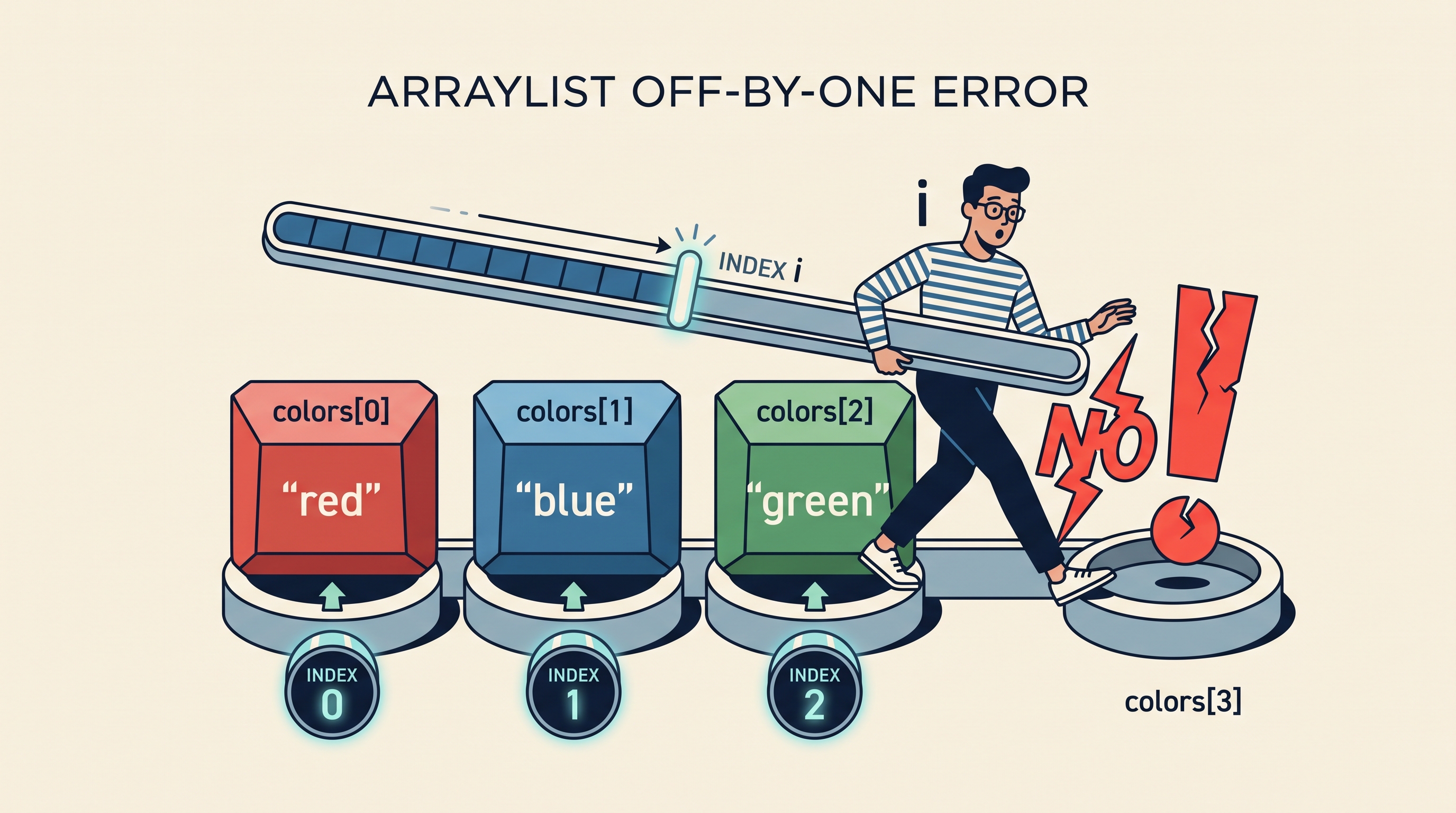
The condition must use i < values.size(), not i <= values.size(). If the list has $4$ elements, its valid indexes are $0$, $1$, $2$, and $3$; index $4$ is outside the list and causes an IndexOutOfBoundsException`.
A traversal that changes list size is especially dangerous. Removing an element while moving forward causes later elements to shift left, so the next index may skip an element. A traversal may safely use set when the list size remains unchanged, but adding or removing elements requires a carefully designed algorithm.
Misconception check
Misconception: “The enhanced for loop variable is the list element’s permanent storage location.” The variable receives the current reference or value; assigning a new value to that variable does not replace the element in the list.
for (String item : items) {
    item = item.toUpperCase();   // does not update items
}
To replace elements, use an index:
for (int i = 0; i < items.size(); i++) {
    items.set(i, items.get(i).toUpperCase());
}
For object elements, changing the object through its reference can affect the object stored in the list, but reassigning the loop variable does not change which reference the list stores. This distinction is essential when tracing ArrayList code.
AP skill connections
ArrayList traversals develop Computational Thinking Practice 2 — Develop Code, because the programmer implements a loop that performs required functionality; Computational Thinking Practice 3 — Analyze Code, because the programmer traces indexes, conditions, and list contents; and Computational Thinking Practice 4 — Document Code and Computing Systems, because comments and method documentation can state traversal assumptions such as valid index ranges. In particular, tracing a traversal means tracking both the loop variable and the changing accumulator after every iteration.
Retrieval check
A list contains ["red", "blue", "green"]. What happens in this loop?
for (int i = 0; i <= colors.size(); i++) {
    System.out.println(colors.get(i));
}
It prints the three valid elements, then attempts colors.get(3) and throws an IndexOutOfBoundsException. Replace <= with < to visit every element exactly once.
Source Materials
- AP Computer Science A Course and Exam Description
- AP Computer Science A Course and Exam Description Clarifications and Corrections
- AP Computer Science A Course Overview
- AP Computer Science A Course at a Glance
- AP Computer Science A Course at a Glance Poster
- Adopt AP Computer Science A
- AP Computer Science A
- AP Computer Science A