From the free course AP Computer Science A on Lykke
4.1 Ethical and Social Issues Around Data Collection
Key concepts: Personal privacy risks from collecting and storing data · Safeguarding user privacy in program development · Data quality · Algorithmic bias · Systemic and repeated errors that create unfair outcomes · Bias and fairness in data sets · Selecting an appropriate data set for a problem · Ethical and social implications of computer science · Responsible computing · Discussing ethical issues in groups
When a computer collects, stores, or uses personal information, privacy can be harmed even when no single programmer intends to cause harm. A fitness app, for example, might record a person’s location, sleep schedule, heart rate, and daily routines; together, these details can reveal far more than any one data point.
4.1 Ethical and Social Issues Around Data Collection
When a computer collects, stores, or uses personal information, privacy can be harmed even when no single programmer intends to cause harm. A fitness app, for example, might record a person’s location, sleep schedule, heart rate, and daily routines; together, these details can reveal far more than any one data point.
Learning Objective 4.1.A — Explain the risks to privacy from collecting and storing personal data on computer systems.
Essential Knowledge 4.1.A.1 — When using a computer, personal privacy is at risk. When developing new programs, programmers should attempt to safeguard the personal privacy of the user.
Privacy is a design responsibility
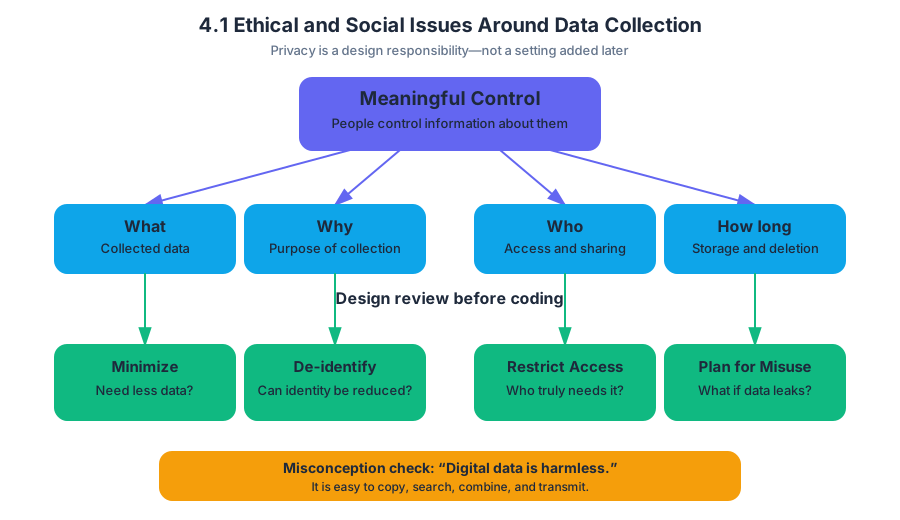
Personal privacy means a person should have meaningful control over information about them: what is collected, why it is collected, who can access it, how long it is stored, and whether it is shared. Risks arise when a system collects unnecessary information, stores it insecurely, combines it with other records, or uses it for a purpose the user did not expect.
A privacy-conscious developer therefore asks questions before writing the program: Do we need this information? Can the program work with less identifying data? Who truly needs access? What happens if the data is leaked or misused? Safeguarding privacy is not merely a setting added after development; it is part of responsible program design.
Misconception check — “If the data is digital, it is harmless.” Digital data is easy to copy, search, combine, and transmit. A database containing names, addresses, or activity records can create risks even if the original collection seemed harmless.
Data quality affects conclusions
Learning Objective 4.1.B — Explain the importance of recognizing data quality and potential issues when using a data set.
Essential Knowledge 4.1.B.3 — Some data sets are incomplete or contain inaccurate data. Using such data in the development or use of a program can cause the program to work incorrectly or inefficiently.
Data quality describes how complete, accurate, relevant, and consistently collected the data is. A program can execute perfectly and still produce unreliable results if its input data contains missing entries, recording errors, outdated information, or measurements collected in inconsistent ways.
Worked example: A city designs a program to predict demand for public buses. Its data comes only from passengers who use a mobile ticketing app. The program may accurately detect patterns in that data, but it could underestimate riders who pay with cash or lack smartphones. The problem is not necessarily the algorithm’s syntax; the data-collection method leaves part of the population out.
Essential Knowledge 4.1.B.2 — Programmers should be aware of the data set collection method and the potential for bias when using this method before using the data to extrapolate new information or drawing conclusions.
Before applying a data set to a new question, identify how it was collected and whether that process favors some users over others. A data set created to study one population, location, time period, or purpose may not support conclusions about a different population, location, time period, or purpose.
Algorithmic bias and fairness
Essential Knowledge 4.1.B.1 — Algorithmic bias describes systemic and repeated errors in a program that create unfair outcomes for a specific group of users.
Algorithmic bias is not simply one accidental wrong answer. It is a repeated, systematic pattern in which a program disadvantages a particular group. Bias can enter through the data, the way categories are defined, the objective selected by programmers, or assumptions built into the program.
Consider a screening program trained mostly on records from one demographic group. If the training data does not represent other groups, the program may perform less accurately for them. Repeating that error across thousands of decisions can produce unfair outcomes even when the program applies the same rule to every input.
Misconception check — “A computer cannot be biased because it follows rules.” A computer follows rules, but people choose the rules, measurements, categories, and data. Consistent execution can consistently reproduce an unfair assumption.
Choosing an appropriate data set
Learning Objective 4.1.C — Identify an appropriate data set to use in order to solve a problem or answer a specific question.
Essential Knowledge 4.1.C.1 — The contents of a data set might be related to a specific question or topic and might not be appropriate to give correct answers or extrapolate information for a different question or topic.
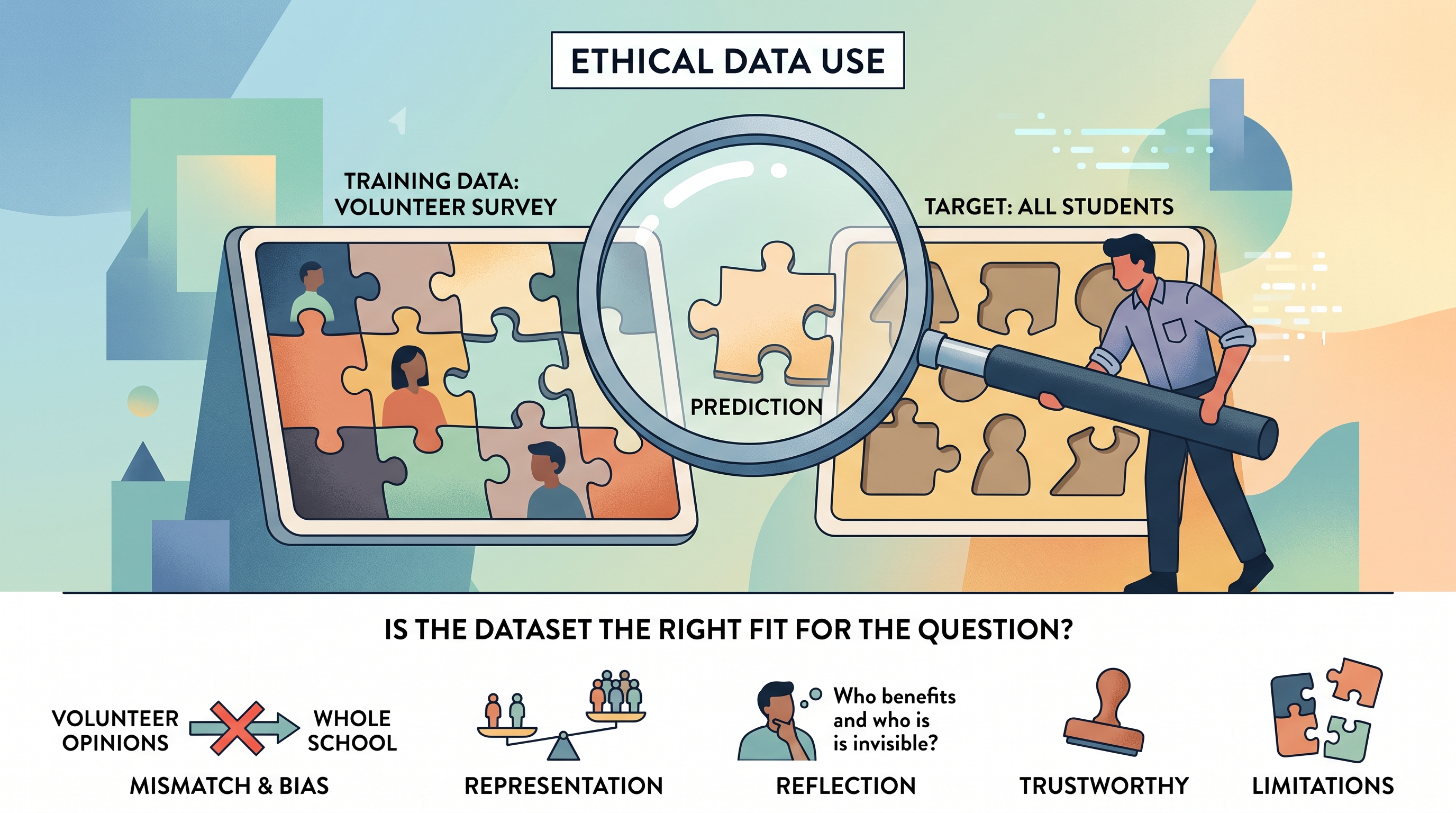
The right data set must match the question. A programmer should examine its relevance, completeness, accuracy, collection method, and representation of the people or situations being studied. Ethical analysis also includes discussing who benefits, who may be harmed, and which groups might be invisible in the data.
Retrieval check: A school uses survey responses from volunteers to predict the opinions of every student. Name one privacy concern, one data-quality concern, and one possible source of algorithmic bias. A strong answer identifies the handling of personal responses, volunteer data that may be incomplete or unrepresentative, and repeated errors caused by treating volunteers as representative of the entire school.
Suggested Skill — Determine what knowledge can be extracted from data; Explain how computing: Use the collection method and limitations of a data set to justify whether a conclusion is trustworthy, rather than accepting a program’s output merely because it is numerical or automated.
Source Materials
- AP Computer Science A Course and Exam Description
- AP Computer Science A Course and Exam Description Clarifications and Corrections
- AP Computer Science A Course Overview
- AP Computer Science A Course at a Glance
- AP Computer Science A Course at a Glance Poster
- Adopt AP Computer Science A
- AP Computer Science A
- AP Computer Science A
- AP Computer Science A-AP Students-College Board
- AP Computer Science A Textbook-Code HS
- AP Computer Science A - Code.org
- Guide to the AP Computer Science A Exam- Princeton Review