From the free course AP Computer Science A on Lykke
3.1 Abstraction and Program Design
Key concepts: Abstraction · Data abstraction · Attributes · Program design · Design Code phase · Develop Code phase · Analyze Code phase · Document Code phase · Parameters and parameterization · Iterative program development
A well-designed program does not expose every detail at once: it presents the important idea and hides the machinery that makes it work. Abstraction is this reduction of complexity by focusing on the main idea while leaving irrelevant details out of view.
3.1 Abstraction and Program Design
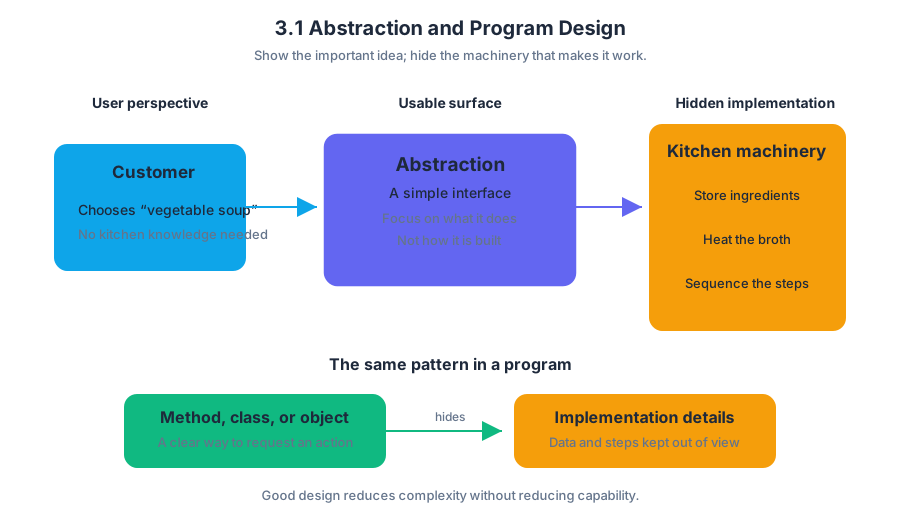
A well-designed program does not expose every detail at once: it presents the important idea and hides the machinery that makes it work. Abstraction is this reduction of complexity by focusing on the main idea while leaving irrelevant details out of view.
A restaurant customer uses a menu item such as “vegetable soup” without needing to know how the kitchen stores vegetables, heats the broth, or sequences the cooking steps. In a program, a method, class, or object can provide the same kind of usable surface: other code interacts with what it does, not necessarily with how it does it.
Data abstraction: what something is versus how it is stored
Data abstraction separates an abstraction’s meaningful properties from its concrete representation. An attribute is data defined in an abstraction, such as a class or object property. For a Playlist, attributes might include its title and number of songs; users of the class should not need to know whether those values are stored in separate variables, an array, or another structure.
The learning objective 3.1.A requires representing a program’s design with diagrams that show its classes and the data and procedural abstractions in each class, including attributes and behaviors. A useful design diagram therefore answers two questions: What information does each class own? and What actions can each class perform?
Worked design: a reusable temperature converter
Suppose a weather application must convert temperatures from Celsius to Fahrenheit. A first design identifies one responsibility: a TemperatureConverter class provides a conversion behavior. The formula is $F = \frac{9}{5}C + 32$, but the program’s users only need the conversion operation and its result.
public class TemperatureConverter {
    public static double toFahrenheit(double celsius) {
        return (9.0 / 5.0) * celsius + 32;
    }
}
Calling TemperatureConverter.toFahrenheit(20.0) produces $68.0$. The parameter celsius makes the procedure general: it can accept $0.0$, $20.0$, or any other input value rather than being permanently tied to one temperature. Parameters allow procedures to be generalized and reused with a range of input values or arguments, which is identified by 3.1.A.5.
This design also demonstrates procedural abstraction: code that calls the method depends on its purpose and signature, not on the internal formula. Under 3.1.A.6, programmers can change a method’s internals—for example, to make it faster or more efficient—without requiring every caller to change, provided the method’s externally usable behavior remains appropriate.
Key insight: A parameter turns a one-time action into a reusable operation; an abstraction turns implementation details into a replaceable interior.
The four development phases
Program design connects four computational thinking practices. Design Code (1) means determining an appropriate program design and developing algorithms. This is where a programmer identifies classes, attributes, behaviors, responsibilities, and relationships before—or while—writing implementation code.
Develop Code (2) means writing and implementing the program. In the converter example, the design becomes a Java class and method. Analyze Code (3) means determining the output or result produced by given code, or explaining why the code does not work as intended; tracing toFahrenheit(20.0) gives $68.0$.
Document Code and Computing Systems (4) means describing what the program does and how it was constructed. Comments, design diagrams, and a development journal can record decisions and rationales, helping a future programmer understand and modify the program later.
These phases are not a one-way staircase. Development is iterative, meaning a programmer may return to an earlier phase: analysis may reveal a faulty design, implementation may expose a missing attribute, or documentation may reveal that a method’s purpose is unclear. Diagramming and physical manipulatives—such as cards representing classes, attributes, and methods—can make relationships visible and build confidence while a solution is being designed.
Misconception check
Misconception: “Abstraction means hiding all information.” Correction: abstraction hides irrelevant implementation details while exposing the information and behaviors needed to use the abstraction. A TemperatureConverter still exposes its method and parameter; it simply does not force callers to manage the arithmetic themselves.
Misconception: “Design must be finished before code begins.” Correction: a design is a working model, not an unchangeable contract. The programmer can develop code, analyze its behavior, revise the design, and document the improved solution.
Retrieval check
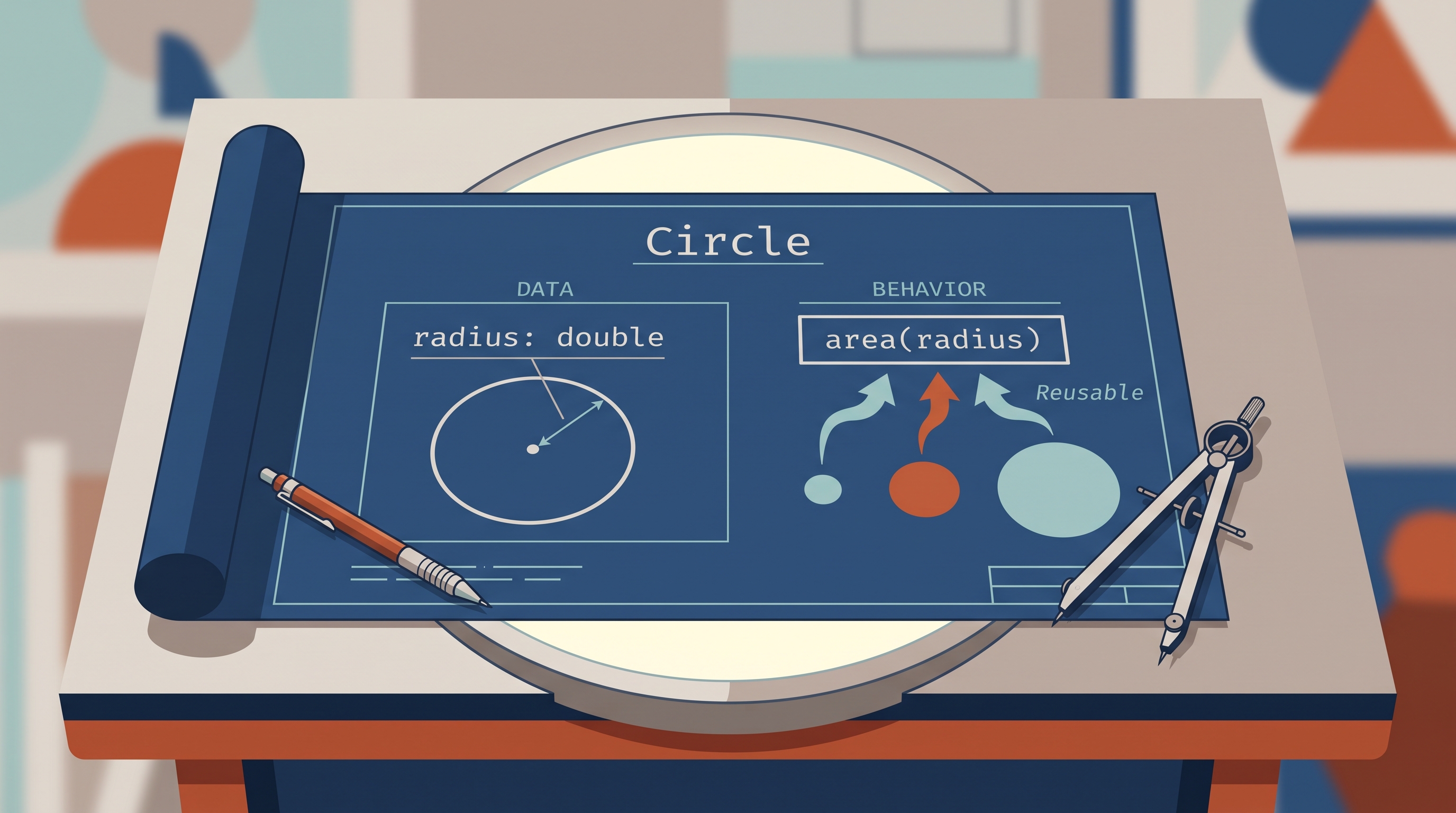
A Circle class has an attribute radius and a method area(). Which is the abstraction’s data, which is its behavior, and why would an area(double radius) method be more reusable than a method containing one fixed radius? The expected reasoning is: radius is an attribute, area() is a behavior, and a parameter allows the procedure to work with a range of input values.
Source Materials
- AP Computer Science A Course and Exam Description
- AP Computer Science A Course and Exam Description Clarifications and Corrections
- AP Computer Science A Course Overview
- AP Computer Science A Course at a Glance
- AP Computer Science A Course at a Glance Poster
- Adopt AP Computer Science A
- AP Computer Science A
- AP Computer Science A
- AP Computer Science A-AP Students-College Board
- AP Computer Science A Textbook-Code HS
- AP Computer Science A - Code.org
- Guide to the AP Computer Science A Exam- Princeton Review